

Ali Yawar Alam ( Project Management Office, Execution Affairs Department, Directorate of Health Affairs, Alahsa, Kingdom of Saudi Arabia. )
June 2016, Volume 66, Issue 6
Editorial

Health system refers to all the activities whose primary purpose is to promote, restore and/or maintain health.1 Health system like any other system, is a set of interconnected parts that have to function together to be effective. Health service means any service (i.e. not limited to medical or clinical services) aimed at contributing to improved health or to the diagnosis, treatment and rehabilitation of sick people.1 W.H.O estimates show that in developed countries as many as 1 in 10 patients is harmed while receiving hospital care.2 According to AHRQ national health disparities report 2013, rate of harm associated with hospital stays in U.S hospitals is 25.1 per 100 admissions.3 Major contributor to these hospital-acquired conditions (HACs) were; adverse drug events, catheter associated urinary tract infections, patient falls, pressure ulcers, surgical site infection, central line associated infections, venous thrombo-embolism and ventilator associated pneumonia. According to Institute for Healthcare improvement (IHI), medical errors have become the third leading cause of death in the United States each year, behind cancer and heart disease.4 A 13.5 percent rate of harm was identified within the US Medicare population by the Office of Inspector General using the Institute for Healthcare Improvement\\\'s Global Trigger Tool. Injuries, disabilities and death figures due to medical errors or hospital acquired conditions in Pakistan are not known, as there are no established medical error reporting and evaluating systems in place in the public health sector.5
Medical errors can occur anywhere in the health care system: hospitals, clinics, surgical centres, doctors\\\' offices, nursing homes, pharmacies, and patients\\\' homes. Errors can involve medicines, surgery, diagnosis, therapy, equipment, lab reports and procedures. Hospitals are a common setting for hospital acquired conditions in part because of the clinically compromised state of many patients admitted to the hospital and because of the high volume of care transactions and interventions that take place during a hospital stay. 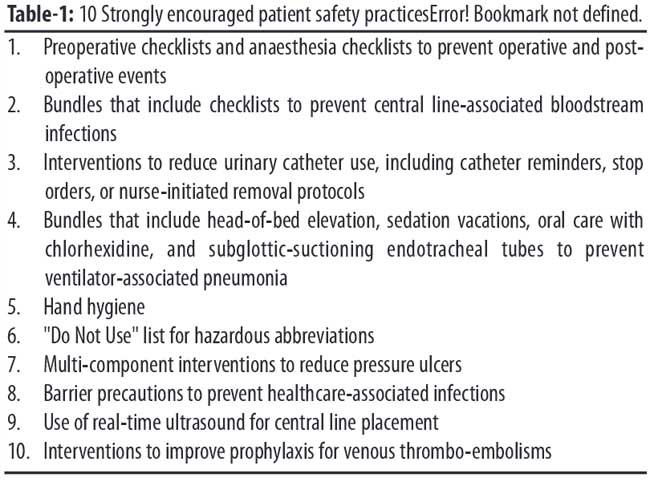
More than half of low- and lower middle-income countries do not have a national health technology policy which could ensure the assessment, acquisition and management of over 10,000 medical devices available world-wide.2
A good health services system should be safe, effective, efficient, equitable, timely and patient centered.6 The idea is how to make the healthcare system safer, given the increasing complexity (including multidisciplinary teams & functions, multiple hand-offs, multiple shifts, extensive range of diagnostic and treatment modalities) of the modern health care system. The aim is to cut-down substantially the preventable medical errors and their consequences. In order to make the patient safety efforts evidence based, AHRQ has done evidence based evaluation (systematic review) of available patient safety practices in order to provide a strong basis for adoption or otherwise of patient safety practices by health care organizations.7
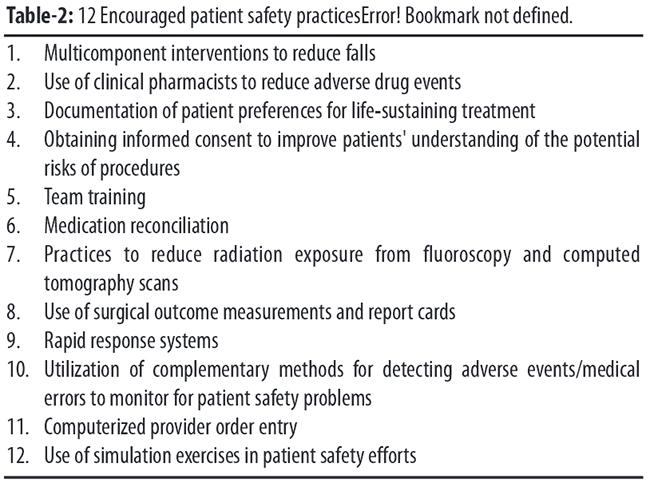
"A Patient Safety Practice is a type of process or structure whose application reduces the probability of adverse events resulting from exposure to the health care system across a range of diseases and procedures."7 Based on a rigorous systematic review and pre-set criteria the 10 strongly encouraged patient safety practices, are listed in Table-1. There is sufficient knowledge to implement them, and that doing so will likely result in safer care.7 Several other patient safety practices had sufficient evidence of effectiveness and implementation, and that they should be "encouraged" for adoption.7 The 12 "encouraged" for adoption.7 The 12 "encouraged" patient safety practices are listed in Table-2.
.
Red rules, as adopted from the nuclear power industry, are non-negotiable rules that should always be followed.8 A red rule in transportation safety is "always have children wear seat belts when riding in a car." Red rules in surgery are "always conduct a time-out to verify the correct patient, procedure and site before surgery" and "if there is any indication we are missing something, never leave the operating room without an X-ray." To be effective, red rules must be agreed upon by everyone in the organization from the board of directors down to the frontline staff. They must be developed collaboratively and enforced consistently. Everyone who works at the hospital should know that performing this process is not a judgment call, but an absolute, non-negotiable requirement.
Improving patient safety begins with being aware of your organization\\\'s culture.9 AHRQs 12 composite measures of patient safety culture include; teamwork within units (team STEPPS), organizational learning, management support for patient safety, feedback and communication about error, frequency of events reported, teamwork across units, and handoffs and transitions.
In Pakistan, the Federal government has constitutional responsibility of health information, interprovincial coordination, global health, and health regulation.10 It is high time for the Federal Government to formulate and implement a strategic plan for ensuring patient safety, general safety and enhancing the quality of care in the public and private sector health facilities of Pakistan. The adoption of evidence based measures as highlighted in this Editorial will be very much wanting and effective. Empowering (financial, technical, technological & professional help) the provincial governments by the Federal government with all the needed resources in this regard will be the key to success.
References:
1. World Health organization. Health systems. [Online] 2015[cited 2015 November 15]. Available from: URL:http://www.who.int/ healthsystems/hss_glossary/en/index5.html
2. World Health Organization. 10 facts on patient safety. [Online] 2015[cited 2015 November 15]. Available from: URL:http://www.who.int/features/factfiles/patient_safety/en/
3. AHRQ, Agency for healthcare research and quality, National healthcare disparities report, [Online] 2013 [cited 2015 November 16]. Available from: URL:http://www.ahrq.gov/research/ findings/nhqrdr/nhdr13/chap4.html
4. Institute for healthcare improvement. Patient safety. [Online] 2013 [cited 2015 November 16]. Available from URL:http://www.ihi.org/PatientSafety
5. Alam AY. Is provision of safe and quality care equivalent to high-tech care? J Pak Med Assoc. 2014; 64:116-7.
6. Institute of Medicine (US) Committee on Quality of Health Care in America. Crossing the Quality Chasm: A New Health System for the 21st Century. Washington DC: National Academies Press, 2001.
7. Shekelle PG, Wachter RM, Pronovost PJ, Schoelles K, McDonald KM, Dy SM, et al.Making Health Care Safer II: An Updated Critical Analysis of the Evidence for Patient Safety Practices. Evid Rep Technol Assess (Full Rep). 2013; 211:1-94.
8. Yates GR, Hochman RF, Sayles SM, Stockmeier CA. Sentara Norfolk General Hospital: accelerating improvement by focusing on building a culture of safety. Jt Comm J Qual Saf. 2004; 30:534-42.
9. Richard Kronick. Patient Safety Measures and Safety Culture Improving, but Gaps Remain. Rockville: AHRQ, 2015.
10.Nishtar S, Boerma T, Amjad S, Alam AY, Khalid F, ul Haq I. Pakistan\\\'s health system: performance and prospects after the 18th Constitutional Amendment. Lancet. 2013; 381:2193-206.
Related Articles
Journal of the Pakistan Medical Association has agreed to receive and publish manuscripts in accordance with the principles of the following committees:


