

Abdul Rehman Arshad ( Department of Medicine, 1 Mountain Medical Battalion, Bagh, Azad Kashmir, Pakistan. )
Kamran Yousaf Alvi ( Department of Medicine, 1 Mountain Medical Battalion, Bagh, Azad Kashmir, Pakistan. )
April 2016, Volume 66, Issue 4
Original Article

Abstract
Objective: To determine frequency of depression in patients with diabetes mellitus type 2 and to identify predictive factors.
Methods: The observational study was carried out at 1 Mountain Medical Battalion, Bagh, Azad Kashmir, Pakistan, from June 2013 to May 2014, and comprised type 2 diabetic patients who were not using anti-depressants and did not have history of other psychiatric illnesses. Demographic data, duration of diabetes, presence of hypertension and type of treatment were recorded and body mass index was calculated. Patient Health Questionnaire-9, translated into Urdu, was administered during face-to-face interviews. Scores >5 indicated depression, which was classified into different grades of severity using standard cut-off values.
Results: Of the 133 patients, 51(38.35%) were depressed. Depression was mild in 34(26%), moderate in 12(9.6%), moderately severe in 4(2.9%) and severe in 1(0.7%) patient. On univariate binary logistic regression, female gender (odds ratio=3.07; 95% confidence interval = 1.43, 6.59), lesser education (odds ratio = 0.90; 95% confidence interval 0.84, 0.97) shorter duration of diabetes (odds ratio=0.87; 95% confidence interval = 0.80, 0.96) and higher body mass index (odds ratio=1.41; 95% confidence interval = 1.05, 1.25) were significantly associated with depression. Only shorter duration of diabetes (odds ratio=0.90; 95% confidence interval = 0.82, 0.99) remained significant after adjustment for confounders. Age, level of education, glycaemic control and type of treatment did not predict depression.
Conclusion: A significant proportion of type 2 diabetics were depressed. Shorter duration of diabetes reliably predicted depression in these patients.
Keywords: Pakistan, Diabetes, Depression, Risk factors. (JPMA 66: 425; 2016)
Introduction
Depression is a major psychiatric illness. Though often under-reported because of the associated social stigma, it is believed that approximately 340 million people worldwide suffer from depression at any given time.1 The disease is already number four on the global burden of diseases and is expected to rank second by 2020.2 Major depression is the second leading cause of disability-adjusted life years (DALYs) lost in women and the 10th leading cause of DALYs in men.3 In addition to being an important reason for suicides, it impairs the quality of life and puts enormous burden on healthcare budgets.
Patients with chronic medical conditions are more likely to be depressed as compared to healthy individuals. Type 2 diabetes mellitus (T2DM) is one such disease. T2DM patients are two times more likely to develop depression than the general population.4 The cause-and-effect relationship between these two entities is not clear as we do not know for sure whether diabetes increases the risk of depression or depression increases the risk of diabetes. Despite the well-known association, physicians often fail to recognise and appropriately address depression while managing diabetics. This could possibly be due to limited time period available for consultations, a perception that treating depression is not in the domain of physicians treating depression or because the doctors under-recognise the potential impact of depression on diabetes. In any case, this omission often leads to poor clinical outcomes.
It is thus clearly evident that accurate assessment of depression amongst diabetic patients is very important so as to guide appropriate treatment and to reduce morbidity and mortality. A number of studies have been done in this regard. It has generally been shown that depression is seen in one-fifth of diabetics.5 Most of these studies have been done in foreign countries. Local data does exist, but is more limited and describes variable figures. For example, one study found that 14.7% type 2 diabetics from a rural area had depression, whereas another study described a frequency of 43.5% in an urban population.6,7
The current study was, therefore, planned to estimate co-existent depression in diabetic patients belonging to one of the smaller cities of Pakistan. It also aimed at identifying different clinical and laboratory factors predictive of depression in such patients.
Subjects and Methods
The observational study was carried out at 1 Mountain Medical Battalion, Bagh, Azad Kashmir, Pakistan, from June 2013 to May 2014 after obtaining approval from ethics review committee of the hospital. T2DM patients attending medical outdoor clinic were selected through non-probability convenience sampling. For the purpose of this study, T2DM patients were defined as those already using oral hypoglycaemic agents (OHAs) alone or in combination with insulin for more than three months to control their blood glucose levels. Patients using anti-depressants, having history of psychiatric illness other than depression, or unwilling to be part of the study were excluded.
After obtaining informed written consent, demographic data, including age, gender, level of education, was noted. Duration of diabetes and presence of hypertension (defined as blood pressure >140/90mmHg or the use of anti-hypertensive medicines) were also recorded. Height and weight were measured using standard techniques to calculate body mass index (BMI) using the formula:
BMI= Weight in kg/ (Height in meters)2
Patient Health Questionnaire-9 (PHQ-9) questionnaire was used to screen the patients for depression. It was initially translated into Urdu and then translated back into English. This version was then analysed by an independent doctor to ensure that no significant differences from the original version had arisen during the process of translation. The Urdu version was administered to all patients during an interview by a single physician. The responses were summed up to determine the total score.
Scores >5 indicated depression, which was classified into different grades of severity using standard cutoff values: 5-9 = mild depression; 10-14= moderate; 15-19= moderately severe depression; and 20-27= severe depression. Fasting plasma glucose and haemoglobinA1c (HbA1c) were also measured in all patients with Merck Microlab-300 Automated Clinical Chemistry Analyser using enzymatic calorimetric and fast ion exchange resin separation methods respectively.
Statistical analysis was carried out using SPSS 20. Parametric data was described as mean± standard deviation and non-parametric data as median and range. Frequencies and percentages of depression and its various severity-based classes were calculated. Different parameters were compared between normal patients and those having depression. For parametric data, means were compared using independent samples t-test. For non-parametric data, medians were compared using Mann-Whitney U test. P<0.05 was considered significant for both the tests. Univariate and multivariate binary logistic regressions were performed to ascertain the effects of age, gender, level of education, coexistent hypertension, duration of diabetes, BMI, fasting plasma glucose, HbA1c and type of treatment (OHA salone or in combination with insulin) on the likelihood that diabetic patients have depression. For multivariable analysis, only those variables were used which had P value <0.25 at univariable stage.
Results
Of the 133 patients, 55(41.4%) were males and 78(58.6%) were females, having an overall mean age of 51.27±11.08 years. The median education was 5 years, median duration of diabetes was 3 years (range: 0-30 years) and 65(48.87%) patients had hypertension. Depression was present in 51(38.35%) patients (Table-1).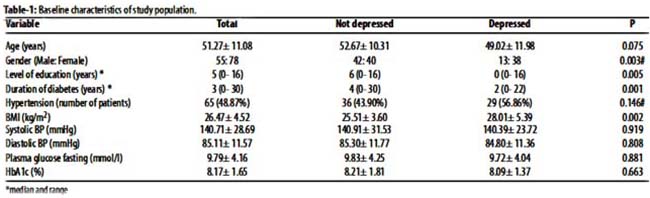
Depression was mild in 34(25.56%), moderate in 12(9.02%), moderately severe in 4(3.01%) and severe in 1(0.75%) patient (Figure).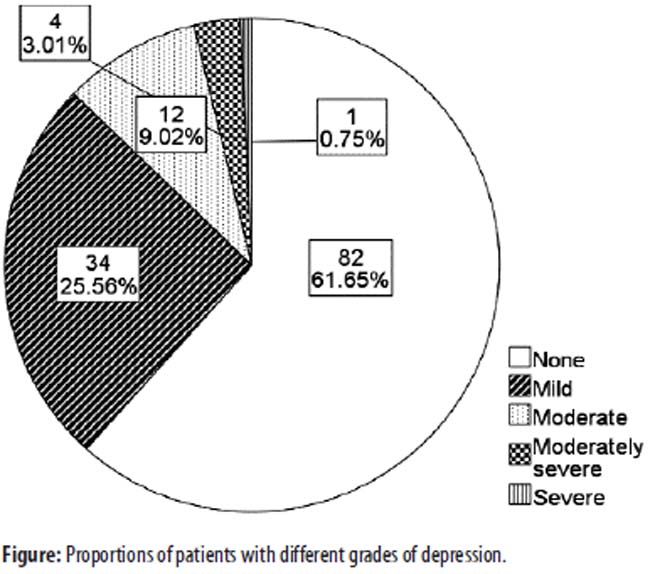
On univariate binary logistic regression, female gender, lesser education, shorted duration of diabetes and higher BMI were significantly associated with depression (p<0.05 each). Multivariate binary logistic regression model based on the mentioned variables was statistically significant (p=0.008), explained 22.8% (Negelkerke R Square) of the variance in depression and correctly classified 92 (69.17%) of cases, showing that the presence of depression could be predicted by duration of diabetes only. With every one-year increase in duration of diabetes, the likelihood of having depression reduced 0.90 times (95% CI: 0.82, 0.99) (Table-2).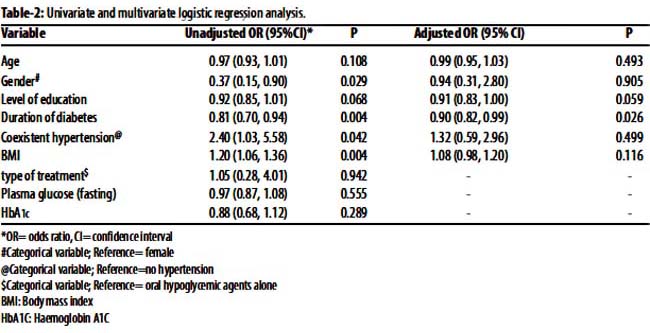
Discussion
Depression is the most common psychiatric illness seen by non- psychiatrists. The gold standard for diagnosing depression is the structural clinical interview that uses Diagnostic and Statistical Manual of Mental Disorders, Fourth Edition (DSM-IV) criteria for illness.8 Since this may be technically difficult and time-consuming for untrained physicians, a large number of diagnostic scales or instruments are available for use in clinical practice as well as for research purposes. Some of these include Beck Depression Inventory (BDI), depression subscale of the Hospital Anxiety and Depression Scale (HADS-D), Centre for Epidemiologic Studies of Depression Scale, ZUNG Self-rating Depression Scale and Hopkins Symptom Checklist Depression Scale. Though there are minor differences in the type of questions and the length of the instrument, they all serve the same purpose of helping clinicians screen for depression and to provide a reliable estimate of disease severity.
Patient Health Questionnaire-9 (PHQ-9) is another such instrument, consisting of 9 questions scored from 0 to 3. Its sensitivity and specificity in picking up depression is similar to many other scales and its validity has been confirmed in the past.9 It is used three times more commonly as compared to HADS-D.10 It closely correlates with and is essentially interchangeable with BDI, which is regarded as the gold standard rating scale.11 We used PHQ-9 because of the short length of the questionnaire and thus the relative ease of administering it to patients in a busy outdoor clinic. Moreover, this questionnaire consists of the actual nine criteria on which the diagnosis of DSM-IV depressive disorders is based, which makes it closest to a structural clinical interview.12 Patients with low level of education may leave some questions unanswered during written administration of this questionnaire. We intentionally avoided this problem by administering it during direct face-to-face interviews.
Nearly 40% of study population was depressed. Similar results have been reported at41%13 and 34%14 using PHQ-9, as well as 36% using Hopkins Symptom Checklist-25 questionnaire.15 However, a recent Pakistani study has reported figures around 60% using BDI.16 Though not mentioned by the authors of that study,16 their higher rates can be explained by the geographical location of the study which was conducted in Peshawar. Bagh is a peaceful city and thus the residents are not exposed to additional psychological trauma which the residents of Peshawar are exposed to, as a result of protracted war on terror.
Females were more likely to be depressed in our cohort of diabetics. Similar results have been reported earlier as well.17 Lesser education also increased the risk of depression, in keeping with the belief that a higher level of educational standard attained has a protective effect against both anxiety and depression.18 However, both these factors lost their statistical significance after adjustment for confounders. Data about the ability of BMI to predict depression in diabetics is conflicting. Some studies reveal absence of a clear relationship between BMI and depression.19 On the other hand, many studies consistently label obesity to be associated with depression.20 Though a higher BMI was predictive of depression in our patients, this parameter became insignificant on multivariate analysis. The only factor that predicted depression on multivariate analysis was shorter duration of diabetes. Most of the previous studies have found increasing duration of diabetes to be associated with depression, probably because of increasing complications and healthcare expenditures.21 Our results are in sharp contrast. This may be because of an enormous psychological burden at the time of diagnosis, only to be followed by a gradual adaptation by the patients.
An interesting finding of this study is an equal level of glycaemic control among the depressed and non-depressed diabetics. This is in contrast to the general belief that depression in diabetes results in a poor glycaemic control.22 However, a study done on 185 Iranian patients also demonstrated equal HbA1c levels amongst these two groups.23 Similarly, average long-term HbA1c did not differ in patients with comorbid diabetes and minor or major depression compared with those with diabetes alone in a study.24 Another study did not find a relationship between depression and glycaemic control in elderly patients.25 A minimum of 45 patients each in depressed and non-depressed diabetic groups provided 80% power to detect a difference of 1.06% in HbA1c amongst the two groups, whereas there were 53 depressed patients in this study. So, this study was not under-powered to detect significant differences.
Poor glycaemic control in depressed diabetics is related to poor compliance. We did not record compliance with treatment in our patients. It is very much possible that there were no significant differences in compliance of treatment amongst depressed and non-depressed patients, since the majority of former had mild depression only. Other than that we do not have a plausible explanation for this equality. Systolic and diastolic blood pressures were also equal amongst the two groups, in accordance with earlierfindings.24
Marital status is important in epidemiology of depression since the latter is more common in separated or divorced individuals. In our cohort, all patients were married. Since none of them was divorced or separated from their partners, we excluded this variable from regression analysis.
Majority of Pakistani population is younger than 50 years. However, our study population was definitely not representative of ordinary Pakistani population since it comprised only patients with type 2 diabetes, a disease not found in younger people. Moreover, it is not necessary for the study population selected by convenience sampling to be really representative of people in the area from where individuals are recruited for any study.
This study is limited by the fact that there was no control group comprising non-diabetic individuals to compare the rates of depression with. Though the rates of depression seen in this study are greater than the average rates of depression in general Pakistani population, we cannot make a definite conclusion as to whether this is significantly higher than the non-diabetic population. Many diabetic patients are also frequently prescribed anti-hypertensive drugs, some of which may predispose patients to developing depression. Unfortunately, data on use of anti-hypertensive drugs by patients in this study was not recorded. Similarly, this study did not address the impact of substance abuse or psychological factors predictive of depression. The sample size is small, but is consistent with the number of patients visiting this small healthcare setup. In addition, patients were not formally assessed by a psychiatrist subsequently because of non-availability at this station.
Conclusion
Depression co-existed in a significant proportion of T2DM patients. It was seen more frequently in females, obese patients and those with lesser education. A shorter duration of disease reliably predicted depression in these patients. Since co-morbid depression is known to be associated with poor outcomes, proper emphasis should be laid down on screening, more so in those having the risk factors identified in this study.
References
1. Greden JF. Physical symptoms of depression: unmet needs. J ClinPsychiatr 2003; 64: 5-11.
2. Gadit AAM, Mugford G. Prevalence of depression among households in three capital cities of Pakistan: need to revise the mental health policy. PLoS One. 2007; 2:e209.
3. Egede LE, Ellis C. Diabetes and depression: Global perspectives. Diabetes Res ClinPract. 2010; 87:302-12.
4. de Groot M, Doyle T, Hockman E, Wheeler C, Pinkerman B, Shubrook J et al. Depression among type 2 diabetes rural Appalachian clinic attendees. Diabetes Care. 2007; 30:1602-4.
5. van Dooren FE, Nefs G, Schram MT, Verhey FR, Denollet J, Pouwer F.Depression and risk of mortality in people with diabetes mellitus: a systematic review and meta-analysis. PLoS One. 2013; 8:e57058.
6. Zahid N, Asghar S, Claussen B, Hussain A. Depressionand diabetes in a rural community in Pakistan. Diabetes Res ClinPract. 2008; 79:124-7.
7. Khuwaja AK, Lalani S, Dhanani R, Azam IS, Rafique G, White F.Anxiety and depression among outpatients with type 2 diabetes: A multi-centerstudy of prevalence and associated factors.DiabetolMetabSyndr. 2010; 2:72.
8. Sanchez-Villegas A, Schlatter J, Ortuno F, Lahortiga F, Pla J, Benito S, et al. Validity of a self-reported diagnosis of depression among participants in a cohort study using the Structured Clinical Interview for DSM-IV (SCID-I). BMC Psychiatry.2008 ; 8:43.
9. Phelan E, Williams B, Meeker K, Bonn K, Frederick J, Logerfo J, et al.A study of the diagnostic accuracy of the PHQ-9 in primary care elderly. BMC FamPract. 2010; 11: 63.
10. Kendrick T, Dowrick C, McBride A, Howe A, Clarke P, Maisey S, et al. Management of depression in UK general practice in relation to scores on depression severity questionnaires: analysis of medical record data. BMJ. 2009; 338:b750.
11. Kung S, Alarcon RD, Williams MD, Poppe KA, Jo Moore M, Frye MA.Comparing the Beck Depression Inventory-II (BDI-II) and Patient Health Questionnaire (PHQ-9) depressionmeasures in an integrated mood disorders practice. J Affect Disord. 2013; 145:34-3.
12. Kroenke K, Spitzer RL, Williams JB. The PHQ-9: Validity of a brief depression severity measure. J Gen Intern Med. 2001; 16:606-13.
13. Raval A, Dhanaraj E, Bhansali A, Grover S, Tiwari P. Prevalence & determinants of depression in type 2 diabetes patients in a tertiary care center. Indian J Med Res. 2010; 132:195-200.
14. Roy T, Lloyd CE, Parvin M, Mohiuddin KG, Rahman M. Prevalence of co-morbid depression in out-patients with type 2 diabetes mellitus in Bangladesh. BMC Psychiatry. 2012; 12:123.
15. Skopljak A, Podzic M, Tiric-Campara M, Macic-Dzankovic A, Pasagic A, Masic I.. Frequency of depression in diabetic patients in the family medicine. Med Arh. 2011; 65:137-9.
16. Khan MA, Sultan SM, Nazli R, Akhtar T, Khan MA, Sher N, et al. Depression among patients with type-II diabetes mellitus. J Coll Physicians Surg Pak. 2014; 24:770-1.
17. Sahota PK, Knowler WC, Looker HC. Depression, diabetes, and glycemic control in an American Indian community. J Clin Psychiatry. 2008; 69:800-9.
18. Bjelland I, Krokstad S, Mykletun A, Dahl AA, Tell GS, Tambs K. Does a higher educational level protect against anxiety and depression? The HUNT study. SocSci Med. 2008; 66:1334-45.
19. Tovilla-ZC, Juárez-RI, Peralta JY, Jiménez MA, Vázquez S, Bermúdez-OD, et al. Prevalence of anxiety and depression among outpatients with type 2 diabetes in the Mexican population. PLoS One. 2012; 7:e36887.
20. Takeuchi T, Nakao M, Nomura K, Inoue M, Tsurugano S, Shinozaki Y, et al. Association of the metabolic syndrome with depression and anxiety in Japanese men: a 1-year cohort study. Diabetes Metab Res Rev. 2009; 25:762-7.
21. Almawi W, Tamim H, Al-Sayed N, Arekat MR, Al-Khateeb GM, Baqer A, et al:Association of comorbid depression, anxiety and stress disorders withttype 2 diabetes in Bahrain, a country with a very high prevalence of type 2 diabetes. J Endocrinol Invest. 2008; 31:1020-4.
22. Papelbaum M, Moreira RO, Coutinho W, Kupfer R, Zagury L, Freitas S, et al. Depression, glycemic control and type 2 diabetes. DiabetolMetabSyndr. 2011; 3:26.
23. Khamseh ME, Baradaran HR, Javanbakht A, Mirghorbani M, Yadollahi Z, Malek M. Comparison of the CES-D and PHQ-9 depression scales in people with type 2 diabetes in Tehran, Iran. BMC Psychiatry. 2011; 11:61.
24. Heckbert SR, Rutter CM, Oliver M, Williams LH, Ciechanowski P, Lin EH, et al. Depression in relation to long-term control of glycaemia, blood pressure, and lipids in patients with diabetes. J Gen Intern Med. 2010; 25:524-9.
25. Masmoudi J, Damak R, Zouari H, Ouali U, Mechri A, Zouari N, et al. Prevalence and impact of anxiety and depression on type 2 diabetes i n Tunisian patients over sixty years old. Depress Res Treat. 2013; 2013:341782.
Related Articles
Journal of the Pakistan Medical Association has agreed to receive and publish manuscripts in accordance with the principles of the following committees:


