

Hasnain Afzal ( Medical Intensive Care Unit, Patel Hospital, Karachi. )
Syed Farrukh Umair ( Medical Intensive Care Unit, Patel Hospital, Karachi. )
March 2016, Volume 66, Issue 3
Case Reports

Abstract
Haemoglobin-D, Los Angeles or Haemoglobin D-Punjab is not a rare variant of haemoglobin worldwide especially in Punjab, North western India, and South Asian continent. It can be inherited rarely as homozygous causing no symptoms or heterozygous with Haemoglobin A, commonly not related to clinical symptomatology. However, these variants can co-exist rarely with other haemoglobinopathies such as thalassemia or haemoglobin-S. We describe the case of doubly heterozygous Hb-SD Punjab in a 8 year old girl who presented with ischaemic stroke. Before this case, only one case has been reported but it was with reversible hyperbilirubinaemia in Hb-SD from Rawalpindi, Pakistan. This case images the propensity for occurrence of rare phenotype within our population and underlines the importance of genotyping to avoid erroneous management and poor counseling hence preventing life altering complications which our case developed.
Keywords: Haemoglobinopathies, Haemoglobin Sickle SD-Punjab, Ischemic stroke.
Introduction
Normal Haemoglobin A consists of 2 b-globin chains and 2 b-globin chains. Sickle cell haemoglobin or Hb-S occurs when valine substitute for glutamic acid at b-6 of chromosome 11 whereas, Hb-D generally results from replacement of glutamic acid for glutamine at b-121. Both Hb-S and Hb-D are autosomal recessive disorder of the b-globin chain. Out of 16 sub-types of Haemoglobin D, Hb-D Punjab or Los-Angeles is most common with 0.86% in Indo-Pakistan continent and 3.6% alone in Punjab.1 Hb-D can be homozygous, usually a rare entity with no clinical symptoms or can be heterozygous commonly with Haemoglobin-A, a benign alteration. However, Hb-D can also be heterozygous with Hb-S, which is an infrequent alteration in our population. Hb-SD, a compound heterozygous disease, behaves like a Sickle cell disease with vaso-occlusive event occurring similarly and requires immediate recognition, management and possible counseling for future care. Although, previously, 7 cases were reported of 15,699 samples analyzed from Pakistan but data still lacks on any type of disease pattern or complication.2 Other than that only one case has been reported with Hb-SD disease presented with recurrent hyperbilirubinaemia.3 In our study we describe a case of an 8 year old girl who presented from Larkana, Sindh with bilateral frontal and parietal lobe Infarcts. Since Hb-SD disease is much un-identified and perhaps under documented as well, we feel that our case report will help to create awareness on the potential life threatening properties of Haemoglobin-SD disease.
Case Report
This is a case of an 8 year old girl from Larkana district who developed altered level of consciousness in April 2015. Father reported that her illness initially started with 15 days history of nausea, vomiting and intermittent headaches for which she was taken to the local district hospital where antibiotics were empirically started in suspicion of meningoencephalitis. However her clinical condition gradually worsened during hospital course where she had multiple episodes of generalized tonic clonic seizures. Subsequently, she was referred to a tertiary care facility for further care. On arrival, her haemodynamics were unstable with Glasgow coma Scale of 5/15. Her neurological examination showed remarkable weakness in both upper and lower limbs with bilateral up going plantars. She was electively intubated in E.R and basic workup was sent, which later turned out to be inconclusive for any type of infection or electrolyte imbalance. Her previous CSF analysis before starting an antibiotic in local district Hospital was also unproductive for any type of CSF infection. So MRI scan was planned before second Lumbar puncture. The radiologist found the hypo dense signals supported with Diffusion weighted Images for ischaemic infarcts bilaterally in frontal, and parietal region of the brain (Figure-1).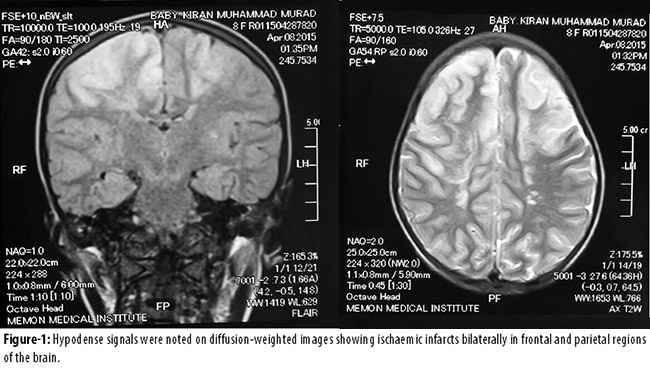
Complete Blood count remained unremarkable except haemoglobin of 9.3 gm/dl with MCV of 77.9 fl. Her peripheral film depicted target cells, sickle cells and anisocystosis. Haemoglobin electrophoresis using cation-exchange High performance liquid chromatography (HPLC) was done which detected the Compound heterozygous Hb-SD, Punjab variant (Figure-2).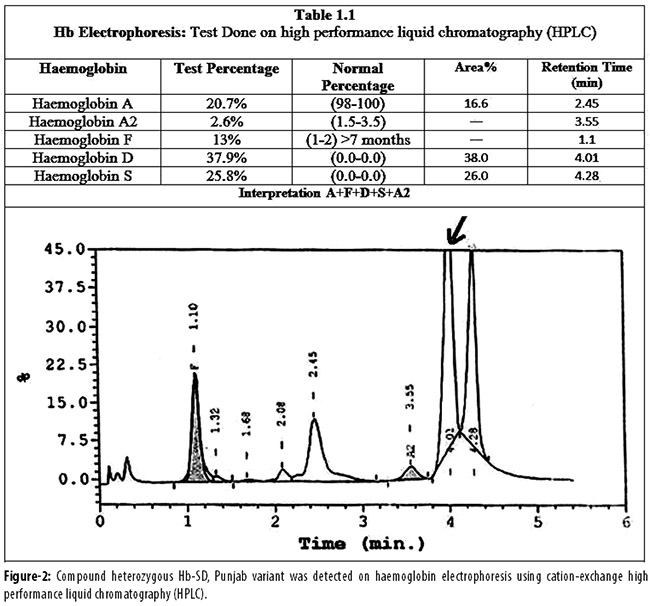
Diagnosis of Haemoglobin-SD disease was made. The neurologist was consulted and along with the haematologist, the data was reviewed for this rare entity and she was started on 10 mg/kg hydroxyurea along with anti-epileptics and anti-platelets. Her condition progressively improved in the next one week and she regained full consciousness. She was discharged with limited ability deficits in her speech, arms and legs.
Discussion
In 1950, itano identified the haemoglobin D as a new variant.4 Since then it has been marked along the geographic regions of preponderance as well as their difference in genetic variations like Hb-D Punjab, Hb-D Los Angeles, Hb D-Portugal or Oak Ridge.5 Haemoglobin D-Punjab is one of the most common haemoglobin variants worldwide, after Hb-S and Hb-C.6 A study on abnormal haemoglobin variant among major ethnic groups who showed haemoglobin D-Punjab to have a prevalence of 0.76 % among all haemoglobinopathies found in Karachi.7
Accurate delineation of these variants is pivotal in managing life threatening complications and to avoid erroneous counseling of these rare compound heterozygous Hb-SD patients. Various techniques have been used to identify haemoglobinopathies such as Haemoglobin electrophoresis with citrate agar/acid gel method or by Iso Electric focusing. Lately, High performance Liquid chromatography (HPLC) is more accurate and preferred over the rest.
Haemoglobin D Punjab can co-inherit with other haemoglobinopathies like b-thalassemia, sickle cell anaemia or could have normal Haemoglobin A along with it. All of these heterozygosities are usually asymptomatic except with Hb-S. Recently, Patel et al. published a study on Hb SD-Punjab showing patients with moderate to severe symptoms analogous to Hb SS genotype, sickle cell disease; having pain due to vaso-occlusive events.8 The author reported a greater vulnerability for haemolysis in Hb-SD patients than Sickle cell disease. Clinical severities in Hb SD-Punjab are usually related to the fact that Hb-D doesn\\\'t polymerize itself but it increases the hydrophobic interaction between Hb-S molecules and facilitates the Hb-S.9
Our case presented with two clinical manifestations that help us reach the diagnosis, anaemia with sickle cell in peripheral film and Cerebral Ischaemic Infarcts. We managed her with supportive care until her Hb electrophoresis results were available, till that time she was much better therefore we never needed the exchange transfusions. Patel et al. used hydroxyurea, a chemotherapeutic agent which induces Hb F production, at a dose of 10 mg/kg, in their patients assuming that since pathophysiology of Hb SD-Punjab is similar to Hb SS, increasing the level of Hb F might decrease the vaso-occlusive events.8 However, Adekile A et al10 observed in all his 5 patients that Hb F was around 20%, similar to our case. Still they had aggressive disease with vaso-occlusive events hence Haemoglobin F level being effective in modulating Hb-SD could be questionable.
Conclusion
Haemoglobin -SD Punjab is a rare disease, but extremely under reported and understudied. Only a single case has been reported in our region from Rawalpindi about disease behaviour and complications. It is crucial to understand and document this phenotypic active disease because it has geographic pattern of distribution as well as demographic mutational variations. A precise genotype diagnosis is required to facilitate error free counseling and proper management.
References
1. Tyagi S, Marwaha N, Parmar V, Basu S. Sickle cell hemoglobin-D Punjab disease (Compound Heterozygous state). Ind J Hematol Blood Transf 2000; 18: 31-2.
2. Hashmi NK, Moiz B, Nusrat M, Hashmi MR. Chromatographic analysis of Hb S for the diagnosis of various sickle cell disorders in Pakistan. Ann Hematol 2008; 87: 639-45.
3. Rahimah A, Syahira Lazira O, Siti Hida HM, Faidatul Syazlin AH, Nur Aisyah A, Nik Hafidzah NM, et al. Haemoglobin sickle d punjab: - a case report. Med J Malaysia 2014; 69: 42-3.
4. Itano HA. A Third Abnormal Hemoglobin Associated with Hereditary Hemolytic Anemia. Proc Natl Acad Sci U S A 1951; 37: 775-84.
5. Atalay EO, Atalay A, Ustel E, Yildiz S, Ozturk O, Koseler A, et al. Genetic origin of Hb D-Los Angeles [beta121(GH4)Glu-->Gln, GAA-->CAA] according to the beta-globin gene cluster haplotypes. Hemoglobin 2007; 31: 387-91.
6. Torres Lde S, Okumura JV, Silva DG, Bonini-Domingos CR. Hemoglobin D-Punjab: origin, distribution and laboratory diagnosis. Rev Bras Hematol Hemoter 2015; 37: 120-6.
7. Ghani R, Manji MA, Ahmed N. Hemoglobinopathies among five major ethnic groups in Karachi, Pakistan. Southeast Asian J Trop Med Public Health 2002; 33: 855-61.
8. Patel S, Purohit P, Mashon RS, Dehury S, Meher S, Sahoo S, et al. The effect of hydroxyurea on compound heterozygotes for sickle cell-hemoglobin D-Punjab--a single centre experience in eastern India. Pediatr Blood Cancer 2014; 61: 1341-6.
9. Adachi K, Kim J, Ballas S, Surrey S, Asakura T. Facilitation of Hb S polymerization by the substitution of Glu for Gln at beta 121. J Biol Chem 1988; 263: 5607-10.
10. Adekile A, Mullah-Ali A, Akar NA. Does elevated hemoglobin F modulate the phenotype in Hb SD-Los Angeles? Acta Haematologica 2010; 123: 135-9.
Journal of the Pakistan Medical Association has agreed to receive and publish manuscripts in accordance with the principles of the following committees:


