

Syed Nawaz-ul-Huda ( DAWNGIS, Geospatial and Statistical Research Division, Dawn Media Group, Karachi, Pakistan. )
Muhammad Azam ( Department of Geography, Federal Urdu University of Arts, Sciences and Technology, Karachi, Pakistan. )
Dr. Salma Hamza ( The Department of Earth and Environmental Sciences, Bahria University, Karachi Campus. )
Prof. Dr. Farkhunda Burke ( Department of Geography, University of Karachi, Karachi. )
Dr. Muhammad Miandad ( Department of Geography, University of Karachi, Karachi. )
March 2016, Volume 66, Issue 3
Original Article

Abstract
Objective: To investigate and analyse patients\\\' educational status and awareness regarding tuberculosis in the context of demographic distribution.
Methods: The survey-based study was conducted at Tuberculosis Diagnostic Centres in Karachi from March to October 2013. A predesigned questionnaire was used as the data collection tool. It was filled through face-to-face interviews. Data was anylsed using SPSS 20.
Results: Of the 1260 respondents, 646(51.2%) were women and 614(48.7%) were men. Women were more affected by extra pulmonary tuberculosis (65%; n=123) compared to men (35%; n=65), while the reverse was the case for pulmonary tuberculosis, with men accounting for 52% (n=557) and women 48% (n=514). Pulmonary tuberculosis was prevalent in all age groups of both genders, but was most notable in the 11-30 years age group. Educational status of tuberculosis patients indicated men as being more educated with 52% (n=91) and 55% (n=258) for above and below secondary school certificate level or education respectively. The level of awareness and pursuance of precautionary measures was higher among literate males (58%; n=108 and 54%; n=347) compared to females at 42% (n=77) and 46% (n=296) respectively.
Conclusion: The findings may prove helpful in convincing the educated tuberculosis patients to reform their lifestyles in order to improve their living environments to prevent the spread of the infectious disease, thereby improving the quality of life in the city.
Keywords: TB, Karachi, Education, Demography, Awareness. (JPMA 65: 265; 2015)
Introduction
Education is the prime motivational force of human civilisation. It not only provides choices to people regarding the kinds of lives they wish to spend, but also enables them to express their views in the community in which they live in and gives them confidence in their personal relationships.1 Educational achievements are stepping stones for job opportunities and earnings which nurture the roots of quality of life. It not only bestows social status and stability to its owners but makes available to individuals a wide range of alternatives for the manner in which they may organise their lives. It inculcates awareness regarding all facets of life, including health. Awareness regarding causes of diseases, infections, spread of infectious diseases, etc. prior to tackling them are possible only through education.2 Uneducated populace not only creates social and economic problems, but also is a potent cause of backwardness, a phenomenon visible in densely populated settlements, as in parts of Karachi.3 The World Health Organisation (WHO) and the International Union against tuberculosis (TB) and lung diseases have not only recorded but also described the TB situation in Pakistan as one of the worst in the world.4-6
Karachi, the mega city of Pakistan, is facing innumerable problems of infectious diseases among which TB is increasing rapidly in areas characterised by overpopulation, housing congestion, environmental degradation, poverty, air pollution and lack of health facilities.7,8 TB awareness, especially among the vulnerable population of slums, is important and can be considered the initial step towards taking safety measures, thereby providing a more positive attitude and response during treatment programmes. Education is an important means of measuring changing human beliefs and behaviours over time.9 Education can prove to be the fountainhead of good health in Karachi.
Various researches have revealed that poor socioeconomic conditions continue to play a vital role in the epidemiology of infectious diseases, especially with reference to TB and they have proved that there is a high correlation between educational status and TB.10,11
The current study was planned to investigate and analyse patients\\\' educational status and awareness regarding TB based on demographic perspective.
Patients and Methods
The survey-based study was conducted at TB Diagnostic Centres in Karachi from March to October 2013. A predesigned questionnaire was used as the data collection tool.
Karachi is the capital city of the province of Sindh and the largest and the most thickly populated city of Pakistan. Located strategically between 24.750 to 25.656 N and 66.653 to 67.574 E on the coast of Arabian Sea, north-west of the Indus delta, it covers an area of 3,600 square kilometres.12 The average prevalence of patients (p) at a confidence interval (CI) of 95% (alpha=0.05) and a deviation (d) of 0.02 was 20%. Acceptable sample size was thus determined to be 1260 as per the last population census of the city.
The questionnaire used for the study only had close-ended questions. The 32-item questionnaire was reviewed by a panel consisting of four faculty scholars and two members of the National TB Control Programme (NTCP). After obtaining permission from the administration of TB Diagnostic Centres at the district level, the centres were visited and revisited several times due to the presence of a large number of patients.
The final questionnaire contained eight significant items. A Likert-type scale was used to elicit each patient\\\'s responses. The maximum score on each question was 5 and so the maximum possible total for the eight questions was 40. Data was collected through face-to-face interviews with patients at their respective TB Diagnostic Centres located at various places in Karachi (Figure).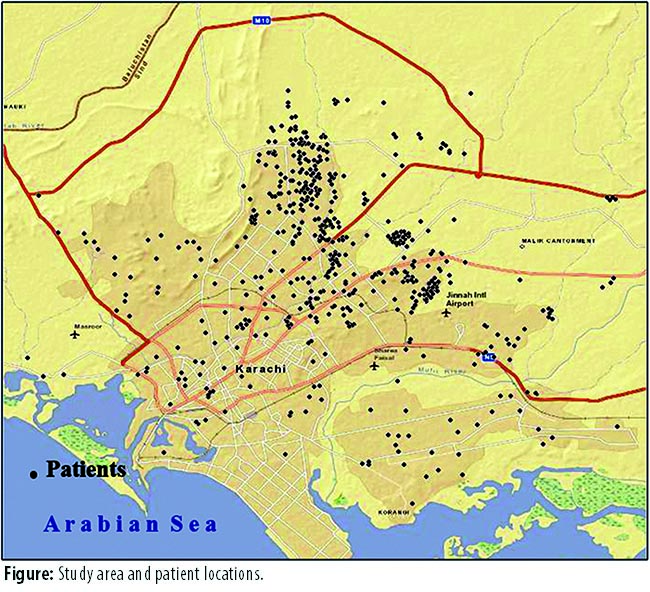
Data was analysed using SPSS 20.
Results
Of the 1260 respondents, 646(51.2%) were women and 614(48.7%) were men. There were more female respondents in the age group 11-20 (32%; n=208) while there were more men in the age group 21-30 (36%; n=221). The lowest recorded occurrence both among males and females was in the 51-60 age group (11% n=69 and 7%; n=48 respectively) (Table-1).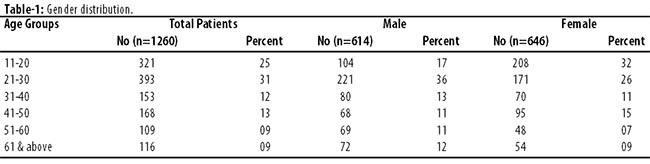
Female respondents were more affected by extra-pulmonary TB (EPTB) (65%; n=123) compared to males (35%; n=65), while the reverse was the case for pulmonary TB (PTB) with male respondents accounting for 52% (n=557) and females 48% (n=514) (Table-2).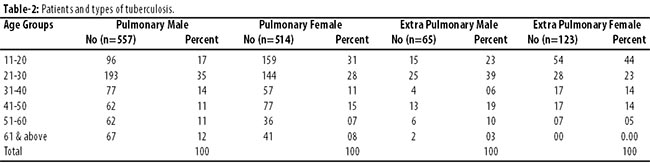
PTB was prevalent among all age groups and both genders, most notably among the younger age group. EPTB prevalence also had the same pattern, but female respondents in 60+ age group were conspicuous by their absence. Younger age groups were more susceptible to TB of any type.
Illiteracy was comparatively higher among female patients (54%; n=333) than the males (Table 3).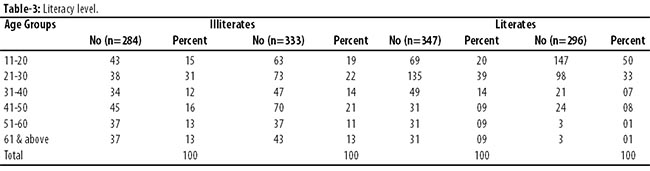
Educational status among the literate, above and below secondary level, showed that the males were more educated with 52% (n=91) and 55% (n=258) respectively against 48% (n=83) and 45% (n=211) for females (Table-4).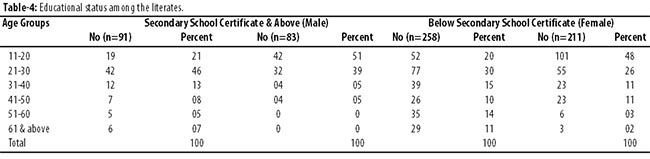
However, on the whole gender-wise, females in age brackets 11-20 and 21-30 revealed better educational status, while males in the age group 21-30 were more. Female TB patients with education more than secondary level were totally absent in the age group 51-60 and above 60. They were, however, present in the distribution below secondary level education which highlighted the significance of education on the occurrence of disease.
There were 74% (n=219) female literate respondents who did not have significant knowledge about TB. Comparatively, 69% (n=239) males revealed that they did not have prior awareness about the disease (Table-5).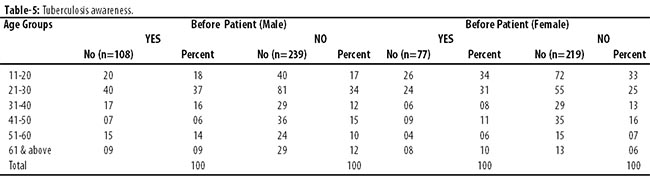
Although overall, males had greater awareness regarding TB and its precautionary measures, but higher education among females in the younger age group was responsible for their greater awareness. Even among the males, educational level was responsible for greater awareness of all types. Upper age group revealed few educated respondents and, hence, lesser awareness.
Relatively more (51%; n=278) female respondents received treatment from the local area compared to males (49%; n=327). TB patients being greater in the younger age groups, their treatment scenario was in close consonance. Overall, 94% (n=605) respondents said they took treatment from the local area although a number of health centres were providing treatment free of cost under the NTCP funded by WHO (Table-6).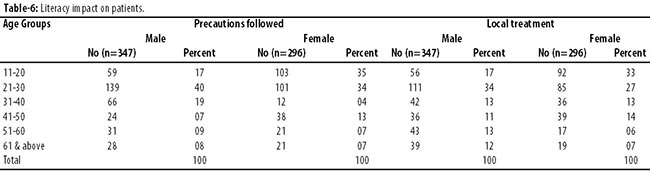
Discussion
The present study was undertaken to determine patients\\\' education level, awareness regarding TB symptoms and treatment in Karachi. Demographic analysis provides significant knowledge of various aspects of human attitude in which educational evaluation is more essential.13,14
Various studies on TB in Karachi have been carried out that mostly focussed on drug resistance against mycobacterium,15,16 and awareness of TB,17,18 but they did not discuss the educational level of patients in line with demographic perception. The current study revealed that about 67% (n=844) patients did not have TB awareness and unfortunately even after registration at diagnosis centres, 31% (n=390) recorded low awareness. Out of the 1260 patients surveyed, 49% (n=617) were illiterate which is an alarming situation for a megacity like Karachi. However, being a megacity of a third world country, a melting pot of cultures with immigration from the whole country, the awareness level among the respondents was low. The level of awareness regarding TB was also a cause of concern in Africa and Serbia.10,19
Our study focussed on the fact that education is necessary to create awareness regarding warning sign i.e., symptoms of TB; its risk factors, treatment and supportive requirements. It is advisable that the TB Control Programme should take steps to initiate awareness at primary and secondary school levels, especially those schools which serve in low income areas (kacchi abadies). Girls\\\' schools should be the prime focus since their ratio (54%) of attendance is comparatively higher than that of boys.
The current study has also brought to light an increase in incidence of TB among educated people. The reason for age-gender difference regarding incidence of TB may be attributed to the fact that not many girls in third world countries in the age-group 21-30 lived under tension of unemployment and search for jobs compared to young boys in the same age group who keep living under tension, thereby becoming addicted to various harmful intoxicants like varieties of smoking, drinking, drug addiction etc, which, coupled with poor diet, multiply the chances of contracting TB.
Conclusion
There was an increasing TB trend in Karachi. Demographically, TB affects both males and females only with a marginal difference. The education level of TB patients was severely undermined due to low income among respondents in the study area. The survey revealed low level of awareness among the respondents, especially those who were residents of substandard homes with polluted immediate environments. The study underscores the simple fact that education is the first pre-requisite for improving health and living standards, as literacy and education can not only enlighten the masses but create and enhance awareness regarding diseases and ways and means of improving their quality of life.
Acknowledgement
We are grateful to Dr. Iqbal Hussain, Deputy Director TB Control Programme, Karachi, and Dr. Nisar Ahmed Rao, Pulmonologist, Ojha Institute of Chest Diseases, and staff of all the BMUs for their support.
References
1. UN. The Millennium Development Goals Repo t 2005. New York: 2005
2. Khan JA, Irfan M, Zaki, A, Beg M, Hussain SF, Rizvi N. Knowledge, attitude and misconceptions regarding tuberculosis in Pakistani patients. J Pak Med Assoc 2006; 56: 211- 4.
3. Burke F, Azam M, Huda SN, Hamza S, Haque Q. Quality of Life and Cause & Effect Relationship with Resources and Facilities- Case Study of Selected Towns in Karachi Pakistan. J Soc Sci 2008; 5: 268-27.
4. WHO. World Health Organization, Annual Report 2013. [online] [cited 2014 May10]. Available from: URL: http://www.who.int/whr/en/.
5. Metzger P, Baloch NA, Kazi GN, Bile KM. Tuberculosis control in Pakistan: reviewing a decade of success and challenges. East Mediter Health J 2010; 16: 47-53.
6. Hasan R, Jabeen K, Ali A, Rafiq Y, Laiq R, Malik B, et al. Extensively drug-resistant tuberculosis, Pakistan. Emerg Infect Dis 2010; 16: 1473-5.
7. Miandad M, Burke F, Huda SN, Azam M. Tuberculosis incidence in Karachi: A spatio-temporal analysis, Geografia. Malaysian J Soc Space 2014; 10: 1-8.
8. Ayaz A, Hasan Z, Jafri S, Inayat R, Mangi R, Channa AA, et al. Characterizing Mycobacterium tuberculosis.isolates from Karachi, Pakistan: drug resistance and genotypes. Int J Infect Dis 2012; 16: 303-9.
9. Chinnakali P, Ramakrishnan J, Vasudevan K, Gurumurthy J, Upadhyay RP, Panigrahi KC. Level of awareness about tuberculosis in urban slums: Implications for advocacy and communication strategy planning in the National program. Lung India 2014; 30: 139-42.
10. Desalu OO, Adeoti AO, Fadeyi A, Salami,AK, Fawibe AE, Oyedepo OO. Awareness of the Warning Signs, Risk Factors, and Treatment for Tuberculosis among Urban Nigerians. Tuberc Res Treatment 2013; 2013:1-5.
11. Yadav SP, Mathur ML, Dixit AK. Knowledge and attitude towards tuberculosis among sandstone quarry workers in desert parts of Rajasthan," Indian J Tuberc 2006; 53: 187-95.
12. Huda SN, Burke F, Anwar E, Ahmed I, Miandad M, Azam M. Spatial analysis of sulfur dioxide (SO2) concentration in Karachi, Megapolis, Pakistan. Lasbela Uni J Sci Technol 2013; 2: 1-18.
13. Middelkoop K, Bekker L, Morrow C, Lee N, Wood R. Decreasing household contribution to TB transmission with age: a retrospective geographic analysis of you g people in a South African township, BMC Infect Dis 2014; 14: 221.
14. Chan-Yeung M, Yeh AG, Tam CM, Kam KM, Leung CC, Yew WW, et al. Socio-demographic and geographic indicators and distribution of tuberculosis in Hong Kong: a spatial analysis. Int J Tuberc Lung Dis 2005; 9: 1320-6.
15. Rao N, Irfan M, Hussain S. Primary drug resistance against Mycobactrium tuberculosis in Karachi. J Pak Med Assoc 2008; 58: 122-5.
16. Khan J, Islam N, Ajanee N, Jafri W. Drug resistance of mycobacterium tuberculosis in Karachi Pakistan. Trop Doct 1993; 23: 13-4.
17. Khan SJ, Anjum Q, Khan NU, Nabi FG. Awareness about common diseases in selected female college students of Karachi, J Pak Med Assoc 2005; 55: 195-8.
18. Sheikh MA, Naqvi SAH, Laghari TM, Chaudhry FF, Siddiqui B, Bokhari F, et al. Knowledge of Tuberculosis among Parents/Guardians of Children with Tuberculosis Attending the Outpatient Department of a Tertiary Care Hospital in Karachi. World Appl Sci J 2012; 19: 1653-8.
19. Vukovic D, Nagorni-Obradovic L, Bjegovic V. Knowledgeand misconceptions of tuberculosis in the general population in Serbia. Eur J Clin Microbiol Infect Dis 2008; 27: 761-7.
Journal of the Pakistan Medical Association has agreed to receive and publish manuscripts in accordance with the principles of the following committees:


