

Meltem Sertbas ( Department of Internal Medicine, Fatih Sultan Mehmet Education and Research Hospital, Istanbul, Turkey. )
Yasar Sertbas ( Department of Internal Medicine, Fatih Sultan Mehmet Education and Research Hospital, Istanbul, Turkey. )
Ozgur Ordu ( Department of Cardiology, Fatih Sultan Mehmet Education and Research Hospital, Istanbul, Turkey. )
Enver Berber ( Department of Internal Medicine, Fatih Sultan Mehmet Education and Research Hospital, Istanbul, Turkey. )
Birgul Ozen ( Department of Internal Medicine, Fatih Sultan Mehmet Education and Research Hospital, Istanbul, Turkey. )
Ali Ozdemir ( Department of Internal Medicine, Fatih Sultan Mehmet Education and Research Hospital, Istanbul, Turkey. )
February 2016, Volume 66, Issue 2
Case Reports

Abstract
Metformin-associated lactic acidosis (MALA) is one of the most important drug toxicities with a high morbidity and mortality rate. We report herein a case of suicide attempt with metformin presenting as MALA and acute renal failure on admission to emergency department and acute myocardial injury later on hospitalisation. An obvious improvement of metabolic parameters was seen in our patient provided by anti-ischaemic treatment together with bicarbonate infusion and haemodialysis. Although myocardial injury due to MALA is not a common disorder, we must be aware that metformin overdose with lack of tissue oxygenation, hypoperfusion, and arrhythmias may cause myocardial ischaemia.
Keywords: Metformin, Lactic acidosis, Myocardial ischaemia.
Introduction
Metformin is a biguanide oral antidiabetic agent which is commonly used in the treatment of diabetes mellitus. Metformin-associated lactic acidosis (MALA) is one of the most important drug toxicities with a high morbidity and mortality rate of 30- 50%.1 Although MALA due to therapeutic usage of metformin occurs rarely with the incidence of 2-9 cases per 100 000 patient-years, overdose of metformin intake is frequently associated with lactic acidosis.1,2
MALA has non-specific symptoms presenting with hypotension, tachypnoea, tachycardia, coma and cardiac arrest.3 We report an unusual case of suicide attempt with metformin presenting with MALA, acute renal failure and acute myocardial ischaemia (MI).
Case Report
A 55 year-old man presented to us at the Fatih Sultan Mehmet Education and Research Hospital in April 2015 with complaints of nausea, vomiting and diarrhoea. He had ingested fifty tablets of metformin (50g) with intent of suicide. The reported time of ingestion was nearly twelve hours prior to arrival. Poorly controlled hypertension and a previous suicide attempt with antihypertensive drugs were noted in his medical history. On presentation, his Glasgow Coma Scale (GCS) score was 15, blood sugar was 77 mg/dl, blood pressure was 157/82 mmHg, pulse was 79 beats per minute, and peripheral oxygen saturation (SO2) was 99 %. Initial laboratory parameters revealed a serum sodium of 140 mmol/L (normal range: 137 to 140 mmol/L); serum potassium of 7.9 mmol/L (normal range: 3.4 to 4.5 mmol/L); serum chloride of 99 mmol/L (normal range: 100 to 109 mmol/L); serum bicarbonate (HCO3) of 10.6 mmol/L (normal range: 22 to 32 mmol/L); an anion gap of 31 mmol/L (normal range: 7 to 17 mmol/L); blood urea nitrogen (BUN) of 27 mg/dL (normal range: 8.9 to 20.6 mg/dL); serum creatinine (Crt) of 3.56 mg/dL (normal range: 0.72 to 1.25mg/dL); serum alanine aminotransferase (ALT) of 25 U/L (normal range: 0 to 55 U/L); and serum aspartate transaminase (AST) of 19 U/L (normal range: 5 to 34 U/L) (Table 1).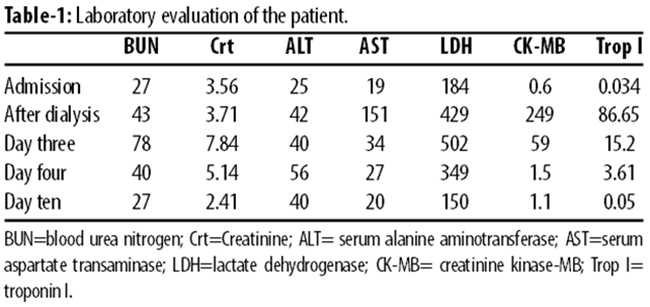
Arterial blood gas measurements revealed a profound metabolic acidaemia with high lactate levels; pH of 7.11; partial pressure of carbon dioxide (pCO2) of 31 mmHg; partial pressure of oxygen (pO2) of 54 mmHg; bicarbonate (HCO3) of 10.6 mmol/L; and lactate of 24 mmol/L (Table 2).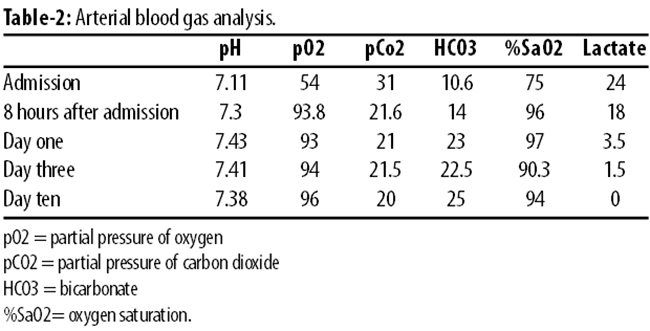
With these signs, symptoms and laboratory parameters, he was diagnosed as a case of metformin-associated lactic acidosis (MALA) with acute renal failure.
After the diagnosis of MALA, he was referred for emergency haemodialysis. The initial treatment with haemodialysis and sodium bicarbonate (NaHCO3) infusion showed an obvious improvement of acidosis without any haemodynamic instability (pH: 7.3; lactate: 18mmol/L; Crt: 3.71 mg/dl). He was then admitted to the internal medicine department; however, after eight hours of arrival to the hospital, an obvious increase of cardiac markers for ischaemia was noted. At the time of arrival, the creatinine kinase-MB (CK-MB) was 0.6 ng/ml and troponin I was 0.034 ng/ml. Eight hours later, the CK-MB was 249 ng/ml and troponin I was 86.65 ng/ml. He was referred to the cardiology department and diagnosed with cardiac ischaemia due to metabolic problems and dehydration without abnormal electrocardiographic changes. NaHCO3 infusion, clopidogrel, low molecular weight heparin and acetyl salicylic acid were administered for the management of acidosis and cardiac ischaemia. There was an obvious improvement of metabolic and cardiac parameters on the tenth day of admission as pH improved to 7.38, HCO3 to 25 mmol/L, lactate 0 to mmol/L, CK-MB to 1.1 ng/ml, and troponin I to 0.05 ng/ml (Table-1, 2). After discharge from the hospital, myocardial perfusion single-photon emission computed tomography (SPECT) was performed and severe ischaemic findings of the lateral wall and inferolateral segments of the myocardium were observed. The patient was then referred to the cardiology department for myocardial angiography and further investigations.
Discussion
Metformin is an oral antidiabetic drug which shows its effects by inhibition of hepatic gluconeogenesis, enhancing peripheral glucose uptake, decreasing insulin resistance and hepatic glucose output.4 Metformin is a small non-plasma-binding molecule and actively excreted via transporters of proximal tubules of the kidneys.5
Under normal conditions, gluconeogenesis consumes pyruvate through pyruvate carboxylase. Biguanides inhibits pyruvate carboxylase and dehydrogenase and causes more lactate accumulation. Two situations in which metformin may contribute to lactic acidosis are inability to excrete the drug and ingestion of a large amount of metformin, overwhelming the clearance capabilities.
Lactic acidosis is the major toxicity of metformin and is associated with high mortality up to 50 %.1 It is defined as metabolic acidosis with a pH of less than 7.35 and a lactate concentration greater than 5 mmol/L.3 The causes of acidosis can be divided into those associated with impaired tissue oxygenation (type A) with poor perfusion resulting from hypovolaemia, cardiac failure, sepsis, or cardiopulmonary arrest, and those in which systemic impairment in oxygenation does not exist (type B). Type B can be divided down into three subgroups. The subtype B1 is attributed to an underlying disease state like diabetes mellitus, chronic liver disease, pheochromocytoma. Subtype B2 refers to a metabolic state induced by toxins as alcohol, biguanides, salicylates, and acetaminophens. Subtype B3 is due to inborn errors of metabolism such as type I glycogen storage disease and pyruvate oxidase enzyme defects.3 Our case is comparable with type B lactic acidosis due to ingestion of high amount of metformin that was overlapping with type A lactic acidosis with a cause of hypoperfusion and cardiac injury.
MALA has non-specific presenting features; typically nausea, vomiting, epigastric pain, renal failure, tachypnoea, tachycardia, arrhythmia, coma and cardiac arrest.6 The prognosis of lactic acidosis is poor with a mortality rate of 30-50%.1 Cardiac arrhythmias are the leading cause of death.7 Myocardial ischaemia on lactic acidosis is a very rare condition as only one patient has been documented in over 4600 reported lactic acidosis cases.8 In our case, cardiac enzymes showed progressive elevation with CK-MB of 249 ng/ml and troponin I of 86.65 ng/ml. Vasodilatation, tissue perfusion defects, cardiac arrhythmias, and decreased oxygen deliveries might be the cause of myocardial injury.
Since there is no antidote for metformin overdose, sodium bicarbonate infusion and haemodialysis are the main components of the treatment. The use of sodium bicarbonate in metformin-induced lactic acidosis is controversial. If severe metabolic acidosis (pH<7.1) is present, sodium bicarbonate is recommended, but there are theoretical disadvantages to its use. These disadvantages include leftward shift of the haemoglobin dissociation curve, excess sodium load, rebound metabolic alkalosis, disturbances in serum potassium and calcium, decreased myocardial contractility, increased carbon dioxide production, and reflex vasodilation.9 We suggest treatment with sodium bicarbonate should be used in patients who are critically ill, with severe metabolic acidosis (pH <7.1). Haemodialysis has also been successfully used in patients with MALA due to chronic use or acute overdose of metformin. It is recommended for the correction of metabolic acidosis and removal of metformin from plasma preventing further production of lactate. In our patient, an obvious improvement of metabolic parameters was provided by anti-ischaemic treatment together with bicarbonate infusion and haemodialysis.
Conclusion
Although myocardial ischaemia due to MALA is not a common disorder, we must be aware that metformin overdose with lack of tissue oxygenation, hypoperfusion, and arrhythmias may cause myocardial injury.
References
1. Peters N, Jay N, Barraud D, Cravoisy A, Nace L, Bollaert PE, et al. Metformin-associated lactic acidosis in an intensive care unit. Crit Care. 2008; 12:R149.
2. Spiller HA, Quadrani DA. Toxic effects from metformin exposure. Ann Pharmacother. 2004; 38:776-80.
3. Kathryn KT, Michael KJ. Metformin-associated lactic acidosis (MALA): case files of the Einstein Medical Center medical toxicology fellowship. J Med Toxicol. 2013; 9:61-6.
4. Stumvoll M, Nurjhan N, Perriello G, Dailey G, Gerich JE. Metabolic effects of metformin in non-insulin-dependent diabetes mellitus. N Engl J Med. 1995; 333: 550-4.
5. Duong JK, Furlong TJ, Roberts DM, Graham GG, Greenfield JR, Williams KM, et al. The role of metformin in metformin-associated lactic acidosis (MALA): case Series and formulation of a model of pathogenesis. Drug Saf. 2013; 3.
6. Spiller HA. Toxicology of oral antidiabetic medications.Am J Health Syst Pharm. 2006; 63:929-38.
7. Emslie-Smith AM, Boyle DI, Evans JM, Sullivan F, Morris AD, DARTS/MEMO Collaboration. Contraindications to metformin therapy in patients with Type 2 diabetes-a population-based study of adherence to prescribing guidelines.Diabet Med. 2001; 18:483-8.
8. Teale KF, Devine A, Stewart H, Harper NJ. The management of metformin overdose. Anaesthesia. 1998; 53:698-701.
9. Heaney D, Majid A, Junor B.Bicarbonate haemodialysis as a treatment of metformin overdose.Nephrol Dial Transplant. 1997; 12:1046-7.
Journal of the Pakistan Medical Association has agreed to receive and publish manuscripts in accordance with the principles of the following committees:


