

Amna Qasim ( MBBS, Aga Khan University, Karachi, Pakistan. )
Ahmad Bashir ( Medical Student, Aga Khan University, Karachi, Pakistan. )
Sara Sajid ( Department of Medicine, Aga Khan University, Karachi, Pakistan. )
Muhammad Mehmood Riaz ( Department of Medicine, Aga Khan University, Karachi, Pakistan. )
Aysha Almas ( Department of Medicine, Aga Khan University, Karachi, Pakistan. )
February 2016, Volume 66, Issue 2
Original Article

Abstract
Objectives: To determine the association of essential hypertension with pregnancy-induced hypertension in women.
Methods: The case-control study was conducted at Aga Khan University Hospital, Karachi, from January 2012 to March 2013, and comprised on hypertensive female patients who visited the outpatient medicine clinics. The patients were aged 18-65 years and had been pregnant atleast once. Cases were women diagnosed as hypertensive or pre-hypertensive and the controls were normotensive women. The primary outcome was essential hypertension and the main exposure was pregnancy-induced hypertension.
Results: Of the 258 subjects, 175(49.7%) were cases and 177(50.3%) were controls. The overall mean age was 44.6±13.3 years. Odds Ratio (95% Confidence interval) for pregnancy-induced hypertension for the outcome of essential hypertension was 1.6 (0.88, 3.0). The odds ratio increased further to 2.5(1.2, 5.2) after adjustment for age, family history of hypertension and physical activity. The association remained after further adjusting for body mass index in the final model; 2.20 (1.06, 4.57)
Conclusion: Women who develop hypertension in pregnancy are at higher risk of developing essential hypertension later in life.
Keywords: Pregnancy induced hypertension, Essential hypertension, Women, Pakistan, South Asia. (JPMA 66: 179; 2016).
Introduction
Hypertension contributes to significant health burden as it leads to complications such as stroke, heart attack, heart failure, kidney disease and even death.1 There is a five- to six-fold increase in risk of morbidity and mortality in hypertensive women as opposed to normotensive women. According to the National Health Survey of Pakistan, conducted during 1990-4, the prevalence of hypertension in Pakistani adults was estimated to be 23% in urban and 18% in rural areas.2 The prevalence of hypertension in women was found to be 14.5%.3 Pregnancy-induced hypertension (PIH) is a form of hypertension that develops after the 20th week of gestation due to changes in haemodynamics that occur during pregnancy. The overall incidence of PIH has been reported to be 9%.4
Studies have reported more than a two-fold increase in the incidence of essential hypertension in women with prior PIH.5 A cohort study of 4782 women was conducted at Mayo Clinic which concluded that women with PIH had a relative risk (RR) of 1.53 (1.25 to 1.87) of developing essential hypertension after 40 years.5 In another retrospective cohort study done at Kailuan Linxi hospital in China, conducted from 1976 to 2001, the cumulative incidence of essential hypertension during follow-up was found to be significantly higher in the PIH group (29.87%) versus the non-PIH group 18.87%.6 The mechanism that is common in both PIH and essential hypertension is early altered diastolic filling of the left ventricle (LV) and some studies have also reported insulin resistance as an underlying mechanism.7,8
Traditional risk factors which lead to the development of hypertension include increased weight, decreased physical activity, increased mental stress and genetically predisposed blood thrombogenic properties. South Asian women differ in terms of their earlier child-bearing age, risk of cardiovascular disease and body mass index (BMI) cutoffs.9 The average child-bearing age in Pakistan is 21.1 years10 and the average fertility rate is 4.0.11 South Asian women are at a higher risk of developing cardiovascular diseases.2 The probability of developing hypertension at a lower BMI and the presence of central obesity in the South Asian population further increases their risk of developing hypertension.12
We hypothesised that women developing PIH were at higher risk of developing essential hypertension later in life. Hence, the current study was planned to report whether South Asian Pakistani women with PIH are at an increased risk of developing essential hypertension later in life.
Subjects and Methods
The case-control study was conducted at Aga Khan University Hospital, Karachi, from January 2012 to March 2013, and comprised of hypertensive female patients who visited the outpatient medicine clinics.
The patients were aged 18-65 years and had been pregnant atleast once. Cases were women who had been diagnosed to be hypertensive or pre-hypertensive based on Joint National Committee Report VII (JNC VII) criteria13 as follows: Normal blood pressure: systolic <120mmHg and diastolic <80mmHg; pre-hypertension: systolic 120 to 139mmHg or diastolic 80 to 89mmHg; hypertension stage 1: systolic 140 to 159mmHg or diastolic 90 to 99mmHg; hypertension stage 2: systolic >160 or diastolic >100mmHg.
The cases were receiving treatment for hypertension if they were hypertensive. Controls were women who did not have hypertension or pre-hypertension based on JNC-VII criteria.13 Those women who had hypertension secondary to other disorders such as renal disease, hypo or hyperthyroidism, unmarried patients and patients who had never conceived or had primary infertility were excluded. The source population for cases and controls was the same. Ethical approval was taken from the institutional ethics review committee and an informed consent was taken from all subjects prior to administration of the questionnaire.
Research staff approached the hypertensive women presenting to Medicine clinics through the nurse triage counter at the time of assessment of blood pressure prior to the clinic visit. The history of hypertension was also confirmed from their hospital medical records. Controls were either the non-hypertensive attendants of these patients or other female patients present in the waiting lounge who fulfilled the inclusion criteria for controls. Data was collected on a structured questionnaire with two parts. The first part included demographic details (age, marital status, age of onset of hypertension for cases only), number of pregnancies, live births and miscarriages, systolic and diastolic blood pressures (Invivo-Omega 1400 non-invasive blood pressure monitor), weight (in kilogrammes), height (in centimetres), physical activity (defined as >30min physical activity at least 4 times a week),14 and family history of hypertension (defined as any first degree relative with a diagnosis of and on treatment of hypertension).15 The variables in the second part of the questionnaire were PIH (as diagnosed by the primary obstetrician the patient had consulted during her pregnancy), the number of pregnancies with PIH, the trimester of its occurrence, the accompanying symptoms, whether it required early admission or any form of oral/intravenous treatment or not, and the mode of delivery. The forms were different for cases and controls.
After a signed informed consent, all subjects underwent general assessment during which demographic data, blood pressure, weight and height of the patients were recorded. Blood pressure of each participant was measured using a mercury sphygmomanometer while the patient had been seated in the assessment room for more than 5 minutes. Height and weight were recorded using standardised methods. The research staff filled the rest of the questionnaire by asking questions from the patients in a separate clinic room, ensuring maintenance of confidentiality.
Women with PIH are said to have a relative risk (RR) of 3.7 for developing essential hypertension.16 A minimum sample size of 125 cases and 125 controls was required to have an odds ratio (OR) of 3 for the association of PIH with essential hypertension in cases versus controls with power of 80%.
Data was analysed using SPSS 19. Means and standard deviations were calculated for quantitative variables, while frequencies and percentages were calculated for qualitative variables. Logistic regression was used to calculate OR for the association of essential hypertension and PIH. OR >1 was considered to signify positive effect of exposure on disease. Multiple logistic regression was used to determine the relation of hypertension with PIH. The factors that were significant (p<0.25) on univariate analysis and/or were biologically plausible were run in the multiple regression model. These were PIH, age, family history of hypertension, physical activity and BMI.
Results
A total of 400 patients were approached and 352(88%) were included as the rest either refused to participate or were unable to recall pertinent information. Mean age of the subjects was 45.4±13.2 years, family history of hypertension was present in 195(55.4%), physical activity >4 times (>30 minutes)/week) was present in 41(11.6%), and the mean BMI was 29.9±6.1. PIH was present in 66(18.8%).
There were 175(49.7%) cases and 177(50.3%) controls. The mean age of the cases was 53.6±8.65 years and 37.2±11.7 years in the controls. PIH was present in 37(21.2%) cases and 29(16.4%) controls (Table-1).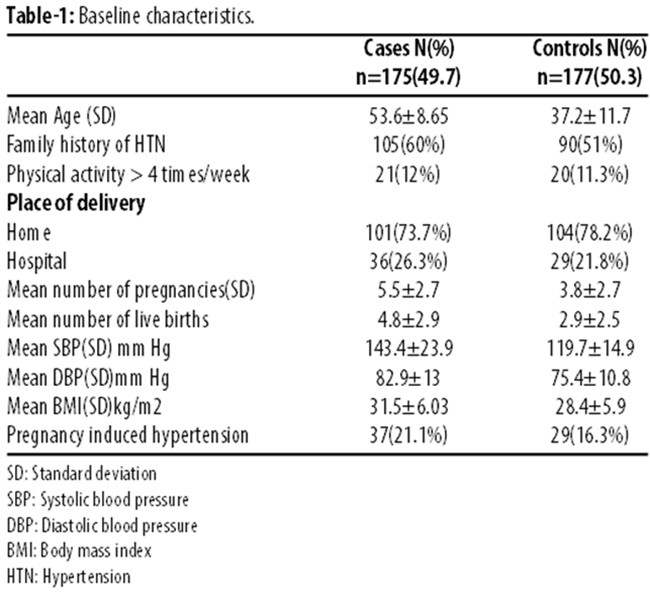
On univariate analysis for outcome of essential hypertension, OR (95% confidence interval [CI]) were:1.4(0.8, 2.4) for PIH, 1.1(1.1,1.1) for age, 1.4(1.0,2.1) for family history of hypertension, and 1.0(0.5,2.0) for physical activity (Table-2).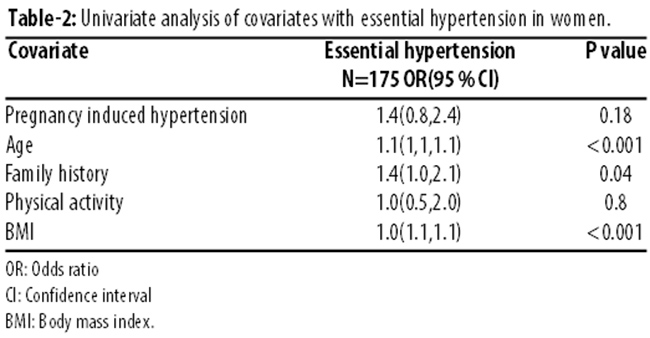
On multivariate regression analysis, OR (95%CI) for the association of essential hypertension with history of PIH was 2.55(1.26, 5.12) (p=0.009) after adjusting for age in model 1. In model 2 it was 2.53(1.25, 5.12) (p=0.010) after adjusting for age and family history. After adjusting for age, family history and physical activity, it was 2.58(1.27, 5.23) in model 3 (p=0.009). In model 4, OR was 2.20(1.06, 4.57) (p=0.035) after adjusting for age, family history, physical activity and BMI (Table-3).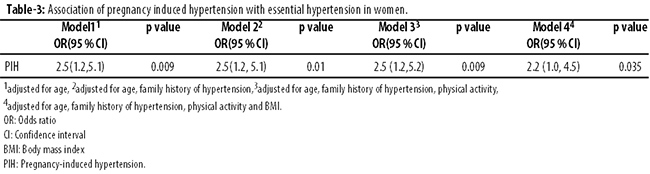
Discussion
Hypertension is a multifactorial disease. Apart from the role of traditional risk factors leading to the development of essential hypertension, we report in this study that PIH is a risk factor for the development of essential hypertension even after adjusting for age, family history of hypertension, BMI and physical activity. A significant difference seen was that women with hypertension were more obese and had a higher number of pregnancies compared to women without hypertension.
PIH has been reported to have an association with essential hypertension. Interestingly, we have one of the highest number of pregnancies and more central obesity in the world which intensifies the risk of developing PIH and, hence, hypertension.2 Women with PIH have a relative risk of 3.7 for developing essential hypertension.16 A cohort study done at Mayo Clinic found the relative risk of developing essential hypertension after 40 years to be 1.88 after adjusting for age and dyslipidaemia.17 Another study done in China concluded that after adjusting for age and BMI, PIH was significantly correlated with long-term systolic blood pressure (SBP) levels.6 Literature shows that early onset hypertension in pregnancy, subsequent hypertensive pregnancies and the severity of the hypertension that developed in pregnancy all have a relationship with the likelihood of developing long-term essential hypertension.18 Our findings are in line with previous findings. A differentiating factor of our study from the aforementioned ones is that in addition to adjusting for age and BMI, we also adjusted for a family history of hypertension and physical activity.
South Asian women are at a higher risk of developing central obesity, are less physically active19 and have a higher fertility rate.20 There is also lack of proper antenatal care which further predisposes these women to remain untreated if they develop pregnancy PIH.11 First pregnancies have been found to be associated with PIH17 and a hypertensive pregnancy increases the risk of developing hypertension and its complications in subsequent pregnancies.17,21 We have a higher number of pregnancies due to early marriages,22 unmet need for family planning leading to unwanted pregnancies20 and a lack of women empowerment.23 Additionally, our women are less physically active compared to the Caucasian population, according to a study done in Europe.24
The strengths of our study include the fact that we used a case-control design which is suitable to answer our main question. Case-control study design was cost-effective in studying the particular question on PIH. A cohort study would have been too long and would have required large resources. Besides, pertinent confounding factors were identified and accounted for when analysing the data in order to get an adjusted relative risk that accurately represents our population.
However, the study had certain limitations. As the sample population is limited to a single tertiary care hospital, it may not accurately represent the source population of the region. The data collection procedure involved interviewing people about events that happened a long time ago, hence recall bias must have confounded the results. We tried confirming the history of PIH for those women who were registered at out hospital at the time of their pregnancy, but the number was very small. The results of our study show that the mean age of cases (53.6 years) was much higher than the mean age of controls (37.2 years). This could mean that some of the women we included as controls may become hypertensive in future and add to the number of cases that had PIH, further strengthening our association. However, we minimised the effect of this limitation by carrying out a multivariate regression analysis and adjusting for age to determine the strength of association.
Conclusion
Hypertension in pregnancy was found to be a risk factor for developing essential hypertension later in life. However, further work needs to be done in this area to establish this link and its underlying causal factors. Women with PIH can be identified much before they develop essential hypertension, and, hence, they can be targeted in primary prevention strategies for essential hypertension. Women with PIH should be cautioned at the time of their postnatal follow-ups and encouraged to get their blood pressure screened frequently.
Acknowledgements
We are grateful to the nursing staff of Consulting Clinics (Medicine), Aga Khan University Hospital for their help.
References
1. Dolea C, AbouZahr C. Global burden of hypertensive disorders of pregnancy.Geneva: WHO, 2000.
2. Jafar TH, Chaturvedi N, Pappas G. Prevalence of overweight and obesity and their association with hypertension and diabetes mellitus in an Indo-Asian population. CMAJ. 2006; 175:1071-7.
3. Aziz Ku, Faruqui AM, Teri M, Davis CE, Abenathy J. Blood pressure and hypertension distribution in a lower middle class urban community in Pakistan. J Pak Med Assoc. 2005; 55:333-8.
4. Xiong X, Mayes D, Demianczuk N, Olson DM, Davidge ST, Newburn-Cook C, et al. Impact of pregnancy-induced hypertension on fetal growth. Am J Obstet Gynecol. 1999; 180:207-13.
5. Beaufils M. Secondary cardiovascular risk and pre-eclampsia.Rev Med Interne. 2011; 32:S36-40.
6. Sun J, Wu SL, Huang YY, Wang ZB, Zhao YM, Li Y, et al. Perpetual impact of pregnancy-induced hypertension on blood pressure.Zhonghua Xin Xue Guan Bing Za Zhi. 2010; 38:11-4.
7. Novelli GP, Valensise H, Vasapollo B, Larciprete G, Di Pierro G, Altomare F, et al. Are gestational and essential hypertension similar? Left ventricular geometry and diastolic function. Hypertens Pregnancy. 2003; 22:225-37.
8. Berkowitz KM. Insulin resistance and preeclampsia. Clin Perinatol. 1998; 25:873-85.
9. Shinn EH, Poston WS, Kimball KT, St Jeor ST, Foreyt JP. Blood pressure and symptoms of depression and anxiety: a prospective study. Am J Hypertens. 2001; 14:660-4.
10. Hanif HM. Association between maternal age and pregnancy outcome: implications for the Pakistani society. J Pak Med Assoc. 2011; 61:313-9.
11. D. Clifton AF. The World\\\'s Women and Girls 2011 Data Sheet. Population Reference Bureau, Washington DC; 2011.
12. Yusuf S, Hawken S, Ounpuu S, Bautista L, Franzosi MG, Commerford P, et al. Obesity and the risk of myocardial infarction in 27 000 participants from 52 countries: a case-control study. Lancet. 2005; 366:1640-9.
13. Chobanian AV, Bakris GL, Black HR, Cushman WC, Green LA, Izzo JL Jr, et al. Seventh report of the Joint National Committee on Prevention, Detection, Evaluation, and Treatment of High Blood Pressure. Hypertension. 2003; 42:1206-52.
14. Bauman A, Craig C. The place of physical activity in the WHO Global Strategy on Diet and Physical Activity. Int J Behav Nutr Phys Act. 2005;2:10.
15. Valdez R, Yoon PW, Qureshi N, Green RF, Khoury MJ. Family History in Public Health Practice: A Genomic Tool for Disease Prevention and Health Promotion. Annu Rev Public Health. 2010; 31:69-87 1-87.
16. Bellamy L, Casas JP, Hingorani AD, Williams DJ. Pre-eclampsia and risk of cardiovascular disease and cancer in later life: systematic review and meta-analysis.BMJ. 2007; 335:974.
17. Garovic VD, Bailey KR, Boerwinkle E, Hunt SC, Weder AB, Curb D, et al. Hypertension in pregnancy as a risk factor for cardiovascular disease later in life. J Hypertens. 2010; 28:826-33.
18. Sibai BM, Mercer B, Sarinoglu C. Severe preeclampsia in the second trimester: recurrence risk and long-term prognosis. Am J Obstet Gynecol. 1991; 165:1408-12.
19. Chopra SM, Misra A, Gulati S, Gupta R. Overweight, obesity and related non-communicable diseases in Asian Indian girls and women. Eur J Clin Nutr. 2013; 67:688-96.
20. Sathar ZA. Family planning: a missing priority in Pakistan\\\'s health sector? Lancet. 2013; 381:2140-1.
21. Irgens HU, Reisaeter L, Irgens LM, Lie RT. Long term mortality of mothers and fathers after pre-eclampsia: population based cohort study.BMJ. 2001; 323:1213-7.
22. Godha D, Hotchkiss DR, Gage AJ. Association Between Child Marriage and Reproductive Health Outcomes and Service Utilization: A Multi-Country Study From South Asia.J Adolesc Health. 2013; 52:552-8.
23. Sathar ZA. Possible reasons for retardation in fertility change in South Asia.Pak Dev Rev. 1989; 28:655-60.
24. Hayes L, White M, Unwin N, Bhopal R, Fischbacher C, Harland J, et al. Patterns of physical activity and relationship with risk markers for cardiovascular disease and diabetes in Indian, Pakistani, Bangladeshi and European adults in a UK population. J Public Health Med. 2002; 24:170-8.
Related Articles
Journal of the Pakistan Medical Association has agreed to receive and publish manuscripts in accordance with the principles of the following committees:


