

Mehmet Serif Arslan ( Department of Pediatric Surgery, Medical School of Dicle University, Kitilbil, Diyarbakir, Turkey. )
Serkan Arslan ( Department of Pediatric Surgery, Medical School of Dicle University, Kitilbil, Diyarbakir, Turkey. )
Ibrahim Uygun ( Department of Pediatric Surgery, Medical School of Dicle University, Kitilbil, Diyarbakir, Turkey. )
November 2015, Volume 65, Issue 11
Letter to the Editor

Madam, Gossypiboma is a rare surgical complication defined as a retained surgical tool, which is mostly a sponge, in the body after a surgical procedure. It may lead to significant morbidity and mortality. Long term non-specific problems seen after surgery should remind us of the differential diagnosis of a retained foreign body. Radiological diagnostic tools may be beneficial to confirm the diagnosis.1
A 7-month-old child was admitted in our hospital on 15th June 2013 with the complaints of abdominal distention, vomiting, and malnutrition and referred with the diagnosis of intestinal obstruction. Past medical history noted the diagnosis of meconium ileus in the neonatal period, after which ileal resection and anastomsis was performed. He then developed non-specific complaints for which he was hospitalised five times. The patient then underwent surgery with the suspicion of adhesive bowel obstruction. Upon laparatomy, it was seen that almost whole intestinal loops, especially the small intestine, were adherent to themselves and omentum. The obstructing material was determined in the terminal ileum and after exploration a sponge was detected which had migrated completely into the lumen (Figure-1).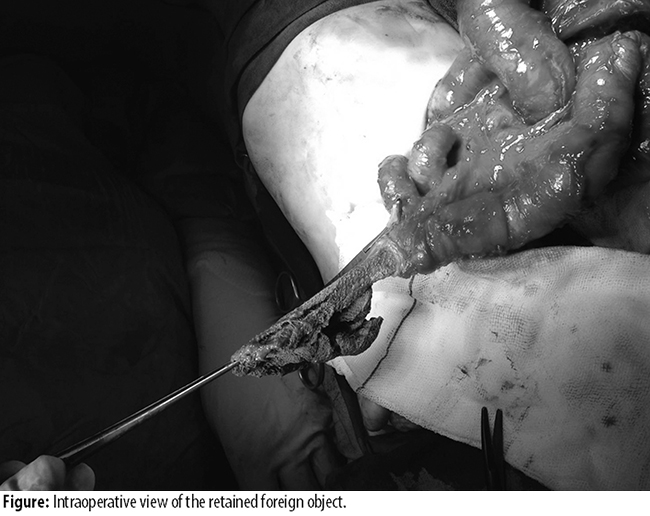
The extracted sponge was not deformed and was free of radiopaque material. The patient was discharged after the 5th day of operation and asymptomatic at three months of follow up.
A systemic review of the PubMed and Google Scholar, and we found the smallest of the cases transmural migration of surgical sponges following abdominal surgery.
The most common cause of intestinal obstruction is adhesion due to previous abdominal surgery. Gossypiboma is a rare cause of such an obstruction. A retained foreign body is found in every 1,000 to 10,000 surgical interventions, of which 75% cases are seen after abdominal or pelvic surgery.2 Migration of a retained surgical sponge into the bowel is rare compared to abscess formation. Once a surgical sponge has migrated into the intestinal lumen, it is advanced further by the peristaltic activity of the bowel. Spontaneous defaecation of the retained sponge is very rare.3
Gossypiboma should be considered as a differential in the diagnosis of a patient who presents with ileus, pain, infection, or a palpable mass postoperatively.4 To our knowledge, ours is the youngest reported case of gossypiboma which migrated into intestinal lumen. This serves as a reminder for the importance of diligence of surgeons, as gossypiboma is possible even in neonatal surgery. Radiopaque markers for sponges and obeying the basic principle of \\\'checking and counting whole surgical equipment completely before and after the operation\\\' are essential for avoiding such complications, and undesired medical and legal consequences.
Conflict of Interests: The authors declare that they have no conflict of interests.
Disclosure: The authors have indicated that they have no financial relationships relevant to this paper to disclose.
Reference
1. Abdul-Karim FW, Benevenia J, Pathria MN, Makley JT. Case report 736: Retained surgical sponge (gossypiboma) with a foreign body reaction and remote and organizing hematoma. Skeletal Radiol 1992; 21: 466-9.
2. Kalovidouris A, Kehagias D, Moulopoulos L, Gouliamos A, Pentea S, Vlahos L.Abdominal retained surgical sponges: CT appearance. EurRadiol 1999; 9: 1407-10.
3. Patil KK, Patil SK, Gorad KP, Panchal AH, Arora SS, Gautam RP. Intraluminal migration of surgical sponge: gossypiboma. Saudi J Gastroenterol 2010; 16: 221-2.
4. Gencosmanoglu R, Inceoglu R. An unusual cause of small bowel obstruction: gossypiboma - case report. BMC Surg 2003; 3: 6.
Related Articles
Journal of the Pakistan Medical Association has agreed to receive and publish manuscripts in accordance with the principles of the following committees:


