

Baris Erdogan ( Department of Otolaryngology, Medipol University Esenler Training and Research Hospital, Istanbul, Turkey. )
Mehmet Ozgur Erdogan ( Department of Emergency Medicine, Haydarpasa Numune Training and Research Hospital, Istanbul, Turkey. )
Sahin Colak ( Department of Emergency Medicine, Haydarpasa Numune Training and Research Hospital, Istanbul, Turkey. )
Ozge Kibici ( Department of Emergency Medicine, Haydarpasa Numune Training and Research Hospital, Istanbul, Turkey. )
Korkut Bozan ( Department of Emergency Medicine, Esenyurt State Hospital, Istanbul, Turkey. )
Baris Alper ( Department of Emergency Medicine, Haydarpasa Numune Training and Research Hospital, Istanbul, Turkey. )
November 2015, Volume 65, Issue 11
Case Reports

Abstract
Hyoid bone fractures due to blunt trauma are exceedingly rare. Here, we present an isolated hyoid bone fracture caused by blunt trauma as well as a detailed discussion of the injury and treatment options.
A 32-year-old male was admitted to emergency department with odynophagia and severe neck pain. He had been hit in the neck with a metal rod during a fight. Computed tomography scan revealed a fracture on hyoid bone and local swelling of adjacent soft tissues. The patient\\\'s head was elevated, and ice packs were used to reduce the swelling. Diclofenac sodium and prednisolone were administered. Patient was discharged with a recommendation of out-patient control.
Odynophagia, dysphagia and dyspnoea should alert the physician to possible hyoid or laryngeal damage. Fibre optic laryngoscopy and neck CT are important diagnostic steps to reveal a possible life-threatening injury. Conservative treatment is usually adequate, and patients rarely require surgical intervention.
Keywords: Hyoid bone fractures, Blunt trauma, Injury.
Introduction
Blunt neck contusion-related injuries can cause rapid deterioration, and a missed or delayed diagnosis may result in morbidity and mortality. Hyoid bone fractures due to blunt trauma are exceedingly rare.1 Hyoid fractures are seen commonly in hanging or manual strangulation. The rarity of these fractures is related to the protected location of the hyoid bone under the mandible and its ability to move in all directions.
Injury to the hyoid bone can be easily missed during an evaluation of associated life-threatening injuries or due to an asymptomatic presentation. An open hyoid bone fracture is an indication for surgical exploration. Treatments for closed hyoid bone fractures are conservative. Due to the rarity of this injury, a specific algorithm has not been defined. Here, we present an isolated hyoid bone fracture caused by blunt trauma as well as a detailed discussion of the injury and treatment options.
Case Report
A 32-year-old male was admitted to the emergency department (ED) in May 2014 with odynophagia and severe neck pain. He had been hit in the neck with a metal rod during a fight. The patient had local tenderness and mild swelling on the left side of the neck, with no respiratory distress or focal neurological deficits.
A neck computed tomography (CT) scan revealed a fracture on the left side of the hyoid bone and local swelling of the adjacent soft tissues (Figure).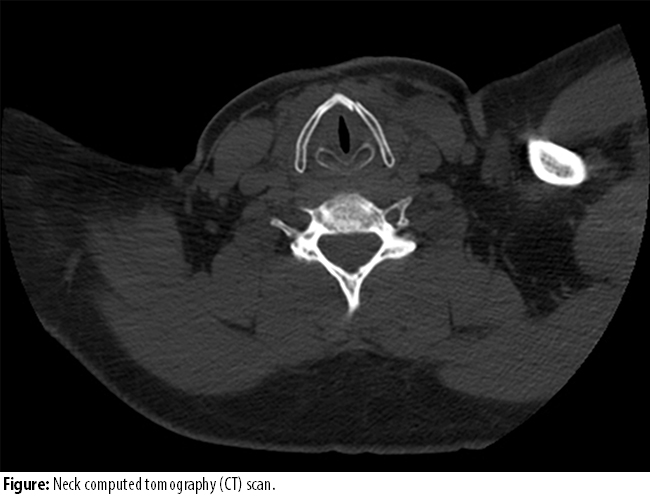
Fibre optic laryngoscopy revealed symmetric motion of the vocal cords but no signs of laceration or oedema. The patient was observed with medical therapy for 24 hours in the ED observation unit. The patient\\\'s head was elevated, and ice packs were used to reduce the swelling. Diclofenac sodium (75 mg, intramuscularly) and prednisolone (60 mg, intravenously) were administered. The patient was discharged with a recommendation of out-patient control.
Discussion
Hyoid bone fractures due to blunt trauma are exceedingly rare; however, they are seen after hanging or strangulation. In a systematic literature review published in 2004, motor vehicle accidents were the most common reason for a hyoid bone fracture (37%).1 Fractures due to helmet straps have been reported twice in the last decade2,3 and may become a frequent reason for this rare trauma, as motorcycle use has been increasing. Other reported causes of hyoid bone fractures are direct trauma, sports injuries, martial arts injuries and hyperextension injuries.4 In our case, the trauma was caused by a direct hit with a metal rod to the neck during a street fight.
A hyoid bone fracture due to trauma other than hanging or strangulation is rare because the bone is protected by the mandible and the spine.5 Mobility of the hyoid due to the lack of articulation with other bones is another protective property.6 Nevertheless, complications can range from very mild to devastating when the hyoid is subject to trauma. Only 5 of 46 reported hyoid bone fracture cases required surgical repair in the aforementioned systematic review.1 In the same review, 26 patients were treated conservatively, and 15 patients required a tracheostomy. As presented in this review, observation, head elevation, stopping oral intake, resting the voice and administering systemic steroids and analgesics are usually sufficient to treat this trauma.4 In our case, the hyoid bone fracture was not related to an upper airway laceration and did not cause airway compromise. The patient was hospitalised and observed closely with a soft diet, analgesia and steroids.
A neck CT scan is the most important diagnostic tool to evaluate the bony structures of the neck. CT is also useful to diagnose laryngeal trauma.4 In the presented case, a neck CT scan revealed a displaced hyoid bone fracture with swelling of the adjacent soft tissues. No airway compromise was detected.
Long-term follow-up of these patients is essential. Dysphagia, crepitation during neck flexion and aneurysm of the external carotid artery are some of the reported long-term complications of this trauma.2
Conclusions
Hyoid bone fractures should be suspected in patients with blunt trauma to the neck. Odynophagia, dysphagia and dyspnoea should alert the physician to possible hyoid or laryngeal damage. A detailed examination of the upper aero-digestive tract using fibre optic laryngoscopy and neck CT are important diagnostic steps to reveal a possible life-threatening injury. Conservative treatment is usually adequate, and patients rarely require surgical intervention. Any patient with trauma to the airway structures should be observed for not less than 24 hours.
Disclosure: Authors have no conflict of interest to disclose.
References
1. Ramchand T, Choudhry OJ, Shukla PA, Tomovic S, Kuperan AB, Eloy JA. Management of hyoid bone fractures: a systematic review. Otolaryngol Head Neck Surg 2012; 147: 204-8.
2. Kuo LC, Lin HL, Chen CW, Lee WC. Traumatic hyoid bone fracture in patient wearing a helmet: a case report. Am J Emerg Med 2008; 26: 251.
3. Badiali G, Pasquini E, Piccin O, Marchetti C. Injury risk related to the helmet strap: mandible and hyoid bone fractures with a hyoepiglottic ligament lesion. Injury Extra 2010; 41: 89-91.
4. Szeremeta W, Morovati SS. Isolated hyoid bone fracture: a case report and review of the literature. J Trauma 1991; 31: 268-71.
5. Bagnoli ML, Leban SG, Williams FA. Isolated fracture of the hyoid bone: report of a case. J Oral Maxillofac Surg. 1988; 46: 326-8.
6. Erdogan MO, Kosargelir M, Yorulmaz R, Meric K, Erdogan B. Isolated hyoid bone fracture due to blunt trauma: case report. Ulus Travma Acil Cerrahi Derg 2013; 19: 282-4.
Journal of the Pakistan Medical Association has agreed to receive and publish manuscripts in accordance with the principles of the following committees:


