

Janan Ghapanchi ( Department of Oral Medicine, Faculty of Dentistry, Shiraz University of Medical Sciences, Shiraz, Iran. )
Fahimeh Rezazadeh ( Department of Oral Medicine, Faculty of Dentistry, Shiraz University of Medical Sciences, Shiraz, Iran. )
Fereshte Kamali ( Department of Oral pathology, Faculty of Dentistry, Shiraz University of Medical Sciences, Shiraz, Iran. )
Mostafa Rezaee ( Department of Oral Medicine, Faculty of Dentistry, Shiraz University of Medical Sciences, Shiraz, Iran. )
Maryam Ghodrati ( Dentist, Faculty of Dentistry, Kerman University of Medical Sciences, Kerman, Iran. )
Sara Amanpour ( Department of Oral pathology, Faculty of Dentistry, Kerman University of Medical Sciences, Kerman, Iran. )
November 2015, Volume 65, Issue 11
Short Reports

Abstract
The effect of asthma on oral health is the subject of debate among dental practitioners. The current study was planned to investigate the oral manifestations of asthmatics compared to healthy subjects. The study group composed of 100 asthmatics and 100 age-matched healthy controls. The caries status based on Decayed/Missing/Filled Teeth (DMFT) criteria and oral lesion were evaluated in all subjects. The mean age of the asthmatics group was 47.5±3.5 years and in the control group it was 43.5±3.0 years. Asthmatics included 45(45%) males and 55(55%) females. There was no statistical difference between caries prevalence in both groups. The most prevalent oral lesions in asthmatics group were geographic tongue 10(10%), fissured tongue 13(13%), chronic atrophic candidiasis13(13%), and in the control group were fissured tongue(11%) and lichenoid reaction(2%). The dental professional must be familiar with all signs and symptoms of this disease in order to offer effective and safe treatment.
Keyword: Oral lesion, Asthma, Dental caries.
Introduction
Asthma is a chronic respiratory disease with airway obstruction, recurrent attacks of dyspnoea, wheezing, coughing and chest tightness.1 About 100 million people in the world suffer from this disease and it is a serious health problem in most countries. Prevalence of asthma has increased in recent decades. Asthma affects people of all ages, but mostly occurs in childhood and the prevalence is 5-6%. Many factors such as familial, infectious disease, allergens, environmental and psychosocial have been reported to be causative agents.2
Oral manifestations can be induced by some systemic diseases and can be detected in dental care settings. In combination with other data, it could be used for bio-surveillance.3 Some medications used in the treatment of asthma have been related to oral disorders such as oral candidiasis, xerostomia and an increased caries rate.4 Among dental practitioners the association of asthma with dental caries, oral mucosal changes, periodontal diseases, and dental erosion has been the subject of debate.5 Many reports showed that children with asthma are at an increased risk of dental erosion.6,7 However, some studies yielded no clear association.5,8
Although there are many studies in literature considering the oral manifestation of asthmatics, but few studies have investigated the prevalence of all oral lesions of this disease and the results are somewhat conflicting. The present study was planned to investigate the prevalence of the oral lesion of asthmatic patients in comparison with healthy subjects in southern Iran.
Methods and Results
The cross-sectional study was conducted from November 2008 to June 2009 and consisted of 100 known cases of asthma between 12 and 83 years of age, who attended Faghihi Hospital, Shiraz, Iran, and 100 healthy, age and demography-matched subjects who attended oral medicine department of Shiraz University of Medical Sciences who worked as the control group. Patients with other systemic disease, drug consumption, smokers and alcohol users were excluded from the study. Two dentists performed oral examination and expert oral medicine specialist re-examined all cases. The caries status based on Decayed, Missing, Filled Teeth (DMFT) criteria and oral lesion were evaluated in all subjects. Dental caries were checked by using probes, dental mirrors and proper light. World Health Organisation (WHO)criteria was used to diagnose dental caries.9 Complete history of another systemic disease, type of breathing, current and past medication schedules, types of medications, duration of drug consumption and the duration of the disease were noted. Data was collected and analysed using SPSS 16. T-test used for comparison of age distribution in both groups. Mann-Whitney U test and Chi-square test were used to compare DMFT scores of both groups. Spearman rank correlation test was used as a non-parametric test to determine the correlations between DMFT and severity of asthma and duration of medication consumption. Finally, Kruskal-Wallis test was performed to compare subjects in the asthmatic group. Statistical significance was set at p<0.05.
The mean age and gender distribution in both groups were approximately similar and there was no significant difference between the groups (p>0.05 each). The mean age of the asthmatic group was 47.5±3.5 and in the control group it was 43.5±3.0 years. The asthmatics group included 45(45%) males and 55(55%) females, and the control group had 44(44%) males and 46(46%) females. The duration of the disease was 1-10.5 years with a mean time of 5.75±2.97 years. In the asthmatic group, 55(55%) patients used inhaled corticosteroids, 28(28%) used other drugs, and 22(22%) did not use any medication.
There was no significant difference in DMFT scores between the groups (p>0.05). Likewise, there were no significant correlation between the severity of asthma, duration of medication consumption and caries prevalence (p>0.05). The most prevalent oral lesions in the asthmatic group were chronic atrophic candidiasis 13(13%), fissured tongue 13(13%), geographic tongue 10(10%). The prevalent oral lesions in the control group were geographic tongue 2(2%), fissured tongue 11(11%), lichenoid reaction 2(2%) (Table).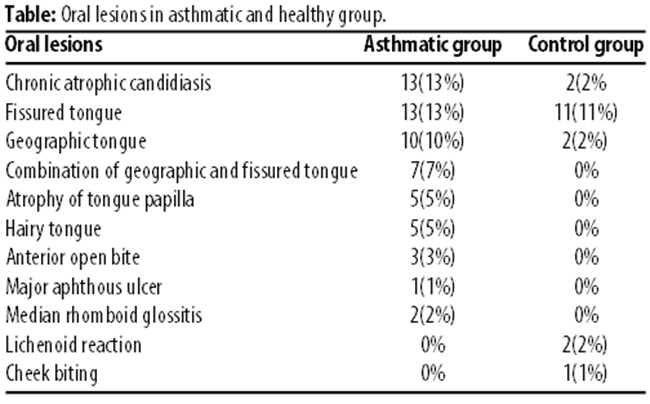
Discussion
Asthma and its medication have been suggested to potentially increase the risk of caries, but the results of studies have been controversial.6,10 In the present study there was not significant higher DMFT in asthmatic patients. These diversities may be explained by differences in study design and population, caries detection criteria and wide age range of samples. Candidiasis and fissured tongue were the most common oral disorders in our study. The dental professional must be familiar with all sign and symptoms of this disease in order to offer effective and safe treatment.
Conclusion
Dentists must be able to recognise oral and/or dental manifestations. They should also pay extra attention to the oral status of asthmatic patients since they are more susceptible to candidiasis development.
Reference
1. Krishnan JA, Lemanske RF Jr, Canino GJ, Elward KS, Kattan M, Matsui EC, et al. Asthma outcomes: symptoms. J Allergy ClinImmunol 2012; 129: 124-35.
2. Johnston NW, Sears MR. Asthma exacerbations · 1: epidemiology. Thorax 2006; 61: 722-8.
3. Torres-Urquidy MH, Wallstrom G, Schleyer TK. Detection of disease outbreaks by the use of oral manifestations. J Dent Res 2009; 88: 89-94.
4. Thomas MS, Parolia A, Kundabala M, Vikram M. Asthma and oral health: a review. Aust Dent J 2010; 55: 128-33.
5. Shashikiran ND, Reddy VV, Raju PK. Effect of antiasthmatic medication on dental disease: dental caries and periodontal disease. J Indian Soc Pedod Prev Dent 2007; 25: 65-8.
6. Reddy DK, Hegde AM, Munshi AK. Dental caries status of children with bronchial asthma. J ClinPediatr Dent 2003; 27: 293-5.
7. Dugmore CR, Rock WP. Asthma and tooth erosion. Is there anassociation? Int J Paediatr Dent 2003; 13: 417-24.
8. Alavaikko S, Jaakkola MS, Tjäderhane L, Jaakkola JJ. Asthma and caries: a systematic review and meta-analysis. Am J Epidemiol 2011; 174: 631-41.
9. Eloot AK, Vanobbergen JN, De Baets F, Martens LC. Oral health and habits in children with asthma related to severity and duration of condition. Eur J Paediatr Dent 2004; 5: 210-5.
10. Reddy DK, Hegde AM, Munshi AK. Dental caries status of children with branchialasthma. J Clin Pediatr Dent 2003; 27: 293-5.
Journal of the Pakistan Medical Association has agreed to receive and publish manuscripts in accordance with the principles of the following committees:


