

Meharun-Nissa Khaskheli ( Department of Obstetrics & Gynaecology, Liquat Univeristy of Medical & Health Sciences, Jamshoro, Sindh. )
Shahla Baloch ( Department of Obstetrics & Gynaecology, Liquat Univeristy of Medical & Health Sciences, Jamshoro, Sindh. )
Sarmad Baloch ( Medical Department, Liquat Univeristy of Medical & Health Sciences, Jamshoro, Sindh. )
Aneela Sheeba ( Department of Radiology, Liquat Univeristy of Medical & Health Sciences, Jamshoro, Sindh. )
June 2015, Volume 65, Issue 6
Original Article

Abstract
Objective: To observe the clinical spectrum, complications and pregnancy outcome in women with Hepatitis E.
Methods: The descriptive prospective study was conducted at the Liaquat University of Medical and Health Sciences, Jamshoro, Red Crescent General Hospital and Saint Elizabeth Hospital, Hyderabad, from January 1, 2011, to December 31, 2013. All pregnant women with Hepatitis E positive on virology screening were included. The subjects were enrolled from the out-patient department as well as from among those admitted in either Obstetrics or Medical wards. Data was obtained through a predesigned proforma, and analysed using SPSS 20.
Result: The overall mean age of the 45 women in the study was 27.78±6.742. There were 21(46.7%) women in 21-30 years age group, 22(48.9) were multiparous, 31(68.9%) were uneducated, and 29(64.4%) were from poor social class. Besides, late second trimester and third trimester of pregnancy was found in 27(60%), unstable condition 10(22.22%), disturbed liver function test 24(53.3%) and raised serum glutamic pyruvic transaminase level >101u/l 27(60%), deranged coagulation profile such as raised prothrombin time 25(55.5%), and activated partial thromboplastin time 18(40%)cases. Overall 36(80%) women were discharged, while 9 (20%) died. Besides, 10(24.4%) babies needed intensive care, 13(42.2%) foetuses died during intrauterine life, 5(11%) were stillborn, while 17(37.8%) were alive and were discharged home.
Conclusion: Pregnant women with Hepatitis E were more vulnerable as their life, health and foetal outcome suffered a lot.
Keywords: Hepatitis E, Pregnancy, Morbidities, Mortalities. (JPMA 65: 655; 2015)
Introduction
Hepatitis E viral infections are frequent in pregnant women.1 Pregnant women having acute Hepatitis E infection and jaundice are at a great risk of high mortality rate and adverse obstetrics and foetal outcomes in comparison with other types of viral hepatitis.2 It has been recently estimated that more than 3 million symptomatic cases of acute Hepatitis E infection occur each year, resulting in approximately 70,000 deaths worldwide.3 Hepatitis E virus (HEV) is a single-stranded ribonucleic acid (RNA) virus T causing large-scale epidemics of acute viral hepatitis in developing countries. The disease is self-limiting and its fatality rate is less than 0.01% both in men and in non-pregnant women, while in pregnant women, HEV infection is associated with high risk of fulminant hepatic failure leading to death. This high mortality rate in pregnant women is associated with hormonal and consequent immunological changes. The immunological changes include down-regulation of the p65 component of nuclear factor (NF-kB) with a predominant T-helper type 2 (Th2) bias in the T-cell response along with host susceptibility factors mediated by human leukocyte antigen expression.4 HEV infection is a common cause of water-borne epidemics. It is frequently responsible for acute viral hepatitis in developing countries. On the contrary, in the industrialised world, anti-HEV antibodies are detected in the general population with no significant morbidity.5 Transmission is usually by faeco-oral route, though person-to-person transmission has also been reported. In non-endemic countries, an increasing number of non-travel-associated HEV cases have been reported in recent years, particularly in Europe.6,7 The incubation period following exposure to HEV ranges from three to eight weeks, with a mean of 40 days.8 Outbreaks of epidemic of HEV infection most commonly occur after heavy rainfall and in monsoon because in these conditions there is usually disruption of water supplies. On literature search, the geographical variation of the disease with associated high maternal mortality is reported during the third trimester of pregnancy in India, while other studies from Egypt, Europe and the USA have shown no difference in the course and severity of HEV infection in pregnant and non-pregnant women.2 Pregnancy appears to be a potential risk factor for viral replication and an extreme low immune status of Indian/Asian pregnant women9 resulting in frequent and severe infection. According to a study,10 two-third pregnant women with fulminant hepatic failure had HEV infection. Fulminant hepatic failure in pregnant women caused by HEV is an explosive disease with short pre-encephalopathy period, rapid development of cerebral oedema and high occurrence of disseminated intravascular coagulation, and may represent a severe manifestation of a Schwartzman-like phenomenon.11 Hepatitis E infection in pregnancy is associated with high rates of preterm labour as well as high perinatal mortality rate.12 HEV is not a new virus, its global presence and associated mortalities were detected three decades ago. Population-based surveillance data suggests that 10% deaths observed in pregnancy and in women of reproductive age in no-epidemic conditions could be attributable to HEV. With the availability of 2-tested efficacious vaccines, we must consider judicious and timely implementation of such interventions, where appropriate, to avoid a substantial portion of preventable deaths in these resource-limited settings. In our part of world, where liver disorders are very common, clean water supply is scarce and sanitation is poor, there is strong need of such type of workup.13
The current study was planned to observe the clinical spectrum, complications and pregnancy outcome in women with HEV.
Subjects and Methods
The descriptive prospective study was conducted at the Liaquat University of Medical and Health Sciences, Jamshoro, Red Crescent General Hospital and Saint Elizabeth Hospital, Hyderabad, from January 1, 2011, to December 31, 2013. The sample size was estimated by empirical method with incidence 3%,14 confidence interval (CI) 95%, and by applying the formula: N= (Z)2(pq)/e2=45. Using non-probability convenience sampling, pregnant women with HEV positive on screening, which was done by enzyme-linked immunosorbent assay (ELISA) technique, were included. Pregnant women with Hepatitis C and Hepatitis B and non-pregnant women with Hepatitis E were excluded. Screening of all these women were also done by ELISA technique.
The subjects were registered on a predesigned proforma after taking informed written consent and approval from the institutional ethics review committee. The study population was followed up during pregnancy, hospitalisation, intensive care admission, labour wards and paediatric intensive care units (ICUs). The study variables included demographic characteristics, symptomatology, clinical findings, labour characteristics, Investigations and complications. Data was collected and analysed on SPSS 20. P-value <0.05 was considered significant.
Result
The overall mean age of the 45 women in the study was 27.78±6.742. There were 7(15.5%) women <20 years of age, 21(46.7%) were in 21-30 years age group, and 17(37.8%) >31 years. The age-based difference was significant (p<0.05).
Besides, 22(48.9) were multiparous with a mean of 2.33±1.883; 31(68.9%) were uneducated, and 29(64.4%) were from poor social class. Overall, 27(60%) women presented with gestation period above 31 weeks. In terms of complaints, weakness was reported by 45(100%), epigastric pain 43(95.5%), loss of appetite 40(88.9%), pruiritis 42(93.3%), fever 19(42.22%), and vomiting 13(28.88%) (Table-1).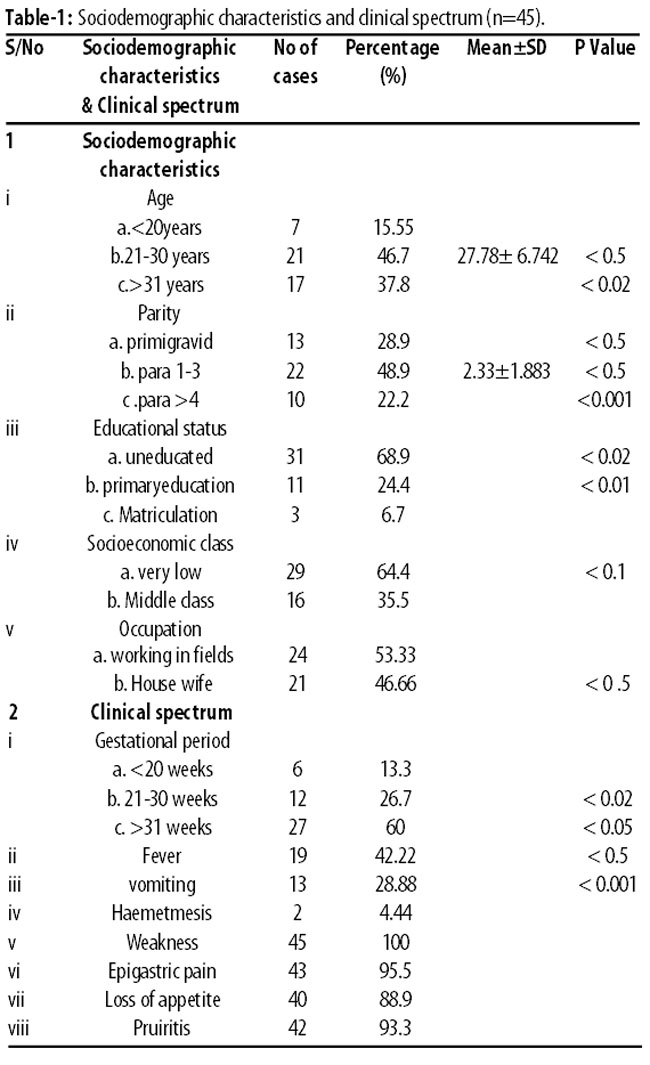
Of the total, 11(24.44%) women were semiconscious, 10(22.22%) were unconscious. Jaundice was seen in 39(86.66%) women, foetal growth was normal in 32(71.1%), preterm labour 34(75.5%) women (p<0.003). There were 29(64.4%) induced labours (p<0.5), vaginal birth was 35(77.8%) (p<0.001). Haemoglobin level was low and varied between 5-7 gram% in 19(42.2%) women (p<0.5) and 8-9 gram% in 17(37.7%) (p<0.5). Platelet count was Low (50,000-150,000cu/mm2) in 24(53.3%) women (p<0.5). On virology screening for Hepatitis E, immunoglobulin (Ig)M was positive in 39(86.6%) cases. Hepatitis-E Antigen PCR (Polymerase Chain Reaction) was done only in 9(20%) cases and it was positive. Serum bilirubin level was raised >6mgm% in 24(53.33%) women (p<0.5), serum glutamic pyruvic transaminase (SGPT) level was normal and varied between 10-49U/L) in 3(6.66%) women, while its value was raised >101 U/L in 27(60%) (p<0.5). Prothrombin time was raised in 25(55.5%) women (p<0.5), and activated partial thromboplastin time was raised in 18(40%) (p<0.05) (Table-2).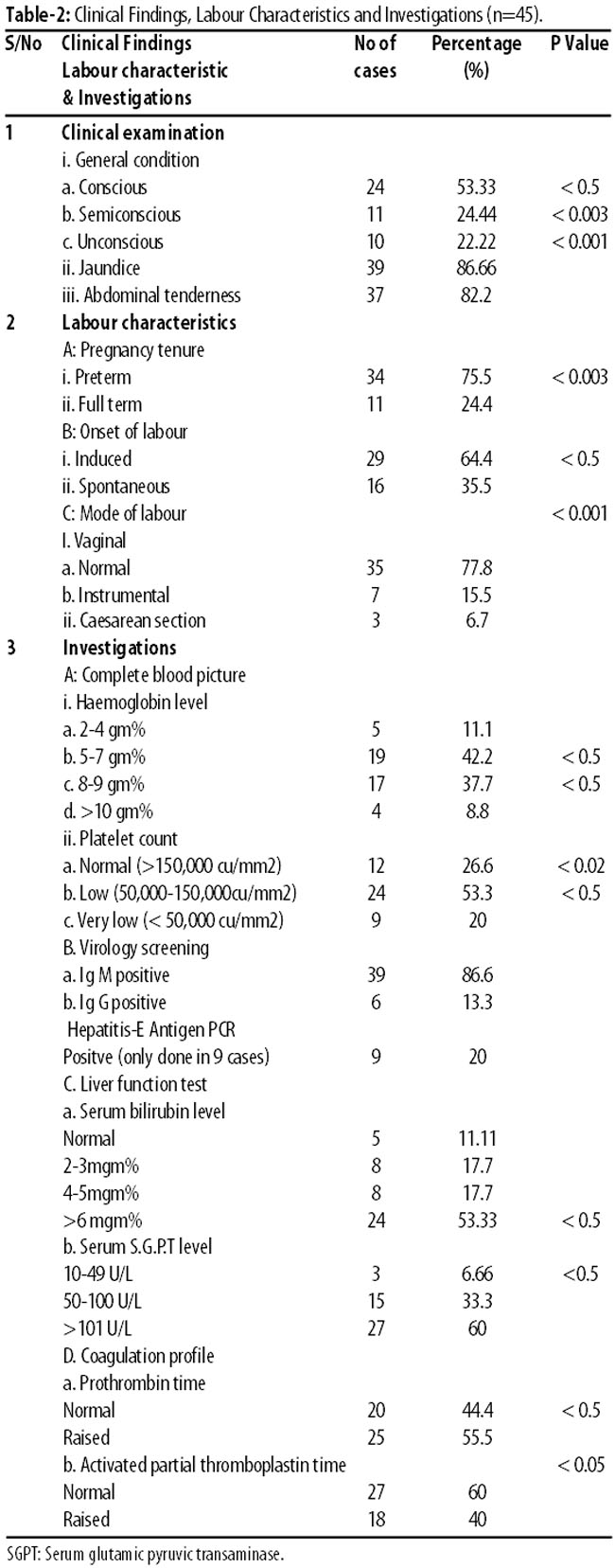
The maternal complications were postpartum haemorrhage in 23(51.1%) women, disseminated intravascular coagulation in 14(31.1%) (p<0.05), hepatic coma in 8(17.8%), while 9(20%) women died. Foetal complications were intrauterine deaths 13(28.8 %) (p<0.003) and stillbirths 5(11.1%) (Table-3).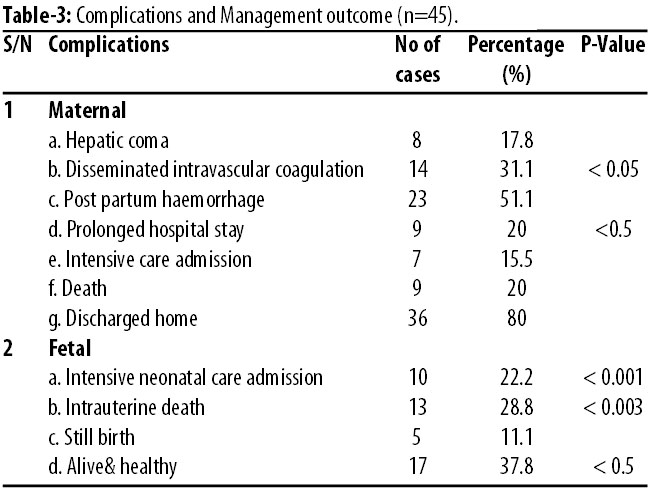
Discussion
Hepatitis E is a form of acute infection, and is particularly severe in pregnant women.15 In this study, the prevalence of the disease was high among women between 21-30 years of age group, as the chances of exposure increase with age.1 The episode of the disease was more frequent in uneducated, very low socio-economic background and those working in the fields. Hepatitis E is common in low economic countries with poor sanitation and hygiene, and the disease has high attack rate in young adults and is particularly severe in pregnant women.3 Hepatitis E was frequently reported during third trimester of pregnancy which may be due to improper antenatal care and screening with late seeking of medical advice as the subjects had come when symptoms had appeared or their condition had deteriorated. The significant high level of anti-HEV antibodies are seen in third trimester of pregnancy.1 The common presenting symptoms were fever, vomiting, haemetmesis, weakness, epigastric pain, loss of appetite, pruiritis, jaundice, abdominal tenderness. In an earlier study16 initial symptoms of acute Hepatitis E were typically unspecific and included flu-like myalgia, arthalgia, weakness and vomiting. However, more severe forms of acute liver disease can occur in pregnant women or patient with underlying chronic liver diseases, sometimes progressing to fulminant hepatic failure. This can be the reason in our part of the world where chronic liver disease is more common. According to another study17 common presenting symptoms of the disease were anorexia, dark urine, nausea and vomiting, abdominal pain and eventually icterus. The severity of the problem is identified by the risk of symptomatic infection leading to death.18 In this study, preterm birth rate was high as frequent terminations are required on medical grounds or women go into spontaneous labour. This is consistent with another study.19 On virology screening, hepatitis E IgM positivity was frequently detected compared to other studies20,21 HEV IgG positivity is associated with age as probability of being exposed to HEV increases with age, while another study22 showed that HEV was endemic in China, India, Nepal as well as in several Asian and African countries where the prevalence of the HEV IgG antibody can be as high as 50%. Liver function test (LFT) such as serum bilirubin level and SGPT levels and coagulation profile like prothrombin time and activated partial thromboplastin time was raised in majority of cases so the maternal complication like disseminated intravascular coagulation (31.1%), postpartum haemorrhage (51.1%) and hepatic coma (17.8%) frequency was high. This is consistent with other studies.23,24 Maternal and foetal morbidity and mortality rate (20%) was high, which can be due to rapid and fulminant course of the disease and late referral, lack of awareness, poverty, and non-availability of expensive laboratory tests at basic health units (BHUs), and the same has been reported in literature.2,19
Conclusion
The disease was common in young, uneducated women of very low socio-economic background. Frequent episode was seen in the third trimester of pregnancy with high risk to maternal and foetal health. Early diagnosis and pregnancy termination may play a great role in saving maternal life.
References
1. Adjei AA, Tettey Y, Aviyase JT, Adu-Gyamfi C, Obed S, Mingle JA,et al.Hepatitis E virus infection is highly prevalent among pregnant women in Accra, Ghana. Virol J 2009;6:108.
2. Teshale EH,Hu DJ,Holmberg SD.The two faces of hepatitis E virus.Clin Infect Dis 2010;51:328-34.
3. Rein DB, Stevens GA,Theaker J, Wittenborn JS, Wiersma ST.The global burden of hepatitis E virus. Hepatology 2012; 55:988-97.
4. Navaneethan U, Al Mohajer M, Shata MT.Hepatitis E and Pregnancy: Understanding the Pathogenesis. Liver Int 2008; 28:1190-9.
5. Purcell RH, Emerson SU. Hepatitis E: an emerging awareness of an old disease\'s Hepatol 2008, 48:494-503.
6. Dalton HR, Bendall R, JJazs, Banks M.Hepatitis E: an emerging infection in developed countries. Lancet infect Dis.2008; 8:698-709.
7. Lewis HC,Wiehmann O,Duizer E.Transmission routes and risk factors for autochthonous hepatitis E virus infection in Europe: a systematic review Epidemiol infect.2010;138:145-66.
8. Miyahara K, Miyake Y, Yasunaka T, Ikeda F, Takaki A, Iwasaki Y,et al.Acute Hepatitis due to Hepatitis E virus Genotype 1 As an imported infectious disease inJapan. Intern Med 2010;49 : 2613-6.
9. Jilani N, Das BC, Husain SA, Baweja UK, Chattopadhya D, Gupta RK, etc.Hepatitis E virus infection and fulminant hepatic failure during pregnancy. J GastroenterolHepatol 2007;22: 676-82.
10. Hamid SS, Jafri SM, Khan H, Shah H, Abbas Z, FieldsH. Fulminant hepatic failure in pregnant women: Acute fatty liver or acute viral hepatitis? JHepatol1996; 25: 20-7.
11. Khuroo MS, Kamili S. Aetiology, clinical course and outcome of sporadic acute viral Hepatitis in preg.J viral Hepat2003; 10:61-9.
12. Kumar A,Beniwal M,KarP,Sharma JB,Murphy NS. Hepatitis E in pregnancy.IntJ GynaecolObstet 2004; 85:240-4.
13. Labrique AB1, Sikder SS, Krain LJ, West KP Jr, Christian P, Rashid M,etal. Hepatitis E, a Vaccine-Preventable Cause of Maternal Deaths.Emerg Infect Dis. 2012; 18: 1401-4.
14. Lindemann ML,Gabilondo G,Romero B,Maza OM,Gracia MT.Low prevalence of hepatitis infection among pregnant women inMadrid,Spain.J Med Virol 2010;82:1666-8.
15. Aggarwal R.Clinical presentation of Hepatitis E. JViral Res 2011; 161:15-22.
16. Bhatia V, Singhal A, Panda SK.A 20 year single center experience with acute liver failure during pregnancy: is the prognosis really worse? Hepatology2008; 48:1577-85.
17. Khuroo MS.Discovery of hepatitis E: the epidemic non-A. Non- B hepatitis 30 years down the memory lane. Virus Res 2011; 161:3-14.
18. Chauhan NT,Prajapati P,Trivedi AV,Bhagyalaxmi A. Epidemic investigation of the jaundice out break in Girdharnagar, Ahmedabad,Gujarat,India,2008.Indian J Commun Med 2010;35:294-7.
19. Sultana R, Humayun S.Fetomaternal outcome in acute hepatitis E.J CollPhysianSurg Pak 2014; 24:127-30.
20. Al-Tayeb ZA, Nafi M, Yassin ME.Frequency of Hepatitis E virus among pregnant women Attending Khartoum Hospital. AmJRes Commun 2014;2; 241-7.
21. Renou C, Gobert V, Locher C, Moumen A, Timbely O, SavaryJ,et al.Prospective study of Hepatitis E virus infection among pregnant women in france.VirolJ2014, 11:68.
22. Mansuy JM,Bendall R,Legrand-Abravanel F,Saune K,Miedouge M,Ellis V,et al. Hepatitis E virus antibodies in blood donors, France.EmergInfect Dis 2011; 17:2309-312.
23. Velosa M,Figueiredo A,Gloria H, Morbey A,Mateus E, Neves Z,et al.Fulminant hepatitis E in a pregnant women.GE J Port Gastrenterol2013;20:210-4.
24. Yasmin T, Hashmi HA, Taj A.Fetomaternal Outcome with Hepatitis E in Pregnancy.JCollPhyiciansSurgPak 2013;23:711-4.
Related Articles
Journal of the Pakistan Medical Association has agreed to receive and publish manuscripts in accordance with the principles of the following committees:


