

Anita Dileep ( Department of Obstetrics and Gynaecology, The Aga Khan Hospital for Women, Karimabad, Pakistan. )
Neelofur Babar Khan ( Department of Obstetrics and Gynaecology, The Aga Khan Hospital for Women, Karimabad, Pakistan. )
Sana Sadiq Sheikh ( Department of Obstetrics and Gynaecology, Aga Khan University Hospital, Karachi, Pakistan. )
June 2015, Volume 65, Issue 6
Original Article

Abstract
Objective: To assess the effect of dexamethasone on neonatal respiratory morbidity in babies delivered by early term elective lower segment Caesarean section.
Method: The retrospective cohort study was conducted at a secondary level hospital in Karachi. It reviewed the medical record of pregnant women and their babies who were delivered by elective lower segment Caesarean section between January 1 and June 30, 2013, at 37-38+6 weeks of pregnancy. The women were divided into exposed group (Group A) who received prophylactic dexamethasone, and non-exposed group (Group B) who did not receive dexamethasone Neonatal respiratory morbidity was compared between the two groups. Data was analysed using SPSS 19.
Results: The 196 subjects in the study were equally divided in two groups. In Group A, only 1(1%) baby developed transient tachypnoea compared to 10(10%) babies in Group B (p=0.005). Besides, 11(11%) babies were admitted to nursery in Group B compared to 1(1%) in Group A (p=0.005). No baby was referred to any tertiary care hospital for intensive care.
Conclusion: Beneficial effects of prophylactic dexamethasone in neonatal respiratory morbidity were found, but further prospective studies with large sample size are required.
Keywords: Early-term Elective Caesarean Section, Antenatal corticosteroids, Transient Tachypnea of Newborn, Respiratory Distress Syndrome. (JPMA 65: 607; 2015).
Introduction
There is a rising trend towards elective Caesarean section (CS) worldwide in the past decades. The major contribution is pervious scar due to drastic decline in trial of scar (34% points per year from 2000 to 2009).1,2 Other reasons for this increased trend are elective Caesarean for breech presentation and maternal request.
Dramatic decline in trial of scar is probably due to the fear that trial of labour would be associated with higher risk of maternal and perinatal mortality.2-4
After the "Term breech trial" conducted in 2000 there was change in the practice of delivering breech by elective CS rather than by vaginal delivery with significant decline in skills for Assisted Breech Vaginal Delivery (ABVD).5 A national audit conducted in UK in 2001 to determine accurately the current rate of CS showed that 11% of elective lower segment CS (EL-LSCS) was for breech presentation.6
In daily clinical practice it has been observed that now more women are requesting for elective CS. One survey reported that 69% consultant obstetricians in England and Wales agree to women\'s request for CS in the absence of obstetric indication.7 Recent guidelines from the National Institute for Health and Care Excellence (NICE) have recommended that women\'s request alone is not an indication for CS.8
Neonatal Respiratory Morbidity (NRM) is one of the known complications of elective CS conducted between 37-38+6 weeks of pregnancy. It ranges from transient tachypnoea (TTN) of newborn to respiratory failure. In 1964, the association of NRM with term elective CS was highlighted for the first time. Since then large number of studies were conducted to establish their correlation. A recently cohort study further strengthened this association.9
Elective term delivery by CS is responsible for 50% of potentially avoidable causes of neonatal respiratory distress (NRD).10 TTN is the most common cause of NRM followed by RDS.11 Iatrogenic RDS (after elective CS) persists as a cause of neonatal morbidity and mortality.12-14
Apart from the mode of delivery, gestational age at the time of delivery also affects risk of NRM. Number of studies15,16 have shown that the risk of NRM is inversely proportional to the gestational age at the time of elective CS. It is 73.8/1000 at 37+6 weeks, 42.3/1000 at 38+6 weeks and 17.6/1000 at 39+6 weeks.17 This trend is particularly pronounced for RDS where the risk decreases from about 39/1000 for period between 37+0 to 37+6 to 8/1000 for period between 39+0 to 39+6 weeks, while TTN decreases from 7/1000at 37 to 4/1000 >39 weeks.18
The development of NRD leads to chain of events, including admission to neonatal intensive care unit (NICU), affecting mother-child bonding, cost of care and complications from invasive procedures, including artificial ventilation.19 It is also associated with the development of asthma in childhood.20
In order to decrease this complication, guidelines issued by the American Council of Obstetricians and Gynaecologists (ACOG),21 the Royal College of Obstetricians and Gynaecologists (RCOG) and NICE recommend that EL-LSCS should be planned at 39+0 weeks. If EL-LSCS is deemed necessary prior to 39 weeks, prophylactic dexamethasone at least 48 hours prior to the date of CS will decrease the risk of NRM.22
Corticosteroids play an important role in final maturation of lungs by increasing number and function of sodium (Na)+ channels and increasing production of surfactant.
The ASTEC trial has proven that incidence of respiratory distress at 37-39 weeks of gestation are reduced to half with the use of antenatal steroids, TTN decreases from 4% to 2.1% and RDS from 1% to 0.2%. This trial also showed that there is 6-fold decrease in the rate of NICU admission with NRD after giving antenatal corticosteroids.23
The decreased incidence of TTN in steroid group is based on normal physiology during labour. During labour there is a rise in corticosteroids\' level which encourages the expression of the epithelial channel gene and allows the lung to switch from fluid secretion to fluid absorption. ELSCS bypasses this mechanism, thereby predisposing to the increased risk of NRM.24
There are a number of studies22,25 that have proven that single course of antenatal corticosteroids is not associated with maternal/foetal infection and has no adverse effects on neurological or cognitive system of the neonate.
The current study was planned to compare incidence and pattern of NRM in neonates delivered by planned CS between 37-38+6 weeks after prophylactic dexamethasone to mothers with those who delivered without prophylactic dexamethasone.
Subjects and Methods
The retrospective cohort study was conducted at Aga Khan Hospital for Women (AKHW), Karimabad, a secondary unit of Aga Khan University Hospital, Karachi, after approval from the institutional ethics review committee from January 1 to June 30, 2013.
It included all women delivered by EL-LSCS between 37 to 38+6 weeks of pregnancy. Mothers with diabetes mellitus (DM) (gestational or overt diabetes), infections including tuberculosis, congenital anomalous foetus and intrauterine growth restriction (IUGR) foetuses were excluded. The record of all women were divided into two groups: Group A comprised data of women who had received two doses of prophylactic dexamethasone prior to delivery, and Group B comprised those who had not received it. Maternal and neonatal medical records were reviewed and all required information was documented in a structured proforma whose primary outcome measure was to see the number of babies with NRM in each group and secondary outcome measure was to compare difference in nursery admission and total hospital stay in both groups. TTN/RDS were diagnosed by neonatologist on the basis of clinical features and radiological findings. Data was analysed using SPSS 19. Baseline characteristics were compared using means and standard deviations (SD) and proportions of both groups by student\'s t test and Chi-square respectively. Factors associated with TTN were explored through student\'s t-test, Fisher exact and chi-square tests whichever was appropriate.
Results
There were 360 El-LSCS cases, but 196(54.44%) women met the inclusion criterion. They were divided into two equal groups of 98(50%) each. The mean age of Group A was 28.6±4.1 years and 29.8±4.4 for Group B. Mean gestational age was 37.5±0.54 and 37.6±0.62 weeks in the two groups respectively; and 84(86%) and 90(92%) women in Group A and Group B respectively were multigravida. Women with history of abortion in Group A was 27(27.6%) and 32(32.7%) in Group B (Table-1).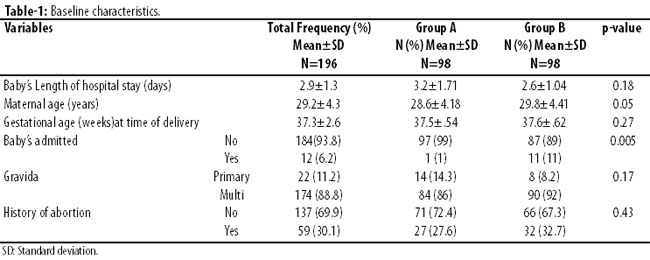
All 196 pregnancies resulted in live births and the average length of hospital stay of newborns in group A was 3.2±1.7 days compared to 2.9±1.3 days in Group B (p=0.18). There was only 1(0.5%) case reported of RDS. The RDS baby was born to a 30-year-old multigravida, delivered at 38 weeks of gestation and did not receive dexamethasone. As there was only one RDS case, its associated factors could not be explored.
Overall, 11(6%) babies experienced TTN; only 1(1%) in Group A versus 10(10%) in Group B(p=0.005). Besides, 11(11%) babies were admitted to nursery in Group B compared to 1(1%) in Group A (p=0.044). There was a significant difference between gestational age at CS (p=0.044) of two groups was compared (Table-2).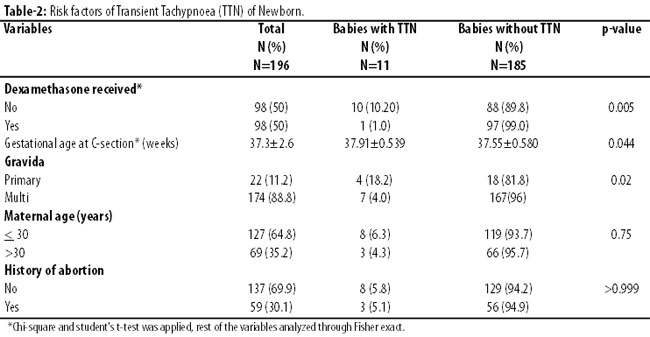
Maternal age was categorised into equal or less than 30 years and more than 30 years to capture effects of extreme ages on incidence of TTN, but it was insignificant (p=0.57). History of abortion was also not contributing to respiratory morbidity (p=1.00).
We were not able to rule out effect of confounders as there was very limited number of TTN cases and sparse data did not allow us to run regression analysis.
Discussion
The increase in elective CS rates in the past decades has highlighted the need to reduce respiratory complications associated with this high rate of CS. In developing countries resources are scarce and it is difficult to provide expensive treatment as neonatal care.
Overall incidence of NRD is estimated at 2.8% and the main risk factors are gestational age at the time of delivery and mode of delivery.2
There is 4-fold increase in respiratory distress and 5-fold increased risk of serious respiratory morbidity in EL-LSCS compared to vaginal delivery.9 Although at term, risk of NRM is low (2-fold) but not negligible, therefore it is important to take best possible action to decrease this complication.
In the absence of stress of labour there is lack of catecholamines and corticosteroids release which is mandatory for final maturation of foetal lungs. Basically there are two mechanisms required to ensure neonatal lung maturity at term: elimination of excessive fluid from alveoli; and increase in pulmonary blood perfusion.
Recent evidence indicates that apart from traditional mechanical concept of vaginal squeeze, molecular mechanism predominantly lung, Na+ channels promote alveolar fluid drainage and these channels may be underactive in foetuses not exposed to the process of labour.26 The expression of these channels is regulated by several factors such as endogenous catecholamines, oxygen, thyroid hormones and, finally, by glucocorticoids. Among these, the most important factor for induction of Na reabsorption in the foetal lungs and surfactant production in advanced gestational age are catecholamines and glucocorticoids.
Glucocorticoids increase the number and function of these Na+ channels as well as responsiveness to catecholamines and thyroid hormones, providing rationale for their exogenous administration in cases of EL-LSCS.
Our results showed significant relationship of dexamethasone with NRM. Total number of babies with TTN were 11(6%); out of these 10(91%) were in Group B (p=0.005). These results are consistent with results of ASTEC trial which also showed significant decrease in incidence of NRM in treated group (19 cases of TTN and 5 cases of RDS in control group versus 10 cases of TTN and 1 case of RDS in the treated group).
Our results are further supported by a study9 which also showed significant association between dexamethasone and improved neonatal outcome in terms of respiratory distress.
In our study, the number of babies admitted in nursery with respiratory distress was high in Group B versus Group A (=0.005). Earlier studies9,23,279,23,27 also supports these results.
During this study, no baby was referred to tertiary care facility for NICU support. The difference in total length of nursery stay in both groups was statistically insignificant (p=0.18).
There are large numbers of international studies related to this topic, but to the best of our knowledge no study has addressed this topic in Pakistan. Though a retrospective study with a small sample size, this is the first study on the role of dexamethasone in decreasing neonatal respiratory morbidity at term in Pakistan.
Conclusion
Ideally, EL-LSCS should not be performed before 39 completed weeks of pregnancy, but when early term EL-LSCS is required, prophylactic dexamethasone plays an important role in decreasing NRM and NICU admission, thereby decreasing the cost of care, separation of baby from mother, and risk of complications in childhood. As prophylaxis is inexpensive, safe, easy to administer and effective, it must be included in hospital protocols.
Acknowledgment
We are grateful to the staff of the Medical Record Office of Aga Khan Hospital for Women (AKHW), Karimabad.
References
1. Villar J, Valladares E, Wojdyla D, Zavaleta N, Carroli G, Velazco A, et al. Caesarean delivery rates and pregnancy outcomes: the 2005 WHO global survey on maternal and perinatal health in Latin America. Lancet 2006;367:1819-29.
2. Paganelli S, Soncini E, Gargano G, Capodanno F, Vezzani C, La Sala GB. Retrospective analysis on the efficacy of corticosteroid prophylaxis prior to elective caesarean section to reduce neonatal respiratory complications at term of pregnancy: review of literature. Arch Gynecol Obstet. 2013;288:1223-9.
3. Uddin SF, Simon AE. Rates and success rates of trial of labor after cesarean delivery in the United States, 1990-2009. Matern Child Health J 2012;17:1309-14.
4. Smith GC, Pell JP, Cameron AD, Dobbie R. Risk of perinatal death associated with labor after previous cesarean delivery in uncomplicated term pregnancies. JAMA 2002;287:2684-90.
5. Hannah ME, Hannah WJ, Hewson SA, Hodnett ED, Saigal S, Willan AR. Planned caesarean section versus planned vaginal birth for breech presentation at term: a randomised multicentre trial. Lancet 2000;356:1375-83.
6. Thomas J PS. The National Sentinel Caesarean Section Audit Report. . Royal College of Obstetricians and Gynaecologists Clinical Effectiveness Support Unit. London: RCOG Press;; 2001 [online] 2001 [ cited May 2014]; Available from: URL:http://www.ans.gov.br/portal/site/_hotsite_parto_2/publicacoes/RCOG_2001_AC.pdf.
7. Cotzias CS, Paterson-Brown S, Fisk NM. Obstetricians say yes to maternal request for elective caesarean section: a survey of current opinion. Eur J Obstet Gynecol Reprod Biol 2001;97:15-6.
8. Bick D. Caesarean Section. Clinical Guideline. National Collaborating Centre for Women\'s and Children\'s Health:. London RCOG.; 2004 [online] 2004 [cited May 2014]; Available from: URL: http://www.nice.org.uk.
9. Hansen AK, Wisborg K, Uldbjerg N, Henriksen TB. Risk of respiratory morbidity in term infants delivered by elective caesarean section: cohort study. BMJ 2008;336:85.
10. Bakr AF, Abbas MM. Severe respiratory distress in term infants born electively at high altitude. BMC Pregnancy Childbirth. 2006;6:4.
11. Hermansen CL, Lorah KN. Respiratory distress in the newborn. Am Fam Physician 2007;76:987-94.
12. Ainsworth SB. Pathophysiology of neonatal respiratory distress syndrome: implications for early treatment strategies. Treat Respir Med. 2005;4:423-37.
13. Gerten KA, Coonrod DV, Bay RC, Chambliss LR. Cesarean delivery and respiratory distress syndrome: does labor make a difference? Am J Obstet Gynecol. 2005;193:1061-4.
14. Louis NA CJ, Eichenward EC, Stark AR. TTN . In: Manual of neonatal care. 5th ed. Philadelphia :Lippincott Williams and Wilkins; 2004.
15. Tita ATN, Landon MB, Spong CY, Lai Y, Leveno KJ, Varner MW, et al. Timing of elective repeat cesarean delivery at term and neonatal outcomes. N Engl J Med 2009;360:111-20.
16. Yee W, Amin H, Wood S. Elective cesarean delivery, neonatal intensive care unit admission, and neonatal respiratory distress. Obstet Gynecol 2008;111:823-8.
17. David M Luesley PNB. Antepartum Haemorhage. Evidence- based text for MRCOG. 2nd ed: Edward: Arnold; 2010, pp 315-28.
18. Zanardo V, Simbi AK, Franzoi M, Solda G, Salvadori A, Trevisanuto D. Neonatal respiratory morbidity risk and mode of delivery at term: influence of timing of elective caesarean delivery. Acta Pediatr. 2004;93:643-7.
19. Madar J, Richmond S, Hey E. Surfactant deficient respiratory distress after elective delivery at \'term\'. Acta Paediatr 1999;88:1244-8.
20. Smith GCS, Wood AM, White IR, Pell JP, Cameron AD, Dobbie R. Neonatal respiratory morbidity at term and the risk of childhood asthma. Arch Dis Childhood. 2004;89:956-60.
21. Clinical Practice Guidelines for Perinatal Care. American College of Obstetrics and Gynaecology [online] [cited 2014 May 5]; Available from URL: https://www.wellcare.com/wcassets/corporate/ assets/ny_medicaid_pem_cpg-perinatalcare.pdf.
22. Royal College of Obstetricians and Gynaecologists Scientific Advisory Committee. RCOG guidelines No 7: antenatal corticosteroids to prevent respiratory distress syndrome. 2nd ed. London: RCOG Press; 2004.
23. Stutchfield P, Whitaker R, Russell I. Antenatal betamethasone and incidence of neonatal respiratory distress after elective caesarean section: pragmatic randomised trial. BMJ 2005;331:662.
24. O\'Brodovich HM. Immature epithelial Na+ channel expression is one of the pathogenetic mechanisms leading to human neonatal respiratory distress syndrome.Proc Assoc Am Physicians. 1996;108:345-55.
25. Crowley P. Prophylactic corticosteroids for preterm birth. Cochrane Database Syst Rev. 2000;(2):CD000065.
26. Jain L, Dudell GG. Respiratory transition in infants delivered by cesarean section. Semin Perinatol. 2006;30:296-304
27. Sotiriadis A, Makrydimas G, Papatheodorou S, Ioannidis JP. Corticosteroids for preventing neonatal respiratory morbidity after elective caesarean section at term. Cochrane Database Syst Rev. 2009;4.
Related Articles
Journal of the Pakistan Medical Association has agreed to receive and publish manuscripts in accordance with the principles of the following committees:


