

Sahar Khalid Zuberi ( Medical Students, Ziauddin University, Karachi. )
Syeda Hafsah Salman ( Medical Students, Ziauddin University, Karachi. )
Rashna Naozer Virji ( Medical Students, Ziauddin University, Karachi. )
Syed Sana ( Medical Students, Ziauddin University, Karachi. )
Sulachhni Kumari ( Medical Students, Ziauddin University, Karachi. )
Nosheen Zehra ( Department of Community Health Sciences, Ziauddin University, Karachi. )
May 2015, Volume 65, Issue 5
Student's Corner

Abstract
Objective: To assess the knowledge, attitudes and practices of family planning among women belonging to different socio-economic status
Methods: A cross sectional study was conducted in the outpatient department of three hospitals of Ziauddin University based on the socioeconomic divide. Total 351 married females of reproductive age group with at least one child were selected after informed consent through non probability convenience sampling. Data was analyzed by using SPSS version 21.
Result: The preferred method of contraception in all three groups was a male condom30.9%. The upper socioeconomic group relied more on the modern methods of contraception 92% while the middle socioeconomic group relied on modern 71.7% as well as natural methods of contraception 28.3%. Use of contraceptives was comparatively lower in the low socioeconomic group 19.5%. Lower socioeconomic group also had the most children per family with mean and standard deviation of 3.6±2.3 and also had the highest number of desired children with mean and standard deviation of 4±1.4. The general reasons for avoiding contraceptives were difficulty in getting pregnant (11.1%), the want for more children (10.2%), infrequent sexual intercourse (10.0%) and fear of side effects (6.9%).
Conclusion: Awareness of contraception was found lowest in the lower socioeconomic class, with the elite class using a high percentage of contraceptives.
Keywords: Family Planning, Socio economic status, Knowledge, Attitude and practices. (JPMA 65: 579; 2015).
Introduction
The population census reveals that Pakistan is the 6th most populous country of world, with Karachi being the most populous city of Pakistan with an estimated population of 21 million (21,142,625) people.1,2 The high rate of population growth has socio-economic, health and demographic implications. A serious problem is heavy population pressure in rural areas with resources consequently diminishing and a resultant amplification of pressure on urban areas due to increasing trend of migration from rural areas to urban areas.3 The job openings are not sufficient enough to accommodate the steady rise in population. Thus, it is difficult for the state to provide basic human facilities to its people i.e. food, clothing, health, housing and education,4 resulting in the divide between the rich and poor widening. Poverty, coupled with the high birth rate, especially among people with lower socioeconomic standing, not only adversely affects individuals or families, but also has significant consequences of national interest. These include an increase in frustration among individuals, a rise in crime rate, increased burden on education and health sector and a drastic increase in the proportion of unemployed population. Family planning promotion is, thus, a priority for the government of Pakistan in order to keep pace between socioeconomic growth and population expansion.5,6
In year 2000, 190 countries including Pakistan declared to meet the \'Millennium Development Goals by 2015. These included a gradual population decline, a decrease in total fertility and attainment of desired family size.7 Some developing countries, including Pakistan are still far from achieving these goals. The massive population growth rate of Pakistan of 1.6%8 is attributed to the low contraception prevalence rate of Pakistan which has been merely 30% for over a decade.9 Bangladesh, on the other hand, also being a developing country has a population growth rate of 1.2% and a corresponding contraception prevalence rate of 42%.10,11 Such progress has been attained as a result of many factors, including a strong dedication by the government to uphold and guard civil and political rights; a growing system of health-care providers from the local to the regional level;12 a growing national effort to lessen gross inequalities;13 the apt implementation of public health interventions; and increasing and stable economic growth maintained by good economic and social strategies.14 A similar strategy, if applied to Pakistan could prove to be very fruitful.
The low contraception prevalence rate in Pakistan has led to the exaggerated increase in population. Keeping the high growth rate with low contraceptive prevalence rate and its repercussions in mind, we intended to explore the perception of population regarding contraceptive. A lot of work has been done in the past on this issue locally as well internationally but this study will be one of its type where knowledge, attitude and practice about contraceptives was assessed in three different socioeconomic areas. Hence the objective of the study was to assess the knowledge and practices of different methods of contraception in three different socioeconomic settings in order to be able to better identify the areas the family planning education needs to be focused towards.
Subjects and Methods
This descriptive, cross-sectional study was conducted from 2012 to 2013 in OPD (Out Patients Department) of Gynaecology and Obstetric Unit of Ziauddin University Hospital, a private tertiary care teaching hospital having three campuses in different areas of Karachi. The participants of Clifton campus were representative of the upper socioeconomic group, those of North Nazimabad of middle socioeconomic group and those of Kemari of lower socioeconomic group.
Sample size for this study was obtained by using WHO sample size estimation calculator with 80% power of the test at 95% confidence level taking prevalence of contraception as 30% in Pakistan and margin of error 5%. Sample size was calculated as 322 but considering data wastage sample size was increased by 10% to 354. For the calculated sample, married females in reproductive age group (15-49 years) who had at least one child were included while pregnant females, females who refused to participate and those who had language barrier were excluded from the study. Data was collected by using non probability convenience sampling technique. A pretested structured questionnaire was designed after thorough literature search and information was gathered after personal interviews of the participants. Questionnaire was also translated into Urdu for smooth data collection.
This study has been approved by Ethical Review Committee of Ziauddin University prior to data collection. Oral consent was taken in most of the cases since a huge majority of the study population was illiterate while written consent was taken from the literate females. Interviews were conducted in Urdu by female investigators and anonymity of participants was maintained. Whenever required female translators familiar with the participant\'s native language assisted the investigators. Confidentiality was ensured to the participants.
Data entry and analysis was done on SPSS v 21. All qualitative variables were presented as percentages and frequencies and all quantitative variables were presented as mean and standard deviation. Data was first checked for normality and Chi square test was then used to determine the association between family planning practices, knowledge of various techniques of family planning, level of education, female employment, etc. P-value < 0.05 was considered significant.
Results
A total of 354 participants were interviewed from three hospitals of Ziauddin. Out of these, 3 refused to participate in the study. Hence, the response rate was 99.2%. There were 114 (32.5%) participants from Clifton Campus, 118 (33.9%) from North Nazimabad Campus and 119 (33.9%) from Kemari Campus. All women included in the study were from different reproductive age group (15-49years) while majority of them were in the age group of 25-29 year, 30-34 years and 35-39 years as 103 (29.3%), 79 (22.4%) and 61 (17.3%) age bracket (51.8%)respectively. Of all, 141 (40.2%) of the women had received high school and above education and 182 (51.9%) of the husbands had received high school and above education. Among them 296 (84.3%) of the females were housewives and rest of them were doing low to high wage jobs. Regarding the occupation of their husbands, 101 (30.7%) had high wage job, 121 (34.4%) had moderate wage job, 112 (31.8%) had low wage job and 10 (2.8%) were unemployed. Of total, 323(92%) of the women currently were living with their husbands while rest of them had husbands working out of country.
Regarding the number of children currently they have the mean number of children were found for upper, middle and lower socioeconomic class as 2.6±1.6, 2.6±1.9 and 3.6±2.3 children respectively with the significant p-value (= 0.001). These females were also asked about the ideal number of children a couple should have and responses were also showed significant difference (p= 0.011). Mean and standard deviation for ideal number of children were 3±1.3, 3±1.2 and 4±1.4 for upper, middle and lower socioeconomic classes respectively.
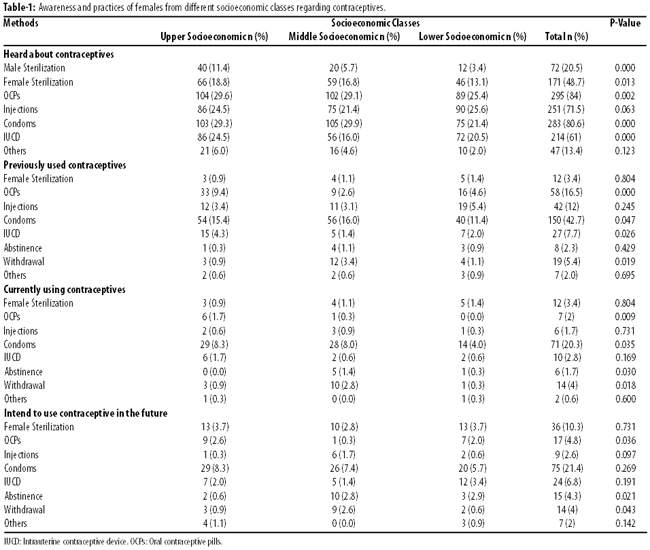
Table 1 illustrates the awareness and practices of females from different socioeconomic classes. It was noted that condoms were the most commonly used method of contraception by the couples with a significant difference among different socioeconomic groups. In our study 12 (3.4%) females had tubal ligation and among them 3 (0.9%) were in age group 30-34 years while 2 (0.6%) and 4 (1.1% were in age group 35 -39 years and 45 -49 years respectively. After knowing the previous and current practices of contraceptives by females from different social classes they were asked about the reasons for not practicing contraception. Their responses are stated in the Figure.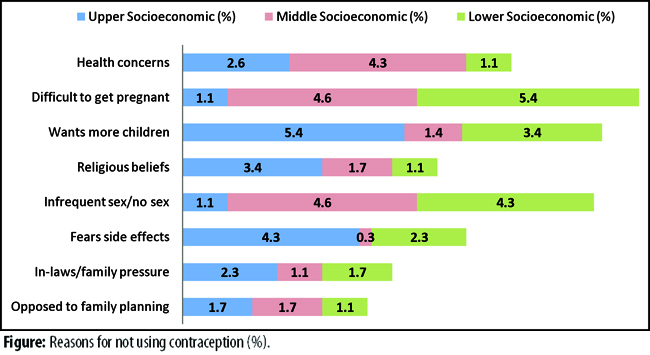
Most commonly reported reason for using contraceptives was birth spacing by 135 (38.4%) and not wanting more children as the family was complete by 82 (23.3%) females. Regarding the benefits of contraceptives, 106 (30.2%) females said that birth spacing was beneficial for both mother and child. Among them 40 (11.4%) were from upper socioeconomic class while 37 (10.5%) and 29 (8.3%) were from middle and lower class respectively. The study participants were asked about which methods of contraception and condoms was considered to be the most successful, easiest to adopt and best method by females from all the social classes. Greatest side effects were reported for OCPs by females from upper and middle class as highlighted in Table-2.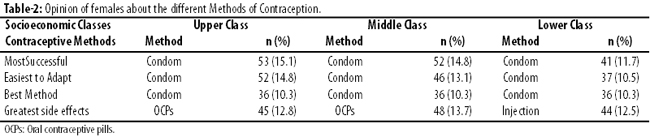
Information about the different methods of contraception was obtained by the participants from various sources including family, doctor, friends and media. Family sources were quoted by 93(26.4%), doctor 76(21.6%), friends 72 (20.5%), and media 71 (20.2%) respectively. Of all 107 (30.4%) females never discussed family planning and contraceptives with their husband. The rest talked on the subject once or often. Similarly 240 (68.1%) females said that they are practicing contraception after a joint approval by both husband and wife while 43 (12.2) females stated that it was disapproved by both husband and wife. About the sources of procurement of contraceptive methods, 79(22.4%) females got it from general stores, 76 (21.6%) from pharmacy and 17 (4.8%) from health care & family planning centres.
Discussion
Contraceptive use has increased in nearly every country in the recent decades.15 A lot of work is being done globally on the use of contraceptives to improve them and make them more acceptable to the masses. The government of Pakistan is also promoting the use of contraceptives and a lot of resources have been exhausted to make them available to all. This study clearly shows that the overall use of artificial methods of contraceptives is higher than the natural methods in this country as the people using natural methods i-e withdrawal and abstinence were only (5.7%) of the total interviewed. This shows that the general opposition towards contraceptive use is minimal and that people not using contraceptives are most likely to be aware of the methods and the decision of not using is based on some other factor and not the low awareness level. Awareness and knowledge is extremely important because knowledge gap certainly affects a women\'s choice for the use of contraceptive.
Results of this study showed that most commonly used method of contraceptive was condoms, consistent with the findings by Sajid A but study by Jabeen M ranked condoms as a non preferable contraception method by study participant.16,17 Amazingly most of the population had heard of OCPs but in comparison its utilization was very small as upper and middle socioeconomic group considered it a method with greatest side effects. The most common cause for not using contraceptives was difficulty in obtaining (11.1%) and desire of more children (10.2%). Most of the other studies also confirmed the fact that desire of more children is the most common reason for least utilization of contraceptives.16,17 Fear of contraceptives side effects was also identified as the frequent factor that reduces the contraceptive prevalence rate in our study as well as by other studies.16,17 Hence, if the Government of Pakistan\'s aim is to promote less number of children per family and improve mother\'s health, attention needs to be paid towards promotion of birth spacing methods that do not affect the fertility of a female.
As this study was done in different socioeconomic groups, the results showed that the socioeconomic inequalities did not affect the most currently used contraceptive choice i.e. condoms in all 3 groups separately and also condoms were thought to be the best method equally in all the 3 groups separately (10.3%). The use of condoms use was slightly higher amongst the women belonging to the upper socioeconomic class as compared to the other 2 groups, the reason being birth spacing. This reflects the positive attitude towards family planning.
The general opposition towards using contraceptives is also decreasing as most of the females questioned, were currently using contraceptives and those who did not use any contraceptive methods or switched from one form to another either feared its side effects or had health concerns. A previous study done in Pakistan showed that health concerns and side effects were major hurdles in the way of using modern methods of contraception18 which is somewhat comparable to this study\'s results as not able to get pregnant can be classified as a side effect. This certainly highlights that the government needs to remove the fear of females and couples regarding the side effects associated with the use of contraceptives.19 This high fertility attitude is attributed to the indigenous culture in favour of large families;20 it also coincides with the Islamic religion which rejects the concept of limiting the family size. The results showed that overall the most popular choice was condoms but this does not match up to the results from a research done in India, a country which is culturally similar to Pakistan. In India, copper t was reported to be the most preferred method.21 On comparing the preferred use of contraceptives to more developed countries, we found that oral contraceptives were most popular in European women,22 and in Germany (54.3%), France (50.5%) and Sweden (34.6%) which is in consistent with the results of our study which reveals that oral contraceptives are the most heard contraceptives in Pakistan (84%). In Andhra Pradesh and Eastern Delhi, tubal ligation and condom (33.9%) were the most preferred methods of contraception respectively23,24 while study done in Sudan revealed that contraceptive pills were the most commonly used method there.25 Socioeconomic disparity does seem to effect the choice globally too since Sudan, a resource poor country was mostly using OCP\'s like other financially stable countries Germany, France and Sweden.
Interestingly, the response to a question regarding who benefits from the use of contraceptives was the mother in all three groups and benefit to the government was the least popular in all three groups. This clearly indicates that we need to mobilize community as a whole to achieve a low population for our country\'s wellbeing.
As most of the subjects included in our study were housewives (84.3%), the socioeconomic status mainly depends on the man\'s source of income in all three socioeconomic groups showing that generally males are the more obvious care takers of the family. Thus, family planning campaigns should be equally directed towards men and women.
The ability to discuss family planning also affects contraceptive usage.22 Results of one of the questions investigating the number of times the couple brings up this discussion in a week revealed that (30.4%) of the women do not discuss it with their husbands and most of them were from the lower socioeconomic group. This shows that there is still a communication gap among the couples of lower socioeconomic group.
Women from the lower socioeconomic group largely felt that the number of children they wished to have was decided by God. This is comparable to another study done in Saudi Arabia which is also an Islamic state.26 This reflects the impact of Islamic culture on the people of Pakistan. These women were less likely to use modern contraceptive methods and mainly relied on abstinence and withdrawal methods.19
Contraceptives were generally accessible in all three groups with general store being the popular source of contraceptives in Clifton and KDLB despite the socioeconomic disparity. In North Nazimabad, pharmacy was the most preferred choice.
All in all, a positive response was seen towards contraceptive usage and socioeconomic inequalities did not affect the contraceptive usage as much as was expected from the gap. However, keeping Pakistan\'s heterogeneous culture in mind, it is imperative not to forget that sociological and cultural variations may contribute to the differences in the choice of use of contraceptives.27
Limitations
This was a hospital based study that focused mainly on gynaecology out patients. Females visiting a doctor are more likely to be aware of the different methods of contraception as counseling on contraception is a part of routine visit to a doctor. This introduces a selection bias.
Additionally, this study does not include women who do not seek any medical advice. They are more likely to be more unaware of the different methods of contraception.
Conclusion
The results of this study reveal the striking difference between the use of contraceptive in different socioeconomic settings; The upper socioeconomic group being the most open to the use of contraceptives and the lower socioeconomic group being the most hesitant. If family planning education campaigns are focused towards the lower socioeconomic group, the contraception prevalence rate will increase and this will lead to a subsequent fall in population growth rate of Pakistan. It is imperative that such campaigns are carried out as the high population growth is the root of most of the problems faced by Pakistan.
Recommendation
Family planning education campaigns should be carried out on a larger scale, focused mainly towards the lower socioeconomic group. Similar campaigns should, however, be carried out in the middle and upper socioeconomic groups as well.
Moreover, such a study should be replicated on a larger scale to better assess the different parameters of the use of contraceptives. A door to door survey will be more representative of the population.
References
1. U.S Census Bureau, International Population Reports WP/02, Global Population Profile: 2002; U.S. Government Printing Office, Washington, DC, 2004. [Online] [Cited 2014 Apr 15]; Available from URL: http://www.census.gov/prod/2004pubs/wp-02.pdf
2. Khan AS. Sindh population surges by 81.5 pc, households by 83.9 pc. [Online] 2012 [Cited 2014 April 2]; Available from URL: http://www.thenews.com.pk/Todays-News-13-13637-Sindh-population-surges-by-81.5-pc,-households-by-83.9-pc.
3. United Nations. The challenge of urbanization: the world\'s largest cities. New York: United Nations; 1995.
4. Population policy of Pakistan. A document of the ministry of population welfare., Islamabad:Government of Pakistan; July 2002.
5. Population policy of Pakistan. A document of the ministry of population welfare, Government of Pakistan, Islamabad, July 2002. Same as NO. 4
6. SatharZA. Fertility in Pakistan: Past, Present and Future. [Online] 2001 [Cited 2014 April 15]. Available from URL: http://www.un.org/esa/population/publications/prospectsdecline/sathar.pdf.
7. (USAID) US Agency for International Development: Health policy initiative, task order 1, futures group international. Washington, DC: US Agency for International Development; 2009.
8. CIA - The World Factbook: Population growth rate. [Online] [Cited 2012 Dec 15]; Available from: URL: https://www.cia.gov/library/ publications/the-world-factbook/fields/2002.html
9. Azmat SK, Shaikh BT, Hameed W, Bilgrami M, Mustafa G, Ali M, et al. Rates of IUCD discontinuation and its associated factors among the clients of a social franchising network in Pakistan. BMC women\'s health 2012; 12: 8.
10. "Population Growth (annual %) in Bangladesh." Population Growth (annual %) in Bangladesh. N.p., n.d. Web. 16 Dec. 2012.
11. Mostafa Kamal SM. Childbearing and the use of contraceptive methods among married adolescents in Bangladesh. Eur J ContraceptReprod Health Care 2012; 17: 144-54.
12. Rahman RM. Human rights, health and the state in Bangladesh. BMC Int Health Hum Rights 2006; 6: 4.
13. Chowdhury AMR. Rethinking interventions for women\'s health. Lancet 2007; 370: 1292-3.
14. To the MDGs and beyond: accountability and institutional innovation in Bangladesh (Bangladesh Development Series Paper No. 14). Dhaka: The World Bank; 2007. [Online] 2007 [Cited 2011 May 17]; Available from URL: http://siteresources.worldbank.org/BANGLADESHEXTN/Resources/295759-1171499457708/complete.pdf.
15. Population Reference Bureau . Family Planning Worldwide 2008 Data Sheet ; 2008.
16. Sajid A, Malik S. Knowledge, Attitude and Practice of Contraception Among Multiparous Women at Lady Aitchison Hospital, Lahore. Annals 2010; 16: 2669.
17. Jabeen M, Gul F, Wazir F, Javed N. Knowledge, Attitude and Practices of Contraception in Women of Reproductive Age. Gomal J Med Sci 2011; 9: 223-9.
18. Marvi K, Howard N. Objects of temporary contraception: an exploratory study of women\'s perspectives in Karachi, Pakistan. BMJ open. 2013; 3:e003279.
19. Agha S. Intentions to use contraceptives in Pakistan: implications for behavior change campaigns. BMC Public Health. 2010; 10: 450.
20. Farrag O, Rahman M, Rahman J, Chatterjee T, Al-Sibai M. Attitude towards fertility control in the Eastern Province of Saudi Arabia. Saudi Med J 1983.
21. Prateek SS, Saurabh RS. Contraceptive practices adopted by women attending an urban health centre. Afr Health Sci. 2012; 12: 416-21.
22. de Irala J, Osorio A, Carlos S, Lopez-del Burgo C. Choice of birth control methods among European women and the role of partners and providers. Contraception 2011; 84: 558-64.
23. Varma G, Rohini A. Attitude of Spouse towards Family Planning: A Study among Married Men and Women of a Rural Community in West Godavari District, Andhra Pradesh; 2008.
24. Saini NK, Bhasin S, Sharma R, Yadav G. Study of unmet need for family planning in a resettlement colony of east Delhi. Health and Population-Perspectives and Issues 2007; 30: 124-33.
25. Umbeli T, Mukhtar A, Abusalab MA. Study of unmet need for family planning in Dar Assalam, Sudan 2001. EastMediterr Health J 2005; 11: 594-600.
26. Sheeha A. Awareness and use of contraceptives among Saudi Women attending Primary Care Centers in Al-Qassim, Saudi Arabia. Int J Health Sci 2010; 4: 11-21.
27. Saurina C, Vall-Llosera L, Saez M, group Gc. Factors determining family planning in Catalonia. Sources of inequity. International journal for equity in health. 2012;11:35. 17. Prateek S, Saurabh R. Contraceptive practices adopted by women attending an urban health centre. Afr Health Sci 2013; 12: 416-21.
Journal of the Pakistan Medical Association has agreed to receive and publish manuscripts in accordance with the principles of the following committees:


