

Afsane Khosravizade ( Department of Health Education and Promotion, Faculty of Health, Isfahan University of Medical Sciences, Isfahan, Iran. )
Akbar Hassanzadeh ( Department Of Biostatistics and Epidemiology, Faculty of Health, Isfahan University of Medical Sciences, Isfahan, Iran. )
Firoozeh Mostafavi ( Department of Health Education and Promotion, Faculty of Health, Isfahan University of Medical Sciences, Isfahan, Iran. )
May 2015, Volume 65, Issue 5
Original Article

Abstract
Objective: To examine the impact of self-efficacy-based education on promoting self-care behaviour in low-salt and weight-setting diets for hypertensive women.
Method: The quasi-experimental study was conducted in 2013 and comprised hypertensive women registered with healthcare centres in Dehaghan, Iran. The subjects were divided into two equal groups; intervention group and comparison group. For the intervention group, four educative sessions were conducted based on self-efficacy leading to self-care behaviours, while the comparison group did not receive any education. Self-efficacy and self-care questionnaires data (obtained before intervention, immediately after intervention and 3 months after intervention) was analysed using SPSS 20.
Results: There were 64 subjects divided into two groups of 32(50%) each. The mean age in the intervention group was 51.2±6.86years and 49.1±7.99years in the comparison group. Self-care behaviours of low salt diet (p=0.002) and weight-setting diet (p=0.004) were more significantly seen in the intervention group. The means of systolic blood pressure (p=0.004) and diastolic blood pressure (p<0.001) were significantly reduced in the intervention group. The mean value for body mass index was not the same in the intervention group (p<0.001).
Conclusion: Self-efficacy-based education had an impact on self-care behaviours in hypertensive patients.
Keywords: Hypertension, Self-efficacy, Self-care behaviours. (JPMA 65: 506; 2015).
Introduction
According to standardised definition, systolic blood pressure (SBP) higher than 140mmHg and diastolic blood pressure (DBP) higher than 90mmHg are considered hypertension.1
Hypertension is one of the diseases which lead to serious complications. Among the most important complications are visual, renal, cerebral and cardiac disorders. If hypertension is not treated, it may cause death in most cases.2 About 50% of hypertensive patients will die due to coronary disease or heart failure, 33% by myocardial infarction (MI) and 10-15% by renal failure if hypertension is not treated or controlled properly. The World Health Organisation (WHO) has estimated that hypertension is the cause of 1/8 of total deaths and the third biggest cause of mortality in the world.3 There are 5 billion hypertensive patients in the world; In the US, 50 million people have the disease and among them, 40% have not been treated and only one-third of the treated patients have controlled BP.4
In the eastern Mediterranean region, its incidence has been reported to be 26% and approximately 125 million people are challenged by this disease.5 According to reports related to investigation of non-contagious diseases and their risk factors in 30 provinces of Iran in 2007, 17.6% of men and 17.1% of women had BP >140/90mmHg. In the Isfahan province, 24.4% men and 17.5% women were hypertensive.1
Surveys indicate that gender plays a significant role in the onset of cardiovascular diseases and confirm that there are more relative hyperlipidaemic, diabetic and hypertensive threats in MI in all age groups of women compared to men.6 A study in Japan indicated that hypertension was the most prevalent risk factor among Japanese patients with acute coronary syndrome (the prevalence for men being 70% and for women, 79%). Also, 60% of deaths which are directly related to hypertension, occurred in women.7
The National Committee of Prevention, Control, Evaluation and Treatment of hypertension (JNC7) recommends hypertensive patients to be committed to adopting self-care behaviours, such as following medical prescriptions, keeping or reducing weight, low-salt diet, physical activity and cessation of smoking. According to Orem definition, self-care behaviours are the learned behaviours that a person tends to adopt because of his life keeping, or life promotion, health, wellbeing, prevention and treatment of diseases. The positive effects of self-care behaviours in treatment and management of hypertension have been shown in researches, but the commitment rate of adult patients in adopting self-care behaviours are relatively low.8
Weight and body mass index (BMI) have been introduced as influential factors in BP variations. The prevalence of hypertension is more in obese individuals compared to the rest. In women, only DBP is affected by obesity, while in men obesity influences both DBP and SBP.9
The use has been recommended of non-medical treatment and also the use of Dietary Approach to Stop Hypertension (DASH) in order to prevent and treat hypertension. The recommended diet included carbohydrates containing whole-grains, fruits and vegetables, low-fat dairy, and low-cholesterol food items.10
More than 5gr of salt consumption per day has been cited as an important BP risk factor. This includes existing salt in foods and additional salt used by people.11 One study showed that women of Ghent area of Belgium and 15% of Liege area were adding some salt to their foods, while eating.12
Helping patients to be aware of this point that their diseases is controllable can lead to better self-confidence about living with a chronic disease.13
Studies have shown that adopting self-care behaviours in hypertensive patients has strong relationship with their self-efficacy.8 Self-efficacy has been defined as an individual\'s confidence to adopt some behaviour, the behaviour which is necessary to reach the intended goals and objectives; according to Bandura\'s theory, self-efficacy includes the individual\'s assurance and confidence to have the abilities of performing self-care activities properly in such a way that the person can get the best results.14
Since several studies have demonstrated the success of health education plans based on behaviour-studying theories and because the application and identification of these theories and their elements in the present socioeconomic and cultural conditions of Iran are necessary for improving health condition of patients, our study was planned to highlight education-based self-care behaviours as an effective factor in changing different lifestyle habits in order to promote self-care behaviour of hypertensive women and to offer some appropriate guidelines for planning patient education.
Subjects and Methods
The quasi-experimental study was conducted in 2013 and comprised hypertensive women registered with healthcare centres in Dehaghan, Iran. Those included were over 30 years of age, using anti-hypertension medicines, having the literacy of reading and writing, non-diabetic, and did not have cardiac or renal complications. To calculate sample size, probability of 0.05 and 80% power was considered. Ethical approval was obtained from the Isfahan University of Medical Sciences and informed consent was obtained from the participants. The demographic, self-care and self-efficacy information were gathered through face-to-face interviews using a standard questionnaire. Body measurements were performed. Height and weight were measured (the least clothes without shoes) by using portal scale. BMI was calculated according to formula of weight in kilogramme by square of height in metres.
The BP was measured after at least 10 minutes of rest by supported credible mercury BP metre in sitting position.
Standardised H-scale.15 questionnaire was used for the measurement of self-care behaviours (low-salt consumption and weight reduction) and a self-generated self-efficacy questionnaire was applied to measure diet and weight regulation. The H-scale questionnaire included 9 questions checking for low-salt consumption in terms of eating salty, packed, fried, oily foods and fruit consumption during the preceding 7 days. It also had 14 questions related to weight regulation by examining the consumption of white meat, grains, fast foods, confectionaries, safe cooking method, and the individual\'s care in choosing safe nutrition by \'yes\' or \'no\'.
Self-efficacy of weight regulation and diet questionnaire was developed by using existing questionnaires and also standard self-efficacy and diet questionnaire with reported Cronbach\'s alpha being 0.87.16
The questionnaire consisted of 15 questions that assessed the individuals\' commitment to use low-fat foods, low salt, grains, white meat, no use of fast foods and no use of saltbox on the dining table with the choices of \'very sure\', \'sure\', \'not so sure\', \'not sure\'.
The apparent consistency of the questionnaire was considered through voting from health education professionals and the questions with less than 50% support were omitted.
The reliability of the questionnaire was specified by using Cronbach\'s alpha coefficient in such a way that the questionnaire was given to 20 women over 30 years of age and hypertensive who were later excluded from the study sample. After the completion of the questionnaire by these individuals, Cronbach\'s alpha coefficient was calculated for examined variables which was 0.862.
Educational sessions took place according to self-efficacy. Since self-efficacy arises from four main sources — practical achievement and improvement, verbal encouragement or giving assurance by the others, social modelling or substitution experiences and physical postures and gestures — educational sessions were conducted according to the four mentioned main sources. The subjects of intervention group were divided into two sub-groups and they were administered four educational sessions each. The sessions involved direct questioning and group discussions.
Since at least one educational session took place each week for each group, at the beginning of each session, weight and BP of each individual were measured and one self-care card (diet, weight-setting and salt-consumption reduction) was given to them. The performance of each individual was also monitored; appropriate behaviours were encouraged; personal experiences were used to encourage others to use them as appropriate models; and the individuals\' achievement were noted. In the last educational session, the intervention group participated in educational session with one of their family members. Educational booklet, including noted self-care behaviours about hypertension, were given to the subjects. One month after the termination of sessions, the questionnaire was completed for intervention group while measuring their height, weight and BMI.
The comparison group did not participate in educational sessions but they did complete the questionnaire one month later. Their height, weight and BMI were also measured. Three months later, noted items were reappraised for both groups.
The gathered data was analysed using SPSS 20. To compare distribution of marital status and level of education, chi square and Mann Whitney tests were used respectively. Changes in self-care and self-efficacy within groups at time were analysed through independent t-test and comparison of mean changes over time was analysed based on repeated measure analysis of variance (RM-ANOVA).
Results
Of the 409 hypertensive women available, 100(24.4%) met the inclusion criterion. After excluding 20(20%) women who were part of the pilot study, and 16(16%) incomplete questionnaires, the final sample size was 64(64%) women who were divided into two equal groups of 32(50%) each. The mean age was 51.2±6.86years in the intervention group and 49.1±7.99years in the comparison group. There was no significant difference between the groups in terms of marital and educational status (p>0.05). In the intervention group, 31(96%) were married, 27(85.4%) had graduated from primary schools, 1(3.1%) from secondary school, 1(3.1%) from high school and 3(9.4%) had a diploma. In the comparison group, 31(90.6%) were married, 3(9.4%) were widowed, 30(93.8%) had graduated from primary schools and 2(6.2%) had a diploma.
There was significant difference between the two groups in terms of self-efficacy marks, mean of diet and weight-setting before the intervention (p=0.662), but after the intervention, it became significantly different (p=0.01) and the same was the outcome 3 months after intervention (p=0.035) (Table-1).
Mean of self-care for salt consumption before the intervention were not significantly different between the groups(p=0.92), but immediately after the intervention the difference became significant (p=0.022) and the trend continued three months after the intervention (p=0.016).
In the comparison group, the mean of self-care for low salt consumption were not significantly different (0.984), but in the intervention group the mean of self-care for low salt consumption was significantly reduced (p=0.003) through the time (Table-2).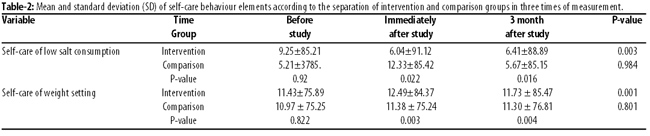
The mean of self-care for weight-setting before the intervention was not significantly different (p=0.822), but immediately after the intervention it became significantly different (p=0.004) and the same was the case three months after the intervention (p=0.004).
The mean of self-care for weight-setting in the comparison group were not significantly different (p=0.801), but in the intervention group, the mean of self-care for weight-setting was significantly increased (p<0.001) through the time (Table-2).
The SBP mean before the intervention (p=0.84) and immediately after intervention (p=0.19) were not significantly different between the two groups, but 3 months after the intervention, the SBP mean in the intervention group was significantly less (p=0.004).
In the comparison group, the mean SBP were not significantly different over three readings (p=0.967), but in the intervention group, it was significantly decreased through the time (p<0.001) (Table-3).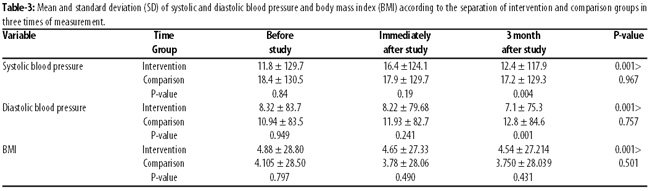
The DBP mean before the intervention (p=0.949) and immediately after the intervention (p=0.241) were not significantly different, but 3 months after the intervention, the DBP mean in the intervention group was significantly less than the comparison group (p<0.001).
In the comparison group the mean DBP was not significantly different over three readings (p=0.757), but in the intervention group, the DBP was significantly decreased through the time (p<0.001).
BMI mean before the intervention (p=0.797) and immediately after the intervention (p=0.49) was not significantly different and even three months after the intervention, the trend continued between the groups (p=0.431).
In the comparison group, mean BMI was not significantly different over three readings (p=0.501), but in the intervention group, mean BMI was not the same (p<0.001).
Discussion
Our results indicate that the self-efficacy-based education can lead to increase in self-care behaviours such as salt-consumption reduction and weight-setting.
Different studies have indicated the effectiveness of self-efficacy-based education in increasing the adoption of self-care behaviours.
One study indicated that 30% of the subjects had weight-setting, 22% low salt consumption and 59% had a good self-efficacy. The good self-efficacy was significantly correlated with reduction of salt consumption.8
In this sense, one study indicated that educating the workers through the internet led to increase in their awareness levels while increasing their adoption of self-efficacy and self-care behaviours.17
Another study indicated that the capability of self-care behaviours in patients were moderate and educational situation and social security were influencing self-care behaviours.18
One study using social cognitive theory indicated that the patients with hypertension over longer time had better control, and had better self-efficacy and self-care behaviour. The results showed that self-efficacy was considered an important factor for self-care behaviours in controlling hypertension. Therefore, interventional planning should focus on improving self-efficacy as a changing individual factor in the future.19
In this investigation, the mean of self-care behaviours for weight-setting and low salt consumption in the intervention group was significantly increased after the intervention but there was not seen any significant difference in the comparison group after measurement at three different times and the mean of self-efficacy for diet and weight-setting in the intervention group compared to the comparison group, indicating significant difference in three-time measurement. These findings are in line with literature.20
Another study stressed that self-efficacy was significantly correlated with the index of oil consumption and concluded that diet educators need to understand the role of self-efficacy as an important index in dietary behaviours.21 One more study supported that self-efficacy was correlated with salt consumption.8
While considering the self-efficacy of hypertensive patients, a study showed that 52% patients had low self-efficacy about their diets.22
In this paper, the mean SBP in the intervention group reduced from 129.7mmHg before the intervention to 117.9mmHg three months after the intervention, but it was not significant; the mean DBP in the intervention group reduced from 83.7mmHg before the intervention to 75.3mmHg three months after the intervention, but it was not significant.
Likewise, the BMI mean in the intervention group reduced from 28.8±4.88 before the intervention to 27.21±4.54 three months after the intervention, but it was not significant.
One study showed that the SBP reduced after 6 weeks, i.e. its mean reduction was 10.4±10.6mmHg. Weight mean reduction was also 3.2±1.5kKg and BMI mean reduction was 0.3±0.5.23
Another study showed that the systolic and diastolic BP significantly reduced in the intervention group compared to the controls. The intervention group received education in the form of group discussions and role-playing, while the control group received oral education.24
One study assessed a self-care programme in 160 hypertensive patients in one intervention group and in one control group with individual education. It pointed out that BP reduced in both groups, but SBP significantly reduced in the intervention group. The reduction of BP was 7mmHg in the intervention group and 2.3mmHg in the control group. Findings suggested that providing self-care-based education to patients in primary health self-cares can lead to controlled hypertension.25
The small sample size and the adoption of self-reporting method, especially because of the low education level of the subjects, were limitations of our study. We suggest using qualitative methods and larger sample size in future studies.
Conclusion
Self-care-based education positively influences self-care behaviours in hypertensive patients. Since hypertension is not treatable and needs to be controlled, the patients should look after themselves throughout their lives. They may be tired over time and shrug off self-care behaviour. The increasing self-efficacy in confronting the challenges and adopting self-care behaviours will help them.
Acknowledgements
We are grateful to the Deputy for Research of Isfahan University of Medical Sciences for financial support and all the women who participated in the study which was part of a Master\'s thesis
References
1. Rafati M, Ghotbi M, Haghazali M. Principles of Disease Prevention and Care, Non-communicable disease surveillance system. Tehran: Ministry of Health and Medical Education Undersecretary For Health Disease Management Center; 2008, 87-104
2. Delavari A, Mahdavi Hazaveh A, Noroozinejad A. Planning of Diabetes Control in Iran.Tehran: Ministry of Health and Medical Education Undersecretary For Health DiseaseManagement Center; 2005, 24-30.
3. Baghianimoghadam M, Aivazi S, Mzloomy SS, Baghianimoghadam B. Factors in relation with self-regulation of hypertension, based on the model of goal directed behavior in Yazd city. J Med Life 2011; 4: 30-5.
4. Sangprasert P, Pradujkanchana N. The Effectiveness of Health Promotion Behavior Program (HPBP) in Thai Hypertensive Patients. Thammasat Int J Sci Tech 2010; 15: 1
5. Khatib OMN, El-Guindy MS, Mediterranean WHOOftE. Clinical Guidelines for the Management of Hypertension: WHO Regional Office for the Eastern Mediterranean; 2005.
6. Mahmoodi M, Kimiagar M, Abadi A. Gender difference in myocardial infarction events between patients with and without conventional risk factors: Themodares heart study. Iranian J Nutr Sci Food Tech 2007; 2: 65-72.
7. Yamamoto A, Richie G, Nakamura H, Hosoda S, Nobuyoshi M, Matsuzaki M, et al. Risk factors for coronary heart disease in the Japanese--comparison of the background of patients with acute coronary syndrome in the ASPAC study with data obtained from the general population. Asia-Pacific Collaboration on CHD Risk Factor Intervention study. J Atheroscler Thromb 2002; 9: 191-9
8. Warren-Findlow J, Seymour RB, Brunner Huber LR. The association between self-efficacy and hypertension self-care activities among African American adults. J Community Health 2012; 37: 15-24.
9. Farshidi H, Zare S, Bushehri E. Association between blood pressure changes and obesity in over-18. Bimonthly J Hormozgan Uni Med Sci 2006; 10: 111-8.
10. Jones JM, Anderson JW. Whole grain intake is associated with reduced risk of chronic disease. Phys Sportsmed 2008; 36: 18-33.
11. Nakano A, Inoue N, Sato Y, Nishimichi N, Takikawa K, Fujita Y, et al. LOX-1 mediates vascular lipid retention under hypertensive state. J Hypertens 2010; 28: 1273-80
12. Vandevijvere S, De Keyzer W, Chapelle JP, Jeanne D, Mouillet G, Huybrechts I, et al. Estimate of total salt intake in two regions of Belgium through analysis of sodium in 24-h urine samples. Eur J Clin Nutr 2010; 64: 1260-5.
13. Bandura A. Self-efficacy: toward a unifying theory of behavioral change. Psychol Rev 1977; 84: 191-25
14. Marks R, Allegrante JP. A review and synthesis of research evidence for self-efficacy-enhancing interventions for reducing chronic disability: implications for health education practice (part II). Health Promot Pract 2005; 6: 148-56.
15. Warren-Findlow J, Seymour RB, Brunner Huber LR. Prevalence Rates of Hypertension Self-care Activities Among African Americans J Natl Med Assoc 2011; 103: 503-12.
16. Ralf Schwarzer , Britta Renner. Health-Specific Self-Efficacy Scales. [online] [cited 2014 Aug 12]. Available from: URL: http://userpage.fu-berlin.de/health/healself.pdf
17. Yu JO CY. [The effect of an internet community on knowledge, self-efficacy and self carebehavior in workers with hypertension]. Taehan Kanho Hakhoe Chi 2005; 35:1258-67.
18. kyol AD, Çetinkaya Y, Bakan G, Yaral? S, Akku? S. Self?care agency and factors related to this agency among patients with hypertension. J Clin Nurs 2007; 16: 679-87.
19. Lee JE, Han HR, Song H, Kim J, Kim KB, Ryu JP, et al. Correlates of self-care behaviors for managing hypertension among Korean Americans: A questionnaire survey. Int J Nurs Stud 2010; 47: 411-7.
20. Mirzaei Alavijeh M, Nasirzadeh M, Jalilian F, Mostafavei F, Hafezi M. Self-efficacy of health promotion behaviours in hypertensive patients. 2012; 19: 51-58.
21. Liou D. Influence of Self-Efficacy on Fat-Related Dietary Behavior in Chinese Americans. Int Elect J Health Educ 2004; 7: 27-37.
22. YANG B, LIU X. A Survey on Self-efficiency of Hypertensives. J Nurs (China) 2007; 4: 6.
23. Del Pilar Rocha-Goldberg M, Corsino L, Batch B, Voils CI, Thorpe CT, Bosworth HB, et al. Hypertension Improvement Project (HIP) Latino: results of a pilot study of lifestyle intervention for lowering blood pressure in Latino adults. Ethnicity Health 2010; 15: 269-82.
24. Scala D, D\'Avino M, Cozzolino S, Mancini A, Andria B, Caruso G, et al. Promotion of behavioural change in people with hypertension: an intervention study. Pharmacy World Sci 2008; 30: 834-9.
25. Germán C, Heierle C, Zunzunegui M, Contreras E, Blanco P, Ruiz E, et al. The control of arterial hypertension in primary care: the evaluation of a program of self-care. Aten Primaria 1994; 13: 3-7.
Related Articles
Journal of the Pakistan Medical Association has agreed to receive and publish manuscripts in accordance with the principles of the following committees:


