

Anila Kamal ( National Institute of Psychology, Quaid-i-Azam University, Islamabad, Pakistan. )
Masood Ali Shaikh ( Independent Consultant, Gulshan-e-Iqbal, Karachi, Pakistan. )
Irum Naqvi ( National Institute of Psychology, Quaid-i-Azam University, Islamabad, Pakistan. )
March 2015, Volume 65, Issue 3
Short Communication

Abstract
Child marriages are more common in developing countries, including Pakistan. This study was conducted to determine the perspective of university students on marriageable age in Islamabad and Rawalpindi. Cumulatively, 1039 students participated in this cross-sectional survey based on convenience sampling. There were statistically significant differences between male and female students pertaining to opinions about what should be the legal age for women and men. Male respondents were more likely to accept 16 years of legal age at marriage for both males as well as females. Female respondents rejected 16 years as the legal age of marriage for girls on physical and emotional health grounds as well as on having negative impact on girl\'s education. Results stress the need for better understanding of socio-cultural norms in the country to more effectively address and discourage the practice of child marriage in the country.
Keywords: Legal age, Marriage, Students, Pakistan.
Introduction
Child marriage constitutes legal union between a man and women where either party is under the age of 18 years.1 Girls are more commonly involved in child marriages, and such marriages are deemed a violation of human rights.1,2 Child marriages are more common in developing countries, including Pakistan.2,3 Girls married before the age of 18 years are more likely to suffer from multitude of adverse emotional and physical health consequences, as well as negative consequences for their children. Issues also include emotional and physical domestic violence, pregnancy and childbirth-related morbidity and mortality, low birth weight of their babies, and infant mortality.2-8 These adverse health outcomes have also been reported from Pakistan, including low healthcare service utilisation for pregnancy and childbirth.5-9
Based on nationally representative survey of 2006-07, half of ever-married women aged 20-24 years in Pakistan were child brides i.e. they were married before the age of 18 years.7 The legal age of marriage in Pakistan is 16 years and 18 years for females and males, respectively; governed by the Child Marriage Restraint Act of 1929.10 The Sindh Assembly recently passed a law, prohibiting marriage of under-18 year olds, for both genders.11
There are no studies in Pakistan on the opinions of young adults on the age of marriage. We conducted this study to determine the perspective of university students in Islamabad and Rawalpindi on marriageable age.
Methods and Results
The cross-sectional survey based on a self-administered questionnaire with convenience sampling was conducted among male and female graduate and undergraduate students aged 20 to 29 years in one private and two public universities in the twin cities of Islamabad and Rawalpindi. A pre-tested questionnaire was used with both open and close-ended questions from August to October 2013. Four trained male and female graduate students approached the students on university campuses, and distributed the questionnaires after obtaining verbal informed consent, and collected the completed questionnaires while ensuring complete confidentiality. Data was analysed using statistical package R 3.0.3, by applying chi-squared test to assess the independent relationships between categorical variables studied and gender; while t-test was used to compare means of continuous variables and their association with gender. Statistical significance was defined by two-sided P <0.05.
A total of 1039 students participated in the survey; 574(55.2%) females, and 465(44.8%) males; with 649(62.5%) enrolled in Masters programme, while the rest in Bachelors programme. The mean age of male and female students was 22.±2 years and 21.7±1.7 years, respectively. The mean age was significantly different (p<0.0001), with female students being younger than male. There were statistically significant differences between male and female students pertaining to opinions about what should be the legal age for women and men (Table-1).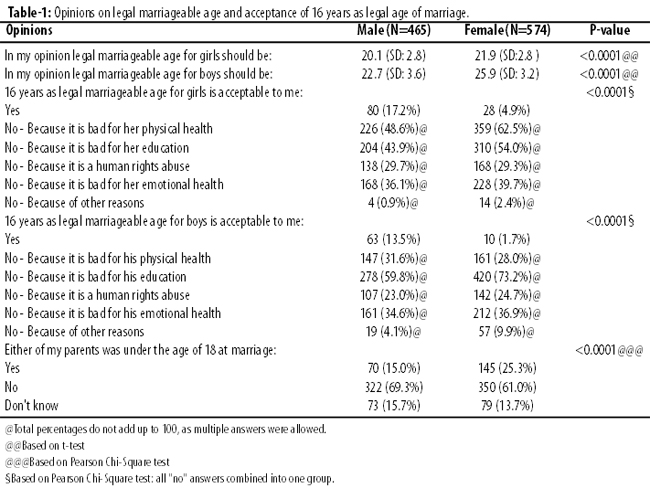
For both female and male students, the opinions on range of ages for legal age of marriage for women spanned from 14 to 30 years; but the inter-quartile range (IQR) was 20 to 25 years for female students and 18 to 22 years for male students. For female and male students, the opinions on range of ages for legal age of marriage for men spanned from 16 to 40 years, and 16 to 35 years respectively; while the IQR was 25 to 28 years for female students and 20 to 25 years for male students. Opinions on age difference between legal marriageable age for girls/women and boys/men were also segregated on the basis of gender (Table-2).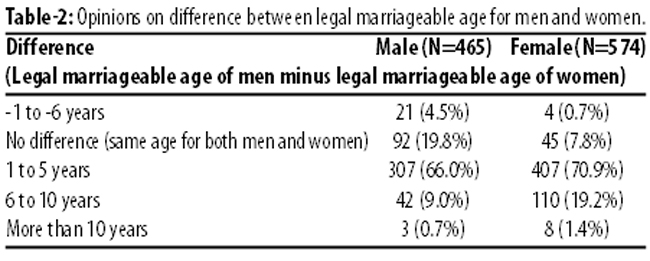
Discussion
Women were more likely to report that one of their parents were under the age of 18 at the time of their marriage. On opinions about legal marriageable age, males tended to report younger age for both genders compared to female students, and this difference was statistically significant. Majority of respondents reported that the difference in ages between two genders should be within one to five years or there should be no difference at all.
Questions on acceptance of legal age of 16 at marriage generated interesting and statistically significant differences between male and female respondents. Male respondents were more likely to accept 16 years of legal age at marriage for both males as well as females. Female respondents rejected 16 years as legal age of marriage for girls on physical and emotional health grounds as well as on having negative impact on girl\'s education. Such differences were either reversed or less pronounced when it came to reasoning for similar age at marriage for boys. Interestingly, there were essentially no differences in proportions between male and female respondents in rejecting 16 years as the legal age of marriage for boys as well as girls as an abuse of human rights. Child marriage is more common among the poor, uneducated and rural dwellers in Pakistan, as in other parts of the world1-3. Respondents in our study were more educated and hailed from middle to upper socioeconomic strata of society. In Pakistan where preserved conservative social customs are sometimes at odds with education and health prerogatives of the youth, the wide spectrum of opinions expressed by respondents in our study probably mirrors the views of general public at large. Addressing and reversing societal health-detrimental attitudes on child marriage at the university level would be a good place to start with.
Conclusion
The results stress the need for better understanding of the socio-cultural norms in order to more effectively address and discourage the practice of child marriage in the country.
References
1. United Nations Children\'s Fund (UNICEF). Early Marriage: Child Spouses. Innocenti Digest. No.7, March 2001. Florence, Italy.
2. United Nations Children\'s Fund. The state of the world\'s children 2009. New York, NY: United Nations Children\'s Fund, 2008; pp 30-3.
3. United Nations Population Fund (UNFPA). Marrying too young - end child marriage. New York, NY: United Nations Population Fund, 2012; pp 53.
4. Santhya KG. Early marriage and sexual and reproductive health vulnerabilities of young women: a synthesis of recent evidence from developing countries. Curr Opin Obstet Gynecol 2011; 23: 334-9.
5. Nasrullah M, Zakar R, Zakar MZ, Krämer A. Girl-child marriage and its association with morbidity and mortality of children under 5 years of age in a nationally-representative sample of Pakistan. J Pediatr 2014; 164: 639-46.
6. Kamal SM, Hassan CH. Child marriage and its association with adverse reproductive outcomes for women in Bangladesh. Asia Pac J Public Health 2013; Oct 4.
7. Nasrullah M1, Muazzam S, Bhutta ZA, Raj A. Girl child marriage and its effect on fertility in Pakistan: findings from Pakistan Demographic and Health Survey, 2006-2007. Matern Child Health J 2014; 18: 534-43.
8. Godha D1, Hotchkiss DR, Gage AJ. Association between child marriage and reproductive health outcomes and service utilization: a multi-country study from South Asia. J Adolesc Health 2013; 52: 552-8.
9. Nasrullah M, Zakar R, Krämer A. Effect of child marriage on use of maternal health care services in Pakistan. Obstet Gynecol. 2013; 122: 517-24.
10. Wikipedia. Child marriage in Pakistan. (Online) (Cited 2014 Aug 11). Available from URL: http://en.wikipedia.org/wiki/ Child_marriage_in_Pakistan.
11. Zia-ur-Rahman M. Pakistan\'s slow but steady progress on ending child marriage. The Guardian, June 2, 2014. (Online) (Cited 2014 Aug 11). Available from URL: http://www.theguardian.com/global-development/2014/jun/02/pakistan-progress-ending-child-marriage.
Related Articles
Journal of the Pakistan Medical Association has agreed to receive and publish manuscripts in accordance with the principles of the following committees:


