

Noureena Kausar ( Department of Psychology, Gujrat University, Gujrat, Pakistan. )
Saima Dawood Khan ( Center for Clinical Psychology, Punjab University, Lahore, Pakistan. )
Bushra Akram ( Department of Psychology, Gujrat University, Gujrat, Pakistan. )
March 2015, Volume 65, Issue 3
Original Article

Abstract
Objectives: To assess the prevalence of depression along gender lines in the general population.
Methods: Using multistage stratified proportionate sampling, the cross-sectional study was conducted in four Union Councils of Jalal Pur Jattan in Gujrat, Pakistan from November 2011 to November 2012. From each stratum, two samples were taken: adults and adolescents. Then each sample was divided into adult males and adult females (20-45 years); adolescent boys and adolescent girls (13-19 years). The questionnaire was developed on the basis of diagnostic criteria given in the revised version of the fourth edition of the Diagnostic and Statistical Manual of Mental Disorders.
Results: Of the total population of 28,259, 1117(3.6%) were approached for the study. Of them, 1110(99.3%) people participated. Overall, 173(15%) were found to be vulnerable to psychological problems whereas 59 (5.31%) were found as vulnerable cases to depression. However, the diagnosis of major depression was handed to 38(3.4%) respondents. Of these 38 subjects, 7(18.42%) persons were suffering from mild; 22(57.89%) from moderate, and 9(23.68%) from severe symptoms. Further, 30(78.9%) of these subjects were women.
Conclusion: Major depression was prevailing in the community of Jalal Pur Jattan in almost the same ratio as in other places around the globe, and, therefore, the inhabitants need psychiatric services.
Keywords: Gender difference, Prevalence, Major depression, Multistage stratified proportionate sampling, Diagnostic interviews. (JPMA 65: 292; 2015).
Introduction
Pakistan is a developing country and presently Pakistani people are facing political, economic and social crisis in addition to security threats. It has been observed that social, political and economic instability and feelings of insecurity in general create distress which seriously affects the mental health of an individual. For the last two decades, electronic and print media have created awareness about psychological problems and psychiatric disorders in the general public. It was reported in \'Pakistan Today\' that psychological disorders are on the rise, and malestal illnesses are reaching alarming proportions as 50 to 60 patients visit the psychiatric department in hospitals on a daily basis. Moreover, the report of Human Rights Commission of Pakistan (HRCP) indicated that 34% of country\'s population is suffering from some form of mental illness.1
In a depressive episode, individuals not only experience changes in mood but it also affects the other areas of life. It disturbs individual\'s ability of thinking, concentration, motivation, physical activity and other areas of functioning.2
Unipolar depression is more common among females than males.3 About twice as many females as males meet the criteria for major depressive disorder or dysthymic disorder at some time in their lives.4 The absolute prevalence of depression varies substantially across cultures and nations, but differences in depression vis-a-vis gender remain significant across most demographic and cultural groups. The World Health Organisation (WHO) estimated that depression is the leading cause of disease-related disability for females in the world today.5 Further gender-wise differences in depression have been reported across 29 countries. They used the data from the World Values Survey across 20 countries. Through multilevel logistic models to examine gender differences in depression, they found that there is no country where the males are more likely to be depressed than females.6 Similarly, it is also found that females were approximately two times more likely to report a lifetime episode for Major Depressive Disorder than males in young adults (n=1197, 528 males and 669 females) of urban, Afro-Americans with an age range of 19--22 years.7 Further, gender differences in depression were also investigated in urban south Indian population. The odds ratio (OR) for depression in female subjects was 1.20 [confidence intervals (CI):1.12-1.28; p<0.001] compared to the male subjects.8 Further, it is concluded that females were more depressed than males among medical students at Nishtar Medical College, Multan, Pakistan.9
A systematic review was conducted about risk factors, prevalence and treatment of anxiety and depressive disorders in Pakistan. Results showed that female gender is a positively associated risk factor for anxiety and depressive disorders. The ratio of the prevalence for females was 66% and 33% for males.10 Similar results were found by other researchers among households in three capital cities of Pakistan.11
The cross-gender differences in depression are in line with the functional mechanism of Pakistani society. In Pakistani culture, females are considered to be fully responsible for all kinds of household activities: chores as well as for child-rearing. Males are deemed to be responsible only for earning for the family. Females are also considered emotionally weak and dependent on males, but at present, the scheme of things has changed as most of the females have started working but even then household activities and child-rearing still remain the responsibility of the females. Dual responsibilities of housekeeping and job performance are patent factors which make them more vulnerable to psychological disturbances and disorders.
The objectives of the current study were to find the prevalence of major depression as well as to explore the gender-wise differences in a Punjab town.
Subjects and Methods
Using multistage stratified proportionate sampling, the cross-sectional study was conducted in four Union Councils of Jalal Pur Jattan in Gujrat, Pakistan from November 2011 to November 2012. The sample size was determined on the basis of literature.12 Proportional allocation method was used to determine the sample size from four strata depending on the proportional contribution of each stratum in the target population. From each stratum, two samples were taken: adults and adolescents. Using random sampling each sample was further divided into adult males and adult females (20-45 years); adolescent boys and adolescent girls (13-19 years). The sample was the 4% of the total population. The respondents were mostly from the same religious background, but their profession, educational level, socioeconomic group and other characteristics were different.
Those not willing to participate in the study, those who were not permanent residents of Jalal Pur Jattan, and those with some terminal physical illness were excluded.
The study questionnaire was developed on the basis of diagnostic criteria given in the revised version of the fourth edition of the Diagnostic and Statistical Manual of Mental Disorders (DSM-IV-TR).13 The questionnaire consisted of three parts: demographic variables; screening questions for major depression; and diagnostic questions related to major depression based on DSM-IV-TR criteria. A cut-off score of 8 was set for major depression. Such cases were categorised as mild, moderate and severe based on their obtained scores on each question on 4 point Likert scale which was validated by five experienced clinical psychologists. First two parts of the questionnaire were administered to all of the respondents, but the third part was administered only to those who were screened as vulnerable cases for major depression.
Structured clinical diagnostic interviews were conducted to collect data from the participants. In order to get their willingness to participate in the study, verbal consent was taken from the respondents before the administration of the questionnaire. The diagnostic interviews were subsequently conducted.
For descriptive analysis of data, frequencies and percentages were computed. The ratio of mild, moderate and severe cases within the diagnosed cases was also worked out. Mann-Whitney test was used to compare the diagnosis of participants with respect to their gender.
Results
Of the total population of 28,259 of the study area, 1117(3.6%) were approached for the study. Of them, 1110(99.3%) people participated. Overall, 173(15%) were found to be vulnerable to psychological problems whereas 59 (5.31%) were vulnerable to depression. However, the diagnosis of major depression was handed to 38(3.4%) respondents. Of these 38 subjects, 7(18.42%) persons were suffering from mild; 22(57.89%) from moderate, and 9(23.68%) from severe symptoms (Table-1).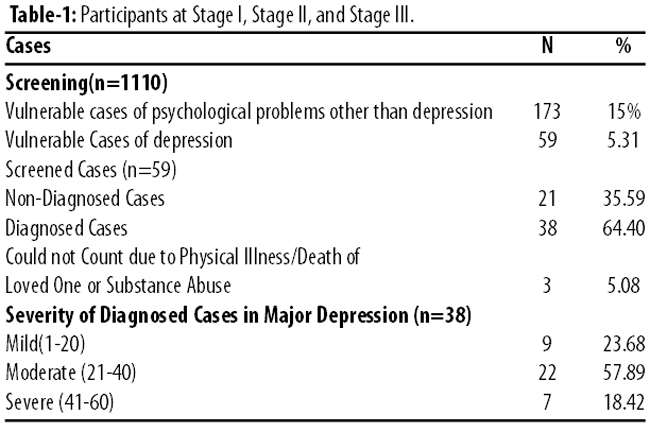
There were 1051(94.68%) non-vulnerable cases that did not have any indication of major depression through screening. Of the 59 vulnerable cases, 21(35.59%) had some symptoms of major depression but they were not diagnosed as depressive as they scored below the cut-off point for diagnosis. Only 3(2%) cases could not be counted as having independent psychiatric illness because they had the history of physical illness, death of loved one or substance abuse.
Further, 30(78.9%) of the diagnosed depressive cases were women against 8(21.1%) men (Table-2)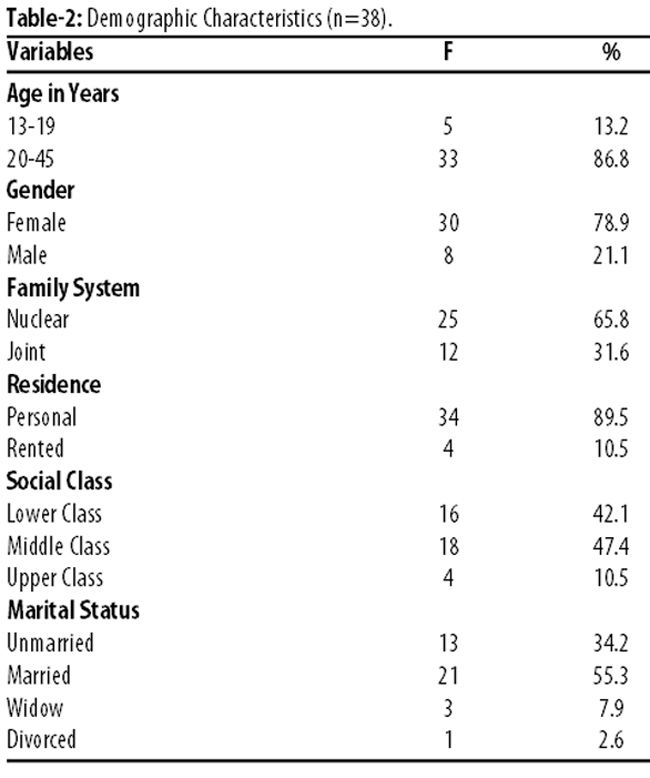
and this comparison was statistically significant (U =190.500; p<0.05) (Table-3).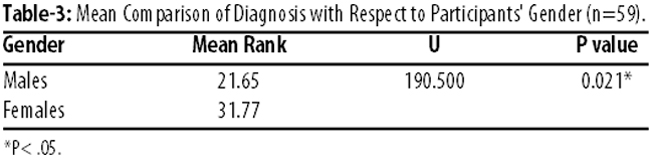
Discussion
It was the first study in Jalal Pur Jattan to explore the prevalence and gender-wise distribution of major depression in the general population. The results are almost in line with the WHO report14 which concluded that 10% of global population is suffering from mental health problems and major depression is only one of them. It further says that this ratio is higher in developing countries. In the current study, 15% people were found to be vulnerable to psychological problems. Besides, 59 respondents were found to be vulnerable to depression only, but 38 were diagnosed with major depression.
Another major finding of the study was the statistically significant difference in the diagnosis of major depression with respect to female gender. The findings are consistent with literature.6, 8-11,15
There could be different possible factors for such gender bias in different cultures. One of the reasons could be the greater amount of stress that females experience in their lives.16 It is reported that females face a number of chronic burdens in everyday life as a result of their social status and roles compared to males, and these strains could contribute to their higher rates of depression.17 They do have to shoulder nearly all the child-care and domestic work of the home, including caring for the sick and elderly family members. This overload contributes to a sense of "burn-out" and general distress, including depressive symptoms, in females.
In Pakistani society, females also face a greater amount of stresses because they are considered solely responsible not only for household affairs but also for the upbringing of children. Further, it is also expected of them to take care of all other family members as well.
The present research had its limitations as it was a cross-sectional study conducted only in one city of district Gujrat. Due to time constrains it could not be done across the district. Another problem related to language. Though the structured diagnostic interviews were based on the translated Urdu version, for some respondents, interviewers had to be conducted in Punjabi language.
Despite the limitations, however, the study\'s findings underscore the need for preventive, therapeutic and rehabilitation programmes for females.
Results indicate that the social structure of Jalal Pur Jattan is depicting increasing trend of major depression regardless of gender, and preventive measures need to be taken across the board. One of the ways to approach the issue is by way of training general health practitioners to differentiate and identify mental health issues from physical problems. Besides, there should be a system of referral of such cases to psychiatrists and clinical psychologists. In the light of the WHO14 report which says depression is suspected to become a major reason of mortality by 2020, the significance of the study is evident, and there is a need for future studies to focus on gender-associated factors in major depression, and to explore the causual factors of major depression and its social correlates in order to prevent the future cases of depression.
Conclusion
Almost 10% study population is suffering from mental health problems in general, and 5% of them have major depression. There is a need of serious attention for provision of psychiatric services to deal with such problems in the community.
Acknowledgements
We acknowledge the support of lady health supervisors/workers in order to get the sampling frame and approach the sample. We would also like to acknowledge the timely cooperation of all participants in data collection. Another acknowledgement is for the co-researchers who gave full support in the field work of data collection.
References
1. Kundi A. Psychological disorders on the rise. Pakistan Today. [Online] [Cited 2011 September 5] .Available from: URL: http://www.pakistantoday.com.pk/2011/08/psychological-disorders-on-the-rise/ 19.
2. Alloy LA, Jacobson, NS, Acocella J. Abnormal psychology: Current perspective (8th ed.). New York: McGraw-Hill Companies, Inc; 1999
3. Kessler RC, Berglund P, Demler O, Jin R, Koretz D, Merikangas KR. The epidemiology of major depressive disorders: Results from the National Comorbidity Survey Replication (NCS-R). J Am Med Assoc 2003: 289; 3095-4105.
4. Andrade L, Caraveo-Anduaga JJ, Berglund P, Bijil, RV, DeGraaf R, Volbergh W. The epidemiology of major depressive episodes: Results from the International Consortium of Psychiatric Epidemiology (ICPE) surveys. Int J Methods Psychiatr Res 2003; 12: 3-21.
5. Murray C, Lopez E. The global burden of disease, injuries and risk factors in 1990 and projected to 2020. Cambridge, MA: Harvard University Press.1996.
6. Lalongo N, McCreary BK, Pearson JL, Koenig Al, Schmidt NB, Podusk, J, et al. Major depressive disorder in a population of urban, African-American young adults: Prevalence, correlates, comorbidity and unmet mental health service need. J Affective Disord 2004; 79:127-36.
7. Hopcroft RL, Bradley DB. The sex difference in depression across 29 countries. JSTOR: Social Forces 2007; 85: 1483-507.
8. Poongothai S, Pradeepa R, Ganesan A, Mohan V. Prevalence of depression in a large urban south Indian population-The Channai urban rural epidemiology study (cures-70). PLOS ONE 2009; 4: e7185
9. Jadoon NA, Yaqoob R, Raza A, Shehzad MA, Choudhry ZS. Anxiety and depression among medical students: A cross-sectional study. J Pak Med Assoc 2010; 60: 699-702.
10. Mirza I, Jenkins R. Risk factors, prevalence, and treatment of anxiety and depressive disorders in Pakistan: Systematic review. Br Med J 2004; 328: 794
11. Gadit AM, Mugford G. Prevalence of depression among households in three capital cities of Pakistan: Need to revise the mental health policy. PLOS ONE 2007; 2: e209
12. Taro Y. Elemalestary sampling theory. Prentice-Hall, Inc., Englewod cliffs. N.J. 1967.
13. American Psychological Association. Diagnostic and statistical manual of mental disorders 4th ed. USA: American Psychological Association; 2000.
14. World Health Organization. Macroeconomic and health: Investing in health for economic developments. Geneva. [online] [ Cited 2001 December 20] Available from: URL: http://www.bvsde.paho.org/bvsacd/milenio/salud/uno.pdf
15. Busari AO. Evaluating the relationship between gender, age, depression and academic performance among adolescents. Schol J Educ 2012; 1: 6-12.
16. Nolen-Hoeksema S. Hilt, LM. Gender differences in depression. In: Gotlib IH, Hammales CL, (Eds.), Handbook of depression. 2nd ed. New York: The Guilford Press, 2009; pp 386-404
17. Nevid JS, Rathus SA, Greene B. Abnormal psychology in a changing world. 4th ed. New Jersey: Prentice-Hall, Inc; 2000; pp 57-95.
Journal of the Pakistan Medical Association has agreed to receive and publish manuscripts in accordance with the principles of the following committees:


