

Amber Mehmood ( Department of Emergency Medicine, Aga Khan University, Karachi, Pakistan. )
Anoosh Moin ( Medical College, Aga Khan University, Karachi, Pakistan. )
Irum Qamar Khan ( Department of Emergency Medicine, Aga Khan University, Karachi, Pakistan. )
Mohammad Umer Mir ( Department of Emergency Medicine, Aga Khan University, Karachi, Pakistan. )
Rashid Jooma ( Department of Surgery, Aga Khan University, and Road Traffic Injury Research & Prevention Centre, JPMC, Karachi, Pakistan. )
March 2015, Volume 65, Issue 3
Original Article

Abstract
Objective: To assess how the frequency, nature and outcome of road traffic crashes differ during the fasting month of Ramadan.
Methods: The retrospective study was conducted in Karachi and comprised data from the Road Traffic Injury Surveillance Project which entailed information on all road traffic injury victims presenting to Emergency Departments in the city between September 2006 and September 2011. Data was analysed to find the frequency of road traffic crashes according to time of incident, road user group and survival. Ramadan and Non-Ramadan groups were compared with respect to time and frequency of incidents, road user group and mortality. SPSS 16 was used for statistical analysis.
Results: There were 163,022 subjects from whom 13,640(8.36%) came during Ramadan and 149,382 (91.6%) during the non-Ramadan months. Frequency of road traffic crashes did not change significantly during Ramadan, but was clustered around the breaking of Fast and the Taravih prayers. The most commonly affected road user group was motorbike riders followed by pedestrians. Overall survival of the RTI victims was 96.1% with a mortality rate of 4.1% which was higher than the figure of 3.5% in the non-Ramadan period.
Conclusion: Vulnerable road users were more frequently involved in road traffic injuries during Ramadan. Moreover, the frequency of crashes increased around evening which requires more careful planning of traffic controls, especially for the vulnerable road users.
Keywords: Ramadan, Road traffic injuries, Mortality, Surveillance, Pakistan. (JPMA 65: 287; 2015)
Introduction
Ramadan is widely observed in the Islamic world during which daylight fasting is commonplace and which entails faithful abstinence from food and drink from a little before dawn to sunset. As the working hours and the road traffic rush hours differ during the month, the pattern of road traffic casualties may also differ.1 It is postulated that the physiological, psychological and behavioural changes associated with fasting may predispose those fasting to an increase in the rate of road traffic crashes (RTCs).2 There is inconsistent data regarding Emergency Department (ED) admissions during Ramadan,3,4 but a recent study suggested that motor vehicle crashes related to sleep-deprivation increase during the month.5 The traffic behaviour changes completely with the approach of Iftar and speeding is observed, increasing the chances and severity of the crashes.6,7 This trend was also witnessed in other countries observing Ramadan.8-10 There are multiple studies conducted in Pakistan related to road traffic injuries, but studies regarding the burden or pattern of road traffic injuries seen in Ramadan are still deficient.
The aim of the current study was to assess the frequency and outcome of RTCs during non-Ramadan and Ramadan as well as the association with the time of the day and road user group recorded in the Road Traffic Injury *RTI) surveillance data from Karachi, Pakistan.11 Karachi has the largest urban road traffic injury surveillance network of the country since 2006 and data from this ongoing surveillance study was used for our research question.
Subjects and Methods
The retrospective study was conducted in Karachi and comprised data related to the period from September 2006 and September 2011 taken from Karachi Road Traffic Injury Surveillance Project (RTIRP). Karachi has five tertiary care centres working round the clock. The centres include three public-sector hospitals: Civil Hospital Karachi, Jinnah Postgraduate Medical Centre, and Abbasi Shaheed Hospital. Besides, there are two private tertiary care hospitals; Liaquat National Hospital and Aga Khan University Hospital. Patients who presented to ED of any of these hospitals were followed up till discharge.
Information was collected in the EDs on a 24-hour basis, whereas those who were admitted were followed up through their hospital course to determine the 30-day outcome. For data acquisition, major sources of information included patients, attendants, police, ambulance and hospital records. Information was collected on patients\' demographics, road user group, time and location of incident and mode of transport.
For the purpose of analysis, the subjects were divided into two groups: those who presented during Ramadan and those who presented in the non-Ramadan months of the year. The data was analysed to find the frequency of RTCs as well as according to the time of incident, road user group and survival.
Using SPSS 16, discrete data was analysed through Chi-square test or Fisher\'s exact test, whereas continuous data was analysed using either the Student t-test or an analysis of variance (ANOVA) to compare more than two groups. P<0.05 was considered statistically significant.
Results
There were 1,63,022 RTI patients out of which, 13,640(8.4%) came during Ramadan and 1,49,382(91.6%) in other months. Only the gender parameter did not show a significant difference between the non-Ramadan and Ramadan groups (p=0.27) (Table).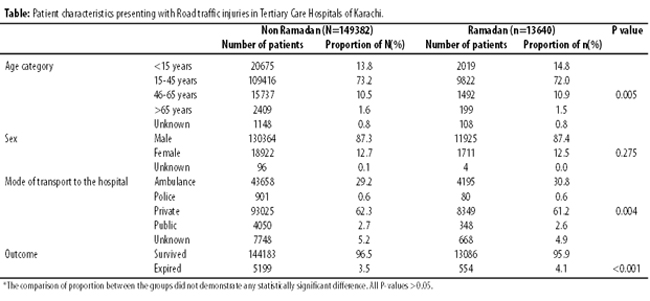
Overall, 109,416(73.2%) RTI patients were males in the 16-45 years age group. Non-Ramadan and Ramadan groups were also compared with respect to time and frequency of incidents, road user group and mortality (Figures-1 and 2).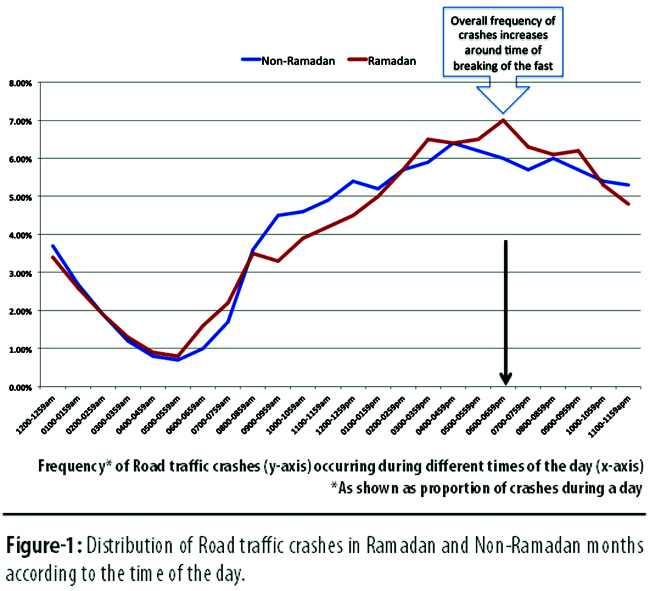
The most common mode of transport was private cars, transporting 93,052(65.6%) and 8,349(64.3%) patients (p=0.004). Besides, 167,269(96%) RTI victims survived with a mortality rate of 3.5% in non-Ramadan cases and 4.1% in Ramadan (p<0.001).
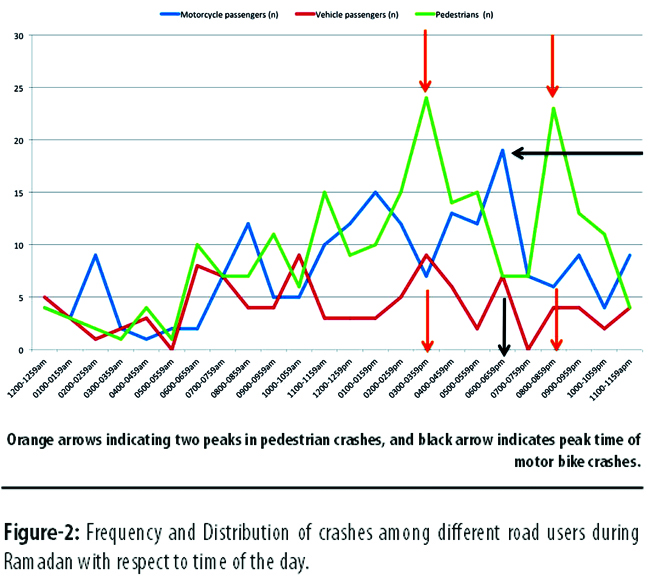
Although there were similarities in the distribution of crashes during different times of the day, but a distinct peak was observed during Ramadan around 6-7pm which fell down to the non-Ramadan level at around 11pm. All three types of road users had different frequency of crashes when compared at different times of the day, but at least two peaks could be seen for increased frequency of road crashes for pedestrians; 3-4pm and 8-9pm. Motorbike riders, however, demonstrated a different pattern and the peak time for motorbike crashes was 6-7 pm. Motor vehicle passengers displayed less variance in RTCs during Ramadan.
For all time periods, the proportion of fatality was higher in Ramadan than in the rest of the year (Figure-3).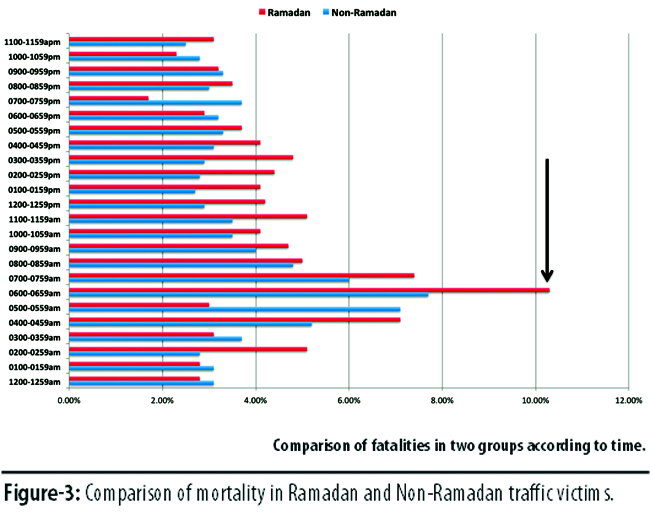
Discussion
The study was conducted in Karachi and could be representative for most of the urban population in Pakistan and possibly other Muslim countries with similar volumes of traffic and traffic hour characteristics during Ramadan in large cities. The study gives important insights about RTCs during Ramadan and the differences in frequency, distribution and outcome of these crashes. There are some important details to help understand the results. First, the month of Ramadan follows lunar calendar and hence could occur in different months of the Gregorian calendar. In our study, Ramadan started early in each consecutive year and, hence, coincided with October to August from 2006-2011. Second, during Ramadan, the working day starts early and ends around 3-4 pm when most workers head home. Third, an important time during Ramadan is that of Iftar, or the breaking of the fast, which occurs at sunset. During our study, the Iftar occurred between 6pm and 7.15pm depending upon the time of the year. Despite difference in business hours, markets and mosques remain open till late night and people frequently visit markets before the Iftar, as well as after late evening prayers that are month-specific and called Taravih, which are offered after 9pm. These prayers are traditionally offered in mosques and almost all healthy and fit male members of the family attend these religious congregations between 6-10pm. Based on this background, there are few important findings of the study.
Overall, pedestrians and motorbike riders, who are classified as vulnerable road users (VRUs), are more commonly involved in RTCs, which has been reported previously.12 Secondly, crashes are more or less as frequent as in the non-Ramadan period but they tend to cluster near the time of breaking the fast till the late evening Taravih prayers, which are traditionally offered in the mosques (6-10pm). Road crashes involving pedestrians occur most commonly at the end of business hours (around 4pm) during the daytime and around the night prayers (around 9pm). At this hour, the markets are still open and many people head for shopping after the last prayer of the day. In contrast, motorbike users are distinctively involved in RTIs just before breaking the fast around 6pm. We also found that during Ramadan, overall RTCs were higher than in the other months of the year. It is important to note that those presenting between 6-7am during Ramadan had a higher fatality rate than the control group i.e. 10.4% vs. 7.7%, but the numbers were so small that statistical significance could not be estimated. Overall road traffic fatalities also rose in Ramadan and particularly early morning crashes were more likely to be fatal. The most significant finding was a rise of fatality in Ramadan between around 6am and 8am that averaged about 9% of all the crashes during a 24-hour time period. However, the reason for this observation could not be determined through this study.
These findings are important not only from RTI standpoint, but also provide information for traffic control authorities. During Ramadan, the day starts early with increasing activity on the roads after dawn. Similarly, significant traffic jams are observed at the time of business closure, which occurs between 3-5pm in the afternoon. This is the time when pedestrians are more likely to be on the roads with the associated increased risk of injury. Another reason for increased traffic and busy roads in Ramadan is the increase in seasonal vendors. These vendors often occupy spaces on the main roads and pedestrian pavements. Thus, they not only obstruct the flow of traffic but also hinder pedestrian mobility. The second most vulnerable group is that of motorbike riders, who are most at risk of RTIs just before the breaking of the fast. In cultures like Pakistan, people prefer breaking fast at home with families and this is the time when everyone hurries back home. Increased attendance of people at mosques at Taravih prayers and people visiting shopping malls and markets as late as midnight result in increased a larger number of people exposed to traffic on the roads, and possibly because of poor visibility and lack of compliance with traffic laws, late-evening crashes and increased involvement of pedestrians in injuries are more common in Ramadan. Physical fatigue from fasting, less sleep and exertion together result in impaired cognition, day-time sleepiness and mood changes both among road users and healthcare providers.13-17 These effects may be responsible for the observed differences, but have not been studied in the local context so far.
Our findings suggest that governmental institutions responsible for traffic control need to design more efficient traffic control systems, especially to protect pedestrians, according to the changing road traffic burden during different times of the day during Ramadan. Finding of this study can help the traffic authorities pay more attention to the VRUs and interventions could be directed towards improved visibility, enforcement of helmets for motorbike users, and more traffic wardens controlling and directing the traffic near mosques and markets until or after midnight. One intervention which could prove helpful in engaging the general public is the enhancement of road safety campaign during Ramadan and dissemination of road safety tips using electronic and social media.
The study has certain limitations as we utilised surveillance data to demonstrate differences in RTCs, frequency, pattern and outcomes during Ramadan. More in-depth studies are required to assess the gaps in the care of these victims, which result in higher mortality during early hours of the day.
Conclusion
Vulnerable Road Users like pedestrians and motorbike users were more frequently involved in RTIs during Ramadan. The times of increased frequency of road crashes before Iftar mirror maximum usage by motorcyclists. Similarly, pedestrians suffered injuries close to the end of the business day and night prayers as those observing the fast returned home and later flocked to the mandatory late-evening Taravih prayers. Traffic control plans by the authorities need to take in to account the profiles of VRUs and the chronology of their crash frequency for evidence-based interventions to reduce injuries and fatalities on the roads in Ramadan. There is also a need for better health education as well as road safety promotion campaigns directed towards VRUs.
Acknowledgement
We are grateful to Johns Hopkins-Pakistan International Collaborative Trauma and Injury Research Training Programme for partially supporting two of the authors through a grant from the Fogarty International Centre of the United States National Institutes of Health.
References
1. Alnasser M, AlSelaim N, Aldhukair S, Elbedah K, Tamim H, Alazzam S, et al. Patterns of pediatric trauma in Ramadan: an observational study. Ann Pediatr Surg 2012; 8: 9-11.
2. Khammash MR, Al-Shouha TF. Do road traffic accidents increase during the fasting month of Ramadan. Neurosciences 2006; 11: 21-3.
3. Pekdemir M, Ersel M, Yilmaz S, Uygun M. No significant alteration in admissions to emergency departments during Ramadan. J Emerg Med 2010; 38: 253-6.
4. Langford EJ, Ishaque MA, Fothergill J, Touquet R. The effect of the fast of Ramadan on accident and emergency attendances. J Royal Soc Med 1994; 87: 517.
5. Al-Houqani M, Eid HO, Abu-Zidan FM. Sleep-related collisions in United Arab Emirates. Accident Analysis Prevention 2013; 50: 1052.
6. Ramadan advisory. Karachi, Jinnah Postgraduate Medical Centre. Road Traffic Injury Research & Prevention Centre; 2010.
7. Tahir MN, Macassa G, Akbar AH, Naseer R, Zia A, Khan S. Road traffic crashes in Ramadan: an observational study. EMHJ 2013; 19: s147-51.
8. Road accidents in Bahrain "on the rise". 2010. [Online] [Cited 2014 July 8]. Available from URL: (http://www.tradearabia.com/ news/MTR_184998.html ):
9. Dajani. H. Ramadan shifts put extra strain on roads. 2010. [Online] [Cited 2014 July 5]. Available from URL: (http://www.thenational.ae/news/uae-news/ramadan-shifts-putextra-strain-on-roads).
10. Shanks NJ, Ansari M, Ai-Kalai D. Road traffic accidents in Saudi Arabia. Public Health 1994, 108: 27-34.
11. Razzak JA, Shamim MS, Mehmood A, Hussain SA, Ali MS, Jooma R. A successful model of road traffic injury surveillance in a developing country: process and lessons learnt. BMC Public Health 2012; 12: 357.
12. Shamim S, Razzak JA, Jooma R, Khan U. Initial results of Pakistan\'s first road traffic injury surveillance project. Int J Injury Control Safety Promotion 2011, 18: 213-7.
13. Chtourou H, Hammouda O, Souissi H, Chamari K, Chaouachi A, Souissi N. The effect of Ramadan fasting on physical performances, mood state and perceived exertion in young footballers. Asian J Sports Med 2006, 2: 177-85.
14. Waterhouse J, Alkib L, Edwards B, Reilly T. Diurnal changes in sleep, food and fluid intakes, and activity during Ramadan, 2006, in the UK: some preliminary observations. Biol Rhythm Res 2008, 39: 449-67.
15. Kirkendall DT, Leiper JB, Bartagi Z, Dvorak J, Zerguini Y. The influence of Ramadan on physical performance measures in young Muslim footballers. J Sports Sci 2008, 26: S15-27.
16. Leiper JB, Molla AM. Effects on health of fluid restriction during fasting in Ramadan. Eur J Clinl Nutr 2003; 57: S30-8.
17. Roky R, Houti I, Moussamih S, Qotbi S, Aadil N. Physiological and chronobiological changes during Ramadan intermittent fasting. Annals Nutr Metab 2004, 48: 296-303.
Journal of the Pakistan Medical Association has agreed to receive and publish manuscripts in accordance with the principles of the following committees:


