

Usamabin Nasir ( Rawalpindi Medical College, Rawalpindi, Pakistan. )
Hania Shahid ( Rawalpindi Medical College, Rawalpindi, Pakistan. )
Muhammad Omar Shabbir ( Rawalpindi Medical College, Rawalpindi, Pakistan. )
March 2015, Volume 65, Issue 3
Original Article

Abstract
Objective: To assess the sleep pattern and depression in patients hospitalised with congestive heart failure, and to study the correlation of poor-quality sleep and depression.
Methods: The cross-sectional, descriptive, co-relational study was conducted from October 2011 to March 2012 and comprised New York Heart Association Class III or IV congestive heart failure patients aged >18 years, admitted at teaching hospitals of Rawalpindi, Pakistan. A standardised questionnaire designed in collaboration with cardiologists and psychiatrists of Rawalpindi Medical College and allied teaching hospitals was administered to the patients while they were hospitalised. Pittsburgh Sleep Quality Index and Beck Depression Inventory questionnaire were also used. Statistical analysis was done using SPSS 20.
Results: Of the 40 patients recruited, 26(65%) were males and 14(35%) were females. The overall mean age was 60±13 years. The mean Pittsburgh Sleep Quality Index score was 15.6±3, with 37(92.5%) patients having poor sleep quality. The mean depression score was 27.65±7.5, with all 40(100%) patients affected. Among them, 14(35.7%) patients had severe clinical depression. Class IV congestive heart failure patients suffered from greater daytime dysfunction (p<0.008) and poor sleep efficiency (p<0.009) compared to Class III. No association of poor sleep quality and depression was found with previous history of smoking, diabetes and hypertension. The study revealed a significant relationship between sleep quality and depression (p<0.005).
Conclusion: Hospitalised congestive heart failure patients suffered from poor sleep and depressive symptoms with overall female predominance. The two symptoms were highly co-related and were more severe in Class IV patients than in Class III. A regular screening of such patients is thus essential for prognosis.
Keywords: Congestive Heart Failure, New York Heart Association, Functional classification, Sleep quality, Depression, Hospitalised. (JPMA 65: 264; 2015)
Introduction
All chronically ill patients,especially those with congestive heart failure (CHF), suffer from varied degrees of physical and psychological disruptions. CHF affects 0.3-2% of the adult population with prevalence increasing with age (1% of people aged >50 years, 5% affected by age 75 years, and 25% of those aged >85 years).1 It continues to be a leading cause of hospitalisation in the world.2 Apart from general symptoms of the disease, sleep problems are frequently reported in CHF patients. These include difficulties in falling asleep, maintaining sleep and frequent midnight or early morning awakenings with inability to go back to sleep again.3,4 Poor or insufficient sleep has a negative impact on the quality of life, resulting in fatigue, irritability, impaired cognitive function and ultimately worsening of symptoms of the underlying disease.5,6 Almost 10-70% of CHF patients experience change in their quality of sleep which affects their overall recovery from the disease.7 The 5-year mortality rate is as high as up to50% despite adequate treatment.8 There is a strong correlation of CHF patients with sleep disturbances with clinical depression as 11-77% of hospitalised CHF patients have clinically diagnosed depression.9-12
A number of investigations have been done to analyse the various biomedical and psychosocial factors affecting sleep quality and mood of these patients, but very few studies have examined it from patient\'s perspective.13-17 Separate studies have been carried out to estimate the prevalence of poor quality sleep and depression in patients suffering from CHF and there are almost no studies analysing the inter-relationship and co-occurrence of poor quality sleep and depression in CHF.6,7,11,14
There is almost no evidence of sleep disturbances and depression in inpatient settings in Pakistan where hospital care is lacking and the degree of such problems are much higher compared to the western population. The current study is the first of its kind in Pakistan to analyse and highlight such problems in hospitalised CHF patients. It was planned to assess the sleep quality and depression in hospitalised patients, and to demonstrate the interactive role of sleep disturbance and depression in CHF.
Patients and Methods
The cross-sectional, descriptive, co-relational study was conducted from October 2011 to March 2012 and comprised New York Heart Association (NYHA) Class III or IV CHF patients aged >18 years, admitted to the Medicine wards or Coronary Care Units (CCU)at teaching hospitals of Rawalpindi, Pakistan. A standardised questionnaire designed in collaboration with cardiologists and psychiatrists of Rawalpindi Medical College and allied teaching hospitals was administered to the patients while they were hospitalised. The study was approved by the institutional ethicscommittee, and a written informed consent was obtained from all the patients to whom the questionaire was explained in the local language.
Data on demographics, aetiology, duration of CHF, smoking habit and the presence of co-morbidities (hypertension, chronic obstructive pulmonary disease (COPD), Type II diabetes mellitus, peripheral vascular disease, renal dysfunction, arthritis and cerebrovascular accident) were collected from medical records. The body mass index (BMI) was determined with the help of weight in kilogrammes and height in meter square. Patients were categorised according to the World Health Organisation (WHO) classification of BMI; severely underweight (=15 kg/m2); underweight (16-18.5 kg/m2); normal (18.5-25 kg/m2); overweight (25-30 kg/m2); and obese (>30 kg/m2). Smoking was defined as a history of half pack-year or greater (during any time period within the preceding five years).
Patients were excluded if they were unable to speak or comply with the study protocol; were critically ill and admitted in intensive care unit (ICU); had a severe debilitating disease like end-stage liver disease, renal failure or malignancies; were already enrolled in some other study; or were exposed to any invasive intervention within the preceding 6 months, like percutaneous transluminal coronary angioplasty (PTCA), coronary artery bypass grafting (CABG), orthotopic heart transplantation (HTX), valve replacement etc.,or if any such priocedure was planned for the following 3 months. The CHF diagnosis of CHF was confirmed by physical examination using the Framingham Criteria for CHF. It requires the simultaneous presence of at least two major criteria (paroxysmal nocturnal dyspnoea, neck vein distension, acute pulmonary oedema, S3 gallop) or 1 major criterion in conjunction with 2 minor criteria (bilateral ankle oedema, nocturnal cough, pleural effusion and dyspnoea on ordinary exertion). The Framingham risk score is 100% sensitive and 78% specific for identifying persons with CHF.18
The patients were classified using the Specific Activity Scale Functional Classification of patients with cardiovascular diseases. It is a clinical questionnaire that assesses the work capacity (walking down stairs with or without weight, taking shower or dressing with or without stopping) of a CHF patient through 5 questions with answers in "yes" or "no" and classifies the patients in classes I-IV accordingly.19 Only those patients which were classified as class III and IV through the questionnaire were chosen for the study.
Patients were asked to fill the self-rated Pittsburgh Sleep Quality Index (PSQI) questionnaire. Those who were unable to understand the questionnaire were briefed by the health professional on duty. Each patient was asked to fill all the questions and incomplete forms were excluded.
The PSQI is a self-rated questionnaire assessing sleep quality and disturbance over a 1-month time period. It carries 19 items that yield 7 individual scores; subjective sleep quality, sleep latency, sleep duration, habitual sleep efficiency, sleep disturbances, use of sleep medication, and daytime dysfunction. Each individual score has a value from 0-3. The sum of all these scores yields the Global PSQI score (maximum 21) which distinguishes good sleepers from poor sleepers. Subjects having global PSQI score of >5 are rated as poor sleepers and those with equal or less than 5, as good sleepers.20
Beck Depression Inventory (BDI) was used for the screening and assessment of the severity of depression in CHF patients. The questionnaire comprises 21 questions with each question carrying 0-3 score where"0" indicates the lowest score and "3" the highest. The total BDI score of all the questions is 63.21 The various scores of BDI give rise to six degrees of depression. Scores between 1-10 are considered normal, 11-16 as mild mood disturbance, 17-20 as borderline clinical depression, 21-30 as moderate depression, 31-40 as severe depression and >40 as extreme depression.
Data were analysed using SPSS 20. Frequencies and percentages were calculated for the demographic data. Independent sample t-test was used to compare the means of normally distributed variables (gender, class) between good sleepers (Global PSQI=5) and poor sleepers (Global PSQI >5). The relationship between NYHA class, global PSQI scores and individual sleep components was determined by bivariant correlations (Spearman rank correlation coefficients). The independent relationship between sleep quality and depression was determined with the help of linear regression with Global PSQI scores as the independent variable and BDI scores as the dependent variable.
Results
Of the 40 patients recruited, 26(65%) were males and 14(35%) were females. The overall mean age was 60±13 years (Table-1).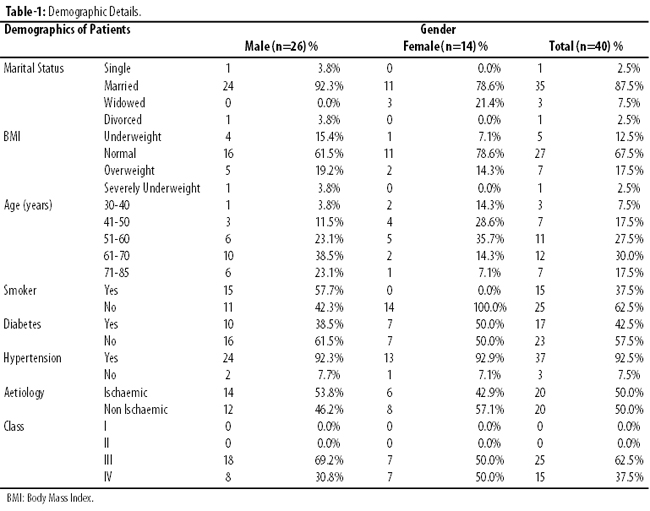
The relationship between hypertension, smoking and diabetes with Global PSQI scores was statistically insignificant (p>0.05 each). On the other hand there was a strong positive correlation between hypertension and BDI scores (rs=0.313; p=0.049) and smoking and BDI scores (rs=0.325; p=0.041). The relationship of diabetes and BDI scores was insignificant (p>0.05).
According to Global PSQI scores, 3(7.5%) patients were good sleepers (Global PSQI=5) with a mean score of 3.3±0.57. There were 37(92.5%) poor sleepers (Global PSQI score >5) with a mean of 15.6±3. Among the poor sleepers, 23(62%) were male and 14(38%) were females. There was a significant difference in the scores for males (13.69±4.92) and females (16.50±2.10); t (38) =-2.028, p= 0.05.
Of the men, 18(69.2%) Class III patients had a mean PSQI score of 12.39±5.33. Among women, 7(50%) Class III patients had a mean PSQI score of 17.14±1.77. There were 8(30.8%) Class IV male patients with a mean PSQI score of 16.63±1.76 and 7(50%) Class IV patients with a mean PSQI score of 15.86±2.34. The difference in Global PSQI scores was statistically insignificant for Class III (13.72±5.071) and Class IV (16.27±2.017) (p=0.072).
A Spearman\'s Rank Order correlation was run to determine the relationship between NYHA class and Global PSQI score along with 6 other component scores, subjective sleep quality, sleep latency, sleep duration, habitual sleep efficiency, sleep disturbances and daytime dysfunction. NYHA class was positively correlated only with daytime dysfunction (rs = 0.416; p<0.01) and habitual sleep efficiency (rs=0.409; p<0.01) (Table-2).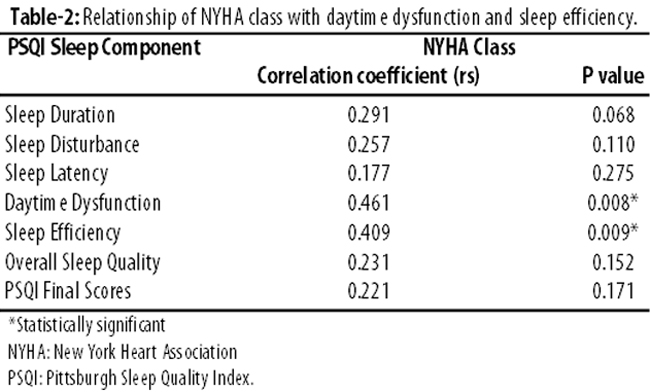
The overall mean depression score was 27.65±7.5 (range: 12-39). There was no patient with normal mental state (BDI: 1-10) or extreme depression (BDI: >40). Four (10%) patients had mild mood disturbance (BDI: 11-16), 3(7.5%) had borderline clinical depression (BDI: 17-20), 18(45%) had moderate depression (BDI: 21-30) and 15(37.5%) had severe depression (BDI: 31-40). Depression was more prevalent in females (31±8.43) compared to males (26±8.23).
Depression symptoms increased with the NYHA class of heart failure. Among the 25 NYHA Class III patients, 4(16%) had mild mood disturbance, 2(8%) had borderline clinical depression, 10(40%) had moderate depression and 9(36%) had severe depression. Among the 15 Class IV patients, 1(6.7%) had borderline clinical depression,8(53.3%) had moderate and 6(40%) had severe depression (Table-3).
Linear regression analysis showed that PSQI scores significantly predicted the severity of depression (r2 =0.187; p=0.005). Sleep duration (rs=0.311; p=0.05), sleep disturbance (rs=0.314; p=0.048) and sleep efficiency (rs0.425; p=0.006) were also positively correlated with the depression.
Discussion
Our study revealed a high degree of poor sleep quality and depression with an overall female predominance and the severity of problems increasing sharply with the class of CHF. As many as 92.5% patients in the study showed poor sleep patterns which was quite alarming. Majority of the patients showed disruptions in sleep duration, sleep latency, daytime dysfunction and total sleep efficiency. Two studies conducted in Taiwan had similar results showing 74% and 81% prevalence of sleep disturbancesin their patient sample respectively.22,23 Another study having a sample of 84 had similar results with some patients requiring the use of medication to help them sleep.14 This is once again very much related to our study as 30% patients in our study used sleep-inducing medication.
All patients had BDI scores of>10 (normal <10) with mean score of 27.65±7.5. The high rate of depression found in the current study is in line with the findings from studies conducted in Western populations.12,13 The results were also similar to a study carried out in central China demonstrating a 60% depression prevalence in hospitalised CHF patients.24 Also, 37.5% patients in our study showed severe clinical depression which is in line with a study which demonstrated that 35% of the hospitalised patients had BDI scores greater than 10, and 14% of these patients met criteria for major depression.25 In 2006, a meta-analysis of 27 studies showed 2% prevalence of clinically significant depression in similar population.26
Regarding the gender characteristic, the Global PSQI scores in our study was higher among women. This indicated that sleep disturbances were more prevalent amongst females than males. This is consistent with the findings of a previous study done in Brazil.27 However, these results show a disagreement with some studies proving a male predominance in developing sleep changes.28 The difference can be attributed to the different methods used to evaluate sleep patterns. Similarly, the BDI scores for depression in our study proved that a higher percentage of females developed a depressive episode with 42.9% developing severe depression as opposed to 34.6% of males developing the same degree of depression. A study done in 2003 found similar results and in 2006 a study in Europe reported a 48% prevalence rate of depression amongst women as opposed to 36% in males hospitalised with CHF.13,29
Degree of impairment of sleep quality and severity of depression was found to vary with the severity of CHF such that those having Class III and IV CHF on NYHA classification had more aggravated symptoms of sleep quality and depression. Previous studies had reported similar results.13,22,24,30 Of the other studied variables, age, BMI, previous history of smoking, hypertension and diabetes were not found to have any association with poor quality of sleep. This has been previously demonstrated in a study.14 However, this was in contradiction of one study stating that these variables added 10% contribution to the sleep problems in heart failure.31
Though the other factors didn\'t seem to be significant predictors of depressive symptoms in CHF, it was observed that patients younger than 60 years tend to have more depression than older patients probably because younger age combined with the burden of the disease makes them more vulnerable to developing a clinically significant depression.13 The results are difficult to be compared as most of the studies have been carried out in older hospitalised patients. We could find only two researches comprising patients from all age groups having similar results.13,24 In one study,24 patients with hypertension, diabetes and a smoking history had more depression than those who didn\'t, which is contradictory to our results and may be attributed to the different methodology and a greater sample size. Finally, the linear regression scatter plot showed a direct relationship between sleep and depression. Those having greater sleep problems hadmore severe depression. One study32 found similar results of a significant relationship between sleep quality and depression.
Identification of sleep problems and the development of depressive episodes is important as both tend to be ignored and fall short of treatment and care in all chronically ill patients. These need to be addressed at the time of admission, during the hospital stay and after discharge as these unrecognised problems are usually associated with worsening of symptoms of the underlying disease, hospital re-admissions and increased mortality.26,33-35 The physicians must take time out of their busy schedule and focus on assessing the sleep patterns, day time naps, daily physical and social activities, the level of sadness/depression, reactions to sleep loss and any external or internal factor that might be the cause of potentiating or recurrance of poor sleep and depression in these patients. The physician may refer the patients to sleep specialists for the evaluation of their problem and intervention. Possible interventions include teaching sleep hygiene and exercises to the patients that promote sleep and help relieve anxiety. Also, in severe cases, hypnotic medications may be advised. Whatever be the case, the goal must be to maintain an optimum quality and quantity of sleep and mood of these patients.
The major limitation of the current study was its small sample size. This can be attributed to two major reasons. First, our sample only included hospitalised patients of Class III and IV severity from Rawalpindi and adjacent areas. Patients presenting to the out-patient department (OPD) were not included. Secondly, the time duration of the study was only six months due to limited resources. Moreover, we had planned to go for detailed sleep study and ploysomnography of these patients, but there was no financial funding to carry out such detailed studies on a larger scale. We recognise the fact that large-scale sleep studies are required for proper assessment of sleep in CHF patients. Previous studies aimed at predicting the various factors associated with sleep disturbance and depression, and studied different variables to support their findings. On the other hand, the interest of our study was to evaluate the quality of sleep and its association with depression in CHF. Our study only focused on hospitalised patients and so a study comparison with the general population is necessary to draw significant conclusions. Finally, it was a cross-sectional study and therefore could not assess the impact of the findings over time. Thus, longitudinal studies are required for further in-depth investigation. A large-scale survey should be undertaken in order to assess the true prevalence of sleep and mood disturbances in chronicly ill patients.
Conclusion
Poor quality sleep and depression are highly prevalent in patients with CHF and play an interactive role in overall disease prognosis. Not only CHF, sleep and depression problems can arise in other chronic diseases as well which requires large-scale surveys and appropriate interventions. Pharmacological interventions help control the symptoms of underlying heart failure, but sleep disturbances and depression remainpoorly treated.
Acknowledgment
We are grateful to the administrations of the Department of Community Medicine, Rawalpindi Medical College, Rawalpindi, and the Department of Clinical Research, Shaukat Khanum Memorial Cancer Hospital, Lahore, for their support and guidance. Thanks are also due to Dr.Maria Ashraf, Rawalpindi Medical College, for helping us out with patient recruitment and the questionnaire.
References
1. Cowie MR, Struthers AD, Wood DA, Coats AJ, Thompson SG, Poole-Wilson PA, et al. Value of natriuretic peptides in assessment of patients with possible new heart failure in primary care. Lancet 1997; 350: 1349-53.
2. Schocken DD, Arrieta MI, Leaverton PE. Prevalence and mortality rate of congestive heart failure in the United States. J Am Coll Cardiol 1992; 20: 301-6.
3. Lanfranchi PA, Somers VK, Braghiroli A, Corra U, Eleuteri E, Giannuzzi P. Central sleep apnea in left ventricular dysfunction: prevalence and implications for arrhythmic risk. Circulation 2003;107: 727-32.
4. Lanfranchi PA, Braghiroli A, Bosimini E, Mazzuero G, Colombo R, Donner CF, Giannuzzi P. Prognostic value of nocturnal Cheyne-Stokes respiration in chronic heart failure. Circulation 1999;99: 1435-40.
5. Parish JM. Sleep-Related Problems in Common Medical Conditions. Chest 2009; 135: 563-72.
6. Katz D, McHorney C. The impact of insomnia on quality of life in patients with chronic illness. Med Decis Making 1996;16:455.
7. Chen HM, Clark AP. Sleep disturbances in people living with heart failure. J Cardiovasc Nurs 2007; 22: 177-85.
8. Levy D, Kenchaiah S, Larson MG, Benjamin EJ, Kupka MJ, Ho KK, et al. Long-term trends in the incidence of and survival with heart failure. N Engl J Med 2002, 347:1397-402.
9. Konstam V, Moser DK, De Jong MJ. Depression and anxiety in heart failure. J Card Fail 2005;11:455-63.
10. Joynt KE, Whellan DJ, O\'Connor CM. Why is depression bad for the failing heart? A review of the mechanistic relationship between depression and heart failure. J Card Fail 2004; 10: 258-71
11. Friedman MM, Grifin JA. Relationship of physical symptoms and physical functioning to depression in patients with heart failure. Heart Lung 2001; 30: 98-104.
12. Vaccarino V, Kasl SV, Abramson J, Krumholz HM. Depressive symptoms and risk of functional decline and death in patients with heart failure. J Am Coll Cardiol 2001; 38: 199-205.
13. Freedland KE, Rich MW, Skala JA, Carney RM, Davila-Roman VG, Jaffe AS. Prevalence of depression in hospitalized patients with congestive heart failure. Psychosom Med 2003; 65:119-28.
14. Erickson VS, Westlake CA, Dracup KA, Woo M, Hage A. Sleep disturbance symptoms in patients with heart failure. AACN Clin Issues 2003; 14: 477-87.
15. Ekman I, Cleland K, Charlesworth A, Metra M, Poole-Wilson PA. Symptoms in patients with heart failure are prognostic predictors: insights from COMET. J Card Fail 2005;11: 288-92.
16. Skobel E, Norra C, Sinhá A, Breuer C, Hanath P, Stellbrink C. Impact of sleep-related breathing disorders on health-related quality of life in patients with chronic heart failure. Eur J Heart Fail 2005; 7: 505-11.
17. Ramasamy R, Hildebrandt T, O\'Hea E, Patel M, Clemow L, Freudenberger R, et al. Psychological and social factors that correlate with dyspnea in heart failure. Psychological 2006; 47: 430-4.
18. McKee PA, Castelli WP, McNamara PM, Kannel WB. The natural history of congestive heart failure: theFramingham study. N Engl J Med 1971; 285: 1441-6.
19. Goldman L, Hashimoto B, Cook EF, Loscalzo A. Comparative reproducibility and validity of systems for assessing cardiovascular functional class: Advantages of a new specific activity scale. Circulation 1981; 64: 1227-34.
20. Buysse DJ, Reynolds CF, Monk TH, Berman SR, Kupfer DJ. The Pittsburgh Sleep Quality Index (PSQI): A new instrument for psychiatric research and practice. Psychiatry Research 1989; 28: 193-213.
21. Beck AT, Ward CH, Mendelson M, Mock J, Erbaugh J. An inventory for measuring depression. Arch Gen Psychiatry 1961; 4: 561-71.
22. Chen HM, Clark AP, Tsai LM, Chao YFC. Self-reported sleep disturbance of patients with heart failure in Taiwan. Nurs Res 2009; 58: 63-71.
23. Wang TJ, Lee SC, Tsay SI, Tung HH. Factors influencing heart failure patients\' sleep quality. J Advanced Nurs 2010; 66: 1730-40.
24. Hussain T, Shu LY , Cheng X, Sosorburam T, Adji AS, Tajammul S, Sartaj A. Depression among Congestive Heart Failure Patients: Results of a Survey from Central China. J Pak Med Ssi 2011; 1: 38-42.
25. Jiang W, Alexander J, Christopher E, Kuchibhatla M, Gaulden LH, Cuffe MS, et al. Relationship of depression to increased risk of mortality and rehospitalization in patients with congestive heart failure. Arch Intern Med 2001; 161: 1849-56.
26. Rutledge T, Reis VA, Linke SE, Greenberg BH, Mills PJ. Depression in heart failure: a meta-analytic review of prevalence, intervention effects, and associations with clinical outcomes. J Am Coll Cardiol 2006; 48: 1527-37.
27. dos SantosI MA, da CruzII DALM, BarbosaIII RL. Factors associated to sleep pattern in heart failure patients. Rev Esc Enferm USP 2011; 45: 1102-9
28. Paulino A, Damy T, Margarit L, Stoica M, Deswarte G, Khouri L, et al. Prevalence of sleep-disordered breathing in a 316-patient French cohort of stable congestive heart failure. Arch Cardiovasc Dis 2009; 102: 169-75.
29. Leegte IL, Jaarsma T, Sanderman R, Linssen G, van Veldhuisen DJ. Depressive symptoms are prominent among elderly hospitalised heart failure patients. Eur J Heart Failure 2006; 8: 634-40.
30. Príncipe-Rodriguez K, Strohl KP, Hadziefendic S, Pina IL. Sleep symptoms and clinical markers of illness in patients with heart failure. Sleep Breath 2005; 9: 127-33.
31. Redeker NS, Hilkert R. Quality of life in stable heart failure. J Card Fail 2005; 11: 700-5.
32. Batal O, Khatib OF, Bair N, Aboussouan LS, Minai OA. Sleep Quality, Depression, and Quality of Life in Patients with Pulmonary Hypertension. Lung 2010; 189: 141-9.
33. Silver MA. Depression and Heart failure: An overview of what we know and don\'t know. Cleveland Clin J Med 2010; 77 Suppl 3: S7-11.
34. Grady K.L. Quality of Life in Patients with Chronic Heart Failure. Crit Care Nurs Clin North Am 1993; 5: 661-70.
35. Weinberger JJ, Kenny C. Nonpharmacological Management and Patient Education in Heart Failure. Nurse Practitioner 2000; 25: 32-3.
Journal of the Pakistan Medical Association has agreed to receive and publish manuscripts in accordance with the principles of the following committees:


