

Sadia Malik ( Department of Psychology, University of Sargodha. )
Maheen Khan ( Department of Psychology, University of Sargodha. )
March 2015, Volume 65, Issue 3
Original Article

Abstract
Objective: To investigate the relationship between Facebook addiction, narcissism and self-esteem and to see if gender played any role in this equation.
Methods: The correlational study was conducted from February to March 2013 at the Department of Psychology, University of Sargodha, Punjab, Pakistan. Using convenient sampling, two equal groups of male and female students were enrolled from different departments of the university. Bergen Facebook Addiction Scale, Hypersensitive Narcissism Scale and Rosenberg's Self-esteem Scale were used for evaluation. SPSS 17 was used for statistical analysis.
Results: Of the 200 subjects in the study, 100(50%) each were males and females. Facebook addiction was positively correlated with narcissism(r=0.20; p<0.05) and negatively with self-esteem(r=-0.18; p<0.05). Relationship between narcissism and self-esteem was non-significant(r=0.05; p>0.05). Facebook addiction was a significant predictor of narcissistic behaviour (b=0.202; p<0.001) and low self-esteem (b=-0.18; p<0.001). There were no significant gender differences in the three variables (p>0.05 each).
Conclusion: Facebook addiction was a significant predictor of narcissistic behaviour and low levels of self-esteem among students.
Keywords: Facebook addiction, Narcissism, Self esteem. (JPMA 65: 260; 2015).
Introduction
Facebook is included in most popular websites with over 600 million users in the world.1 Facebook users enjoy many benefits. In recent experiments, it is found that distressed people feel better when they turn to Facebook.2 According to different opinions, Facebook addiction means spending an excessive amount of time on Facebook. Normally, excessive Facebook use interferes with important activities of a person's life.2 Facebook has a great influence on our daily lives; we can observe that people from every age group are using Facebook.
The meaning of narcissism involves seeking attention or wanting to be liked. People who use social media sites want to make relations with other social media users. Previous studies found correlation between Facebook addiction and narcissism.3 In an individualistic society, Facebook is a social and cultural norm.4 People with extrovert personality have a more intense tendency to be Facebook addicts.5 Results of a study showed that extroverts want unlimited contact with friends and the virtual world for higher stimulation and large social network. It also revealed that people with low scores on conscientiousness spent more time on Facebook. People having openness trait showed no influence of using social networking sites. People with agreeableness and neuroticism also have no impact of Facebook.5
A recent study on university students exploring narcissism on Facebook and self-promotional and anti-social behaviours among Facebook addicts found consistent results for its hypothesis.6
A study defined self-esteem as the subjective evaluation that a person makes and maintains about himself or herself and the extent of belief in their capability, worth and significance.5 It found no relationship between self-esteem and social networking sites (SNS) use. The excessive use of modern technologies is specifically limited to young people and, as a result, addictive tendencies are more common among them.7
Some studies observed that Facebook usage had a significant negative relationship with self-esteem (University of Gothenburg in Sweden, 2012).8 One study found that people with low self-esteem feel safer when they use Facebook. It was also concluded that people with high self-esteem usually post positive updates and get positive responses.9
It is also observed that young people have more chances of falling victim to SNS addiction.10
Social media has become an important part of our life, especially for the youth. Facebook addiction has become a common pattern in our colleges, universities and even at workplaces. But the excessive use of Facebook is creating a lifestyle addiction which is causing different psychological and social problems such as depression, anxiety, loneliness, lack of self-esteem and poor social interaction. Unfortunately, no proper attention has been given to this serious issue in Pakistan. A very few researches have been conducted to explore the issue. The current study was aimed at investigating the serious impact of Facebook addiction on the self-esteem and behaviour of university students as it is evident from literature that students are the most vulnerable segment as far as Facebook addiction is concerned.
Subjects and Methods
The correlational study was conducted from February to March 2013 at the Department of Psychology, University of Sargodha, Punjab, Pakistan. Using convenient sampling, two equal groups of male and female students were enrolled from different departments of the university.
Facebook addiction was measured by the Bergen Facebook Addiction Scale (BFAS).11 It is a five-point likert scale ranging from "very rarely" to "very often". Narcissistic behaviour was assessed by the Hypersensitive Narcissism Scale (HSNS).12 It is a five-point likert scale ranging from "very uncharacteristic" to "very characteristic". Self-esteem was measured by the Self-Esteem Scale (SES) which contains 10 items. The scale has a 4-point response format (1= strongly agree; 4 = strongly disagree). Scores range from 10-40, with higher scores indicating higher self-esteem.13
Data was analysed using SPSS 17. Pearson product moment Correlation, Regression analysis and independent sample t-test were applied.
Results
Of the 200 students in the study, 100(50%) each were males and females, while 110(56.7%) belonged to extended families and 90(43.3%) lived in a nuclear family environment (Table-1).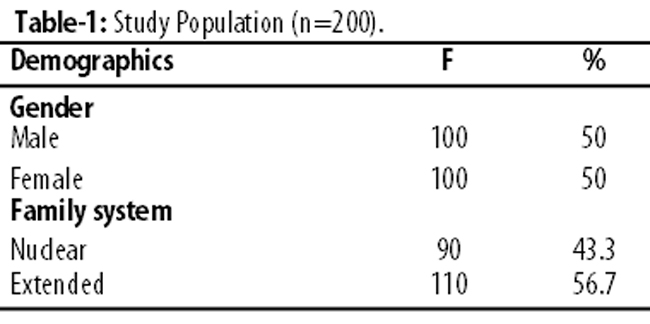
Facebook addiction had significant positive correlation with Narcissism (r=0.20; p<0.05). It had significant negative correlation with self-esteem (r=-0.18; p<0.05). The findings were non-significant for narcissism and self-esteem (r=0.05; p>0.05) (Table-2).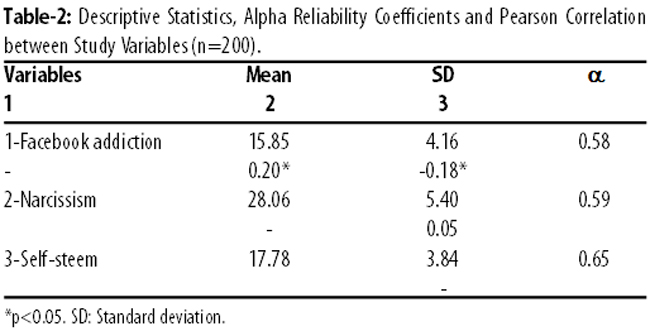
Facebook addiction had significant positive effect on narcissism (b=0.202; p<0.001) and significant negative effect on self-esteem (b=-0.18; p<0.001) (Table-3).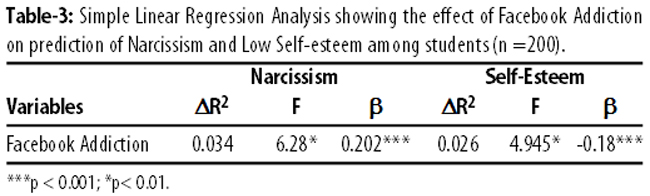
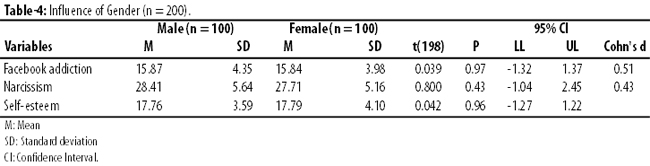
In terms of gender, the findings were non-significant for Facebook addiction (p>0.05), narcissism (p>0.05) and self-esteem (p>0.05).
Discussion
The study was designed to explore the relationship between Facebook addiction narcissism and self-esteem. Correlation analysis was run to test the first two hypothesis and results revealed that a significant positive relationship existed between Facebook addiction and narcissism. Results also supported the second hypothesis and revealed that Facebook addiction was negatively correlated with self-esteem. However, results of the present study are not supported by literature for the third hypothesis showing gender as having no effect on the studied variables.
Our results are consistent with earlier studies suggesting that Facebook addiction and narcissism are positively correlated. One study said people who are narcissistic use Facebook in a self-promoting way which can be identified by others. A personality questionnaire was given to almost 130 Facebook users and the data was interpreted.3 It found correlation between narcissism and Facebook addiction. Beautiful and self-promoting profile pictures were used by people with narcissistic personality.
Results of the present study are also consistent with a recent study on the effect of two socially disruptive elements of narcissism (grandiose exhibitionism and entitlement exhibitionism) on specific pattern of Facebook behaviours. With few exceptions, the results of that study were consistent with its hypotheses. It was also found that self-esteem was negatively related with the studied narcissistic behaviours.6
Another study showed that Facebook users were not narcissistic.4 A survey was conducted on 233 college students to predict whether the narcissistic personality is developed because of excessive use of social media sites or not. Results showed that people use Facebook and other social media sites to inflate their ego via sharing their photos and stories in their friends' circle as in person.4 Results of the present study are contrary to such results.
Another objective of the present study was to explore the relationship between Facebook addiction and self-esteem. Results indicated that the two were negatively correlated. A recent study also found a negative correlation between Facebook addiction and self-esteem.6
Facebook can enhance 'social self-esteem'.14 Facebook may provide opportunities to people with low self-esteem which helps to improve their self-esteem.15 A study concluded that teenagers were more willing to compromise their health, social life and studies for the sake of fun and entertainment or whatever satisfaction they get after using Facebook.16 Although there are many benefits of SNSs, but addiction can ruin the future of teenagers. Moreover, many psychological problems have also been reported due to SNS addiction.17 Participants with lower self-esteem had correlation with greater amount of time spent on Facebook. It is also believed that Facebook use is motivated by the need of belongingness and the need of self-presentation.17 All these studies support the results of the present study which argued that people with low self-esteem spend more time on Facebook and they have more chances to be addict of social networking sites.
The generalisability of findings of the current study is limited because the sample was only limited to the students of a single university, and, as such, was not representative of the general population. Facebook is being used all over the world and across all demographics.1 Replication of this study with other groups and variables is important. Perhaps in other cultures, narcissism expresses differently on Facebook addiction. Furthermore, socioeconomic status, education, and birth order of students were not taken into account. Future studies should include all such factors as well.
Conclusion
Significant relationship was found between Facebook addiction and narcissistic behaviour among students. It was also found that Facebook addiction significantly predicted narcissistic behaviour and low levels of self-esteem. Students spending more time on Facebook actually have low level of self-esteem and to compensate it, perhaps unconsciously, they show an even more serious narcissistic behaviour.
References
1. Ahmad A. Social network sites and its popularity. Int J Reser Rev Computer Sci 2011; 2: 522-6.
2. Toma CL, Hancock J. Affirming the self-online: Motives and benefits of Facebook use: Paper presented at the annual meeting of the International Communication Association. Boston, MA; 2011
3. Buffardi LE, Campbell WK. Narcissism and social networking web sites. Personality Soc Psychol Bull 2008; 34: 1303-14.
4. McKinney B, Kelly L, Duran RL.Narcissism or Openness?: College Students' Use of Facebook and Twitter. Communication Research Reports 2012; 29: 108-18
5. Wilson K, Fornasier S, White KM.. Psychological Predictors of Young Adults' Use of Social Networking Sites. Cyberpsychology Behavior Social Networking 2010; 13:173-7
6. Carpenter CJ. Narcissism on Facebook: Self-promotional and anti-social behavior. Personality Individual Differences 2012; 52: 482-6
7. Echeburua E, de Corral P. [Addiction to new technologies and to online social networking in young people: A new challenge.] Adicciones 2010; 22: 91-5
8. Denti L, Barbopoulos I, Nilsson I, Holmberg L, Thulin M, Wendebland M, et al. Sweden?s largest facebook study. Gothenburg research Institute Report, University of Gothenburg; 2012
9. Forest AL, Wood JV. When Social Networking Is Not Working Individuals With Low Self-Esteem Recognize but Do Not Reap the Benefits of Self-Disclosure on Facebook. Psychol Sci 2012; doi: 10.1177/0956797611429709
10. Karaiskos D, Tzavellas E, Balta G, Paparrigopoulos T. Social Network addiction: A new clinical disorder? Eur Psychiatr 2010; 25: 855
11. Andreassen CS, Torsheim T, Brunborg GS, Pallesen S. Development of Bergen Facebook Addiction Scale. Psychol Rep2012; 110: 501-17.
12. Hendin HM, Cheek JM. Assessing Hypersensitive Narcissism: A Re-examination of Murray's Narcissism Scale. J Res Personality 1997; 31: 588-99.
13. Rosenberg M. Society and the Adolescent Self-Image. Morris Rosenberg. Princeton University Press, Princeton, N.J., Science 1965; 148: 804
14. Valkenburg PM, Peter J, Schouten MA. Friends networking sites and their relationship to adolescents'well-being and social self-esteem. Cyberpsychol Behav 2006; 9: 584-90
15. Ellison NB, Steinfield C, Lampe C. The Benefits of Facebook "friends": Social Capital and College Students' use of Online Social Network Sites. J Computer-Mediated Communication 2007; 12: 1143-68
16. Farooqi H, Patel H, Aslam HM, Ansari IQ, Khan M, Iqbal N, et al. Effect of Facebook Addiction on Medical University Students. Int Arch Med 2013; 6: 40
17. Tariq M, Mehboob M, Khan A, FaseehUllah. The Impact of Social Media and Social Networks on Educationand Students of Pakistan. Int J Computer Sci Issues 2012; 9: 407-11.
Journal of the Pakistan Medical Association has agreed to receive and publish manuscripts in accordance with the principles of the following committees:


