

Ibrar Rafique ( Pakistan Medical Research Council Islamabad. )
Muhammad Arif Nadeem Saqib ( Pakistan Medical Research Council Islamabad. )
Muhammad Arif Munir ( Pakistan Medical Research Council Islamabad. )
Shajee Siddiqui ( Pakistan Institute of Medical Sciences, Islamabad. )
Huma Qureshi ( Pakistan Medical Research Council Islamabad. )
Sultana Habibullah ( PMRC Research Centre, Dow Medical College, Karachi. )
Saira Bashir ( PMRC Research Centre, Fatima Jinnah Medical College, Lahore. )
Sana Rehman ( PMRC Research Centre, King Edward Medical University, Lahore. )
Sajjad Ashraf ( PMRC Research Centre, Punjab Medical College, Faisalabad. )
March 2015, Volume 65, Issue 3
Original Article

Abstract
Objectives: To assess the economic burden of dengue infection by calculating cost per patient and disability adjusted life years lost.
Methods: The cross-sectional study was conducted in Islamabad, Lahore, Faisalabad and Karachi from July 2012 to March 2013. Residential addresses and telephonic numbers of dengue patients were taken from the records of Pakistan Institute of Medical Sciences, Islamabad, Mayo and Ganga Ram Hospital, Lahore, Civil Hospital, Karachi, and Allied Hospital, Faisalabad. A total of 250 dengue confirmed cases - 50 from each hospital - were randomly selected. Information regarding duration of illness and out-of-pocket expenses were collected to estimate the direct cost, while indirect cost (number of work days missed by the patient) was calculated from disability adjusted life years using Murray\'s formula.
Results: Overall, there were 162(65%) men and 88(35%) with a mean age of 30.4±13.5years. More than half 138(55%) were below 30 years of age. Socio-economically, 145(58%) belonged to low, 70(28%) middle and 35(14%) to high socioeconomic groups. Of the total, 210(84%) cases had dengue fever followed by 32(12.8%) dengue haemorrhagic fever and 8(3.2%) dengue shock syndrome cases. Average duration of illness was 32±7.1 days. Overall direct cost per patient was Rs.35,823 (US$358) and average pre-hospitalisation, hospitalisation and post-hospitalisation was Rs.6154, Rs.21,242 and Rs.8,427 respectively. The overall disability adjusted life years per million population was 133.76.
Conclusions: Although the government had provided free treatment for dengue in public-sector hospitals, still patients had to pay Rs.21,242 during hospital stay, resulting in substantial burden which needs to be addressed.
Keywords: Dengue, Economic burden, 2011. (JPMA 65: 256; 2015).
Introduction
Dengue is a mosquito-borne viral infection that causes mild to severe illness. It is estimated that 50-100 million infections occur in over 100 endemic countries, putting almost half of the world\'s population at risk.1 The disease is transmitted to humans by the bite of female Aedes aegypti.2 Infection leads to a spectrum of diseases ranging from sub-clinical infection to dengue fever and most severe forms like dengue haemorrhagic fever (DHF) and dengue shock syndrome (DSS).3,4 In recent decades, dengue fever (DF) has become the second most prevalent mosquito-borne infection after malaria.5
The disease results in huge morbidity and mortality and causes significant economic burden in the endemic countries.5 The cost of disease is not only limited to patients and their families, but the government has also faced the burden. Cost of disease is generally categorised into direct and indirect costs.6 The direct cost comprises the expenses incurred on disease diagnosis, treatment and prevention of dengue, while the indirect cost is the economic value lost by households and society due to illness and premature mortality of dengue patients and productivity loss of household members and friends.6 The burden of disease is also showed in term of disability-adjusted life years (DALYs) which are based on disease incidence and provide estimates of the number of years lost due to premature death and number of years of life lived with disability.7
The economic burden of disease from different countries have shown substantial economic impact on families and societies. Recently Shepard et al. has analysed the economic burden of dengue in 12 Southeast Asian countries and reported a burden of US$950m or about US$1.65 per capita in these countries.8
In Pakistan, first case of dengue was reported in 1994 and later faced three dengue epidemics in 2006, 2010 and 2011 in Karachi and Lahore respectively.5 These epidemics caused many deaths and thousands got affected, resulting in huge impact on individuals and society. Although the government provided free treatment facilities for dengue patients, but still patients had to pay a large sum of money in terms of private consultation, diagnosis and medication before and after hospitalisation as well as during hospitalisation.
Different studies have been conducted to describe dengue in terms of clinical picture, diagnosis, treatment and prevention. However, little data is available from Pakistan in terms of economic burden of dengue and its impact on the normal living of citizens. The current study was planned to assess the economic burden of dengue infections on life in major cities of Pakistan.
Patients and Methods
The cross-sectional study was conducted in Islamabad, Lahore, Faisalabad and Karachi from July 2012 to March 2013. Residential addresses and telephonic numbers of dengue patients were taken from the records of Pakistan Institute of Medical Sciences, Islamabad, Mayo and Ganga Ram Hospital, Lahore, Civil Hospital, Karachi, and Allied Hospital, Faisalabad, after permission was taken from the institutional heads. A total of 250 dengue confirmed cases — 50 from each hospital — were randomly selected. Those selected were either contacted telephonically or visited in person. After taking informed consent from the participants, interviews were conducted using a pre-designed proforma. The information documented were patient\'s demographic and socioeconomic status, duration of illness (pre-hospital, hospital and post-hospital) and questions for calculating the direct and indirect cost. The direct cost included the expenses incurred by patients in pre-hospitalisation, hospitalisation and post-hospitalisation phases. Pre-hospitalisation expenses were private consultation fee, medication, diagnosis etc., while hospitalisation expenses were transportation cost related to both patients and accompanying relatives, charges of medicine and tests paid by patients themselves, food and lodging of the accompanying relatives. Similarly, the post-hospitalisation cost comprised consultation, medicine and extra supplements if taken by the patients. The indirect cost included number of workdays missed by the patient and accompanying relatives due to the illness. The questionnaire was filled by the researchers for each participant.
Data was entered in MS excel sheet and analysed for average and percentages. The DALYs lost was calculated using Murray\'s formula.9 Cost per patient was calculated by taking the average cost borne by each patient. The hospital cost (which included nursing care, food, lab investigations, physician\'s time and other administrative costs) was taken as Rs.458/patient/day as reported previously.10
Formula for calculation of DALYs:
-[DCe-ba/(b+r)2 = {e-(b+r)(L) (1+ (b+r) (L+a)) - (a+(b+r) a)}]
where D is disability weight (or 1 for premature mortality); r is the discount rate; C is the age weighting correcting constant; b is the parameter from the age-weighting function; a is the age of onset; L is the duration of disability or time lost due to premature mortality.
In the specific form used for calculating DALYs, r equals 0.03, b equals 0.04 and C equals 0.16243.9
The DALYs were multiplied by the number of cases in a year, and then summed up to give annual totals. These totals were then divided by the estimated population to give DALYs per million population per year.
A multiplication factor of 10 was used for estimation of under-reported cases of DF/DHF and disability weight of 0.81 as used in other studies.10,11
There were 21,245 dengue-confirmed cases in Punjab in 201112 and 1,533 in Sindh.13
Results
Overall, there were 162(65%) men and 88(35%) with a mean age of 30.4±13.5 years. More than half 138 (55%) were below 30 years of age. There were 65 (26%) students, 52 (21%) housewives, 40 (16%) labourer, 33 (13%) businessmen and 25 (10%) government employees etc. Socio-economically, 145 (58%) belonged to low, 70 (28%) middle and 35 (14%) to high socioeconomic groups. Of the total, 210(84%) cases had dengue fever followed by 32(12.8%) dengue haemorrhagic fever and 8(3.2%) dengue shock syndrome cases. Most of the patients 155 (62%) had undergone multiple diagnostic tests (enzyme-linked immunosorbent assay [ELISA] Immunoglobulin G [IgG], Immunoglobulin M [IgM], and NS1 antigen). Overall, 157(63%) had had private consultation before coming to public-sector hospitals. Average duration of illness was 32±7.1 days which included 6.25±4 days of pre-hospitalisation, 6.76±5 days of hospitalisation and 18.89±9days of post-hospitalisation (Table-1).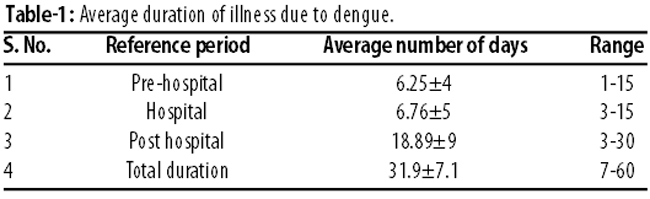
On average 2 persons were attending each patient.
Direct cost per patient was calculated to be Rs.35,823 which included an average pre-hospitalisation cost per patient of Rs.6,154, hospitalisation cost of Rs.21,242 and post-hospitalisation cost of Rs.8,427 (Table-2).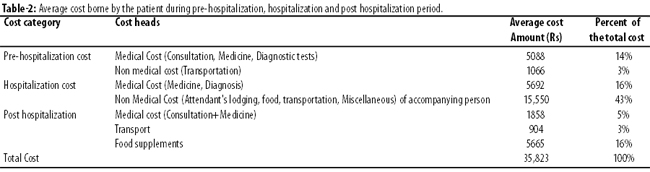
Total calculated DALYs were 103,438.2 and for per million population it was 133.76. Average number of days lost by the attendants of the patient were 13±8 days. DALYs lost per million population for Punjab was 214.18.
Discussion
The study showed that dengue illness had a substantial financial impact on patients in Pakistan. The average direct cost per patient was Rs.35,823 (US$358.23) which is much higher than previously reported from Thailand and Vietnam i.e. US$23-6114 and US$167.7715 respectively. Similarly, the calculated cost per patient is also much higher than the average monthly income per household i.e. Rs.21,785.16 The estimated pre-hospitalisation cost was Rs.6,154 which was incurred on private consultation, laboratory testing etc., indicating that patients preferred either to visit private healthcare provider or did self-treatment. This is also evident from the pre-hospitalisation duration which was about 6 days and may be overcome by educating people to visit the nearest facility after the appearance of symptoms.
Although the government had provided free treatment for dengue in public-sector hospitals, but out-of-the-pocket expenses of the patients during hospital stay was Rs.21,242 in which 73% were non-medical payments like attendants\' living, food, transportation and miscellaneous costs, including the family members\' visits, and only 27% were medical (medicine and laboratory tests). Similarly, these non-medical payments constitute about 43% of direct cost which is much higher than previous reported (10%) for other countries.17 This may be reduced by improving indoor facilities so that patients may stay in hospital without the attendants, and by discouraging family members of patients to avoid frequent hospital visits.
The average hospitalisation period was about 6.76 days which is consistent with recent report of retrospective analysis of two major hospitals of Lahore.18
The overall post-hospitalisation cost was Rs.8,427 in which major expenditure i.e. Rs.5,665 (67%) was due to use of food supplements. This is because of the common perception prevailing among patients and community that taking fresh juices and fruits help in quicker recovery. Further post-hospitalisation illness duration was about 18.89 days which was 1.5 times higher than pre-hospitalisation and hospitalisation. It was described earlier that dengue patients developed post-infection fatigue.19 Similarly, it was reported that sometimes patients might suffer from fatigue and depression after recovering from uncomplicated dengue.19 Although in the present study, such information was not collected, but higher post-hospitalisation illness shows that these patients might have faced similar problems.
DALYs for dengue infection was 133.76/million population which is more than 90-140 reported from Singapore,20 22 from Brazil21 and 83.83 from Myanmar.22 Higher DALYs are reported from other countries and regions: 427 in Thailand,23 658 in Peurto Rico,24 372 in southeast Asia,8 99 to 805 in Nicaragua,25 240 in 2008 and 400 in 2006 in Cambodia.6
Economic burden of dengue in terms of DALYs (133.76/million population) was more than that seen in other infections such as lower respiratory infections (76.9), diarrhoeal diseases (59.2), Human Immunodeficiency Virus/Acquired Immunodeficiency Syndrome (HIV/AIDS) (42.9), malaria (32.8), neonatal infections (31.4) and tuberculosis (22.4).26
The current study did not address the cost of dengue treatment incurred by the hospital, but a local study reported tertiary care hospital cost (including nursing care, food, lab investigations, physician\'s time and other administrative costs) as Rs.458/patient/day.11 If this is taken as the reference cost, hospitalisation cost for all admitted patients comes to around Rs.56 million.
The study was limited to tertiary care hospitals of major cities and only 50 admitted cases were enrolled from each station. As such, its findings cannot be generalised.
Conclusion
Major expenditure was incurred during hospital stay and most of it related to non-medical cost. Further, the average post-hospitalisation illness period was much higher resulting in increased DALYs. Comprehensive disease surveillance is required for timely management of disease and also to provide insight for future planning and research on dengue, especially to investigate whether patients suffered from post-dengue complications.
References
1. World Health Organization. WHO. [online] [cited 2013 Jan 5]. Available from URL: website www.who.int/dengue/mosquito/en/index.html
2. Heaton NS, Randall G. Dengue Virus and Autophagy. Viruses 2011; 3: 1332-41.
3. Halstead SB. Dengue. Lancet 2007; 370: 1644-52.
4. Mairuhu AT, Wagenaar J, Brandjes DP, Van EC. Dengue: an arthropod-borne disease of global importance. Eur J Clin Microbiol Infect Dis 2004; 23: 425-33.
5. Raheel U, Faheem M, Riaz MN, Kanwal N, Javed F, Zaidi NS, et al. Dengue fever in the Indian subcontinent: an overview. J Infect Dev Ctries 2011; 5: 239-47.
6. Beaute J, Vong S. Cost and disease burden of Dengue in Cambodia. BMC Public Health 2010; 10: 521.
7. Fox-Rushby JA, Hanson K. Calculating and presenting disability adjusted life years (DALYs) in cost effectiveness analysis. Health Policy Planning 2001; 16: 326-31
8. Shepard DS, Undurraga EA, Halasa YA. Economic and Disease Burden of Dengue in Southeast Asia. PLoS Negl Trop Dis 2013; 7: e2055. doi:10.1371/ journal.pntd.0002055.
9. Murray CJ.Quantifying the burden of disease: the technical basis for disability adjusted life years. Bull World Health Org 1994; 72: 429-45.
10. Hazir T, Qazi S.A, Abbas KA, Khan MA. Therapeutic Re-appraisal of Multiple Drug Resistant Salmonella Typhi (MDRST) in Pakistani Children. J Pak Med Assoc 2002; 52: 123-7
11. Clark DV, Mammen MP, Nisalak A, Puthimethee V, Endy TP. Economic Impact of Dengue Fever/Dengue Hemorrhagic Fever In Thailand at the family and population levels Am J Trop Med Hyg 2005; 72: 786-91.
12. Dengue in Punjab. [online] [cited 2013 March 3] Available from: URL: http://dengue.punjab.gov.pk/?q=node/234.
13. Weekly Dengue & Malaria Bulletin Sindh Province. Report week 51, 16 December - 22 December 2011.
14. Okanurak K, Sornmani S, Indaratna K. The cost of dengue hemorrhagic fever in Thailand. Southeast Asian J Trop Med Public Health 1997; 28: 711-7.
15. Tam PT, Dat NT, Huu LM, Thi XC, Duc HM, Tu TC, et al. High household economic burden caused by hospitalization of patients with severe dengue fever cases in Can Tho province, Vietnam. Am J Trop Med Hyg 2012; 87: 554-8.
16. Pakistan Bureau of Statistics. [online] [cited 2013 March 3] Available from: URL: http://www.pbs.gov.pk/sites/default/files/ pslm/publications/hies10_11/tables/table11.pd
17. Suaya JA, Shepard DS, Siqueira JB, Martelli CT, Lum LC, Tan LH, et al. Cost of dengue cases in eight countries in the Americas and Asia: a prospective study. Am J Trop Med Hyg 2009; 80: 846-55.
18. Saqib MA, Rafique I, Bashir S, Salam AA. A retrospective analysis of dengue fever case management and frequency of co-morbidities associated with deaths. BMC Res Notes 2014; 7: 205.
19. Raymond CSS, Amy MLQ, Erle CHL. Post-infectious fatigue syndrome in dengue infection. J Clin Virol 2007; 38: 1-6
20. Carrasco LR, Lee LK, Lee VJ, Ooi EE, Shepard DS, Thein TL, et al. Economic Impact of Dengue Illness and the Cost-Effectiveness of Future Vaccination Programs in Singapore. PLoS Negl Trop Dis 2011; 5: e1426.
21. Luz PM, Grinsztejn B. Galvani AP. Disability adjusted life years lost to dengue in Brazil. Tropical Med Int Health 2009; 14: 237-46.
22. Naing CM. Assessment of dengue hemorrhagic fever in Myanmar. Southeast Asian J Trop Med Public Health 2000; 31: 636-41.
23. Clark DV, Mammen MP, Nisalak A, Puthimethee V, Endy TP. Economic Impact of Dengue Fever/Dengue Hemorrhagic Fever in Thailand at the family and population levels. Am J Trop Med Hyg 2005; 72: 786-91.
24. Meltzer MI, Rigau-pe JG, Clark GG, Reiter P, Gubler DJ. Using disability-adjusted life years to assess the economic impact of dengue in Puerto Rico: 1984-1994. Am J Trop Med Hyg 1998; 59: 265-71.
25. Wettstein ZS, Fleming M, Chang AY, Copenhaver DJ, Wateska AR, Bartsch SM, et al. Total economic cost and burden of dengue in Nicaragua: 1996-2010. Am J Trop Med Hyg 2012; 87: 616-22.
26. Global Burden of Disease. Analysis categories and mortality data sources. WHO Report; 2004.
Journal of the Pakistan Medical Association has agreed to receive and publish manuscripts in accordance with the principles of the following committees:


