

Abubakar Tauseef ( 4th Year MBBS Students, Dow Medical College, Dow University of Health Sciences, Karachi. )
Wajahat Fareed ( 4th Year MBBS Students, Dow Medical College, Dow University of Health Sciences, Karachi. )
Anaam Bugti ( 4th Year MBBS Students, Dow Medical College, Dow University of Health Sciences, Karachi. )
Mohammad Hasham Naim ( 2nd Year MBBS Student, Dow Medical College, Dow University of Health Sciences, Karachi. )
Muhammad Nawaz Lashari ( Department of Cardiology, Dow University of Health Sciences, Civil Hospital, Karachi. )
February 2015, Volume 65, Issue 2
Student's Corner

Abstract
Objective: To evaluate comorbidities and risk factors among ischaemic heart disease patients.
Methods: The descriptive study was conducted at the cardiology wards of three hospitals in Karachi, and comprised and comprised data related to patients from September 5, 2013 to January 15, 2014. Data was analysed using SPSS 20.
Results: Out of 377 individuals, 238(63.1%) were males and 139(36.9%) were females. Depression outnumbered all other comorbids 137(58%) in males and 103(74%) in females. It was followed by anxiety in 129(54%) males and 90(65%) females. In risk factors, high-cholesterol diet outnumbered all other risk factors 137(58%) followed by stressful life 123(52%)in males, while in females physical inactivity 91(65%)and stressful life 91(65%) both were leading risk factors.
Conclusion: A variety of risk factors existed in ischaemic heart disease patients. Special attention should be paid to stressful lifestyle and high cholesterol, two of the most common risk factors in both genders.
Keywords: Risk factor, Ischaemic heart disease, Karachi. (JPMA 65: 235; 2015)
Introduction
Ischaemic heart disease (IHD), the leading cause of death in most Western countries, is a "cardiovascular" disease - literally meaning a disorder affecting the heart and/or blood vessels. In IHD, the blood vessels that supply the heart become increasingly narrow. Eventually, the flow of blood to the heart slows or stops, causing chest pain (angina), breathlessness and heart attack,1 it has been considered the leading cause of mortality and morbidity across the world.
IHD has been associated with a large number of comorbidities like obesity, which is an increasingly prevalent metabolic disorder affecting not only the US population, but also that of the developing world. IHD usually occurs among the obese as the body mass index (BMI) increases along with variation in distribution of body fat, leading to dyslipidaemias, atherosclerosis, hypertension and then finally IHD.2
Diabetes mellitus (DM) is also considered an IHD comorbid as it usually leads to kidney damage (kidney failure) leading to hypertension and further narrowing of the vessels and ultimately to IHD.3,4
Psychic conditions like anxiety and depression may also lead to IHD as mood and anxiety disorders in particular have been linked to heart disease, with researches showing that those displaying symptoms of anxiety or depression are at higher risk for cardiovascular-related morbidity and mortality.5,6 Those with the highest levels of anxiety have as much as a three-fold increase in risk for fatal IHD,7 and those with clinical depression have been shown to be at double the risk for cardiac incidents even as much as 10 years following the onset of depression.8 While it is clear that there is a link between these disorders, the connection itself is not well understood.
Chronic anaemia increases preload, reduce after load, and leads to increased cardiac output.9 Anaemia is also linked with IHD as it usually exacerbates the condition and leads to heart failure. Anaemia in heart failure is believed to develop due to a complex interaction of iron deficiency, kidney disease and cytokine production, although micronutrient insufficiency and blood loss may contribute.10 There are pathophysiological reasons why the presence of anaemia may lead to adverse cardiovascular consequences. In the long term, this may result in maladaptive left ventricular hypertrophy (LVH), which, in turn, is a well-recognised risk factor for cardiovascular disease (CVD) outcomes and mortality. In theory, the presence of anaemia may also exacerbate cardiac ischaemia as a result of decreased supply or increased demand for oxygen, such as in patients with underlying coronary disease or those with LVH.11
IHD has great association with sleep disorders as they play a role in CVD. The exact role that they play is still not quite clear.CVD was a leading cause of death in a cross-sectional study of 5419 Finnish adult men. A higher prevalence of diagnosed myocardial infarction (MI) was found among those who slept more than 9 hours, whilst those sleeping less than 6 hours per night had more symptomatic coronary heart disease (CHD), showing the relationship of sleeping disorders with IHD.12
IHD has been associated with a large numbers of risk factors, like smoking as the smoke contains those irritants which on one side increases carb oxy-haemoglobin to an unacceptable level while on the other hand it also contains irritants causing pulmonary oedema.13
Increased uptake of cholesterol in diet usually is a cause of atherogenesis, leading to narrowing of the vessels then to hypoxia of cardiac muscles, and finally to IHD.14
Obesity means increase in amount of body fat, which on the one hand leads to increase in vasculogenesis, increase in cardiac output and stroke volume output leading to LVH and IHD, while on the other hand the adipose tissue is not simply a passive storehouse for fat but an endocrine organ that is capable of synthesising and releasing into the bloodstream an important variety of peptides and non-peptide compounds that may play a role in cardiovascular homeostasis. Since homeostasis is disturbed in obesity, hence, the chance of IHD keeps rising.15
Physical inactivity has great association with increase in bodyweight leading to obesity which ultimately leads to IHD.16,17
Stress usually has an adverse effect on heart as brain and heart work closely and continuous stress leads to hypertension, ultimately leading to CVD.18
High salt intake is mostly not always considered to be the cause of IHD as high-salt diet leads to hypertension, ultimately leading to IHD and it is also considered to be a cause of mortality in CVD. On the basis of the results of a meta-analysis of randomised controlled trials of salt reduction, it was estimated that a reduction in habitual dietary salt intake of 6g a day would be associated with reductions in systolic/diastolic blood pressure of 7/4mmHg in people with hypertension and 4/2mmHg in those without hypertension.19
Dyslipidaemia means deranged lipid profile, i.e. bad cholesterol, low-density lipoprotein (LDL) very low-density lipoprotein (VLDL) and triglycerides (TG), increase from the normal level, while good cholesterol, the high-density lipoprotein (HDL), decreases to below acceptable range. This derangement usually leads to atherogenesis and to IHD.20-22
The current study was planned to evaluate the frequency of comorbidities and risk factors among males and females, and to find out the most common risk factors and comorbidities associated with IHD in patients of both genders.
Patients and Methods
The descriptive questionnaire-based study was conducted at Cardiology Wards of the National Institute of Cardiovascular Disease (NICVD), Liaquat National Hospital (LNH) and Civil Hospital, Karachi (CHK), from September 5, 2013, to January 15, 2014.
A preform was designed to have two sections; first section covered demographic details, while the second section was further divided into two compartments. The first included comorbidities, i.e. hypertension, DM, dilated cardiomyopathy (DCMP), neuropsychiatric disorders like anxiety, depression, Alzheimer\'s disease, and cognitive disorders, as well as anaemia and sleeping disorders. The second sub-section included risk factors i.e. smoking, high-cholesterol diet, obesity, physical inactivity, stressful life, high salt intake and dyslipidaemia.
After approval by the institutional review boards, a sample size was calculated by using Arosoftware formula by using 5% as margin of error, 95% as confidence interval (CI), 20,000 as a population size and response distribution as 50%. The division of sample among the three hospitals was done randomly on the basis of the burden of heart patients. Subjects for this study were selected using convenience sampling.
Those who refused to sign consent and those who were not suffering from IHD were excluded. The proforma was filled up during one-on-one sessions with all the subjects individually. Data was analysed using SPSS 20.
Results
There were 377 patients in the study; 100(26.5%) from CHK, 200(53%) from NICVD, and 77(20.4%) from LNH. Overall, there were 238(63.1%) males and 139(36.9%) females.
Among the males, depression 137(58%) outnumbered all other comorbidities, followed by anxiety 129(54%). Among the females, depression was the leading comorbid 103(74%) followed by anxiety 90(65%) (Table).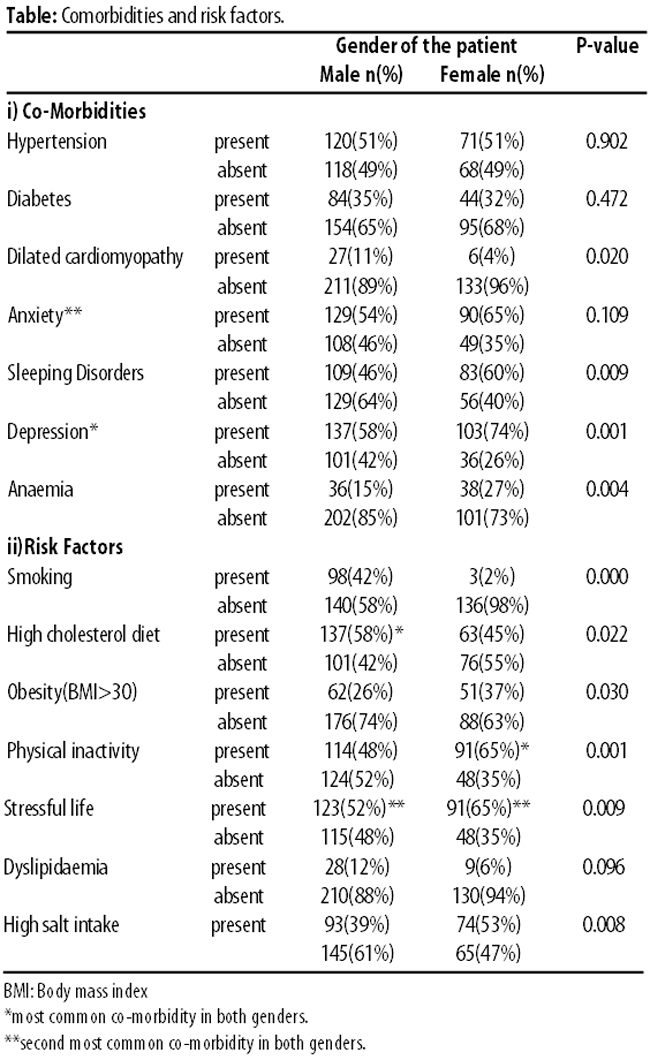
High-cholesterol diet 137(58%) outnumbered all other risk factors among the males followed by a stressful life 123(52%). Among the females, physical inactivity and stressful life both had the same frequency of 91(65%).
Discussion
The study showed interesting results.
An earlier study showed that 2.55% of IHD patients had diabetes as a comorbid associated with it while in our study 34.2% patients had diabetes as a comorbidity, highlighting the fact that diabetes is one of the commonest comorbidities associated with IHD.23
Literature has also quoted that 26% IHD patients had anxiety as a comorbid, while in our study 58.1% had anxiety.24
According to another study which was conducted in France in 2010, 4.99% IHD patients had depression as a comorbid, while in our study 63.6% had depression; a huge and alarming difference.25
Another study which was conducted in Canada showed that 5.4% IHD patients had smoking as a risk factor, while in our study it was 26.8%.26
A study conducted in Gujarat, India, showed that 56% IHD patients had dyslipidaemia, while in our study there were 9.8%.27
Conclusion
A variety of modifiable risk factors exist in patients with coronary heart disease. Special attention should be paid to stressful lifestyle, high cholesterol and physical inactivity; three of the most common IHD risk factors in both genders.
References
1. Di Angelantonio E, Danesh J, Eiriksdottir G, Gudnason V. Renal Function and Risk of Coronary Heart Disease in General Populations: New Prospective Study and Systematic Review. PLoS Med 2007; 4: e270
2. Eckel RH. Obesity and Heart Disease: A Statement for Healthcare Professionals From the Nutrition Committee, American Heart Association. Circulation 1997; 96: 3248-50.
3. Grundy SM, Benjamin IJ, Burke GL, Chait A, Eckel RH, Howard BV, et al. Diabetes and cardiovascular disease: a statement for healthcare professionals from the American Heart Association; Circulation 1999; 100: 1134-46.
4. Shaikh A, Shah AH, Gurbakhshani KM, Ansari I, Yasin G. Prevalence of Ischemic Heart Disease in Diabetes Mellitus. Med Channel 2005; 11: 20-2.
5. Larsen BA, Christenfeld NJ. Cardiovascular disease and psychiatric comorbidity: the potential role of perseverative cognition. Cardiovasc Psychiatry Neurol 2009; 2009: 791017.
6. Kimbro LB, Steers WN, Mangione CM, Duru OK, Ettner SL. The Association of Depression and the Cardiovascular Risk Factors of Blood Pressure, HbA1c, and Body Mass Index among Patients with Diabetes: Results from the Translating Research into Action for Diabetes Study; Int J Endocrinol 2012; 2012: 747460.
7. Kawachi I, Sparrow D, Vokonas PS, Weiss ST. Symptoms of anxiety and risk of coronary heart disease: The Normative Aging Study. Circulation 1994; 90: 2225-29.
8. Ford DE, Mead LA, Chang PP, Cooper-Patrick L, Wang NY, Klag MJ. Depression is a risk factor for coronary artery disease in men: the precursors study. Arch Intern Med 1998; 158: 1422-26.
9. Baigent C, Burbury K, Wheeler D. Premature cardiovascular disease in chronic renal failure. Lancet 2000; 356: 147-152.
10. Felker GM, Stough WG, Shaw LK, O\'Connor CM. Anaemia and coronary artery disease severity in patients with heart failure. Eur J Heart Fail 2006; 8: 54-57.
11. Vlagopoulos PT, Tighiouart H, Weiner DE, Griffith J, Pettitt D, Salem DN et al. Anemia as a risk factor for cardiovascular disease and all-cause mortality in diabetes: the impact of chronic kidney disease. J Am Soc Nephrol 2005; 16: 3403-1.
12. Partinen M, Putkonen PT, Kaprio J, Koskenvuo M, Hilakivi I. Sleep disorders in relation to coronary heart disease. Acta Med Scand Suppl 1982; 660: 69-83.
13. Oram S, Smoking and ischaemic heart disease. Br Heart J 1968; 30: 145-50.
14. Kratz M. Dietary cholesterol, atherosclerosis and coronary heart disease. Handb Exp Pharmacol 2005; 170: 195-213.
15. Poirier P, Giles TD, Bray GA, Hong Y, Stern JS, Pi-Sunyer FX, et al. Obesity and cardiovascular disease: pathophysiology, evaluation, and effect of weight loss: an update of the 1997 American Heart Association Scientific Statement on Obesity and Heart Disease From the Obesity Committee of the Council on Nutrition, Physical Activity, and Metabolism. Circulation 2006; 113: 898-918.
16. Bunker SJ, Colquhoun DM, Esler MD, Hickie IB, Hunt D, Jelinek VM, et al. "Stress" and coronary heart disease: psychosocial risk factors. Med J Aust 2003; 178: 272-6.
17. Umesawa M, Iso H, Date C, Yamamoto A, Toyoshima H, Watanabe Y, et al. Relations between dietary sodium and potassium intakes and mortality from cardiovascular disease: the Japan Collaborative Cohort Study for Evaluation of Cancer Risks. Am J Clin Nutr 2008; 88: 195-202.
18. Chaudhry AH, Muhammad D, Sharif MA, Ahmad N. Study of various risk factors in patients with Ischemic Heart Disease. Professional Med J 1996; 3: 151-9.
19. Strazzullo P, D\'Elia L, Kandala NB, Cappuccio FP. Salt intake, stroke, and cardiovascular disease: meta-analysis of prospective studies. BMJ 2009; 339: b4567.
20. Goldschmid MG, Barrett-Connor E, Edelstein SL, Wingard DL, Cohn BA, Herman WH. Dyslipidemia and ischemic heart disease mortality among men and women with diabetes. Circulation 1994; 89: 991-7.
21. Akram Z, Sarwar M, Shafi T, Kamal T, Aziz T, Sheikh SA. Risk factor analysis of Ischemic Heart Disease in patients presenting for Coronary Angiography at Punjab Institute of Cardiology, Lahore - Initial results of ongoing prospective study. Pak J Cardiol 1999; 10: 115-20.
22. Tauheed S, Shoaib S, ul Haque MN. Levels of non-high density lipoprotein cholesterol (Non-HDL-C) in patients with ischemic heart disease. J Ayub Med Coll Abottabad 2003; 15: 33-4.
23. Barrett-Connor EL, Cohn BA, Wingard DL, Edelstein SL. Why Is diabetes mellitus a stronger risk factor for fatal ischemic heart disease in women than in men? The Rancho Bernardo Study. JAMA 1991; 265: 627-31.
24. Hendrick B. Anxiety May Increase Risk of Heart Disease. Web MD Health News. 2010 (Cited Feb 2014). Available from URL: http://www.webmd.com/anxiety-panic/news/20100623/anxiety-may-increase-risk-of-heart-disease
25. Nabi H, Shipley MJ, Vahtera J, Hall M, Korkeila J, Marmot MG, et al. Effects of depressive symptoms and coronary heart disease and their interactive associations on mortality in middle-aged adults: the Whitehall II cohort study. Heart 2010; 96: 1645-50.
26. Lamarche B, Tchernof A, Moorjani S, Cantin B, Dagenais GR, Lupien PJ, et al. Small, dense low-density lipoprotein particles as a predictor of the risk of ischemic heart disease in men. Prospective results from the Québec Cardiovascular Study. Circulation 1997; 95: 69-75.
27. Auti SS, Thakar AB, Shukla VJ, Ravishankar B. Assessment of Lekhana Basti in the management of hyperlipidemia. Ayu 2013; 34: 339-45.
Journal of the Pakistan Medical Association has agreed to receive and publish manuscripts in accordance with the principles of the following committees:


