

Sara Habib ( Department of Medicine, Health Sciences and Medicine, Aga Khan University,Karachi. )
Romaina Iqbal ( Departments of Community Health Sciences and Medicine, Aga Khan University, Karachi. )
Muhammad Shahid ( Department of Endocrinology, Liaquat National Hospital, Karachi. )
Aysha Habib ( Department of Medicine, Health Sciences and Medicine, Aga Khan University,Karachi. )
February 2015, Volume 65, Issue 2
Letter to the Editor

Madam, life expectancy in Pakistan has increased from 46.6 years in 1960 to 65.4 years in 2010 and is projected to reach 72.4 years in 2023.1 With a steady increase in elderly population and poor nutrition, osteoporosis is attaining the rank of a major public health problem in Pakistan. It is estimated that the cost of hip fractures in Pakistan varies between 4000 to 10000 USD depending on the hospital setting with an average hospital stay of 7-10 days.2 Consequently, osteoporosis is becoming a burden on the country\'s health infrastructure.
There is limited data on the prevalence of osteoporosis in Pakistan with wide variations in reported estimates. A study conducted in different socioeconomic strata of Karachi reported that 6.7% of post-menopausal women were suffering from osteoporosis and 32.4% from osteopenia,3 whereas a study from an ambulatory setting in Lahore reported that 18.6% of the population had osteoporosis while 64.1% had osteopenia.2
The majority of the population in the developing countries lives in rural areas with inadequate access to health care facilities. Consequently, osteoporosis remains under diagnosed and untreated leading to fractures causing an even higher cost burden and prolonged disability. Osteoporosis has attracted little attention in this population due to several other reasons, such as lack of awareness, accepting osteoporosis as an inevitable disease of the old age, preoccupation of the healthcare system towards infectious diseases and the belief that osteoporosis being the disease of the developed nation does not pose any threat to the developing countries.5
Keeping the above facts in light, we conducted a cross-sectional community-based study from January 2011 to December 2011 investigated the status of bone mineral density of adult residents in Gadap, a peri urban area of Karachi, Pakistan. Calcaneal ultrasound was performed on 238 adults, between the ages of 35 and 75 years. The T-scores were classified into "Normal", "Osteopenia" and "Osteoporosis" in accordance with the standard T-score values allotted by the World Health Organization.6 The mean age of the population was 50.3 ± 9.9 years. The analysis revealed that the prevalence of osteoporosis was 16.4%, of this, 20.3% were females and 11.8% were males while osteopenia was present in 45.8%. The gender and age distribution and their association with osteoporosis and osteopenia are presented in Table.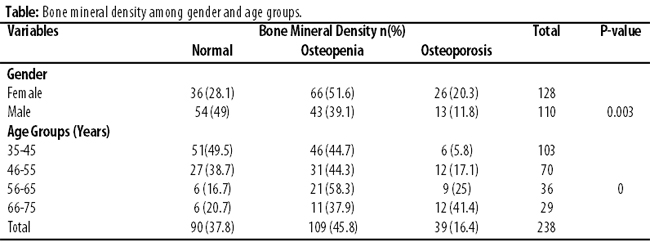
Our findings, albeit on a small sample, are indicative of a rise in prevalence of osteoporosis. This warrants more and better designed researches to estimate prevalence of osteoporosis and identify risk factors specific for our population, as well as development of effective implementation programmes to address the modicum of awareness about this serious health issue.
References
1. International Data Base IDB. International Programs Center, Population Division, US Bureau of Census, 2004.
2. Mithal A, Dhingra V, Lau E. The asian audit: Epidemiology, costs and burden of osteoporosis in Asia. Beijing, China: An International Osteoporosis Foundation (IOF) publication; 2009.
3. Baig L, Mansuri FA, Karim SA. Association of menopause with osteopenia and osteoporosis: results from population based study done in Karachi. J Coll Physicians Surg Pak 2009; 19: 240-4.
4. Nagi D, Butt Z, Farooq F, Aamar A. Frequency of osteoporosis in an ambulatory setting in Lahore using quantitative calcaneal ultrasound. J Pak Med Assoc 2013; 63: 965-8.
5. Handa R, Ali Kalla A, Maalouf G. Osteoporosis in developing countries. Best Pract Res Clin Rheumatol 2008; 22: 693-708.
6. Woolf AD, Pfleger B. Burden of major musculoskeletal conditions. Bull World Health Organ 2003; 81: 646-56.
Journal of the Pakistan Medical Association has agreed to receive and publish manuscripts in accordance with the principles of the following committees:


