

Rehan Rais ( Medical Student, Liaquat National Hospital and Medical College, Karachi. )
Mohammad Saeed ( Department of Rheumatology, Liaquat National Hospital and Medical College, Karachi. )
Rimsha Haider ( Medical Student, Liaquat National Hospital and Medical College, Karachi. )
Zahra Jassani ( Medical Student, Liaquat National Hospital and Medical College, Karachi. )
Amir Riaz ( Department of Rheumatology, Liaquat National Hospital and Medical College, Karachi. )
Tahira Perveen ( Department of Rheumatology, Liaquat National Hospital and Medical College, Karachi. )
December 2014, Volume 64, Issue 12
Student's Corner

Abstract
Objective: To determine the presentation patterns, biologically vulnerable patient groups and treatment strategies of rheumatoid arthritis.
Methods: The retrospective study was conducted at the Rheumatology Clinic of Liaquat National Hospital and Medical College, Karachi, and comprised data of rheumatology patients who presented between September 2006 and September 2012. After screening all the files, rheumatoid arthritis cases were identified. Data collection was done using a questionnaire that included patient demographics, co-morbidities, clinical manifestations and drug therapy. SPSS 13 was used for statistical analysis.
Results: Of the 2300 files screened, 500(21.7%) related to patients of rheumatoid arthritis. The mean age at presentation of these 500 patients was 41±15 years. There were 367(73.4%) women and they presented at an earlier age compared to men (p<0.024). Erosions were present in 198(40%) patients on X-rays and 22(4.4%) had joint deformities. Seropositive rheumatoid arthritis was associated with higher erythrocyte sedimentation rate levels (p<0.014), but did not differ from seronegative rheumatoid arthritis in terms of Disease Activity Score-28 levels (p<0.21).
Conclusions: The skewed gender distribution was likely an effect of rheumatoid arthritis biology rather than due to issues of healthcare accessibility. Seronegative RA is likely to present late though it is as destructive as the seropositive disease.
Keywords: Rheumatoid arthritis, Clinical features, Management, Pakistan. (JPMA 64: 1430; 2014).
Introduction
Rheumatoid arthritis (RA) is the most common form of polyarticular inflammatory arthritis characterised by persistent synovial inflammation, bony erosions and progressive articular destruction leading to varying degrees of physical disability.1 It affects approximately 0.5-1% of population all over the world.2 Worldwide variations in the prevalence of RA do exist, with low levels in rural Africa,3 Indonesia4 and other developing countries.5 In the urban population of southern Pakistan the prevalence of RA is reported to be 0.142%,6 whereas in northern Pakistan the estimated prevalence is 0.55%.7 It has been reported that RA has a higher prevalence rate in the affluent communities of Pakistan.8 Overall, RA shows heterogeneity in presentation, clinical course, extra-articular systemic manifestations and associated co-morbidities.1 The specialist referral in Pakistan is patient-driven; therefore patients choose to visit multiple physicians before deciding on the course of therapy. Hence, presentation of RA to the rheumatologist is variable.
In this regard, several issues need to be addressed. RA predominantly affects women and genetic factors account for a large degree of susceptibility to the disease.9 Health access to rheumatology services may have a degree of gender bias, perhaps leading to delayed presentation of women with RA. The prevalence is about 2.5 times higher in females than males.10 Rheumatoid factor (RF) positivity and anti-cyclic citrullinated peptide (anti-CCP) antibodies may lead to earlier referral to a rheumatologist than if these serological markers are absent. However, RF is found in up to 5% of healthy population as well.11 Seropositivity is associated with rheumatoid nodule formation in approximately 25% of patients as the most common extra-articular manifestation of RA12 and the presence of anti-CCP predicts more aggressive disease,13 but seronegative RA can be aggressive as well. Male gender, presence of RF, extra-articular manifestations and co-morbidity has been implicated as baseline predictors for increased mortality.14
Treatment strategies in our setting may differ from what may be international standards. Biologics have become an integral component of RA management in the West, but due to its expenses, they are usually avoided in healthcare settings such as ours. Thus, treatment strategies vary and even amongst non-biologics, dosing schedules coupled with patient\'s educational level and access to the rheumatology facility may determine the choice of disease-modifying anti-rheumatic drugs (DMARD) therapy.
The current study was designed to identify presentation patterns, biologically vulnerable patient groups and treatment strategies in the local population so that strategies could be devised to cater to patients\' needs in a healthcare system like ours.
Patients and Methods
The retrospective study was conducted at the Rheumatology Clinic of Liaquat National Hospital and Medical College, Karachi, and comprised data of rheumatology patients who presented between September 2006 and September 2012.
Data was collected using a questionnaire which included demographic information such as age and gender, clinical features of RA, disease activity score in 28 joints (DAS28), tender and swollen joint count, duration of morning stiffness and co-morbidities. X-rays findings were noted for deformities and erosions. Treatment regimens, including steroids and DMARDs, were documented.
Laboratory values included erythrocyte sedimentation rate (ESR) and C-reactive protein (CRP) at initial presentation. RF and anti-CCP statuses were also noted. DAS28 score of each patient was calculated. A DAS28 score higher than 5.1 was indicative of high disease activity, whereas a score below 3.2 indicated low disease activity.15 Based on the most recent clinical follow-ups, we determined response to therapy. Patients were classified as having complete response if they did not have any synovitis, and partial response if synovitis was present. Arthralgias were separately evaluated in these follow-ups. Data was analysed using SPSS 13. Descriptive statistics included frequencies and chi-square evaluation for categorical data such as gender and seropositivity. T-test was used to compare means.
Results
Of the 2,300 files screened, 500(21.7%) related to RA patients. The mean age at presentation of these patients was 41±15 years. There were 367(73%) females with a 3:1 gender ratio. Men present later in age than the females. The mean age at presentation of men was 43.7±18 years and of women it was 40.3±13 years (t=2.26, p<0.024).
There were 245(49%) seropositive RA patients, while 79(16%) were negative. RF data was not available in the rest of the cases. Anti-CCP levels of only 12(2.4%) patients were found with a mean value of 77.8±108.7 IU. The mean swollen joint count of all RA patients was 4±3 with the mean tender joint count being 5±4 and morning stiffness of 1.2±1.7 hours. ESR averaged 60±32 mm/hour.
Mean ESR was higher in seropositive (t=2.48; p<0.014; 95 Confidence Interval [CI]: 2.2-19.0). Seropositivity was not associated with age (t=1.55, p<0.12), disease activity (t=0.33, p<0.74), morning stiffness (t=0.47, p<0.64) or DAS28 score (t=1.25, p<0.21). Seronegative RA did not differ from seropositive RA in terms of DAS28 activity scores (p<0.09).
According to DAS28 scores, 203(41%) patients presented with moderate activity. Mild disease was present in 31(6%), while 72(14%) had severe disease, and 9(2%) presented in remission. DAS28 could not be calculated for the remaining patients. Erosions were present in 198(40%) patients on X-rays and 22(4%) had joint deformities.
Moreover, 65(24%) men presented with moderate to high disease activity compared with 210(76%) women (p<0.23), but the odds ratio showed a trend 1.06 (0.95-1.19) giving a Disease Activity Score of 28.
In terms of, 173(35%) patients did not require steroids at initial presentation (Figure).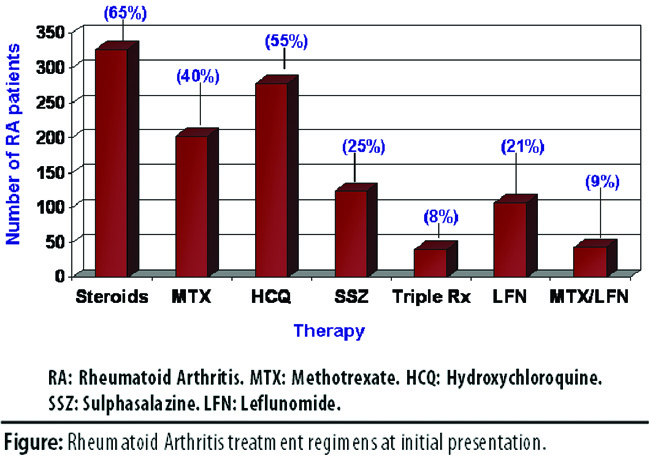
Methotrexate (MTX) and hydroxychloroquine (HCQ), followed by sulphasalazine (SSZ) were the preferred DMARDs in the cohort. Triple regimen therapy with MTX, SSZ and HCQ was infrequently used in 40((8%) patients.
We had follow-up data available for 212(42.4%) patients, of which 20% patients showed resolution of synovitis, while 17% had shown partial improvement and 5% of patients showed no improvement to the initial management. A small percentage of patients (2.8%) reported absence of pain at follow up visits. The minimum duration of follow-ups was 3 months.
Discussion
The study was aimed at understanding the patterns of RA disease presentation and management in a large tertiary care referral centre. The study determined that RA patients present to rheumatologists late in the course of their disease, with majority having at least moderate disease activity and a substantial proportion already having developed joint erosions. Males interestingly presented later than females and had lower DAS28 scores at presentation, indicating that the skewed gender distribution is likely an effect of RA biology rather than due to issues of healthcare accessibility.
ESR is correlated with seropositivity. It makes biological sense as RF is an Immunoglobulin M (IgM) against Immunoglobulin G (IgG), and therefore ESR is an indirect measure of immunoglobulin production. Presence of an elevated ESR and RF facilitate earlier referral to a rheumatologist. Hence, seronegative RA is likely to be more frequently missed due to lower ESR and absence of RF, thus delaying rheumatology referral. However, seronegative (RF-) RA did not differ in clinical disease activity from seropositive (RF+) RA and can result in similar morbidity. Thus, diagnosis and referral of seronegative RA is of greater concern.
Approximately 35% patients did not require steroids at initial presentation, indicating previous DMARD therapy prior to the referral. This could be due to our hospital being a tertiary care referral centre and patients presented for a second opinion. However, it is also likely that DMARD therapy had been initiated by non-rheumatologists and the patient did not present in acute disease. It is not clear, however, whether non-rheumatologists are familiar with DMARD management strategies and adverse drug reactions and if they can safely institute and monitor such therapies. Essentially these therapies should remain within the domain of rheumatologist as is the international practice. Steroids may be started and the patient should be referred to a rheumatology centre for evaluation and further management as soon as possible for the control of the inflammatory process. This will also decrease the frequency of deformities in RA patients which is the end goal of immunosuppressive therapy.
MTX and HCQ, followed by Leflunomide (LFN), were the preferred DMARDs in this study. Patients who received biologics could not be evaluated due to lack of such data at our centre as biologics are made available to the patients directly through pharmaceutical industry on separate forms. We are in the process of streamlining this shortfall. Combination therapy of MTX/HCQ/SSZ (Triple regimen) was infrequently used though its response is not inferior to tumour necrosis factor-alpha (TNF inhibitors.16 Initial combination therapy is known to result in earlier functional improvements and less structural damage than sequential monotherapy or step-up combination therapy.17
Conclusion
Referral of RA, especially seronegative strain, needs to be enhanced mainly through educational activities such as continuous medical education for referring physicians. Aggressive initial management with triple DMARD regimen should be encouraged to ensure rapid control of the disease.
References
1. Alam SM, Kidwai AA, Jafri SR, Qureshi BM, Sami A, Qureshi HH, et al. Epidemiology of rheumatoid arthritis in a tertiary care unit, Karachi, Pakistan. J Pak Med Assoc 2011; 61: 123-6.
2. Lawrence RC, Helmick CG, Arnett FC, Deyo RA, Felson DT, Giannini EH, et al. Estimates of the prevalence of arthritis and selected musculoskeletal disorders in the United States. Arthritis Rheum 1998; 41: 778-99.
3. McGill P. Rheumatoid arthritis in sub-Saharan Africa, Ann Rheum Dis 1991; 50: 965-6.
4. Darmawan J, Muirden K, Valkenburg H, Wigley R. The epidemiology of rheumatoid arthritis in Indonesia.Br J Rheumatol 1993; 32: 537-40.
5. Mendez-Bryan R, Gonzales-Alcover R, Roger L. Rheumatoid arthritis prevalence in a tropical area. Arthritis Rheum 1964; 7: 171-6.
6. Hameed K, Gibson T, Kadir M, Sultana S, Fatima Z, Syed A. The prevalence of rheumatoid arthritis in affluent and poor urban communities of Pakistan. Br J Rheumatol 1995; 34: 252-6.
7. Farooqi A, Gibson T, Prevalence of the major rheumatic disorders in the adult population of North Pakistan. Br J Rheumatol 1998; 37: 491-5.
8. Gibson T, Hameed K, Kadir M, Sultana S, Fatima Z, Syed A. Knee pain amongst the poor and affluent in Pakistan, Br J Rheumatol 1996; 35: 46-9.
9. Turesson C, Matteson EL. Genetics of rheumatoid arthritis, Mayo Clin Proc 2006; 81: 94-101.
10. Goronzy J, Cornelia M. Rheumatoid arthritis epidemiology, pathology and pathogenesis. In: Klippel JH, Wehand CM, Wortmann RL, ed. Primer on the rheumatic disease. 11th ed. Georgia: William M, 1997; pp 155-74.
11. Lipsily PE. Rheumatoid Arthritis. In: Fauci AS, Braunwald E, Raspur DL,Hauser SL, Lonjo DL, Jameson JL, eds. Harrison\'s principles of internal medicine. 17th ed. New York: McGraw Hill, 2008; pp 2083-92.
12. Magro CM, Crowson AN. The spectrum of cutaneous lesions in rheumatoid arthritis a clinical and pathological study of 43 patients. J Cutan Pathol 2003; 30: 1-10.
13. Marasovic-Krstulovic D, Martinovic-Kaliterna D, Fabijanic D, Morovic-Vergles J. Are the anticyclic citrullinated peptide antibodies independent predictors of myocardial involvement in patients with active rheumatoid arthritis? Rheumatol 2011; 50: 1505-12.
14. Young A, Koduri G, Batley M, Kulinskaya E, Gough A, Norton S, et al. Mortality in rheumatoid arthritis. Increased in the early course of disease in ischaemic heart disease and in pulmonary fibrosis. Rheumatol 2007; 46: 350-7.
15. Provide title please, unable to open webpage by given web address. (Online) (Cited 2014 July 17). Available from URL: http:// www.das-score.nl/www.das-score.nl/dasculators.html.
16. Isik M, Halacli B, Atmaca O, Etgül S, Do?an I, K?l?nç L, et al. Triple DMARD combination for rheumatoid arthritis resistant to methotrexate and steroid combination: a single-center experience. Rheumatol Int 2013; 33: 1425-7.
17. O\'Dell JR, Haire CE, Erikson N, Drymalski W, Palmer W, Eckhoff PJ, et al. Treatment of rheumatoid arthritis with methotrexate alone, sulfasalazine and hydroxychloroquine, or a combination of all three medications. N Engl J Med 1996; 334: 1287-91.
Journal of the Pakistan Medical Association has agreed to receive and publish manuscripts in accordance with the principles of the following committees:


