

Suresh Kumar Rathi ( Department of Medicine, ISRA University, Karachi. )
Raeefuddin Ahmed ( Abbott Laboratories (Pakistan) Limited, Karachi. )
August 2014, Volume 64, Issue 8
Original Article

Abstract
Objective: To study the prevalence of Group A beta haemolytic Streptococcus in patients with acute pharyngitis and correlation of Modified Centor Score and Rapid Antigen Detection Test.
Methods: The multi-centre, prospective, cross-sectional study was conducted in 8 major cities of Pakistan between June 2012 and February 2013, and comprised patients presenting with acute pharyngitis. The subjects were above 3 years of age presenting to primary care physician with sore throat, temperature over 100.4°F, tonsillar exudates and/or cervical adenopathy (duration of symptoms <14 days). They were scored using Modified Centor Score and were tested with Rapid Antigen Detection Test for Group A beta haemolytic Streptococcus. SPSS 19 was used for statistical analysis.
Results: Of the 5140 patients, 1299(25.3%) tested positive, for RADT Group A beta haemolytic Streptococcus in acute pharyngitis. There was no significant difference across different age groups (p<0.08). There was a strong correlation between Modified Centor Score and Rapid Antigen Detection Test results (p<0.001). Of the patients with positive result, 3(0.4%) had a Modified Centor Score <0; 23(1.8%) had score of 1; 152(11.7%) had score of 2; 511(39.3%) had score of 3; and 609(46.9%) had Centor score of >4.
Conclusion: The prevalence of Group A beta haemolytic Streptococcus as a cause of acute pharyngitis was 25.3%. Modified Centor Score had a strong positive correlation with Rapid Antigen Detection Test in identifying Group A beta haemolytic Streptococcus as a cause of acute pharyngitis.
Keywords: Acute pharyngitis, Group A beta haemolytic Streptococcus, Rapid Antigen Detection Test (RADT), Modified Centor Score. (JPMA 64: 928; 2014).
Introduction
Pharyngitis is a common reason for patients\' visit to doctors. Group A beta haemolytic Streptococci (GABHS) account for 15-30 per cent of cases of acute pharyngitis in children and 5 to 20 per cent in adults.1
As the signs and symptoms of GABHS pharyngitis overlap extensively with other infectious causes, it is difficult to make a diagnosis based solely on clinical findings. In patients with acute febrile respiratory illness, physicians accurately differentiate bacterial infections from viral ones using only the history and physical findings about one half of the time.2 No single element of the patient\'s history or physical examination reliably confirms or excludes GABHS pharyngitis.3 Sore throat, fever with sudden onset (temperature higher than 100.4°F [38°C]), and exposure to Streptococcus within the preceding two weeks suggest GABHS infection. Cervical node lymphadenopathy and pharyngeal or tonsillar inflammation or exudates are common signs. Palatal petechiae and scarlatiniform rash are highly specific, but uncommon; a swollen uvula is sometimes noted. Cough, coryza, conjunctivitis, and diarrhoea are more common with viral pharyngitis.
The original Centor score uses four signs and symptoms to estimate the probability of acute streptococcal pharyngitis in adults with a sore throat.4 The score was later modified by adding age and validated in 600 adults and children.5,6 The cumulative score determines the likelihood of streptococcal pharyngitis.
Rapid Antigen Detection Tests (RADTs) have been developed for the identification of GABHS directly from throat swabs. Although these rapid tests are more expensive than blood agar culture, they provide results in less than 10 minutes compared to throat swab cultures that can take 48 hours. Furthermore, for throat swab cultures, if no micro-organism is isolated in 48 hours, then one has to check the growth every day until 7 days to confirm that the test is truly negative.7 Rapid identification and treatment of patients with streptococcal pharyngitis can reduce the risk of the spread of GABHS, allowing the patient to return to school or work sooner, and can reduce the acute morbidity associated with the illness. The use of RADTs for certain populations (e.g., patients in emergency departments) has been shown to significantly increase the number of patients who are appropriately treated for streptococcal pharyngitis, compared with the use of traditional throat cultures.8
The great majority of the RADTs that are currently available have an excellent specificity of 95%, compared with throat swab culture. This means that false-positive test results are unusual, and, therefore, therapeutic decisions can be made with confidence on the basis of a positive test result.9 Unfortunately, the sensitivity of most of these tests is 80%-90%, or even lower, compared with throat swab culture. It has been suggested that most of the false-negative RADT results occur in patients who are merely Streptococcus carriers and are not truly infected.10 However, early studies of first-generation RADTs demonstrated that a large proportion of patients with false-negative RADT results were truly infected with GABHS and were not merely carriers.11,12
Acute pharyngitis is commonly encountered in clinics and hospitals across Pakistan. It is common not only in children, but also among adults. Limited data is available on the prevalence of this condition and existing data is from small single-centre studies.
The available data from Pakistan suggests that the most common bacterial organism is GABHS, but majority of throat swabs did not yield any isolate.13,14 The signs and symptoms of GABHS pharyngitis overlap extensively with other infectious causes, thus to make an etiologic diagnosis based solely on clinical findings is difficult. Improving diagnosis of bacterial causes of pharyngitis will lead to more rational use of antibiotics by clinicians, and potentially have a positive impact on the development of bacterial resistance in community-acquired infections.
The Modified Centor Score (MCS) is a valid tool to estimate the probability of acute streptococcal pharyngitis in patients with a sore throat. Patients with a score of -1, 0 or 1 are at very low risk for streptococcal pharyngitis and do not require testing (i.e., throat culture or RADT) or antibiotic therapy. Patients with a score of 2 or 3 should be tested using RADT or swab culture; positive results warrant antibiotic therapy. Patients with a score of 4 or above are at high risk of streptococcal pharyngitis, and empiric treatment may be considered.
The current study was conducted to study the prevalence of GABHS in patients with acute pharyngitis and correlation of MCS and RADT on a multi-centre scale.
Patients and Methods
The prospective, multi-centre, cross-sectional study was conducted in 8 major cities of Pakistan between June 2012 and February 2013. The cities included were Karachi, Hyderabad, Lahore, Multan, Faisalabad, Islamabad, Rawalpindi, and Peshawar. A non-random sequential sample of 5,140 subjects was selected from 5,000,000 individuals living in the participating cities. The prevalence of GABHS in pharyngitis is in the range of 5-30%, hence the prevalence was kept at 15%. Along with 1% precision, 95% confidence and 80% power and incorporating 5% for non-response/missing data, a number of 5,140 was found to be sufficient for the study. Male and female adult subjects of any age and children 3 years of age and above with signs of acute pharyngitis (duration of symptoms <14 days), subjects with sore throat, fever with sudden onset (temperature >100°F [38°C]), exposure to contacts with signs of acute pharyngitis within the preceding 2 weeks, subjects/guardians giving written consent for participation were included in the study.
Subjects were excluded if they had episodes of recurrent or persistent cases of sore throat, complicated pharyngitis (peritonsillar abscesses, Lemierre disease, Vincent\'s angina), severe comorbidity, immunosuppression or history of acute rheumatic fever or special circumstances, such as sore throat after travel in the preceding 2 weeks, sore throat linked to sexual transmission or rare epidemics (e.g. diphtheria).
All patients aged 3 years and above presenting with acute pharyngitis to their primary care physicians were enrolled in the study. Primary care physicians (PCPs) included those who see both children and adults and routinely treat patients with respiratory tract infections.
The study comprised only single visit which included signature of patient authorisation form to provide personal health data. Data-identifying subjects like name, date of birth, address, national identity card number were not collected to maintain patient confidentiality.
The investigators evaluated the patient for his/her symptoms. The subject once enrolled as one with acute pharyngitis, was scored on MCS.
Written authorisation was obtained from the patient or their legal guardian in the case of minors. Baseline demographic details were recorded on the Case Report Form (CRF). Those included in the study underwent RADT and the result of the test was recorded on CRFs which were forwarded for entry. Data was subsequently checked for any missing entry.
SPSS Version 19.0 was used for data analysis which was carried out in two steps: descriptive statistics and inferential analyses.
In descriptive analysis, frequencies were generated for normally distributed continuous variables. Percentages and proportions were reported for categorical variables. However, in order to estimate the prevalence of pharyngitis, a binary variable of "pharyngitis status" was created. For all independent categorical variables, cross-tabulation was performed in order to look for sparse data. Categories with sparse data were merged together on the basis of data presentation.
Correlation between MCS and the predictive value of pharyngitis test results was also conducted. P <0.05 was considered statistically significant.
Results
Of the 5140 subjects in the study, 3140(61.1%) were male and 2000(38.9%) were females. All the subjects were assessed for MCS (Table).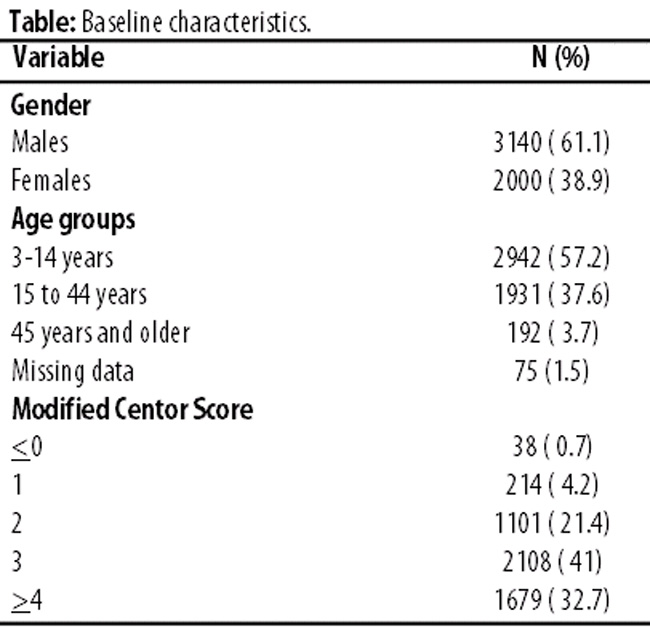
The subjects were tested with RADT and 1299(25.3%) tested positive. Among them, 61.8% were males and 38.2% were females. Besides, 780 (60.7%) subjects aged 3 to 14 years were positive, 462 (35.5%) of those 15-44 years of age, and 43 (3.3%) of those >45 years of age.
The study showed prevalence of GABHS as a cause of pharyngitis as 780 (26.5%) in children between the age 3-14 years, 462 (24%) in the age group of 15 to 44 years, and 43 (22.4%) among patients 45 years or older. There was no statistical significance among different age groups.
There was a strong positive correlation between MCS and RADT results; higher the MCS, higher was the chance of positive RADT result (p<0.001) (Figure).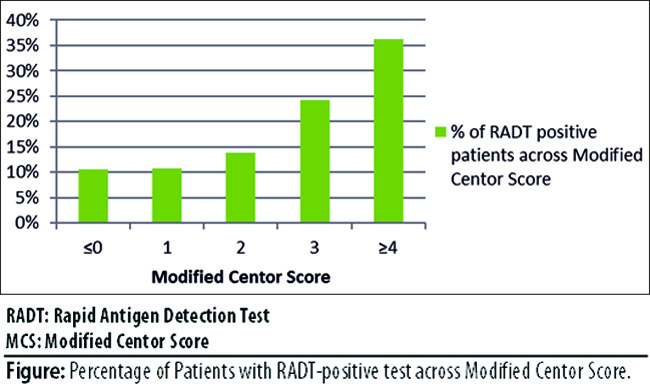
Discussion
GABHS are common etiological agents for acute pharyngitis. However, local data is limited and large-scale surveillance studies have not been done. This study was aimed at evaluating the disease burden in the community due to GABHS.
Additionally, quality of healthcare in Pakistan is constrained by economics due to lack of health insurance and reimbursement plans. Therefore, for a common ailment like sore throat, throat cultures are not part of the routine practice. Moreover, RADT is not an option in the local setting because of additional cost. Validated methods, clinical signs can help physicians in diagnosing the cause and providing the best possible treatment without incurring additional financial burden of diagnostics on patients. MCS system in our study showed to have a positive correlation (correlation co-efficient 0.24) with RADT results. According to some studies, Centor criteria are the most reliable predictive clinical factors for diagnosis of pharyngitis caused by GABHS.15
Prevalence of GABHS in the current study is comparable to epidemiological data available for other countries.1 MCS has also been shown to have positive correlation with RADT results in the local population.
Several guidelines have been published on diagnosis and treatment of streptococcal pharyngitis in adults, but not all are in agreement. The American College of Physicians\' (ACP) guideline, endorsed by the Centre for Disease Control (CDC), American Academy of Family Physicians and the American Society of Internal Medicine, recommend that patients with low Centor scores of 0 or 1 (i.e., low-risk for streptococcal pharyngitis) do not require any testing or treatment with antibiotics. For patients with Centor scores of 2 or, 3, the guidelines suggest using RADT, which would give a sensitivity of >80% for accurate diagnosis of GABHS infection, and prescribing antibiotics to patients with positive tests.16,17 Empirical treatment with antibiotics is recommended for patients with Centor scores of 3 or 4.18
In children, GABHS can lead to complicated conditions like rheumatic fever and since the availability of diagnostics is limited, MCS can be used with reliability to diagnose and treat the condition with appropriate antibiotics.
Conclusions
The prevalence of GABHS in acute pharyngitis was found to be 25.3% among the local population. There was no significant difference between the prevalence of GABHS in acute pharyngitis across different age groups. There was a strong positive correlation of MCS and RADT results.
Acknowledgement
We are grateful to all the physicians across Pakistan who participated voluntarily in this survey, and to Abbott Laboratories (Pakistan) Limited for providing the Rapid Antigen Detection Test kits.
References
1. Bisno AL, Gerber MA, Gwaltney JM Jr, Kaplan EL, Schwartz RH, for the Infectious Diseases Society of America. Practice guidelines for the diagnosis and management of group A streptococcal pharyngitis. Clin Infect Dis 2002; 35: 113- 25.
2. Mayes T, Pichichero M. Are follow- up throat cultures necessary when Rapid Antigen Detection tests are negative for Group A Streptococci?. Clin Pediatr 2001; 40: 191-5.
3. Schalger TA, Hayden GA, Woods WA, Dudley SM, Hendly JO. Optical immunoassay for Rapid detection of Group A B Hemolitic Streptococci. Arch Pediatr Adolesc Med 1996; 150: 245-8.
4. Gunnarsson R', Holm S, Soderstrom M. The prevalence of beta-haemolytic streptococci in throat - specimens from healthy children and adults Implications for the clinical value of throat cultures. Scand J Prim Health Care 1997; 15: 149-55.
5. Lieberman D, Shvartzman P, Korsonsky I, Lieberman D. Aetiology of respiratory tract infections: clinical assessment versus serological tests. Br J Gen Pract 2001; 51: 998-1000.
6. Ebell MH, Smith MA, Barry HC, Ives K, Carey M. The rational clinical examination. Does this patient have strep throat? JAMA 2000; 284: 2912-8.
7. Centor RM, Witherspoon JM, Dalton HP, Brody CE, Link K. The diagnosis of strep throat in adults in the emergency room. Med Decis Making 1981; 1: 239-46.
8. McIsaac WJ, Goel V, To T, Low DE. The validity of a sore throat score in family practice. CMAJ 2000; 163: 811-5.
9. Clinical and Laboratory Standards Institute, vol. 28 no. 29, Abbreviated Identification of Bacteria and Yeast - Approved Guideline, 2nd ed, 2008.
10. Gerber MA, Randolph MF, Chanatry J, Wright LL, DeMeo KK, Anderson LR ,et al. Antigen detection test for Streptococcal pharyngitis: evaluation of sensitivity with respect to true infections. J Pediatr 1986; 108: 654-8.
11. Ebell MH. Making decisions at the point of care: sore throat. Fam Pract Manag 2003; 10: 68-9.
12. Lieu TA, Fleisher GR, Schwartz JS. Clinical evaluation of a latex agglutination test for Streptococcal pharyngitis: Performance and impact on treatment rates. Pediat Infec Dis J 1988; 7: 847-54.
13. Fine A, Nizet V, Mandl K. Large-Scale Validation of the Centor and McIsaac Scores to Predict Group A Streptococcal Pharyngitis. Arch Intern Med 2012; 172: 847-52.
14. Pharyngitis: bacterial isolates and drug susceptibility pattern. J Postgrad Med Inst 2005; 19: 360-4.
15. Poisson R, Meier FA, Johnson J. Effects of a Rapid Antigen Test For Group A Streptococcal Pharyngitis on Physician Prescribing and Antibiotic Costs. Arch Intern Med 1990; 150: 1696-700.
16. Cooper RJ, Hoffman JR, Bartlett JG, Besser RE, Gonzales R, Hickner JM, et al. Principles of appropriate antibiotic use for acute pharyngitis in adults: background. Ann Intern Med 2001, 134: 509-17.
17. Snow V, Mottur-Pilson C, Cooper RJ, Hoffman JR. Principles of appropriate antibiotic use for acute pharyngitis in adults. Ann Intern Med 2001, 134: 506-8.
18. Timothy AD, Graham MD. Diagnosis and treatment of pharyngitis in adults. CJEM 2002; 4: 429-30.
Journal of the Pakistan Medical Association has agreed to receive and publish manuscripts in accordance with the principles of the following committees:


