

Touqeer Hussain ( 3rd year MBBS Students, Dow Medical College, Dow University of Health Sciences, Karachi. )
Abubakar Tauseef ( 3rd year MBBS Students, Dow Medical College, Dow University of Health Sciences, Karachi. )
Asra Bari ( 3rd year MBBS Students, Dow Medical College, Dow University of Health Sciences, Karachi. )
Umber Rasheed ( 3rd year MBBS Students, Dow Medical College, Dow University of Health Sciences, Karachi. )
Jahan Ara Hassan ( Department of Gynae/Obstetrics, Civil Hospital Karachi, DMC (DUHS), Karachi. )
June 2014, Volume 64, Issue 6
Student's Corner

Abstract
Objective: To evaluate awareness amongst general population attending Civil Hospital Karachi regarding risk factors associated with infertility.
Methods: A descriptive study was conducted on subjects who were attendants to the patients admitted in Civil Hospital Karachi or had appointment in outpatient department. They were interviewed one-on-one after their verbal consent, through separate questionnaires for each gender, from September 2012 to January 2013. Minimal age of the respondents included was 18 years. Data was entered and analyzed in SPSS (version 20.0).
Results: A total of 289 attendants were interviewed, 150 were females, with mean age 38.1±11.3 years, remaining 139 were males having a mean age of 32.5±9.9 years. Correct knowledge about the risk factors causing infertility was found to be limited among people. Only 159 (66.9%) and 142 (49%) of the total respondents recognized obesity and diabetes as a threat. Just 54 (36%) and 72(48%) of females were able to appreciate hirsutism and menorrhagia respectively as cause. Sixty (43%) and 67 (48%) of males considered mumps and smoking respectively as culprits. In contrast to previous researches, men received greater votes for being a probable victim of infertility (55%; 159 of the total respondents).
Conclusion: Inadequacy of knowledge about infertility was clearly demonstrated through this study. This lack of knowledge explains why such a strong stigma is attached to infertility in the society.
Keywords: Awareness, Risk factors, Infertility. (JPMA 64: 725; 2014).
Introduction
Infertility is defined as the failure of a couple to conceive a pregnancy after trying to do so for at least one full year with unprotected intercourse and without using any other method of contraception.1 This problem worldwide carried a value of 10-15% in 1991.2 It was reported to be present in 21.9% of Pakistani population in 2003.3 Common people in Pakistan are able to appreciate certain causes of infertility but, about others, they are either confused or have been misguided, resulting in inadequate knowledge about this socio-medical problem.
Some factors truly contribute to the development of infertility but others just carry mindsets and false beliefs among people. About some factors, a common man seems well-educated but about others there seems to be an alarming lack of knowledge.
Infertility as a whole cannot be attributed to a single cause or risk factor, rather many factors entwine to set the stage for infertility. These risk factors should be known by a common man because if faced with them, the person (especially women) go through a lot of psychological trauma and social boycott, and their married life becomes severely challenged.
Difficulty in conceiving may be due to some factor/s in both partners or due to some pathology in any one spouse.
Most risk factors of infertility are different in both genders and they all can contribute to a couple\'s inability to conceive. In females, problems regarding menstruation (ammenhorroea, polymenhorroea, menorrhagia, dysmenhorroea) along with insanitation are the major danger alarms while mumps and oxidative stress contribute to exclusive male- related causes. RTIs, mental stress,4 narcotics, diabetes, and obesity5-7 constitute the common factors of both genders.
Obesity is associated with oligospermia6 and reduced testosterone7 in men and is a major contributor to PCOS. Increased levels of insulin in diabetes, lead to development of Polycystic Ovary Syndrome7 (due to impaired GnRH-LH regulation), while in males, Diabetes comes with the complications of reduced erection, impotence, and libido dissociations8,9 majorly contributing to conception difficulties.
Smoking, due to high cadmium content risks for infertility by interfering with gametogenesis, ovulation, implantation, embryogenesis and results in oligoasthenospermia in men.10
Increased exposure to reactive oxygen species (ROS) is the most common risk factor for infertility in men, high levels of which in the body leads to spermatic deformities, all in number, motility and quantity,11-13 while factors contributing to increased scrotal temperature lower the sperm quality and are responsible for low sperm count.14 Disseminated mumps lead to bilateral orchitis and sterility.13
As far as abortions are concerned, they can be spontaneous (miscarriage) or induced.1 Induced abortion further gets classified as either therapeutic and what is commonly known as "unsafe" abortions, carried out by non-professionals.15
The link between spontaneous abortion and infertility depends on the cause behind the miscarriage. Any cause leading to irreversible or non-compensable damage to the genital tract, uterus, fallopian tubes or ovaries may cause inability to conceive. Meanwhile, induced abortion in safe hands (by a registered medical practitioner or a certified Gynaecologist) does not cause risks for infertility as frequently as "unsafe" abortion does. This occurs due to unsterilized instrumentation, mishandling and retained products of conception after improper evacuation.16,17
Due to combined anatomy in males and close proximity in females of urinary and genital tracts, complicated infections of only one, can\'t remain isolated but interferes with other also.18,19
This study was conducted to evaluate the degree of awareness on causes of infertility amongst general population attending Civil Hospital Karachi.
Methodology
It was a descriptive study conducted in Civil Hospital Karachi from September 2012 to January 2013. Participants were included on convenience and were informed consent was sought.
Sample size was calculated to be two hundred and eighty nine (289) with confidence levels 95%, using Open Epi, version 2, (open source calculator SS Proper)20 with absolute precision of 5% and margin of error of 5.7%, keeping the awareness proportion 25% as mentioned in research by Ali S et al.21 Inclusion criteria comprised of attendants to patients who were either admitted or had appointment in Outpatient Department of CHK. Minimum age of included participants was 18 years. Respondents possessing any medical or related faculty/profession were excluded.
Data was collected through separate questionnaire for each gender. It was filled by interviewing in one-on-one manner using understandable language of communication. The questionnaire was in English and was filled by interviewer; respondents were asked about their age, level of education, marital status, and number of children and whether they were brought up in Karachi or elsewhere. Demographic data did not include name or anything which could disclose a person\'s identity and their privacy was assured to them. Rest of the questionnaire comprised of some probable risk factors posing a threat to fertility. Respondents were inquired only for their respective genders.
Factors, which needed differentiation by females, included; menstrual problems (irregular periods, amenorrhea, polymenorrhea, menorrhagia, dysmenorrhea), abortions (spontaneous, performed by midwife, therapeutic), obesity , use of oral contraceptives, urinary and reproductive tract infections and practicing improper sanitation during menstruation and after delivery.
Male respondents were to give their views regarding occupations needing prolonged sitting, frequent driving, persistent increased temperature of groin area, exposure to radiations, working against photostat machine, placing cell phone in side pocket, mumps and polio vaccines.
Risk factors being common in both questionnaires included obesity, diabetes, late marriage, autoeroticism, narcotics and alcohol consumption, use of paan/gutka/chalia, smoking habits, psychological distress, generalised physical weakness and urethral infections. Lastly both genders were asked about the prevalence of infertility in our society, whether male or female are the greater target of this \'illness\'.
Respondents were also asked about their own opinions on infertility and their personal views were respected. If they were confused about any mentioned risk factor they were allowed to skip it.
Statistical analysis was done through SPSS (version 20.0). Quantitative variable like age was presented by mean and standard deviations. Cross tabulations along with total and selective frequencies and percentages were also calculated, for age, education and residential areas versus all variables but it yielded insignificant results.
Results
Total one hundred fifty females and one hundred thirty nine male participants were interviewed; mean age of female participants was (38.1±9.9) years ranging from 19 years to 66 years. Of the total, 127 had received their education below or up to matriculation level. 142 (94.7%) were married, while 13 married females did not achieve conception after one year of unprotected sex life, 138 (92%) of them were permanent residents of Karachi.
Mean age of male responders was (32.5±9.8) years ranging from 18 years to 60 years, 136 (97.8%) were below or up to matriculation level, 103 (74.1%) were married while 11 (n=102) of the male respondents were childless after trying for (24±6) months of their un protected sex life, permanent residents of Karachi were 99 (71.6%).
Only limited number of male respondents were able to appreciate that causative agents of reactive oxygen species; x-rays-83(60%), photo-rays-50(36%) and electromagnetic signals-70(50%) could precipitate infertility by repeated exposure. Only 60 (43%) males thought that post-pubertal mumps may fulminate infertility (due to bilateral orchitis) while more than half of the males agreed that factors leading to increased groin temperature like frequent driving 77(55%), having occupation which requires prolonged sitting 71(51%) and working in warm environment may also exaggerate probability of having infertility. Forty-nine (35%) males said that administration of polio vaccine in childhood interferes with development of reproductive organs and results in infertility (Table-1).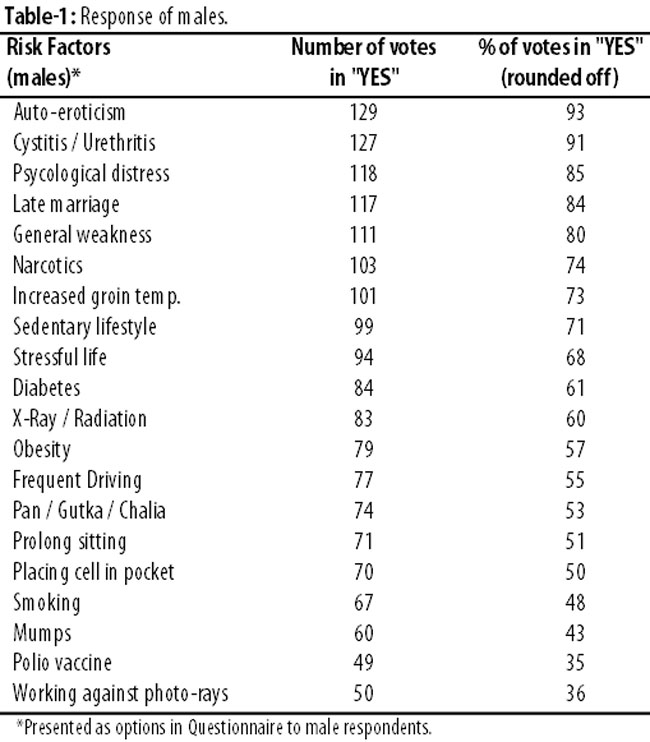
As for female respondents, majority of them were sure that abnormalities in menstrual cycle like amenorrhoea 132(88%), polymenorrhoea 86(57%), irregular menstrual cycle 83(55%) menorrhagia 72(48%), and menstrual cramps 46(31%) are the leading causes of infertility among women. Regarding abortion related questions, only 33 (22%) females considered spontaneous abortion as a contributing factor while 67(45%) and 35(23%) voted for abortion by \'midwives\' and therapeutic abortion, respectively. One hundred and twenty-four (83%) voted yes for reproductive tract infections, 66(44%) for Oral Contraceptive Pills (OCPs) and 64(43%) thought improper sanitation was a risk factor associated with infertility in our society (Table-2).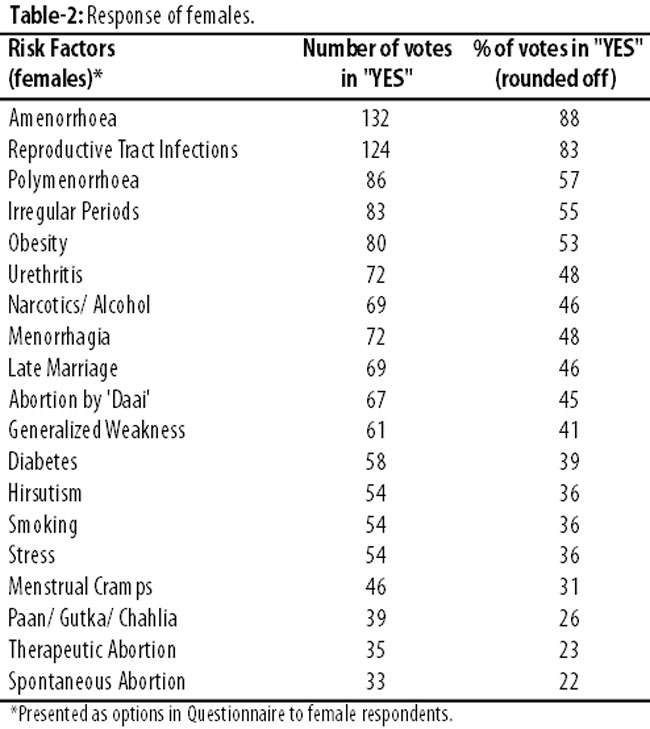
Regarding alcohol, 103(74%) male respondents voted in affirmation but only 69(46%) of female participants agreed to it while 74(53%) participants from males and 39(26%) from females voted for paan/gutka or chahlia addiction as a probable risk factor. Obesity got 79(57%) of male votes and 80(53%) of female votes. Some other factors received a high percentage of "yes" votes from the male side but female side seemed to contradict that; these included autoeroticism (males 129 i.e. 93% , females 65 i.e. 43% ), urethral infections (males 127 - 91%, females 72 - 48%), stress (males 118 - 85%, females 54 - 36%), late marriage (males 117 - 84%, females 69 - 46%) and generalized weakness (111 - 80% of male voters and 61 - 41% from female voters). Diabetes gathered 84(61%) affirmative votes from male side and 58(39%) from female side. Smoking, a well-established health hazard, had 67(48%) and 54(36%) positive votes from male and female respondents respectively.
Ninety-seven males and 62 females (55% of total respondents) said infertility prevails more in male gender, while 33 males and 51 females (29% of total) voted for females as a greater target of infertility. Remaining 15.9% of the total (9 male respondents and 37 females) said that both genders have equal prevalence of infertility (Table-3).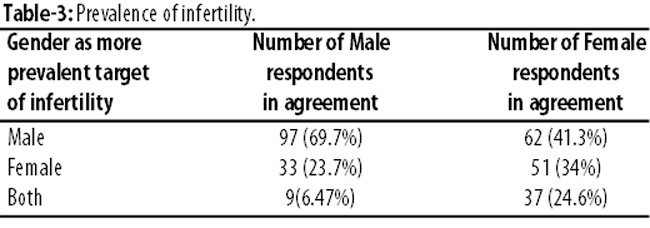
Discussion
There are many factors of which the majority of subjects to our research remain either unaware, ignorant or do not think of it as a risk factor because they don\'t seem "related" to the reproductive system. Apart from these there are some presumed factors based on mythical backgrounds, which do not pose any danger to a human\'s fertility but are thought of as a major cause of inability to achieve conception.
A 30-year-old woman, uneducated, mother of four, commented during the survey,
"There is no such thing as infertility, people suffering from curable diseases name their conditions as such"
Obesity although is a major culprit, but most of the subjects to this research did not consider it a cause, a 45 years old female respondent, mother of seven children remarked;
"Women go for operations to stop having kids, they get their uteruses excised, and this is a cause of obesity in these women"
Narcotics or Alcohol consumption, a common practice in both developing and developed countries, is also found to be an accelerating factor for infertility. in both sexes.
A 27 year old female respondent said,
"Alcohol and all other narcotics, decrease the blood content in body, no blood means no health"
X-rays and radiation exposure lead to ROS formation in the body which are a hazard for fertility potential, but majority of the people were not found to be in agreement to it. One of the male respondents said;
"Childless couples existed even before the discovery and use of X- rays; than how can we say that it is a contributor to infertility"
Mumps infection can spread to testis and can cause irreversible damage but most of the participants were not able to appreciate link between the two. Autoeroticism; although a huge percentage (93%, 129 from 139) of male respondents named it as a risk factor, no such findings have been found that could second this thought. In Pakistan, this thinking can be linked to religious views because a number of respondents said;
"It is a sin, and infertility is a punishment for it"
Regarding psychological distress, a 33 years old, unmarried male remarked;
"Depression causes loss of libido and sterility"
Oral Contraceptive Pills; is the most common method of contraception used by the middle class women of Pakistan, more in urban areas and less in rural, nearly half of the women claimed that the use of oral contraceptive pills (OCPs) may delay a woman\'s return to fertility, but a study showed otherwise.22
There is a prevalent misconception about the killed Polio vaccine used worldwide for WHO polio eradication campaign, that it can cause infertility,23 Pakistan is no different. This misconception causes parents to boycott this method of immunisation predisposing their children to lifelong disability by polio virus but has no proved relation with sterility. From our participants, only 36.2% had this belief.
Some of the menstrual abnormalities are truly due to reproductive system pathology, like menorrhagia is a sign of endometriosis, and it may also occur as a consequence of some other systemic disease like clotting factor deficiency.
Regarding abortion related queries, most of the women marked yes for abortions carried by midwives as a contributing factor. Insanitation is a major cause of reproductive tract infections and a study regarded it as a probable risk factor for infertility.24
An uneducated, mother of four, commented,
“Daai (midwife) uses bitter poisonous herbs as per vaginum suppositories to expel foetus, which causes vaginal itching, infections, abnormal foul smelling discharge and infertility”
An interesting finding of this research was that, many of the male respondents knew that oligospermia and deformed sperms constitute the major factors for males to remain childless, while asking about their personal views about infertility, 29 years old male, father of two said:
"Some males carry tailless seeds in their semen, which do not possess enough ability to swim through the birth canal and develop into an embryo"
Interpreting oligospermia, another male respondent said:
“A men\'s semen should be rich in germs (sperms), if there\'s not enough viscosity of it, he will face severe challenges in having a baby”
During our discussion with males, some of them also mentioned homosexuality as a cause of being infertile. A 33 years old respondent said;
“Homosexuality is an act against nature and infertility is a verdict of it”
Sumera Ali and her co-investigators, carried out a similar cross-sectional study, published in 2011,21 on the attendants accompanying the patients of two tertiary care hospitals, and found that correct knowledge of infertility was limited amongst their participants, belief in evil forces and supernatural powers as a cause of infertility was prevalent. These mythical thoughts remain pronounced throughout our discussion with female respondents, one of the female aged 48 years, mother of six, said in response to abortion related question;
\'Some women carry evil spirits inside their wombs and suffer repeated abortions, they are better to be treated by aalims (religious scholars), and peers (religious pain healers) than by a doctor.\'
Qualitative research about perception of women about infertility,25 concluded same mythical perceptions, some of their experiences were different from us; according to their survey report women perceived their husbands, as not being a culprit of childlessness, but in our research males received more votes for being targeted by infertility, both by their own and opposite gender, one of the female respondent said;
“This thought is false utterly, that, if a man can copulate, he can\'t be barren, it is important that they get tested, men always blame their women and go for another wife.”
Conclusion
Confused concepts about major risk factors associated with infertility were found to be existing amongst the general population attending Civil Hospital Karachi. Majority of people believed the male side as a more prevalent target of infertility, even though in the past researches, opposite results were obtained.
References
1. Dorland WA. Dorland\'s illustrated medical dictionary. 2nd ed. India: Saunders; 2007.
2. World Health Organization, Infertility: A Tabulation of Available Data on Prevalence of Primary and Secondary Infertility. Geneva Program on Maternal and Child Health and Family Planning. Division of Family Health, WHO, 1991.
3. UNFPA. Pakistan population assessment. Islamabad: Government of Pakistan, 2003.
4. Maeda K, Tsukamura H. The Impact of Stress on Reproduction: Are Glucocorticoids Inhibitory or Protective to Gonadotropin Secretion? Endocrinology 2006; 147: 1085-6.
5. Cabler S, AgarwaL A, Flint M, Du Plessis SS. Obesity: modern man\'s fertility nemesis. Asian J Androl 2010; 7: 153-61.
6. Du Plessis SS, Cabler S, McAlister DA, Sabanegh E, Agarwal A. The effect of obesity on sperm disorder and male infertility. Nat Rev Urol 2010; 7: 153-61.
7. Gambineri A, Pelusi C, Vicennati V, Pagotto U, Pasquali R. Obesity and the polycystic ovary syndrome. Int J Obes Relat Metab Disord 2002; 26: 883-96.
8. Livshits A and Seidman DS. Fertility issue in women with diabetes. Women Health 2009; 5: 701-7.
9. Delfino M, Imbrogno N, Elia J, Capogreco F and Mazzilli F. Prevalence of diabetes mellitus in male partners of infertile couples. Minerva Urol Nefrol 2007; 59: 131-5.
10. Dunson DB, Baird DD, Colombo B. Increased fertility with age in man and woman. Obstet Gynecol 2004; 103: 51-6.
11. Agarwal A, Makker K, Sharma R. Clinical relevance of oxidative stress in male factor infertility: an update. Am J Reprod Immuno 2008; 59: 2-11.
12. Juhl M, Anderson AM, Gronback M, Olsen J. Moderate Alcohol Consumption And Waiting Time To Pregnancy. Hum Reprod 2001; 16: 2705-9.
13. Close CE, Roberts PL, Berger RE. Cigarettes, alcohol and marijuana are related to pyospermia in infertile men. J Urol 1990; 144: 900-3.
14. Koskelo R, Zaproudina N and Vuorikari K. High Scrotal Temperature and Chairs In The Pathophysiology Of Poor Semen Quality. Pathophysiol 2005; 11: 221-4.
15. Masarani M, Wazait H, Dinneen M. Mumps Orchitis. J R Soc Med 2006; 99: 573-5.
16. Jain V, Saha SC, Bagga R, Gopalan S. Unsafe abortion: a neglected tragedy. J Obstet Gynaecol Res 2004; 30: 197-201.
17. World Health Organization. Safe Abortion: Technical Policy Guidance for Health System. WHO; 2003, pp 13-4.
18. Pawanarkar J, Chopra K. Prevalence of lower reproductive tract infection in infertile women. Health Popul Perspect Issues 2004; 27: 67-75.
19. Bar-Chama N, Goluboff E, Fisch H. Infection And Pyospermia In Male Infertility. Urol Clin North Am 1993; 21: 469-75.
20. Dean AG, Sullivan KM, Soe MM. Open Epi: Open Source Epidemiologic Statistics for Public Health. Version 2.3.1. (Online) Updated 23-6-2011. (Cited 2014 April 29). Available from URL: www.openepi.com.
21. Ali S, Sophie R, Imam AM, Khan FI, Ali SF, Sheikh A, et al. Knowledge, perceptions and myths regarding infertility among selected adult population in Pakistan. Obstet Gynecol Int 2012; 2012: 760.
22. Farrow A, Hull MG, Northstone K, Taylor H, Ford WC, Golding J. Prolonged use of oral contraception before a planned pregnancy is associated with a decreased risk of delayed conception. Hum Reprod 2002; 17: 2754-61.
23. Kishore J, Pagare D, Malhotra R, Singh MM. Qualitative Study of Wild Polio Cases In High Risk Districts Of Uttar Pradesh, India. Natl Med J India 2003; 16: 131-4.
24. Ali TS, Sami N, Khuwaja AK. Are unhygienic practices during the menstrual, partum and postpartum periods risk factors for secondary infertility? J Health Popul Nutr 2007; 25: 189-94.
25. Sami N, Ali TS. Perceptions and experiences of woman in Karachi, Pakistan regarding secondary infertility. Obstet Gynecol Int 2012; 2012: Article ID(108756). doi:10.1155/2012/108756.
Related Articles
Journal of the Pakistan Medical Association has agreed to receive and publish manuscripts in accordance with the principles of the following committees:


