

Masood Ali Shaikh ( Independent Consultant, Block No. 7, Gulshan-e-Iqbal, Karachi, Pakistan. )
Anila Kamal ( National Institute of Psychology, Quaid-i-Azam University, Islamabad, Pakistan. )
Irum Naqvi ( National Institute of Psychology, Quaid-i-Azam University, Islamabad, Pakistan. )
June 2014, Volume 64, Issue 6
Short Reports

Abstract
Polio vaccinators and law enforcement officials protecting them, have been killed in the line of duty since 2012 in Pakistan. This study was conducted to determine the opinions of university students in Islamabad and Rawalpindi, regarding the importance of polio vaccination, and the role of international donor agencies. Nine hundred forty-six students participated in this study; 833 (88.1%) students thought that polio is a public health problem in the country, and 815 (86.2%) thought that polio vaccination prevents polio in children. About a quarter of respondents thought that Pakistanis as well as non-Pakistanis working for either international non-governmental organizations or United Nations agencies are spies working for the Western governments or their spy agencies. An appalling 300 (31.7%) respondents replied as either affirmatively or \'don\'t know\' to the question whether killing of polio vaccinators is justified.
Keywords: Polio, Vaccination, Pakistan.
Introduction
Polio is a debilitating yet vaccine preventable disease that affects children and robs them and their country of a healthy and economically productive life. Yet polio vaccination campaigns in Pakistan are replete with political and cultural conspiracy theories, ranging from sterilization of an entire generation to Western spy agencies using vaccination campaigns as a ruse for their own nefarious designs.1-10 Polio vaccinators have been threatened, and in the past couple of years have even been killed simply for vaccinating children against this crippling disease, as an attempt to influence politics.1-7 Even law enforcement officials protecting these vaccinators have not escaped the wrath of this warped ideology.5-7 According to media reports over a dozen police and polio team members have been killed over the past year in the country.2-7 Pakistan holds the dubious distinction of being one of the only three countries in the World today where polio virus is still endemic.8 In 2012, 58 polio cases were reported in Pakistan, while until November 2013, 64 cases have been reported i.e. a percent change of 10.3% increase.8
There are no studies on opinions about polio vaccinators, the lethal violence they encounter in the line of duty, and the role of national and international staff working for international funding agencies which support and conduct polio vaccination campaigns in Pakistan. In December 2012, five health workers immunizing children against polio were brazenly shot dead;1 prompting us to conduct this study to determine the opinions of students enrolled in the masters or higher degree programmes in the universities of Islamabad and Rawalpindi, regarding the importance of polio vaccination, violence encountered by vaccinators, and the role of international donor agencies.
Methods and Results
A cross-sectional survey, using a self-administered questionnaire, with convenience sampling was conducted among 20 to 29 year old male and female graduate and postgraduate students in the two public and one private universities in the cities of Islamabad and Rawalpindi. To elicit opinions about polio vaccination, the role of United Nations agencies, and international nongovernmental organizations involved in polio vaccination, and killings of polio vaccinators; a pre-tested questionnaire was used with close-ended questions answered as either \'yes\', \'no\', or \'don\'t know\' from February to May 2013. Four trained male and female graduate students approached students in # university campus in Islamabad and distributed the questionnaires after obtaining verbal consent and collected the completed questionnaires while ensuring complete confidentiality. Data were analyzed using statistical package STATA version 12, by applying chi-squared test to assess the independent relationships between categorical variables studied and sex. Statistical significance was defined by two-sided P-values of <0.05.
Cumulatively 946 students participated in this study, with 474 (50.1%) males and 472 (49.9%) females. The mean age of males and female respondents was 23.4±2.6 years and 23.4±2.0 years, respectively; 739 (78.1%) students were between the ages of 20 to 24 years. Seven hundred and forty-one (78.3%) were enrolled in masters programme, 141 (14.9%) in M.Phil, and 64 (6.8%) in doctoral programmes.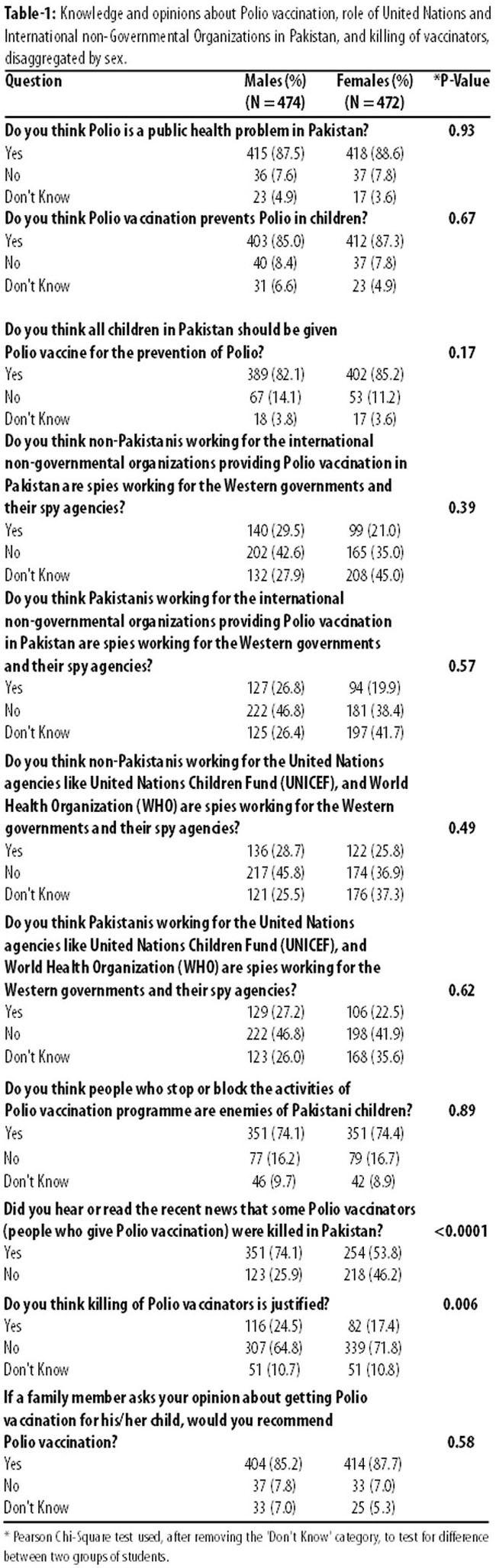
Table shows the responses to the questions asked, disaggregated by sex, and the p-values for Pearson chi-square test of difference between two groups of students for the questions answered. Cumulatively, 833 (88.1%) students thought that polio is a public health problem in the country, and 815 (86.2%) thought that polio vaccination prevents polio in children. About a quarter of respondents thought that Pakistanis as well as non-Pakistanis working for either international non-governmental organizations or United Nations agencies are spies working for the Western governments or their spy agencies. However, another quarter or so replied as \'don\'t know\' to the questions pertaining to aid agencies staff working for Western spy agencies. Statistically significant differences were found between the two sex groups on having read or heard news about polio vaccinators being killed, and the opinions on such killings only.
Conclusion
An overwhelming majority of respondents believed polio is a public health problem in the country and that vaccination does prevent polio in children. Only 155 (16.4%) replied as either \'no\' or \'don\'t know\' to question that all children in the country should be given vaccine for preventing polio. While 702 (74.2%) thought that people who block or try to stop polio vaccination programmes are the enemies of children. Against this backdrop, an appalling 300 (31.7%) respondents replied as either affirmatively (n=198-20.9%) or \'don\'t know\' (n=102-10.8%) to the question whether killing of polio vaccinators is justified; highlighting the need for better use of mass media and health education campaigns in the country to counter such disturbing opinions and ambiguities.
Public health and politics are inextricably intertwined. Yet, crippling children, engendering their lives, and setting back global public health initiative to eradicate polio - arguably with the potential of becoming the second greatest public health success story after eradication of Smallpox — in the name of politics or misguided perceptions is truly a public health tragedy of epic proportions. The results of this study demonstrate that university students — a group with much higher educational attainment vis-à-vis the general public — have ambiguities about the role and motives of international non-governmental agencies, and United Nations organizations, involved in eradicating polio in Pakistan. So far, health promotion campaigns conducted in concert with these agencies and government of Pakistan have only succeeded so much; underlining the need for better choreographed campaigns to realize the ultimate goal of eradicating polio not only from Pakistan but globally.
References
1. Khan T, Qazi J. Hurdles to the global antipolio campaign in Pakistan: an outline of the current status and future prospects to achieve a polio free world. J Epidemiol Community Health 2013; 67: 696-702.
2. New York Times. Gunmen in Pakistan Kill Women Who Were Giving Children Polio Vaccines. (Online) (Cited 2013 Dec 4). Available from URL: http://www.nytimes.com/2012/12/19/world/asia/attackers-in-pakistan-kill-anti-polio-workers.html.
3. DAWN. Gunmen kill five polio workers in Pakistan. (Online) (Cited 2013 Dec 4). Available from URL: http://www.dawn.com/ news/772219/gunmen-kill-four-female-polio-workers-in-karachi.
4. CNN. 2 killed in blast targeting Pakistani polio workers. (Online) (Cited 2013 Dec 4). Available from URL: http://edition.cnn.com/ 2013/10/07/world/asia/pakistan-polio-workers-attack/.
5. Associated Press. Police Guarding Polio Team in Pakistan Shot Dead. (Online) (Cited 2013 Dec 4). Available from URL: http://world.time.com/2013/11/30/police-guarding-polio-team-in-pakistan-shot-dead/.
6. CNN. Pakistan condemns anti-polio volunteers\' killings. (Online) (Cited 2013 Dec 4). Available from URL: http://edition.cnn.com/ 2013/06/16/world/asia/pakistan-violence/.
7. New York times. Gunman Attacks Police Officer Guarding Polio Workers in Pakistan. (Online) (Cited 2013 Dec 4). Available from URL: http://www.nytimes.com/2013/04/11/world/asia/gunman-kills-policeman-guarding-polio-workers-in-pakistan.html?_r=0.
8. Global Polio Eradication Initiative. Polio this week - As of 27 November 2013. (Online) (Cited 2013 Dec 4). Available from URL: http://www.polioeradication.org/Dataandmonitoring/Poliothisweek.aspx.
9. Sheikh A, Iqbal B, Ehtamam A, Rahim M, Shaikh HA, Usmani HA, et al. Reasons for non-vaccination in pediatric patients visiting tertiary care centers in a polio-prone country. Arch Public Health 2013; 71: 19.
10. Abimbola S, Malik AU, Mansoor GF. The final push for polio eradication: addressing the challenge of violence in Afghanistan, Pakistan, and Nigeria. PLoS Med 2013; 10: e1001529.
Journal of the Pakistan Medical Association has agreed to receive and publish manuscripts in accordance with the principles of the following committees:


