

Mojgan Rahmanian ( Department of Gynaecology, Department of Community Medicine, Semnan University of Medical Sciences, Semnan, Iran. )
Zohre Salari ( Department of Gynaecology, Neyshabur University of Medical Sciences, Neyshabur, Iran. )
Majid Mirmohammadkhani ( Research Center for Social Determinants of Health, Department of Community Medicine, Semnan University of Medical Sciences, Semnan, Iran. )
Raheb Ghorbani ( Research Center for Social Determinants of Health, Department of Community Medicine, Semnan University of Medical Sciences, Semnan, Iran. )
June 2014, Volume 64, Issue 6
Original Article

Abstract
Objective: To evaluate the association between Sex Hormone Binding Globulin and preeclampsia in Iranian women considering the probable confounding effect of insulin resistance.
Methods: The case-control study was conducted at the Semnan University of Medical Sciences, Iran, and comprised pregnant women who received prenatal care at Amiralmomenin Hospital in 2011. Cases represented patients admitted because of preeclampsia, while controls were randomly selected eligible pregnant women without hypertension and/or proteinuria. Fasting blood sugar and insulin were assessed for all participants as well as their blood concentration of Sex Hormone Binding Globulin. The Homeostasis Model Assessment of Insulin Resistance Score was used. The correlation between dependant and independent variables was reported by crude and adjusted odds ratio applying logistic regression models. SPSS 16.0 was used for statistical analysis.
Results: Of the 100 pregnant women in the study, 45(45%) were cases. Insulin resistance was found to be significantly more frequent in the cases compared to the controls (adjusted odds ratio=2.78; 95% Confidence Interval: 1.11, 6.90; p<0.01). There was a significant reverse correlation between level of Sex Hormone Binding Globulin in blood and being a case of preeclampsia (adjusted odds ratio=0.99; 95% Confidence Interval: 0.98, 1.00; p=0.04).
Conclusion: Independent of insulin resistance, every 1nmol/l increase in Sex Hormone Binding Globulin, decreases the odds of preeclampsia by 1%, notifying Sex Hormone Binding Globulin as an important biomarker about its etiology and prediction.
Keywords: Preeclampsia, Sex Hormone Binding Globulin, Insulin Resistance, Case-control study. (JPMA 64: 640; 2014).
Introduction
Preeclampsia, which is characterised by pregnancy-induced hypertension and proteinuria, causes complications in 5-14% of all pregnancies worldwide. It is the second most common obstetric cause of stillbirths and early neonatal deaths reported in 4-18% of pregnancies in developing nations.1,2 Preeclampsia is highly associated with diabetes mellitus (DM). In women with gestational and pre-pregnancy DM, its incidence rises 10-50 per cent compared to normal pregnant women. In women with glucose intolerance (GI), it occurs 5 to 7 per cent more.3-6 GI is associated with insulin resistance (IR) identified by the concurrent increscent of blood glucose and insulin.7 The Homeostasis Model Assessment of Insulin Resistance Score (HOMA-IR Score) is the standard measurement used to evaluate the beta-cells\' function to determine IR. Recent studies have shown association between preeclampsia and IR.8-12
Sex Hormone Binding Globulin (SHBG) is a liver synthesised glycoprotein which binds the circulating sex hormones including oestrogen and testosterone. SHBG\'s production in hepatic cells is inhibited by insulin. Thus reduced levels of SHBG can be considered a marker of hyperinsulinaemia which makes it another probable index for IR as well as consequent diabetes.13-15 SHBG levels rise steadily during the first and second trimesters, reaching a peak at week 24, which is 4 to 6 times more than non-pregnant normal range. Thereafter, its blood concentration remains constant up to the end of pregnancy. Since SHBG has minimal diurnal variation, it can be regarded as a reliable marker for IR. Thus decreased SHBG correlates positively with decreased HOMA-IR Score in relation with IR.16-18
Association observed between low SHBG levels and preeclampsia can be justified by the relationship between IR and disease occurrence.19 But some researchers find no link between these two which suggests that the observed relationship may be more complex than what it seems.20 The aim of the present study was to evaluate the association between preeclampsia in Iranian women and the SHBG level, removing the probable confounding effect of IR measured by HOMA-IR Score as the standard scale for its determination. The main questions were: Is SHBG associated with preeclampsia independent of IR? Is it reasonable to focus on evaluation of its diagnostic capability for preeclampsia as an independent screening marker in the future studies?
Patients and Methods
With due approval of the ethics committee of Semnan University of Medical Sciences, Iran, the case-control study was conducted at Semnan\'s main gynaecology hospital — Amiralmomenin Hospital — in 2011. The cases were preeclampsia patients who were diagnosed for the first time (incident cases), characterised by new onset of hypertension (systolic/diastolic blood pressure >14090mmHg) and proteinuria (protein excretion >300mg/dl in a 24-hour urine collection, or a positive dipstick >1+), that developed after 24 weeks of gestation with or without oedema. Cases were selected consecutively from all patients referred to the hospital due to preeclampsia during the study period. The control group was randomly selected from all outpatient eligible pregnant women within 24 weeks of gestation or more, with history of attending the hospital gynaecological clinic for routine prenatal cares, being normotensive and without proteinuria. For this purpose, and after obtaining written permissions, the medical records of the outpatients available at the clinic office were carefully reviewed by the researcher. From among those eligible, the control group was selected randomly and those selected were contacted through phone call. No excess matching was done for sampling purposes. Women with a history of diabetes, liver disease, chronic renal disease, pre-existing chronic hypertension or previous history of preeclampsia were excluded after obtaining a careful medical history by a gynaecologist. After giving complete explanation about the study aims, an informed consent was obtained. In addition to measurement of weight and blood pressure, 5cc blood was taken from each participant in fasting state and all samples were handled identically during storage, transport and processing. Fasting Blood Sugar (FBS, mm/lit) was determined using standard glucose oxidise assays. SHBG level was measured by immune-radiometric assay. Fasting Insulin (FI, µm/ml) was evaluated via enzyme-linked immunosorbent assay (ELISA) method. All participants in the control group were followed up till delivery to get excluded in case of developing preeclampsia.
In the study, no payment was done by the patients and all laboratory information was collected and kept in pre-prepared data-gathering forms. HOMA-IR Score formula (FI × FBS /22.5) was used to asses IR. A calculated score of more than 4.5, was considered as IR 21-22. In literature, the mean and standard deviation (SD) of SHBG has been reported as 396±186 in the cases vs. 302±120 the controls.18 Based on the data, with the confidence interval (CI) of 95% and power of 80%, the minimum sample size of participants enrolled in each group was estimated to be 45. Using SPSS 16 software and considering p< 0.05 as statistically significant, analyses were done in two stages. First, the variables were compared marginally between the two groups using parametric and nonparametric analyses (independent T-test, Mann-Whitney U, and Pearson Chi-Square). Then in order to remove the effect of probably confounding variables such as IR, multiple logistic regression models were applied, and the correlation between dependant (preeclampsia) and independent (SHBG) variables were expressed through crude and adjusted odds ratio (OR). In the multiple models, we excluded FBS and FI due to their co-linearity with HOMA-IR Score and marginally not-correlated variables with the p>0.2 were also not included in the multi-stage analyses. The main inferences were based on the final reduced model developed by using backward approach regarding likelihood ratio test.
Results
Of the 100 pregnant women enrolled, 45(45%) were cases. Mean of systolic and diastolic blood pressures in the cases were 144.2±7.4 and 95.3±5.8, and in the control group were 67.45±6.7 and 107.2±8.6 respectively (p<0.001). There was no significant difference in the two groups in terms of weight (p=0.06) and gestational age (p=0.07), but the observed differences were considerable (p<0.1). The two groups were significantly different regarding the distribution of nulliparity (p<0.03) (Table-1).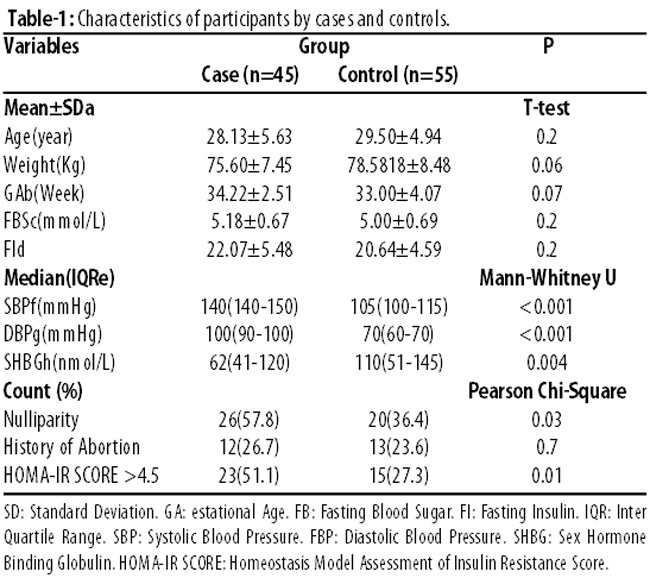
Although FI and FBS levels were higher in the cases numerically, the observed differences are not statistically significant (p<0.2). IR persistence in 23(51.1%) cases and 15(27.3%) controls showed significantly different distribution in the two groups (p<0.01). Comparing the two groups, SHBG in cases were significantly lower than the controls (p<0.004). The adjusted OR of each variable for disease occurrence was also worked out (Table-2).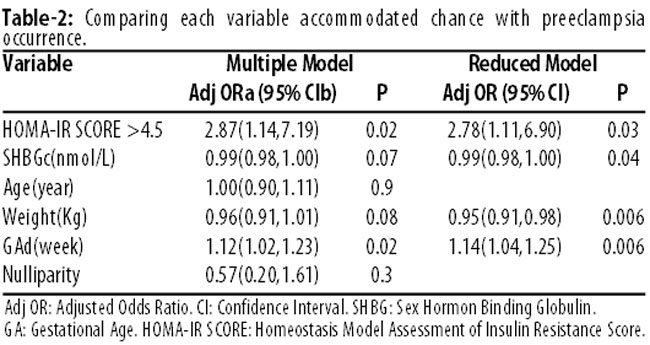
Not only IR in preeclamptic cases was reported significantly more than normal controls (adjusted OR=2.78, 95% CI: 1.11, 6.90; p<0.01), but also there was a significant correlation between decreased levels of SHBG and the occurrence of preeclampsia (adjusted OR=0.99; 95% CI: 0.98, 1.00; p<0.04) adjusting for age, weight, gestational age and parity.
Discussion
Preeclampsia is a multi-factorial disease with doubts surrounding its aetiology. As such, more investigations on its associations with laboratorial and clinical markers are needed to better know the nature of the disease and its determinants. Some studies show that in preeclampsia, IR is more prevalent than normal pregnancy. So the surrogate markers of IR like SHBG are also expected to change in preeclampsia. Whether these changes are connected with aetiology or with the pathogenesis of preeclampsia is still not clear.9 Some researchers have acknowledged the role of IR in the pathogenesis of preeclampsia, which is interpreted on the basis of changes in the natural process of angiogenesis. Some believe IR increases the sympathetic release and therefore increases the tone of smooth muscles of the vessels leading to increasing of the blood pressure in pregnant women; consequently the drugs which decrease IR, decrease the blood pressure as well.16,23 Different indices have been used for determining IR. In a study, the FI level in women with preeclampsia was reported about twice of normotensive and healthy women.24 In our study FI increment in preeclampsia patients was not statistically significant. Some other studies showed a correlation between IR and preeclampsia based on the HOMA-IR Score.9,12-17 In our study, the Score was investigated as the standard way for IR determination. Our results concluded that with the adjustment of other variables, the chance of developing preeclampsia in case of IR increases by three times, which is in agreement with aforesaid studies.
According to today\'s knowledge, a decrease in SHBG in IR is expected. Despite this significant correlation between IR and preeclampsia, the net and adjusted association between gestational levels of SHBG and preeclampsia is unknown. For example, in one study, although IR was significantly higher in preeclampsia, still there was no difference in the SHBG level between normal women and patients with preeclampsia.25 Another study did not find significant correlation between preeclampsia and SHBG compared to normal control groups too.20
But, one study concluded a 48nmol/l difference in the SHBG between the two groups.17 Another research studied the association between IR, marked by reduced first trimester SHBG levels, and subsequent preeclampsia, which had higher differences of SHBG. The mean of 302mmol/l was reported in preeclampsia patients and 396mmol/l in normotensive persons. The study concluded that every 100nmol/liter increase in SHBG was associated with a 31% reduced risk of preeclampsia development.18
Our findings showed significant and independent association between SHBG levels and preeclampsia, reporting lower levels of SHBG in preeclampsia. As mentioned before, the HOMA-IR Score is based on FI levels and FBS and both have significantly diurnal variations, while SHBG has minimal diurnal variation in comparison, while it does not need the fasting state for measurement.
Considering HOMA-IR Score as the gold standard for IR detection, and according to outputs of multiple regression analyses performed in our study, it can be concluded that independent of IR, every 1nmol/l increase in SHBG decreases the odds of developing preeclampsia by 1%. This important finding notifies that SHBG levels may be an important biomarker for preeclampsia aetiology and prediction. Further studies should be done on SHBG and its predictive value in preeclampsia regarding its proper measuring time during pregnancy. Further knowledge about the nature of SHBP\'s variations during preeclampsia and the degree of association between its components will help to inform future research efforts and to identify it as a biochemical marker that could help in clinical practice.
Conclusion
Independent of IR, high blood SHBG is linked with reduction of the odds of preeclampsia, suggesting that SHBG may be an important biomarker about its aetiology and prediction. Further research in this area is recommended.
Acknowledgment
The study is based on a medical specialty degree thesis in the field of obstetrics and gynaecology, supported by Semnan University of Medical Sciences, Iran.
References
1. Khedun SM, Moodley J, Naicker T, Maharaj B. How do South African obstetricians manage hypertensive disorders of pregnancy — a survey. S Afr Med J 2000; 90: 156-60.
2. Ngoc NT, Merialdi M, Abdel-Aleem H, Carroli G, Purwar M, Zavaleta N, et al.Causes of stillbirths and early neonatal deaths: data from 7993 pregnancies in six developing countries. Bull World Health Organ 2006; 84: 699-705.
3. Report of the National High Blood Pressure Education Program Working Group on High Blood Pressure in Pregnancy. Am J Obstet Gynecol 2000; 183: S1-S22.
4. ACOG practice bulletin. Diagnosis and management of preeclampsia and eclampsia. Number 33, January 2002. Obstet Gynecol 2002; 99: 159-67.
5. Innes KE, Wimsatt JH. Pregnancy-induced hypertension and insulin resistance: evidence for a connection. Acta Obstet Gynecol Scand 1999; 78: 263-84.
6. Lorentzen B, Birkeland KI, Endresen MJ, Henriksen T. Glucose intolerance in women with preeclampsia. Acta Obstet Gynecol Scand 1998; 77: 22-7.
7. Morteza A, Abdollahi A, Bandarian M. Serum nitric oxide syntheses and lipid profile of the mothers with IUGR pregnancies uncomplicated with preeclampsia. Does insulin resistance matter? Gynecol Endocrinol 2012; 28: 139-42.
8. Hauth JC, Clifton RG, Roberts JM, Myatt L, Spong CY, Leveno KJ, et al. Maternal insulin resistance and preeclampsia. Am J Obstet Gynecol 2011; 204: e321-6.
9. Mladenova M, Dimitrakova E, Amaliev G, Pehlivanov B. [Insulin resistance in preeclampsia]. Akush Ginekol (Sofiia) 2011; 50: 31-3.
10. Masuyama H, Inoue S, Hiramatsu Y. Retinol-binding protein 4 and insulin resistance in preeclampsia. Endocr J 2011; 58: 47-53.
11. Valerio EG, Muller AL, Martins-Costa SH, Lopes Ramos JG, Rodini G. Are insulin resistance index, IGF-1 and metabolic syndrome components correlates with severe preeclampsia? Hypertens Pregnancy 2011; 30: 302-10.
12. Scioscia M, Gumaa K, Rademacher TW. The link between insulin resistance and preeclampsia: new perspectives. J Reprod Immunol 2009; 82: 100-5.
13. Plymate SR, Matej LA, Jones RE, Friedl KE. Inhibition of sex hormone-binding globulin production in the human hepatoma (Hep G2) cell line by insulin and prolactin. J Clin Endocrinol Metab 1988; 67: 460-4.
14. Pasquali R, Vicennati V, Bertazzo D, Casimirri F, Pascal G, Tortelli O, et al. Determinants of sex hormone-binding globulin blood concentrations in premenopausal and postmenopausal women with different estrogen status. Virgilio-Menopause-Health Group. Metabolism 1997; 46: 5-9.
15. Sherif K, Kushner H, Falkner BE. Sex hormone-binding globulin and insulin resistance in African-American women. Metabolism 1998; 47: 70-4.
16. Wolf M, Hubel CA, Lam C, Sampson M, Ecker JL, Ness RB, et al. Preeclampsia and future cardiovascular disease: potential role of altered angiogenesis and insulin resistance. J Clin Endocrinol Metab 2004; 89: 6239-43.
17. Thadhani R, Ecker JL, Mutter WP, Wolf M, Smirnakis KV, Sukhatme VP, et al. Insulin resistance and alterations in angiogenesis: additive insults that may lead to preeclampsia. Hypertension 2004; 43: 988-92.
18. Wolf M, Sandler L, Munoz K, Hsu K, Ecker JL, Thadhani R. First trimester insulin resistance and subsequent preeclampsia: a prospective study. J Clin Endocrinol Metabr 2002; 87: 1563-8.
19. Yu CK, Papageorghiou AT, Bindra R, Spencer K, Nicolaides KH. Second-trimester sex hormone-binding globulin and subsequent development of pre-eclampsia. J Matern Fetal Neonatal Med 2004; 16: 158-62.
20. Spencer K, Yu CK, Rembouskos G, Bindra R, Nicolaides KH. First trimester sex hormone-binding globulin and subsequent development of preeclampsia or other adverse pregnancy outcomes. Hypertens Pregnancy 2005; 24: 303-11.
21. Tian L, Shen H, Lu Q, Norman RJ, Wang J. Insulin resistance increases the risk of spontaneous abortion after assisted reproduction technology treatment. J Clin Endocrinol Metab 2007; 92: 1430-3.
22. Moses RG, Luebcke M, Davis WS, Coleman KJ, Tapsell LC, Petocz P, et al. Effect of a low-glycemic-index diet during pregnancy on obstetric outcomes. Am J Clin Nutr 2006; 84: 807-12.
23. Roberts JM, Gammill H. Insulin resistance in preeclampsia. Hypertension 2006; 47: 341-2.
24. Sowers JR, Saleh AA, Sokol RJ. Hyperinsulinemia and insulin resistance are associated with preeclampsia in African-Americans. Am J Hypertens 1995; 8: 1-4.
25. Stefanovic M, Vukomanovic P, Milosavljevic M, Kutlesic R, Popovic J, Tubic-Pavlovic A. Insulin resistance and C-reactive protein in preeclampsia. Bosn J Basic Med Sci 2009; 9: 235-8.
Related Articles
Journal of the Pakistan Medical Association has agreed to receive and publish manuscripts in accordance with the principles of the following committees:


