

Hameed Afzal ( Department of Microbiology, University of Agriculture, Faisalabad. )
Mohammad Khalid ljaz ( Department of Microbiology, University of Agriculture, Faisalabad. )
Farkhanda Akhtar ( Department of Microbiology, University of Agriculture, Faisalabad. )
July 1982, Volume 32, Issue 7
Original Article

Abstract
Bacteriological study of one hundred samples ofYaginal discharge from patients suffering from leukorrhea, revealed the presence of staphylococcus aureus (33 %), staphylococcus epidermis (20%), streptococcus pycgenes (25%), Escherichia coli (22%), Streptococcus faecalis (18%), Bacillus subtilus (16%) and Staphylococcus saprophyticus (11%).
The invitro antibiotic sensitivity test of organisms against seven antibiotics exhibited that streptomycin, pyopen and combiotic were the most effective drugs. Penicillin, Septran and Vibramycin were least effective (JPMA 32:163, 1982).
Introduction
Leulcorhea is a disease common in women of all ages. In view of its increased frequency and complications, a study was undertaken to determine the causative organisms, as well as the effective antibiotics to combat them.
Material and Methods
The study was done on 100 cases of lcukorrhea diagnosed by the Gynecologists of different hospitals of Faisalabad. The swab technique as described by Bailey and Scott (1962) and Cruick shank et al. (1974) was used for qualitative assessment of vaginal flora. For primary isolation the swabs were cultured on two blood agar plates and one MacConkey agar within two hours of collection. The pure isolates were then characterised and identified by morphological, biochemical and other bacteriological tests.
The in vitro, antibiotic sensitivity test of samples (Swabs) was performed by using’ standardized pharmaceutical discs on blood agar plates. The procedure followed was that described by Bailey and Scott (1962) and the antibiotics used were Penicillin, Combiotic, Streptomyein, Pyopen, Septran, Vibrarnycin and Erythrocin.
Results
From 100 leukorrhea cases 151 strains of different species of organisms were isolated, 57 cases showed infection with a single species and 43 revealed mixed infection.
In mixed infections the results indicated that Stceptoeoeeus faeealis and Bacillus subtilus were the main organisms.
In vitro, sensitivity of different samples ofvarious organisms to antibiotics was recorded. Overall sensitivity of all samples to each drug was, Erythrocin 68%, Streptomycin 63%, Pyopen 61%, Combiotie 49%, Septran 19%, Vibramycin 4% and penicillin 3%. The most effective of these drugs were Brythroein, Sueptomycin, Pyopen and Combiotic.
Discussion
In the present study as regards the efficacy 0f the various antibiotic, Septran, Vibramycin and Penicillin did not exhibit encouraging results and sensitive strains comprised only 10, 4 and 3% respectively. The production, of penicillinase by naturally resistant strains explains the relative ineffectiveness of penicillin attributable to the extensive use of this drug in practice. This view is supported by the observations,of Pelczar and Reid (1972).
The different species of organisms solated from 100 cases of Ieukorrhca are shown in the accompanying table.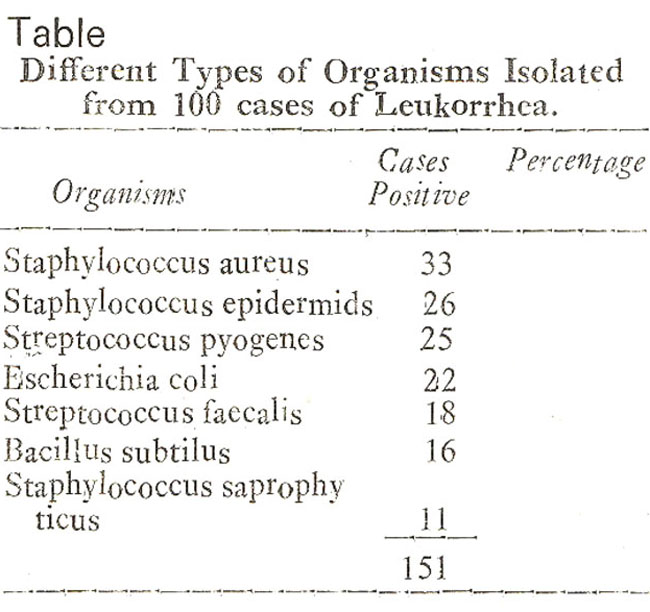
Incidence of these organisms in leukorrhea correspond with the findings of many other workers (Jerome and Lynebrook, 1951; Bailey and Scott, 1962). Levy et at. (1973) reported that the vaginal flora usually contain a mixed species.of lactohacillus and streptococcus as well as coliforms.
Bacteriological studies of infections of the female genital tract have demonstrated a complex flora involving multiple aerobic or facultative aerobes and anaerobic organisms. In this study more emphasis was given to aerobic flora, owing to poor availability of adequate facilities for anerobic cultures. According to Swanson etal. (1973) and Thadepalli et al.(l973) many of the pathogens have also been isolated from the vagina of healthy women. These represent the major pathogens in non-venereal infections of the female genital tract.
According to Bartlett et al. (1979) the factors determining the organisms colonizing in the genital tract are poorly established. The vagina harbours an unstable bacterial population subject to constant fluctuations based on well defined hormonal influences. The factors primarily responsible for the pattern of vaginal flora are influenced by local environmental conditions (Bartlett et at., 1978). Another explana-tion given was contamination during sampling though skin contaminants such as coliforins and Bacillus subtilus were infrequently encountered. It is aIso possible that the swab culture technique may cause some variation.
Haemophilus vaginalis, Neisseria genorrhoeae and lactobacillus could not be isolated which might be due to local environmental conditions. Levison et al. (1977) demonstrated that the site of gonococcal infection is the colurnner opithelium (e.g., edocervical glands) and the microflora at these sites may not be appropriately sampled by vaginal culture.
In vitro antibiotic sensitivity of each sample was tested with Septran, Penicillin, Vibrarnycin, Streptomycin, Erythrocin, Pyopen and Cornbiotic. In the present study it was observed that 68 cases were sensitive to Erythrocin which was found in accordance with the observation made by Dzhamalova et al. (1970). In the present study Septran, Vibramycin and Penicillin did not exhibit encouraging results and sensitive strains comprised only 10, 4 and 3% respectively. The great resistance to penicillin may be explained on the basis of production of pemicillinase by such strains which are naturally resistant rather than sensitive strains which have developed resistance due to contact. The resistance of the present strains towards penicillin s supported by the observation of Pelczar and Reid (1972) who reported that 80 percent of the strains of Staphylococcus aurelis isolated from hospital patients were PenicilIin resistant. The reasons for emergence of resistant strains was attributed to the extensive use of these drugs in medical practice.
References
1. Bailey, W.R. and Scott, E.G. Diagnostic microbiology. Saint Louis Mosby 1962, pp. 91-6.
2. Bartlett, J.G., Onderdonk, A.B., Drude, E., Goldstein, G., Anderka, M., Alpert, S. and McCormack, W.M. (1979)
3. Quantitative bacteriology of the vaginal flora. J. Infect. Dis.. 136:271.
4. Bartlett, J.G., Nancy, M.E. Goldstein, P.L.B., Gorden, B., Onderdonk, A.B. and Polk, B.F. (1978) Cervical and vaginal bacterial flora. Am. J. Obstet. Gynecol., 130:658.
5. Cruickshank, R., Duguid, J.P., Marmion, B.P. and Swain, R.N.A. Medical microbiology. 12th ed. Edinburgh, English Language Book Society, 1973.
6. Dzhamaloya, Z.M., Khattaev, S.N. and Turaeva, P.E.Resistance of antibiotics of the microflora of the genitalia in vulvovaginitis. Med. 2:33:34 (cited by Biol. Abst. 52 (13):7088, 1971, 1970.
7. Jerome, J.S. and Lynebrook, M.D. (1951) Aureomycin therapy for E. coli vaginitis. JAMA., 147:652.
8. Levison, M.E., Corman, L.C., Carrington, E.L. and Kaye, D. (1977) Quantitative microflora of the vagina. Am. J. Obstet. Gynecol., 127:80.
9. Levy, J., Campbell, J.J.R. and Blackburn, T.H. Introductory microbiology. 2nd ed. New York, Wiley, 1973, p. 536.
10. Pelczar, M.J. Jr. and Reid, R.D. Microbiology, New York, McGraw Hill, 1972.
11. Swenson, R.M., Michaelson, T.C., Daly, M.J. and Spauldrng, E.H. (1973) Anaerobic bacterial infections of the female genital tract. Obstet. Gynecol., 42:538.
12. Thadepalli, H., Gorbach, S.L. and Keith, L. (1973) Anaerobic infections of the female genital tract; bacteriologicalaud therapeutic aspects. Am. J. Obstet. Gynecol., 117:1034.
Journal of the Pakistan Medical Association has agreed to receive and publish manuscripts in accordance with the principles of the following committees:


