

Mukkaram Khan ( Surgical 'B' Unit, Lady Reading Hospital, Peshawar. )
Tariq S. Mufti ( Assistant Professor of Surgery, Ayub Medical College, Abbottabad. )
May 1982, Volume 32, Issue 5
Original Article

Abstract
A study of incidence of External Hernias out of a sample of four hundred and forty four patients admitted and operated in Government Lady Reading Hospital, Peshawar is presented. Detailed incidence of Inguinal hernia, its complications and recurrence is assessed and data compared with the available figures from other parts of the world (JPMA 32:119, 1982).
Introduction
Exact incidence per population of external hernias is not established as yet in our country and would be extremely difficult to collect with any precision even today because of want of maintenance of National Register for disease. Still it is considered that Hospital admissions provide the best data for comparing incidence in different geographical areas (Jannett and Mac Millan, 1981). It would not be out of place to mention here that even in U.S.A. accurate figures for the incidence of hernia are not available (Christopher, 1972).
Available figures in European and U.S. literature vary from each other for many tvpes of hernias (Ellis, 1970; Christopher, 1972; Bailey, 1977). Thus they cannot be applied to our population. No such survey has been carried out in our country. This study is, therefore, conducted to determine the frequency of External Hernias presenting in Government Lady Reading Hospital, Peshawar (draining major portion of population of NWFP). Different aspects of inguinal hernia were studied in detail on account of its common occurrence.
Material and Methods
Out of 444 cases, 326 patients were collected prospectively while, remaining figures were obtained after careful and accurate scrutiny of patient records admitted in various surgical units of Hospital. Patients coming from differrent regions of the province were included in sufficient proportion in the trial.
Results and Discussion
Breakdown of total number and percentage representation of each type of hernia is shown in the accompanying figure. As expected occuir-ence of inguinal hernia was dominant (76.35%). This, however, is universally recognised and is in accordance with British and American data (Table 1).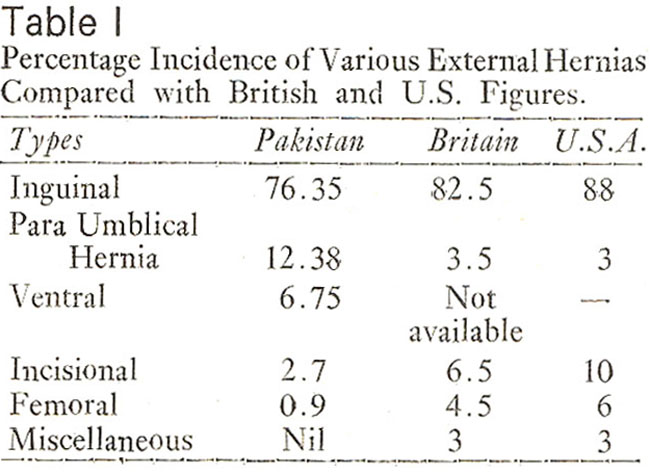
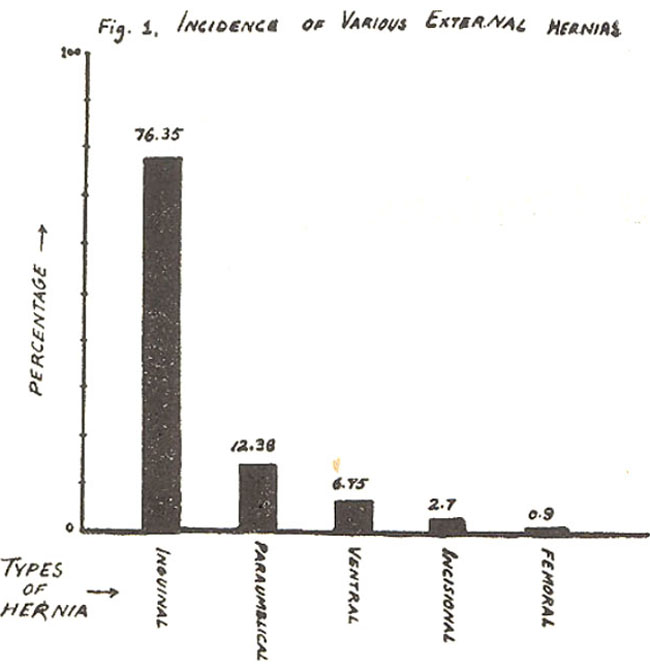
Figures for para-umblical hernia is significantly higher in our study as compared to western figures (U.S. Department of Health, 1960; Bailey, 1977).
Ventral hernia is included in the present study as a distinct group on account of its higher incidence than Western literature. Many western authors include it in miscellaneous group or, perhaps with para umblical hernias. Low incidence of incisional hernia in this study (2.7% as contrast to British, 6.7% and U.S. 10%) is not a true reflection of overall incidence per population. In fact this type of hernia is far more prevalent and disparity in figures is due to un-willingness on the part of patients with uncomplicated incisional hernias, to seek medical advice and treatment.
It is astonishing to have come across too few femoral hernias i.e. four out of 444 (less than 1%). Americans report in 6% of their population while it is 4.5% for British population.
Inguinal Hernia
343 patients with inguinal hernias were recorded and of them 250 (72.8%) were adults, 67(19.5%) children and 26(7.5%) infants.
The oldest of all the patients was a 91 year old man and the youngest presented on the 30th day of his life with strangulation. Average age for adults with indirect type was 27 and for direct 55 years. 312 (91%) were indirect, 30(8.7%) direct and one (less than 1%) had both types of hernial protrusion.
Frequency of right sided hernias over left sided cases in children was consistant with reported incidence in British literature (Bailey, 1977). On the contrary where for adults left sided hernia is more common in British population, this study shows preponderance of right sided hernias over those occurring on the left side (Table II).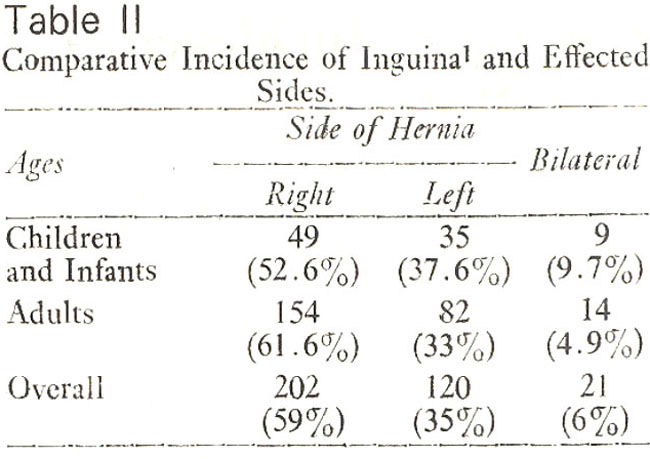
Bilateral cases accounted for only 6% of our admission while higher figures are reported in the west (Ellis, 1970).
Male to Female ratio was 30: i (females being 9 out of 343). Other workers have reported this ratio varying from 20:1 to 10:1, (Cristopher, 1977; Bailey, 1977).
268 cases who could be enquired about their occupation fell into following groups:-
Farmers 108(40.5%)
Labourers 32(12%)
Sedentary Workers 32,(12%)
Children and Infants 60(22%)
Miscellaneous 13(13%)
Inference from this categorisation is, perhaps, that the occupation does not particularly affect the incidence of hernia and higher percentage of farmers indicates preponderance of this section amongst our population.
Complications associated with hernias along-with their incidence is given in Table III.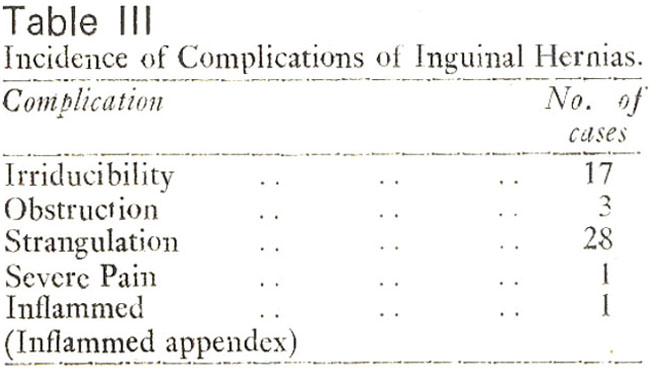
Strangulation was the feature of only 8.4% of our patients which is quite low as compared to the data reported from some of the other developing countries i.e., 35% in Nigeria (Cole, 1965) and 35% in Rhodesia (now Zembabwe). Even in Indian Punjab the figures showed 27% as reported by Gill and Eggleston (1965). In European and U.S. population it is exceedingly uncommon due to prophylactic surgery (Ellis, 1970). Just under half the strangulations had gangrenous contents (mostly gut) and this indicates the delay in getting the patient into Hospital either due to lack of communication facilities from home to hospital or ignorance on the part of patients, relatives and local quacks.
Recurrence account for 0.10% of the hernia repairs has been stated by different authors (Griffith, 1959; Bailey, 1977; Zimmerman and Anson, 1967). Most of the recurrences in our patients developed during the first year of repair which is a universally admitted fact.
Conclusion
Due to lack of facilities of collecting statistics in the population with absolute precision in our community, sampling technique is used to draw the incidence. The fact remains that many of our figures tally with internationally documented data, and approximate incidence of diseases could be determined by this technique. The authors look forward to similar studies carried out in other centres of the country.
Acknowledgement
We are indebted to incharge and other medical staff of Surgical \'A\' and \'C\' Units in addition to our own medical colleges who helped us in collecting the record of their patients included in this study.
References
1. Bailey, H. Short practice of surgery. 17th ed. London, Lewis 1977, p. 1104.
2. Christopher, F. Textbook of surgery. 11th ed. Philadelphia, Saunders, 1977, p. 1345.
3. Cole, G.J. (1965) Hernial repairs. J. Gastent., 6:151.
4. Ellis, H. (1970) Inguinal hernia. Br. J. Hosp. Med., 9:535.
5. Gill, S.S., Eggleston, F.C. (1965) Acute intestinal obstruction. Arch. Surg., 91:589.
6. Griffith, C.A. (1959) Inguinal Hernia; an anatomic surgical correlation. Surg. Clin. North Am., 39:531.
7. Jennet, B. and MacMillan, R. (1981) Epidemiology of head injuries. Br. Med. J., 282:101.
8. U.S. Deptt. of Health, Education and Welfare (1960) "National Health Survey on Hernias", Series B, December.
9. Zimmerman, L.M., Anson, B.J. Anatomy and surgery of hernia. 2nd ed. Baltimore, Williams and Wilkins, 1967.
Journal of the Pakistan Medical Association has agreed to receive and publish manuscripts in accordance with the principles of the following committees:


