

A. Qsyum ( Pakistan Council of Scientific & Industrial Research Laboratories, Peshawar. )
Naheed Ahmed ( Pakistan Council of Scientific & Industrial Research Laboratories, Peshawar. )
K.D. Ahmad ( Pakistan Council of Scientific & Industrial Research Laboratories, Peshawar. )
S.G. Khattak ( Pakistan Council of Scientific & Industrial Research Laboratories, Peshawar. )
Inayatullah ( Department of Physiology, Khyber Medical College, Peshawar. )
June 1983, Volume 33, Issue 6
Original Article

Abstract
This work deals with the effects of the alcoholic extracts of 15 plants (collected from the northern region of Pakistan) on isolated guinea-pig ileum preparation.
Dried powdered plant material was extracted with alcohol. The extract obtained after the removal of the alcohol was triturated with pet-ether (40-60°) and then charcoaled, filtered and dried under vacuum.
The isolated guinea-pig ileum preparation was set up in an organ bath of 10 ml capacity containing exygenated Tyrode solution. A 10 mg/ml solution/suspension of the extract (in distilled water) was added to the bath in 100-800 ug/mI concentrations. Those extracts which did not produce a spasmogenic effect, were tested for antispasmogenic action against acetyicholine.
The extract of Cleome brachycarpa, Fagonia cretica and linum usitatissimum produced spasmogenic effect. The extracts of Asperugo procumbens, Capparis decidua, Cichorium intybus, Cnicus arvensis, Euphorbia hirta, Equisetum arvense, Eugenia jambolana, Forsskalea tenacissima, Onosma echiodes, Peganum harmala, Prospopis glandulosa and Ranunnculus acetylcholine (JPMA 33: 136, 1983). muricatus antagonized the spasmogenic effect of acetylcholine (JPMA 33: 136, 1983).
Introduction
In the course of investigations on the pharmacological effects of indigenous medicinal plants collected from the Northern region of Pakistan, it was observed that the alcoholic extracts of some of the plants produced spasmogenic and antispasmogenic effects on the isolated preprations of intestines obtained from various Laboratory animals. This work deals with a preliminary report on the effects of the alcoholic extracts of 15 plants (Table-I) on the isolated guinea-pig ileum preparations.
Material and Methods
Preparation of Plant Extracts: 100 gms of the dried,, powdered plant material was extracted three times with alcohol in a percolator. The alcoholic extract obtained after removal of solvent under vacuum was triturated with pet-ether (40-600) a sufficient number of times until a fresh addition of pet-ether failed to remove significant colouring material. This pet-ether treated alcoholic extract was charcoaled, filtered, dried under vacuum and weighed (Table I).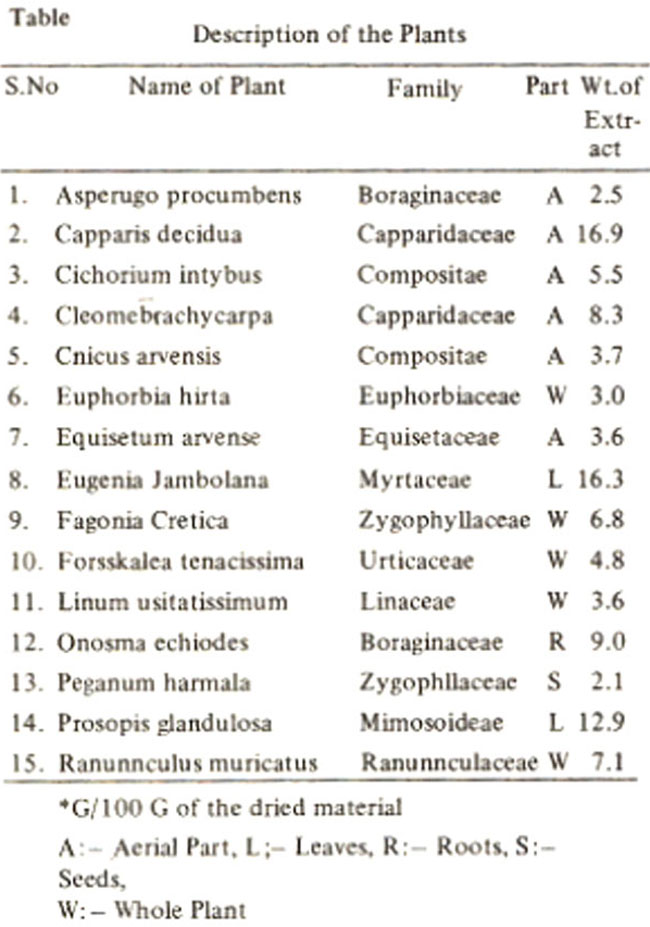
Isolated Guinea-Pig ileum Preparation The preparation was set up, according to the procedure adapted by Khan (1959) in an organ bath of 10 ml capacity containing oxygenated Tyrode solution. The contractions were recorded on a revolving smoked drum with the help of a frontal writing point lever. The sensitivity of each preparation was tesetd with graded doses of acetylcholine, before starting experiments with the extract in hand.
Experimental Procedure : A 10 mg/mi stock solution/suspension of the extract concerned was prepared freshly (in distilled water) and 0.1, 0.2, 0.4 and 0.8 ml of this solution/suspension were added to the bath for recording their effects. Final concentrations in the bath were, therefore, 100, 200, 400 and 800 ug/mi. The tissue was washed for several times and tested with acetyicholine 45 seconds to 1 minute after the addition of a particular dose of the extract. Those extracts which did rot produce a spasmogenic effect of their own were tested for their antispasmogenic effect against acetylcholine induced contractions.
Sulution used Tyrode solution containing the following constituents (in GIL of distilled water) was used:- Naci, 8.0; Kcl, 0.2; Cad2, 0.2; Mgcl2 0.1; NaH2 Po4, 0.05; NaHCO3, 1.0 and Glucose, 1.0.
Results
The extracts of the following three plants produced spasmogenic effect on the isolated guine-pig ileum preparation. Cleome brachycarpa, Fagonia cretica and Linum usitatissimum.
The extracts of the following twelve plants antagonized acetylcholine on the isolated guinea-pig ileum preparation: Asperugo procumbens, Cap-paris decidua, Cichorium intybus, Cnicus arvensis, Euphorbia hirta, Equisetum arvense, Eugenia jambolana, Forsskalea tenacissima, Onosma echiodes, Peganum harmala, Prosopis glandulosa and Ranunnculus muricatus.
Discussion
The findings reported in this paper indicate that the extracts of different parts of fifteen indigenous plants produced important pharmacological (spasmogenic or spasmolytic) actions on the isolated guinea-pig ileum preparation. Detailed studies on the determination of the mechanism of The spasmogenic or antispasmogenic actions of these extracts may help in the detection of therapeutically active compounds of natural origin, which may prove beneficial in the treatment of various gastro-intestinal disorders. Studies on the effects of several other plants, on similar lines, are in progress. The effects of fifteen indigenous plants on the isolated guinea-pig ileum preparation have previously been reported under the same research project (Qayum et al., 1982).
References
1. Khan, LDrugs modifying the action of 5-hydroxytryptamine. Edinburgh, university of Edinburgh, 1959 (Ph. D. Thesis).
2. Qayum, A., Ahmed, N., Ahmad, K.D. and Khattak, S.G. (1982) JPMA., 32: 103.
Journal of the Pakistan Medical Association has agreed to receive and publish manuscripts in accordance with the principles of the following committees:


