

Qaiser Iftikhar ( Department of Biochemistry and Department of Pharmacology, University of Agriculture, Faisalabad. )
Afzal Ilahi ( Department of Biochemistry and Department of Pharmacology, University of Agriculture, Faisalabad. )
M. Nawaz ( Department of Biochemistry and Department of Pharmacology, University of Agriculture, Faisalabad. )
Naeem-ur-Rahman ( University of Engineering and Technology, Lahore. )
December 1985, Volume 35, Issue 12
Original Article

Abstract
The residue levels of Endrin were estimated for two vegetables, i.e., raddish (Raphanus sativus) and cabbage (Brassica oleracia). Samples were collected from fields and markets. The disappearance of endrin in raddish was also noted after spraying. Ten percent of raddish and 30 percent samples of cabbage were found to contain large amounts of the insecticide ranging from199.4 ± 6.8 to 388.7 ± 16.9 ug per 100 gsample. The residues of the insecticide after spraying the raddish crop, persisted upto 10 days. The insecticide accumulated in the blood and livers of albino rats receiving three different doses of endrin orally. The growth rate was significantly affected (JPMA35 :362, 1985).
INTRODUCTION
Insecticides protect agricultural commodities from plant and diseases by their immediate action. The increasing use and presence of insecticide residue in food material is likely to create multiple health problems in Pakistan.
The present study was undertaken to detect endrin in vegetables and its effect on biological systems.
ATERIAL AND METHODS
Samples of two vegetable, raddish (Raphanus sativus) and cabbage (Brassica oleracia) were collected randomly from different fields and markets. Raddish crop was also sown in an experimental plot measuring 1350 square feet. At the time of maturity, it was sprayed with 0.05 percent solution of endrin at the rate of 100 gallons per acre. Raddish samples were collected from that plot on alternate days.
Random and self sprayed samples were qualitatively screened for endrin residues using thin layer chromatography1. Insecticide was separated from the plant material2 and endrin was estimated using the method of Terriere et al.3
Sixteen male albino rats were randomly divided into four groups A,B,C and D. The control group D was given normal stock diet throughout the experimental period of four weeks. The rats in three treated groups A,B and C were administered endrin orally in doses of 4.5, 2.25 and 1.125 mg per Kg body weight respectively. The initial and subsequent daily weights of rats were recorded. Initial and weekly blood samples were collected by cardiac puncture under anaesthesia from one randomly selected rat from each group for estimation of endrin.4 At the end of four weeks, the rats were killed and weights of their principal organs like liver, kidney, spleen, heart, adrenals and lungs, were recorded for comparison. The livers were analysed for any accumulation of endrin5.
RESULTS AND DISCUSSION
Ten samples of raddish and ten of cabbage collected randomly from various fields and markets, were analysed for the presence,, of endrin residues. Only one sample of raddish and three of cabbage contained endrin. The amount of endrin in cabbage ranged from 199.4 ± 6.8 to 388.7 ± 16.9 ug per 100 g of the vegetable, whereas for raddish it was 380.3 ± 8.5 ug per 100 g. These results indicate that the daily consumption of endrin by human population. ranges from 598.2 to 1166.1 ug per person, provided it is assumed that an adult healthy man of 70 kg body weight with normal dietary habits, consumes 300 g of the vegetable. The acceptable daily intake (AD!) calculated on this basis ranges between 8.5 and 16.6 ug per kg body weight. This amount is quite high and alarming as compared to the ADI established by FAO6 to be 0.2 ug per kg body weight.
The endrin residues persisted in the edible portion of raddish, upto 10 days and diminished thereafter (Figure 1).
Other studies show that endrin residues on cabbage disappeared within 2! days7 and on raddish crop they persisted from7 to 12 days. 8
The various concentrations of endrin in blood of different groups of rats are shown in Figure 2.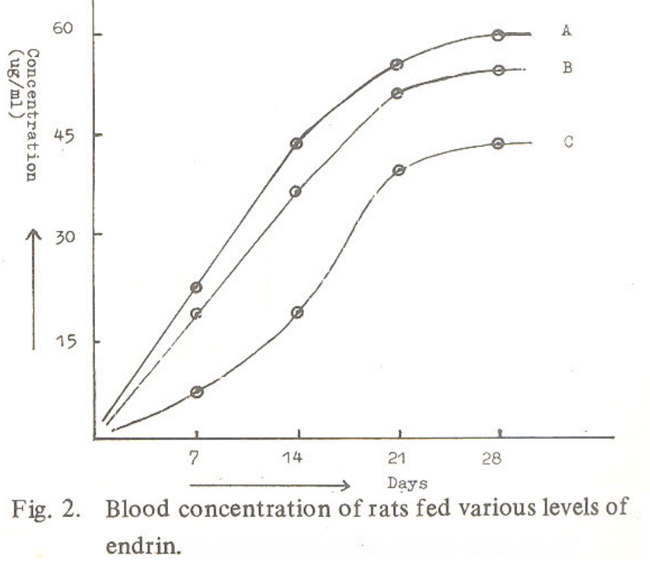
The results indicated that the amount of endrin in blood increased progressively. A study of these values indicated that the blood endrin values of groups A and B did not increase with respect to the dose level. The blood endrin concentrations were therefore divided by the level of dose to eliminate the dose effect. The values obtained (Table I)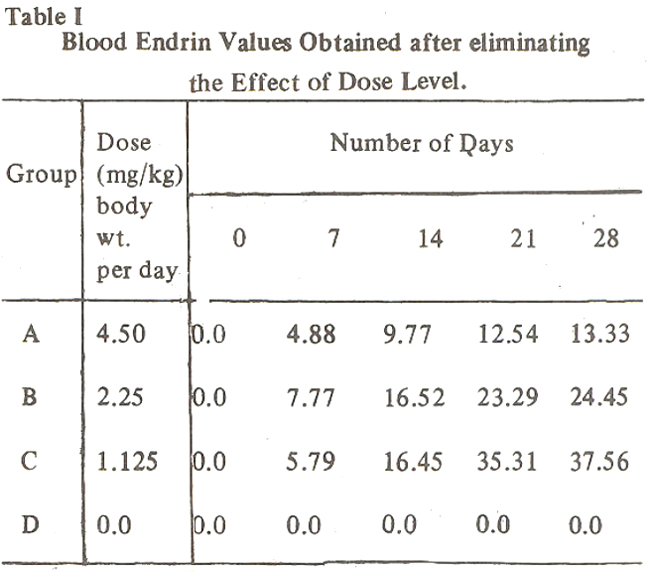
indicated that the increase in plasma level of endrin, was not proportionate to the increase in dose as is evidenced by the observation that minimum dose exhibited maximum plasma level on the 21st and 28th day. It may therefore, be concluded that the rate of absorption from the gastro-intestinal tract was independent of the amount of insecticide fed to the rats. The amounts of endrin residues accumulated in the livers of different groups of rats, have been shown in Figure 3.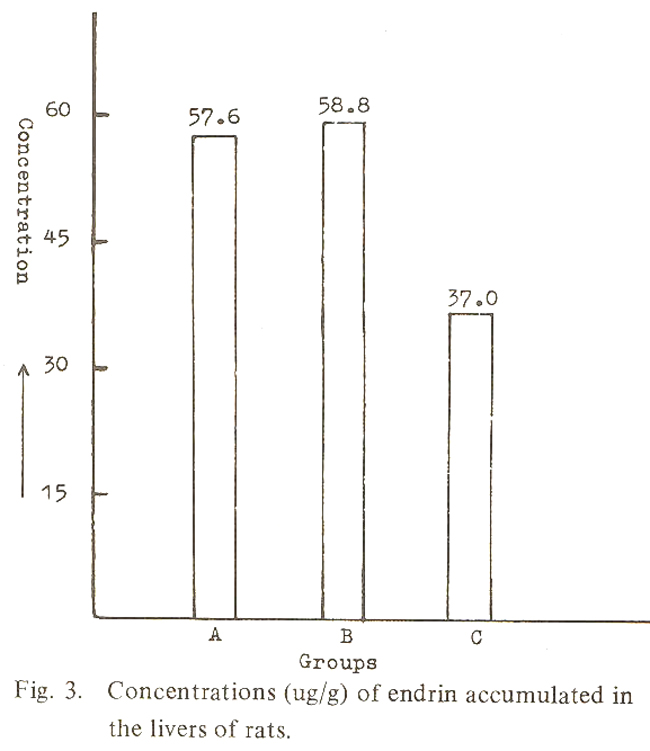
The values indicated that the amount accumulated was independent of dose.
The regression lines (Figure 4)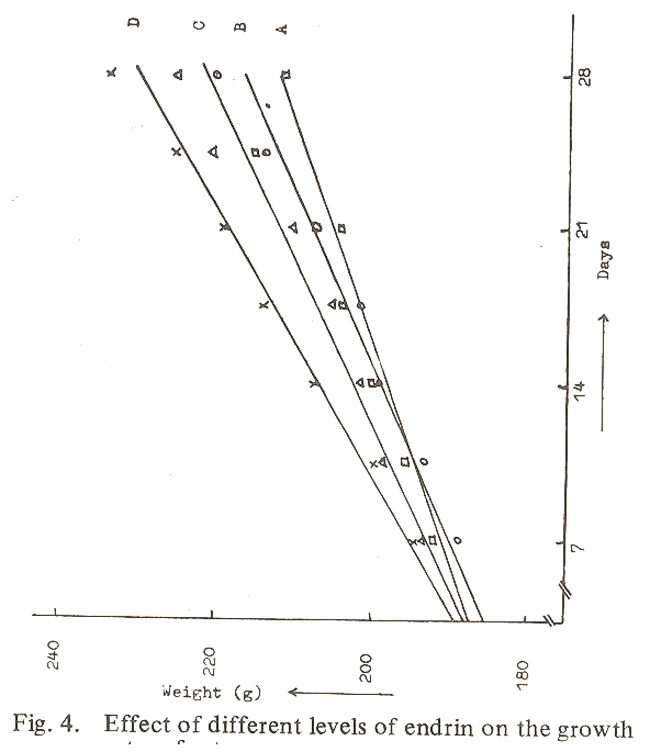
drawn on the basis of average daily body weights of rats in each group, indicated that all doses of endrin adversely affected the growth rate of rats when compared with the control group. However, there was a non-significant difference on the decreased growth rate of rats by different dose levels of endrin.
The ratio of the weight of various organs to that of body weight is shown in Table II.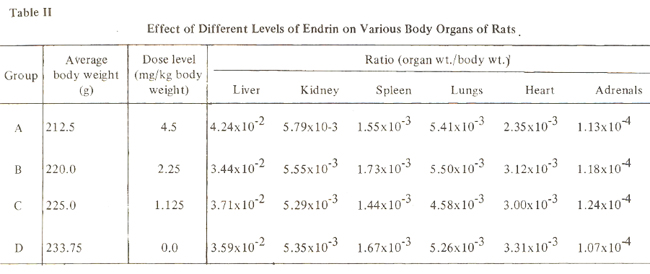
The livers of treated groups of rats, were significantly enlarged except in case of groups B. The hearts regressed in response to the treatment with endrin No effect of endrin was observed on other organs.
REFERENCES
1. Morley, H.V. and Chiba, M. Thin layer chromatography for chlorinated pesticide residue analysis without clean-up. J. AOAC., 1964; 47 : 306.
2. Albert, R.A. Clean up method for electron capture determination of endrin in fatty vegetables. J. AOAC., 1964;47 : 659.
3. Terriere, L.C., Kiigemagi, U. and England, D.C. Endrin content of body tissues of steers, lambs and hogs receiving endrin in their body. J. Agric.FoodChem., 1958;6 :516.
4. Griffith, F.D. Jr. and Blanke, R.V. Micro-colourjmetric determination of organo-chlorine pesticides in human blood. J. AOAC., 1974; 57 : 595.
5. Jones, L.R. and Riddick, J.A. Separation of organic insecticides from plant and animal tissues. Analyt.Chem., 1952; 24 :569.
6. FAO. Pesticide residues in food. Index and Survey. Food and Agriculture Organization. Rome, 1978.
7. Mattick, R.L., Barry, D.L., Antenucoi, F.M. and Avens, A.W. The disappearance of endrin residues on cabbage. J. Agric. Food Chem., 1963; 11: 54.
8. Abdullah, A. and Ahmad, M. Bioassay of effective residues of malathion, dimecron and endrin on raddish crop. Pakistan J. Agric. Sci., 1971; 8 : 72.
Journal of the Pakistan Medical Association has agreed to receive and publish manuscripts in accordance with the principles of the following committees:


