

G.J. Hadfield ( Stoke Mandeville Hospital, Aylesbury (Bucks) England. )
November 1985, Volume 35, Issue 11
Special Communication

This article follows the format of my lecture given at the XVI biennial conference of the Pakistan Medical Society. The term “update” denotes personal interpretation and for this reason the style of this article will follow this point of view. This article will not therefore be an all embracing treatise on breast cancer, but rather a discussion on some points of change and controversy.
The discrete palpable breast mass is one of the most common presentations of breast disease. Attitudes in it’s management have changed and the general plan of management is best shown in figure.
The early obtaining of a tissue diagnosis made by pathological examination makes it possible for the patient to know the nature of her disease
Pre-operative treatment can be fully discussed and informed consent obtained. In this way it has replaced the wholesale use of local excision and frozen section proceeding to mastectomy.
In some clinics, the services of an expert cytologist who is prepared to give a categorical diagnosis one way or the other is available, this can be used to either complement or replace Tru-cut biopsy.
The choices in primary treatment, Haistead’s radical mastectomy was the end product of the search for a solution to local nodal and skin recurrences occurring after smaller procedures. While locally radical it did not entirely solve the local problem and had no effect on occult or demonstrable metastatic disease.
Over the last thirty years a variety of local treatments have been suggested and carried out. When theft results have been analysed they can be judged. It remains vitally important that only those which are efficacious should be perpetuated.
In this field recent contributions on the study of the whole breast and in some cases the opposite breast by pathologists have provided important data. In the majority of specimens where the whole specimen was examined after mastectomy, ductal epitheliosis was present, three quarters of all patients showed further intraductal cancer or marked atypia and half of all cases showed a second focus of invasive cancer less than 5cms in diameter.
The concept of adequate local treatment is produced by such analyses. The main choices range from total mastectomy, leaving all the muscles to local amstectomy with or without axillary node sampling and on to local surgery to the breast lump with radiotherapy. Each have their protagonists and problems. However, follow up and analysis of results dividing the patients into three groups, A, being the most favourable but least common and B, and C, being the least favourable as shown on Table.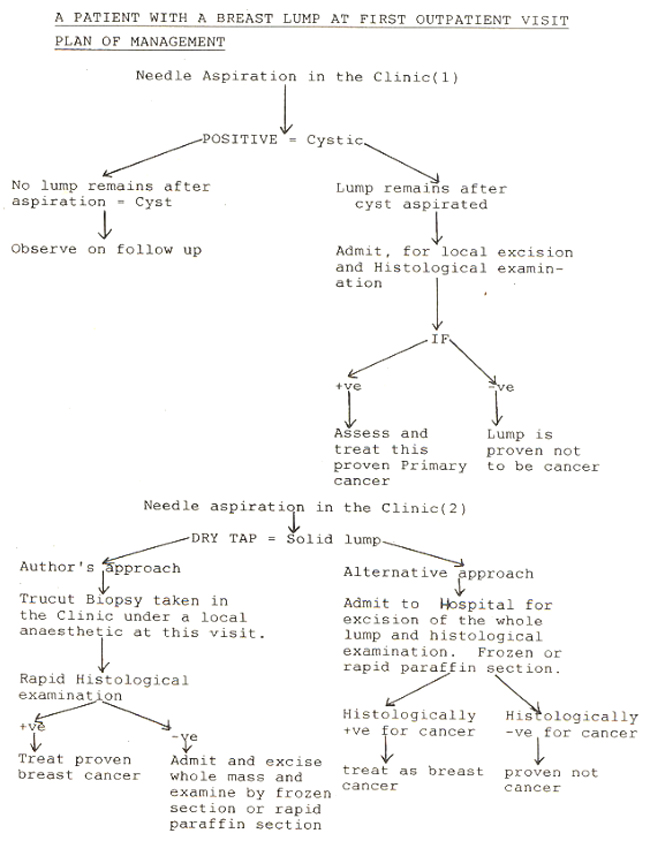
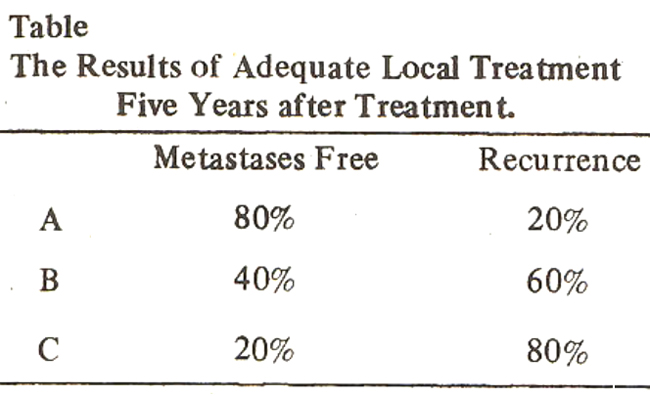
Study of these figures has stimulated the trial of adjuvant therapies at the time of adequate local treatment. So far, no single generally effective agent has emerged. The search remains for a drug with maximum effects for tumour destruction and minimal side effects. Good reports have come from the use of Nalvadrex (Tamoxifen), at first it was thought to act as an antioestrogen and therefore of use in receptor positive patients. However, on analysis of it’s use on unselected patients it had a significant effect on receptor negative patients, suggesting that it had a direct effect on the tumour cells themselves.
The finding of an agent with these credentials and without unacceptable side effects would not only materially improve the results of adequate local treatment, but reverse the clearly unsatisfactory results shown in Table.
The search for the early tumour has for a long time occupied medical ingenuity, the advances in mammography with the demonstration of tiny impalpable tumours, some of which are cancers, has opened a new field of endeavour.
First they need to be marked for surgical removal and histological examination, this can be done by a wire marker put through the sldn or by a dye injection into the tumour area under mammographic control.
In spite of their small size, not all these small tumours are “early”, reported series put the incidence of axillary metastases between 1 8.-25% of all specimens examined.
Prosthetic Breast Replacement has recently caused great interest in the treatment of breast cancer and there is an increasing call for it’s use especially in young women, but not exclusively so, and in patients judged to have a good prognosis.
The methods are standard and well known using a my-cutaneous flap and inserting the prothesis simultaneous with initial surgery.
The demand has grown for this type of surgery, but it too has it’s problems, not the least that there is no change in prosthesis size when the patient loses or gains weight.
The future holds challenges and possibilities for this common and as yet unsatisfactorily treated disease. Advances in the nature and spread of metastases, the development of new techniques in histopathology which will tell us more about the biology of cancer cells and their stroma, the definition of prognostic signs and their evaluation, these with the experience of the past may lead to progress in the future.
More detailed reading and references on this subject can be obtained from:
Hadfield, G.J., Cancer of the breast: retrospect, circumspect and prospect. In Hadfield S., Hobsley M., eds Current Surgical Practice, Vo.3. Edward Arnold, 1981: 292-307
Related Articles
Journal of the Pakistan Medical Association has agreed to receive and publish manuscripts in accordance with the principles of the following committees:


