

Haifa A Al-Turki ( Department of Obstetrics and Gynecology, King Fahd University Hospital, AlKhobar. )
Abdallah Kalaf AL-Hwiesh ( Internal Medicine/Nephrology, King Fahd University Hospital, AlKhobar. )
Fahd A Al-Muhanna ( Internal Medicine/Nephrology, King Fahd University Hospital, AlKhobar. )
Ibrahim Saeed Abd-AlRahman Taha ( Internal Medicine/Nephrology, King Fahd University Hospital, AlKhobar. )
Nehad AlAwdah ( College of Medicine, University of Dammam and Peritoneal Dialysis Unit, King Fahd University Hospital, AlKhobar. )
March 2014, Volume 64, Issue 3
Short Reports

Abstract
Women with End Stage Renal Disease (ESRD) have hormonal imbalance leading to gynaecological and reproductive disturbances. The objective of this study was to see the reproductive and gynaecological problems associated with ESRD. Forty Saudi Arabian women with a diagnosis of ESRD for a period of 60 months were interviewed at the dialysis unit of King Fahd University Hospital, Al Khobar. The average age was 51.5±17.1 years with a range of 19-90 years. Eighteen (45%) were premenopausal with a mean age of 36.5±11.1 years. Diabetes mellitus and Hypertension was the cause of ESRD in 29 (72.5%). Out of 18 menstruating women 11(61.1%) had irregular periods. Only 2 had children after ESRD was diagnosed. Thirty-three (82.5%) women did not have their regular mammograms and 25 (73.5%) had no pap smears. Our study shows that majority of women with ESRD have gynaecological and reproductive issues which are being neglected.
Keywords: ESRD, Gynaecological problems.
Introduction
End Stage Renal Disease (ESRD) is a chronic debilitating disease affecting most of the systemic functions of the body. Lim et al (1980)1 reported that ESRD is associated with disturbances of neuro-endocrinal and irregularities of the reproductive functions. It is observed that gynaecological issues are often neglected which are serious and need to be addressed.2
Chronic renal failure leading to ESRD is increasing in the World and the annual increase in the patients with ESRD globally is between 6.6-8.2%.3,4 In Saudi Arabia this is estimated to be 8.6% which is the highest in the world.8 An extensive review of English Language literature showed no studies reported from Saudi Arabia on reproductive and gynaecological problems among patients with ESRD. Hence we undertook this survey to address the long neglected reproductive and gynaecological issues among Saudi women with special emphasis on prevalence, type of problems and to suggest the preventive measures.
Patients, Methods and Results
Forty Saudi Arabian women with ESRD either admitted to the hospital/ or seen at the haemodialysis facility of the King Fahd University Hospital, AlKhobar were interviewed. After obtaining informed consent to participate in the study, one of the researchers interviewed the patients and a preset proforma was completed. Patients diagnosed to have ESRD and on dialysis for at least 60 months prior to the interview were included. Patients under the age of 18 years were excluded from the survey. The data included age, years of renal disease, type of dialysis, cause of renal disease, other known diseases, marital status and number of children. Gynaecological and reproductive history included menstrual history, birth control, sexual activity, last mammogram and Pap smear.
The average age of the patients included was 51.5±17.1 years with range of 19-80 years. Eighteen (45%) were of premenopausal age range 36.5±11.1 years and 22 were peri and post menopausal with a mean age of 63.8±9.7 years. Demographic characteristics are shown in Table-1.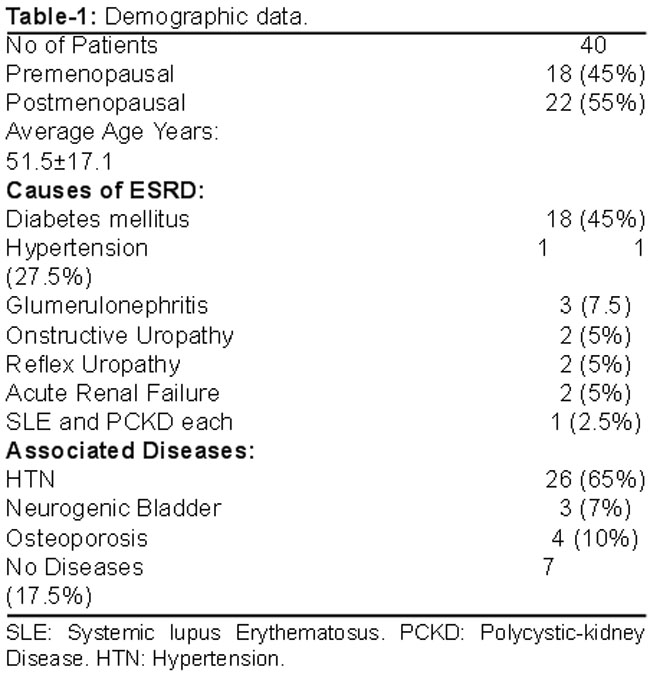
Diabetes mellitus and Hypertension was the cause of ESRD in 29 (72.5%). Twenty nine (72.5%) women were married, 6 (15%) were unmarried, 4 were divorcees and 1 was a widow.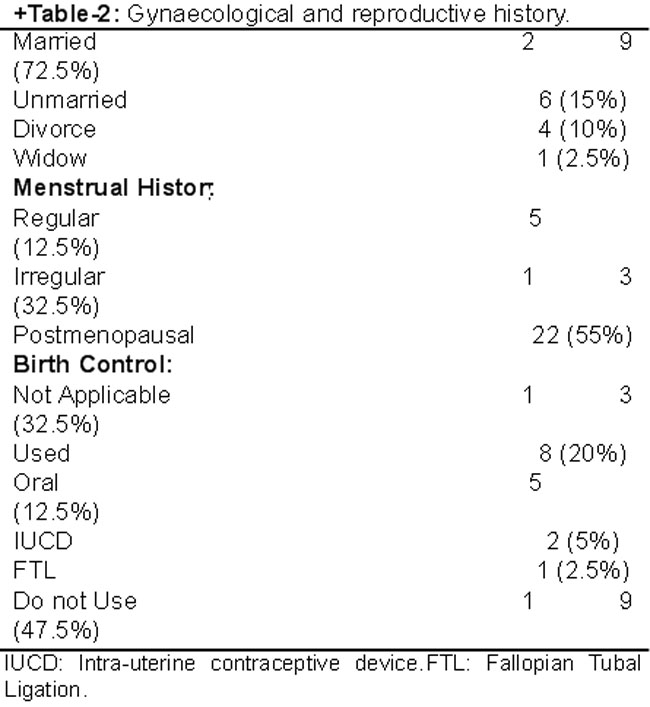
Table-2 gives the gynaecological and reproductive details. Out of 18 menstruating women, 11(61.1%) had irregular periods. Thirty- four women had children, average 5.91±2.7 (range 2-10) and only 2 had children after ESRD was diagnosed. Out of 23 women, 13(56.5%) said they were sexually active. None of the patients had any advice on their gynaecological and reproductive problems. Thirty-three (82.5%) women did not have their regular mammograms and 25 (73.5%) had no pap smears.
Conclusions
Our study has lent further support to the hypothesis that menstrual irregularities are more common than previously suggested in premenopausal women with ESRD. The reported prevalence of menstrual irregularities in patients with ESRD is 50%.5 In this study over 60% of women were suffering from menstrual irregularities. The issue of pregnancy in childbearing women with ESRD is an important one which cannot be ignored as recent figures put the incidence of women of childbearing age with Chronic Kidney Disease (CKD) to be around 3%.6,7 Hladunewich et al (2011)8 found that pregnancy in women of childbearing age with ESRD on dialysis is uncommon and reported that frequency of pregnancies during haemodialysis was between 0.3% and 0.75% per year. In our study 2 out of 17 women of child bearing age became pregnant on haemodialysis.
There are pronounced effects on the sexual functions of patients on dialysis due to CKD which in turn affects quality of life. Sexual dysfunction is a common problem in ESRD and has received little attention. The sexual activity of women with haemodialysis is under-evaluated and very little is reported. The reported incidence of sexual dysfunction range between 66.4% to 84.5% depending on the medications they take.9 In our study 56.5% of patients confirmed that they were sexually active, although these are slightly better figures than reported but still more work is required to make these patients live a normal life.
In the CKD and ESRD population, malignancies develop more frequently than the normal population. Maisonneuve (1999)10 reported that in women with ESRD, cervical cancer was 2.5 times more common than the general population. The need for routine screening is still debated and currently, there are no cancer screening guidelines. The discussion is due to the benefits of screening due to shorter life span of patients with ESRD. We believe whatever the period of life with ESRD, patients do deserve to be early diagnosed if a malignancy develops. There was no malignancy diagnosed in our patients but the screening like mammograms and pap smears was performed in only 17.5% and 26.5% of patients.
In conclusion gynaecological and reproductive problems are highly prevalent in womenon haemodialysis. Contraceptive advice was not adequately provided and screening for cervical or breast cancer was dismal. We believe that regular gynaecological and reproductive review should be routinely available for women with ESRD.
Acknowledgements
No conflict of interests and none disclosures.
References
1. Lim VS, Henriquez C, Sievertsen G, Frohman LA. Erythropoietin causes hormonal changes in haemodialysis patients? Ann Intern Med 1980; 93: 21-7.
2. Holley JL, Schmidt RJ, Bender FH, Dumler F, Schiff M. Gynecologic and reproductive issues in women on dialysis. Am J Kidney 1997; 29: 685-90.
3. Saudi Center for Organ Transplantation Data 2003. (Online) (Cited 2013 Aug 1). Avaiable from: URL: http://: www.scot.org.sa.
4. Briggs JD. The ERA-EDTA Registry returns to Amsterdam. Nephrol Dial Transplant 2000; 15: 1326-27.
5. Kawashima R, Tsutomu Douchi T, Oki T, Yoshinaga M, Nagata Y. Menstrual disorders in patients undergoing chronic hemodialysis. J Obstet Gynaecol Res 1998; 24: 367-73.
6. Williams D, Davison J. Chronic kidney disease in pregnancy.BMJ 2008; 336: 211-5.
7. Hou S. Historical perspective of pregnancy in chronic kidney disease. Adv Chronic Kidney Dis 2007; 14:116-8.
8. Hladunewich M, Hercz AE, Keunen J, Chan C, Pierratos A. Pregnancy in end stage renal disease. Semin Dial. 2011; 24: 634-9.
9. Bailie GR, Elder SJ, Mason NA, Asano Y, Cruz JM, Fukuhara S et al. Sexual dysfunction in dialysis patients treated with antihypertensive or antidepressive medications: results from the DOPPS. Nephrol Dial Transplant 2007; 22: 1163-70.
10. Filocamo MT, Zanazzi M, Li Marzi V, Lombardi G, Del Popolo G, Mancini G, et al. Sexual dysfunction in women during dialysis and after renal transplantation. J Sex Med 2009; 6: 3125-31.
Journal of the Pakistan Medical Association has agreed to receive and publish manuscripts in accordance with the principles of the following committees:


