

Abdul Bari ( Department of Biological Sciences, Quaid-i-Azam University, Islamabad. )
Mohammad Farooq Khan ( Department of Biological Sciences, Quaid-i-Azam University, Islamabad. )
M. Bashir Awan ( Department of Biological Sciences, Quaid-i-Azam University, Islamabad. )
May 1986, Volume 36, Issue 5
Original Article

Abstract
Two hundred and fifty stool samples of clinically diagnosed diarrhoea patients were subjected to detailed bacteriological examination for the causative agents. Samples were collected from patients attending Rawalpindi General Hospital, Holy Family Hospital Rawalpindi and Central Government Polyclinic, Islamabad.
Using standard laboratory techniques for isolation and identification of bacterial pathogens, two hundred and fifty stool samples yielded two hundred and eight bacterial strains.These possible causative agents of infantile diarrhoea were recognised, to be species of seven genera, six belonging to family enterobacteraceae and one to pseudomonadaceae. Infection rate of each organism was found to be: Escherichia coli 128 (45.7%), K/ebsie/la aerogenes 27 (9.6%), Enterobacter aerogenes 10 (3.6%), Shigella sonnei 43 (15.4%), Salmonella typhi 9 (3.2%), Proteus morganll 51 (18.2%) and Pseudomonas aeruginosa 12 (4.3%).
Relationship of age in months to incidence of infantile diarrhoea was worked out. It was seen that infants between ages 4-6 months were highly infected. There was decline in infection Percentages among the infants of 7-9 months, disease incidence further decreased with increase in age upto 12 months.
Higher incidence rate was recorded among infants fed on tinned milk followed by animal milk feeding and breast feeding. Infants belonging to families having income up to Rs.2000/- were more prone to infantile diarrhoea. Infants of middle class families (income beyond Rs.2000/-) showed lower infection rates. (JPMA 36: 104, 1986).
INTRODUCTlON
Until 1930 infantile diarrhoea was considered to be mainly an epidemic summer diarrhoea1. This regular epiderniological pattern is now no longer observed though severe local outbreaks are still apt to occur at irregular intervals.2 Even in the developed countries gastroenteritis is still one of the commonest diseased of infancy, with a hospital mortality rate of over one percent.3
In general, infantile diarrhoea tend to be prevalent wherever socio-economic levels are low and in such areas the high mortality is also, in part, due to associated malnutrition. Gastroenteritis is probably responsible for kiffing more children throughout the world than any other single disease.4
Very little work has been done in Pakistan on infantile diarrhoea. The available information is not specific for infants. As such in view of clinical importance of the infantile diarrhoea and huge mortalities caused by this infection the present study has been designed with the following objectives.
- To investigate the bacterial causes of infantile diarrhoea.
Work out the incidence rates under various socio-economic conditions of urban community.
- Examine the role of breast and bottle feeding on incidence rates.
The gathered information is likely to be of much value to the clinicians in the treatment of infantile gastroenteritis.
MATERIAL AND METHODS
Collection of Samples
Stool Specimens from cases of infantile diarrhoea were collected from children wards of General Hospital, Rawalpindi, Holy-Family Hospital, Rawalpindi and from the out patients paediatric department of Central Government Polyclinic, Islamabad. A total number of two hundred and fifty infants were included in the present study. The test population was randomly selected out of the patients diagnosed to be suffering from diarrhoea, based on history and clinical findings. Children under one year of age were believed to be the infants for the purposes of this study. Collected samples were transferred into a reasonable amount of buffered glycerol broth transport medium and carried to the laboratory for further processing.
A brief history of the infants under study relating to his age, sex, socio-economic status of the patients was also recorded.
Isolation and Identification
Isolation of bacterial infantile diarrhoea pathogens was attempted on suitable primary isolation and enrichment culture media. Isolated strains of the organisms were identified on the basis of morphology, biochemical behaviour and majdr fermentation reactions.
RESULTS AND DISCUSSION
Using standard laboratory techniques for isolation and identification of bacterial pathogens, two hundred and fifty stool samples yielded two hundred and eighty bacterial strains. These possible causative agents of infantile diarrhoea were recognised to be species of seven genera, six belonging to family enterobacteraceae and one to pseudomonadaceae. Infection rate of each organism was found to be: Escherichia coli 128 (45.7%), Kiebsiella aerogenes 27 (9.6%), Enterobacter aerogenes 10 (3.6%), Shigella sonnei 43 (15.4%), Salmonella typhi 9 (3. 2%), Proteus morganii 51 (18.2%) and Pseudomonas aeruginosa 12 (4.3%).
Relationship of age versus types of infection was worked out. These reults are presented in Table 1.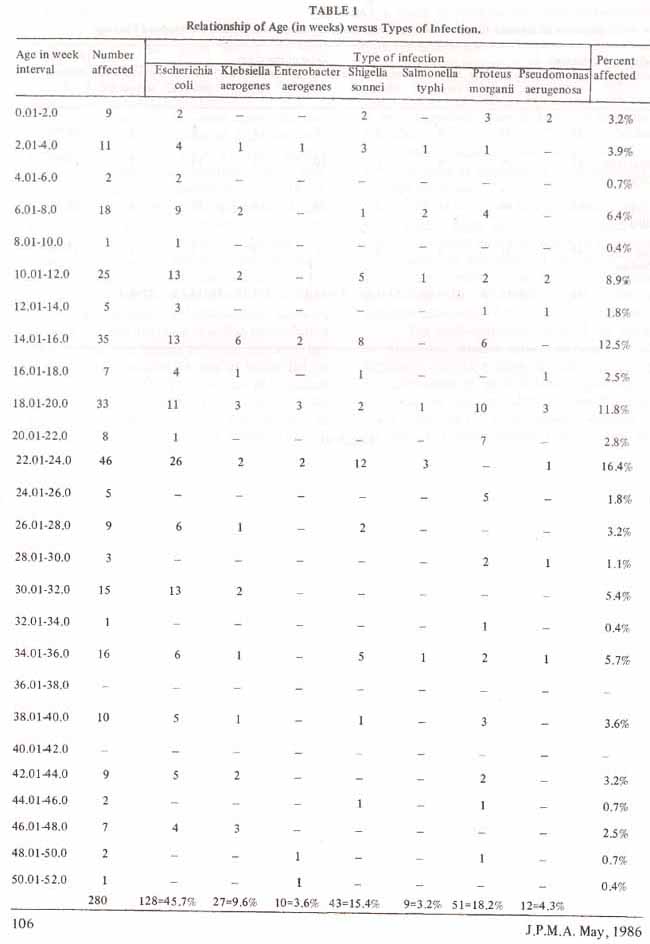
Agewise distribution of incidence rate of infantile diarrhoea caused by different types of micro-organism was condensed to three month incidence rate. These results are presented in Figure 1.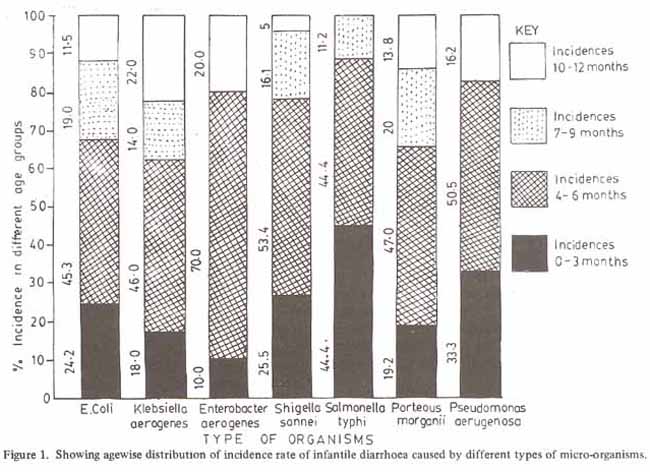
Influence of type of milk fed to infants, modes of feeding and their relationship to diarrhoea incidence were are also studied, the results placed in Table II.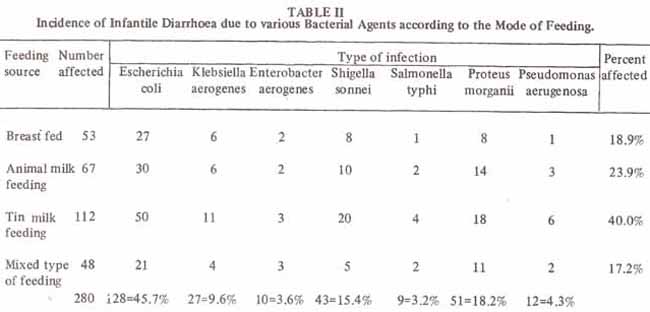
Influence of socio-economic status to incidence of diarrhoea due to various bacterial agents was also explored. The results are presentéd in Table III.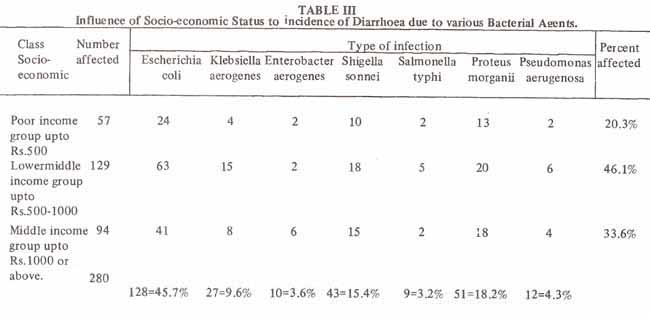
In the present study the isolation rate of E. coil (45.7%) was highest among the total isolates. Similar high percentage of E. coil as causative agent of the infantile diarrhoea has been reported by a number of workers5-8.
More than one bacterial agents has also been found to be the cause of diarrhoea, such associated populations were Proteus, Shigella and Pseudomonas in combination with E. coil.
Proteus morganii incidence rate was 18.2%. In this case out of fifty-one isolates, twenty strains were found to be coexistant with E.coii strains that is these were in mixed infections. The remaining thirty-one strains of Proteus were found to cause infantile diarrhoea independently.
The present study signifies the importance of Proteus morganhii as independent causative agent of infantile diarrhoea as well as its cohibition with E. coil. The highest infection rate with this pathogen was recorded in case of babies fed on tinned milk i.e. (40%). Next in order of frequency of incidence were babies fed on animal milk (23.9%) and lowest infection was recorded in babies fed on mixed type of feeding (17.2%). In connection with influence of age to infection with Proteus morganii, it was found that highest infection incidence was at the age of S months.
Shigella sonnei incidence rate was 15.4%. Among forty-three isolates of this species ten were found to be coexistant with E.coli and another two were found to be co.existant with Kiebsieila aerogenes. The remaininj thirty.one strains were found to cause infantile diarrhoea independently. The observation of Shigella species causing infantile diarrhoea independently as well as in combination with other pathogens has also been reported by Khan et ai (1981). 7
The highest frequency due to Shigeiia sonnei was recorded in case of babies fed on tinned milk or animil milk. Lower infection incidence was recorded in babies who were fed on mixed type of feeding or were breast fed.
Twenty.seven isolates of Kiebsiella aerogenes were recorded as microbial agents of infantile diarrhoea. Out of twenty-seven, only six strains were found to be coexistant with Proteus morganhi. The remaining twenty-one strains of Kiebsieiia aerogenes were seen to cause infantile diarrhoea independently.
Twelve (4.3%) strains of Pseudomonas aerugenosa were recorded as microbial agents of 108 infantile diarrhoea. All the strains were found to be a cause of infantile diarrhoea independently. No association with other pathogenic isolates was observed in this case.
Only ten strains of Enterobacter aerogenes (3.6%) were isolated as microbial agents of infantile diarrhoea. All the ten strains were found as an independent cause of infection of infantile diarrhoea.
Nine strains of Saimoneiia typhi (3.2%) were recovered as independent microbial agent of infantile diarrhoea.
Milk as source of infection, was studied in some details. Forty percent infected babies who were fed on tinned milk were found to be diseased, .23.9% infection was recorded among the infants fed on animal milk. In case of breast fed infants and infants fed by mixed type of feeding, infection rates were 18.9% and 17.2% respectively.
The socio-economic status of the families to which the studied infants belonged to also influenced infection rates. In order to examine the correlation of socio-economic conditions to infection, the test population was distributed into three categories. (1) poor, monthly income upto Rs.l000, (2) lower middle class, income upto Rs.2000 and (3) middle class, income beyond Rs.2000.
The highest infection rate 46.1% was recorded among lower middle class subjects. Next was the infants belonging to middle class families (33.6%) and the lowest infection rate was recorded among the infants of poor families (20.3%). Probable reason for low infection among poors was that most of them were breast fed. Moreover, the sample size for this class was small.
The study under discussion also dealt with the correlation of age to infection. The peak infection rate was recorded among the children aged 6 months. With increase in age a decrease in infection rate was recorded.
REFERENCES
1. Wilson, G.S. and Miles, A.A. Topley and Wilson’s Principles of bacteriology and immunity. 5th ed London, Arnold, 1964; V.2, p. 1879.
2. Smith, J. Association of certain types (a and B) bact. coil with infantile gastero-enteritis. J. Hyg., 1949; 47:221.
3. Ironside, A.G. Infantile gastroenteritis. Br. Med. J., 1970; 3:20.
4. Alastair, G.A., Tuxford,’ A.F. and Heyworth, B. A survey of infantile gastroenteritis. Br. Med. J., 1970; 3:. 20.
5. Khan, A.M., Gilani, S. and Ghafoor, A. Bacteriological studies of gastroenteritis. Pakistan J. Health,1970; 19:41.
6. Tauseef, Z., Azini, S., Roghani,M.T. and Ahmad, A. Pathogenesis of infantile gastenteritis and value of antibiotic treatment in this disease. Pakistan J. Med. Res., 1976; 15:39.
7. Khan, M.M., Ghafoor, A. and Burney, M.I. Aetiology of gastroenteritis in infancy and early childhood in Rawalpindi and Islamabad area, JPMA., 1981; 31 :201.
8. Khan, M.A., Burney, M.I. and Ghafoor, A. Aetiology of infantile gastroenteritis. Pakistan J. Med. Res., 1981;21 1.
Journal of the Pakistan Medical Association has agreed to receive and publish manuscripts in accordance with the principles of the following committees:


