

Talat Khan ( National Research Institute of Fertility Control, Karachi. )
Majeed Siraj ( National Research Institute of Fertility Control, Karachi. )
March 1986, Volume 36, Issue 3
Original Article

Abstract
Although breast feeding is not an absolutely reliable method of contraception yet its birth spacing effect is of great importance in communities where the prevalence of alternative contraception is too low. It is well recognized that breast feeding affects the fertility of women by delaying resumption of menses. The extent to which duration of breast feeding effects the duration of Postparturm amenorrhoea in our population is an issue dealt in this study. In this paper, data from a survey of 1098 women in a few selected urban and rural areas is examined. The findings supported the available literature on lactation. The average duration of lactation was found to be 16.8 months and duration of lactational amenorrhoea was 11 .9 months in the population under study. About 7.3 percent pregnancies occurred amongst breast feeding mothers during the period of amenorrhoea.(JPMA 36 63 1998).
INTRODUCTION
The contraceptive effect of breast feeding is a physiological phenomenon of major impbrtance. In developing countries breast feeding prevents more pregnancies than all the contraceptive methods put together. The efficiency of breast feedings as a means of birth spacing, however, varies widely among different communities and may differ between individuals within the same community depending upon their socio-cultural, economical and religious background.
Traditional breast feeding is widely practiced in Pakistan as cultural norms and religion enjoins upon women to breast feed their children for two years.
However, the duration of lactation period varies from few months to two’ years in individuals. During the period of lactationa.l amenorrhoea there is a complete supression of ovulation in the initial months, but conception might occur in 8 to 10 percent cases before resumption of menses2. Ovulation during lactational amenorrhoea is invariably followed by either menstruation or conception. Conception is more likely to occur when the period of amenorrhoea has been prolonged3. The median duration of Postpartum amenorrhoea is reported to be 17 months in Bangladesh, 11 months in Punjab, 11 months in Taiwan, 11.9 months in Bombay, 8.6 months in Turkey and 9 months in South Korea.
The National Research Institute of Fertility Control conducted a study in a few urban and rural areas to collect information on breast feeding practice, lactational amenorrhoea and incidence of conception during this period. The determinants of post amenorrhoea are age of mother, parity, number of living children, duration of lactation, starting time of supplementary food and other biological factors. The well established determinants of post partum amenorrhoea are duration of lactation and mother’s age, therefore only these variables have been analysed in this study.
MATERIAL AND METHOD
In urban areas the data was collected from out-patient department of three hospitals of Karachi where women of middle and lower socioeconomic groups attend the hospital for medical care, where as in rural areas women were interviewed in their homes. The rural sample areas were Sujawal, 80 miles from Karachi and Lulliani 40 miles from Lahore. A pre-designed interview schedule was administered to those women who had a live birth within last five years and were not lactating at the time of interview. Information was obtained about the last child a woman had borne in the previous 5 years. The important variables were:
i. Duration of lactation, resumption of menses after termination of last pregnancies.
ii Occurrance of pregnancy during lactat. ing amenorrhoea.
This paper represents the analysis of data based on responses of 1098 women, 400 in rural areas and 541 in urban hospitals.
RESULTS AND DISCUSSION
Duration of Lactation and Ainenorrhoea:
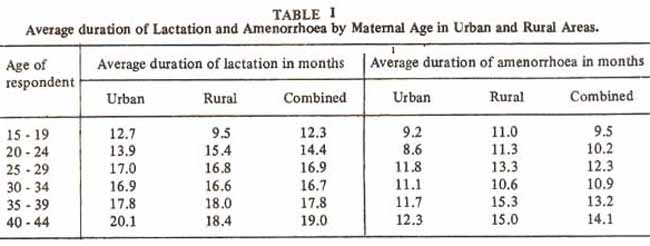
Table 1, shows the average duration of lactation and amenorrhoea by age of women for urban as well as rural sample. The duration of lactation gradually increased with the age of women, the younger women aged 15-19 years lactated for about 12.3 months while older women aged 40-44 lactated for 19 months.
The table-1 also shows that duration of lactational amenorrhoea varies from 9.5 months in women aged 15-19 years to 14.1 months in women 4044 years. Lactation continued for 3 to 5 months after the termination of amenorrhoea. It is observed that the period of amenorrhoea was longer in case of rural women than in urban women.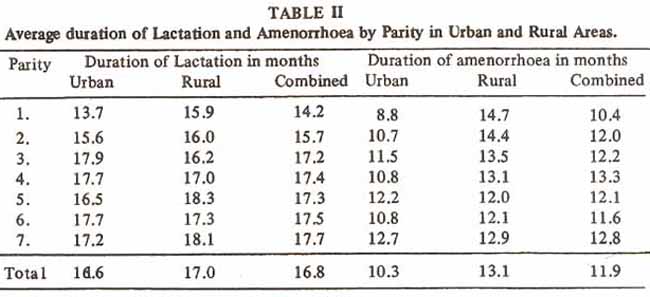
Table II depicts the average duration of lactation and average duration of amenorrhoea by parity status.
In table II a positive relationship between months. But no systematic pattern in resumption of menses was observed in relation to parity. Although not much difference in duration of lactation was observed (16.6 months and 17.0 months in urban and rural mothers) but amenorrhoeaic period was more in rural women than in urban (10.3 in urban and 13.1 months in rural women) 175 women who did not breast feed their last child experienced amenorrhoea only for 3.2 months. It strongly supports the view that lactation prolongs period of amenorrhoea.
Of 941 women, 69 experienced pregnapcies while lactating. The rural women experienced slightly more pregnancies (8.2 percent) as compared to urban women (6.6 percent). Age of the mother had some influence on the contraceptive effect of lactation. As the age of the mother increased the incidence of pregnancies also in. creased, below the age of 30 years, only 2 women became pregnant. While in the age group above 40 years, 38 pregnancies (27.4 percent) had occured. The pattern of pregnancies appeared to be similar in urban rural women.
CONCLUSION
Of 1098 sample women, 941 breast fed their last child and 157 did not. The average duration of lactation was 16.8 months and average duration of amenorrhoea was 11.9 months.
Those women who did not breast feed had an average of 3.2 months of amenorrhoea. Preg. nancy rate amongst lactating women was 7.3 percent. Age and parity both have strong influence on conception during lactational amenorrhoea. Women in younger age group and low parity had observed low pregnancy rates of 3.8 percent as compared to older multiparous women who had 10.3 percent pregnancies.
These findings should not be regarded as an alternative to other form of contraception, but rather as practice which is complementary to them.
REFERENCES
1. Perez, A., Vela, A, Masnick, G.S. and Potter, R.G. First ovulation after child birth; the effect of breast feeding. Am. J. Obstet. Gynecol., 1972;114: 1041.
2. Kamal, I., Hefnawi, F., Ghoneim, M., Talat M., Younis, N., Tagui, A. and Abdalla, M. Clinical, biochemical,and experimental studies on lactation. 1. Lactation pattern in Egyptian women. Am. J. Obstet. Gynecol., 1969; 106: 314.
3. Berman, M.L.,Hansan, K. and Heliman, i.L. Effect of breast-feeding on postpartum menstruation, ovulation, and pregnancy in Alaskan Eskimos. Am. Obstet. Gynecol., 1972; 114:524.
4. Gioiosa, R. incidence of pregnancy during lactation in 500 cases. Am. Obstet. Gynecol., 1955; 70:162.
5. Jeroen, K., Gunnoken, VAN. “Prolonged breast feeding as a birth spacing method”. Studies in Family Planningvol. 5. Number 6 201-2O6, 1974.
Journal of the Pakistan Medical Association has agreed to receive and publish manuscripts in accordance with the principles of the following committees:


