

Mustafa Haroon ( Department of Community Medicine, Rawalpindi Medical College, Rawalpindi. )
Ahmed Munir ( Department of Medicine, Rawalpindi Medical College, Rawalpindi. )
Waqas Mahmud ( Department of Surgery, Rawalpindi Medical College, Rawalpindi. )
Omar Hyder ( Department of Obstetrics and Gynaecology, Rawalpindi Medical College, Rawalpindi. )
February 2014, Volume 64, Issue 2
Original Article

Abstract
Objectives: To assess knowledge, attitude and practice of water-pipe smoking among medical students.
Methods: The cross-sectional study using self-administered questionnaire was conducted at Rawalpindi Medical College, Rawalpindi, in 2011, and included all five batches of medical students. SPSS 17 was used for statistical analysis of the data.
Results: The final sample comprised 724 participants; 505 (69.7%) being female and 219 (30.2%) being male students. Besides, 625 (86.6%) participants knew about shisha smoking, and 140 (22.4%) reported to have smoked shisha. Curiosity (n=44; 31.4%) and social trends (n=41; 29.2%) were cited as main reasons for shisha smoking. Overall, 572 (91.5%) participants thought shisha was dangerous for health, with majority 261 (41.8%) believing it to be more dangerous than cigarettes.
Conclusions: There was awareness among medical students about the hazards of shisha smoking. Even then water-pipe smoking was relatively common among them.
Keywords: Water-pipe, Shisha, Medical students, Pakistan. (JPMA 64: 155; 2014)
Introduction
Water-pipe is known around the globe by many different names, with slight modifications - Hookah, Shisha, Narghile, Hubble-bubble, Nargeela, Argeela, Kalian, Ghelyoon, Ghalayan, Okka, Boury and Gouza.1,2 Even though water-pipe smoking may be perceived as less harmful compared to cigarettes, 3,4 water-pipe contains tobacco; therefore, it contains many of the same toxicants as cigarette smoke including high concentrations of nicotine, carbon monoxide (CO), \'tar\' and heavy metals.5 Nicotine content in water-pipe tobacco is documented to be 2-4%, whereas in cigarettes, it is 1-3%.6 Similarly, CO concentration in water-pipe smoke ranges from 0.34-0.40% compared to 0.41% in cigarette smoke.7 Water-pipe smoking has been linked to malignancy, cardiovascular disease, pulmonary dysfunction and nicotine dependence.2,8,9 It has potential to transmit infectious diseases since the same mouth-piece is passed from person to person during a session.10,11
Across the world, water-pipe smoking has been gaining in popularity. A study amongst university students in Syria showed that 69.9% of men and 29.8% of women had tried water-pipe smoking, and 25.5% of men and 4.9% of women were current smokers.12 Among the youth of Arizona, USA, it was noted to be the 3rd most common source of tobacco after cigarettes and cigars.13
Previous research exploring trends in water-pipe smoking in Pakistan has mostly focussed on the city of Karachi. One study cited 22.7% of medical students at six medical and dental schools in Karachi as active shisha smokers.14 In a recent survey in Karachi, 53.6% of the participants, all university students, had ever smoked shisha. Boredom in youth, peer pressure, and use of water-pipe in leisure activities were listed as the most common reasons for increasing popularity of water-pipe smoking in Pakistan.15 Peer pressure has been commonly noted as a key factor in adopting shisha smoking.
The current cross-sectional study was conducted to assess knowledge, attitude and practices of water-pipe smoking among medical students in Rawalpindi, Pakistan.
Subjects and Methods
The cross-sectional study amongst medical students at the Rawalpindi Medical College, Rawalpindi, was conducted in 2011. An organised self-administered questionnaire in English was developed after studying the current literature and tools used in assessing cigarette and water-pipe smoking.14-16 The questionnaire was distributed in each class after participating students gave their informed consent and the study was approved by the institutional ethics committee. The information on individual students was kept confidential. Participants were given 24 hours to fill out the questionnaire, after which they were collected for analysis. The investigators of the study were responsible for administering and collecting questionnaires from each class. All students in attendance were invited to participate and no sampling was employed. With regard to statistical considerations, a sample of 725 would provide 95% confidence level for an expected prevalence of current shisha smoking among 5% of students, with a 1.6% margin of error.12
The survey was kept anonymous and brief in order to ensure maximum participation. The first part of the questionnaire was meant to notice the practices among water-pipe smokers, including age of initiation, frequency, duration of a single session, location of shisha smoking, and whether students shared the water-pipe with other individuals. The second part focussed mainly on attitudes of the students, primarily highlighting if they felt addicted, and if they felt an effect on their personality and academic performance. The third part was used to assess the knowledge about harmful effects, including myths such as whether water filters the smoke, if shisha has tobacco, and whether it is \'more dangerous\', \'equally dangerous\' or \'less dangerous\' than cigarette smoking. In order to find association between cigarette smoking and water-pipe smoking, questions were added regarding frequency and prevalence of cigarette smoking as well.
Questionnaires were manually checked for accuracy and completeness. Data entry and analysis were carried out using SPSS 17.0. Frequencies and percentages were presented where appropriate. Associations were determined by chi-square test and statistical significance was taken at p<0.05.
Results
Of the 1,033 forms initially distributed, 724 were returned duly filled. The response rate, as such, was 70.1%. Of the 724 students in the study, 505 (69.7%) were female. The overall mean age of the participants was 20.6±1.4 years. A total of 625 (86.6%) reported knowledge of shisha smoking and 140 (19.3%) had smoked shisha at one or more occasions (ever smokers). Of those who reported ever smoking shisha a majority 54.28% were male (n=76; 34.7% of all male participants) and 45.7% were females (n=64, 12.7% of all female participants). Besides, 54 (38.6%) ever shisha smokers reported smoking it in the preceding 30 days. A majority of respondents reported smoking shisha for the first time between the ages of 18-24years. The frequency of shisha smoking was variable, with once in 6 months (n=41; 29.3%) being the commonest and with 50.7% (n=71) of the sessions lasting <30mins. Curiosity (n=44; 31.4%) and social trends (n=41; 29.2%) were cited as the main reasons for initiating shisha smoking, with 76.4% (n=107) respondents reporting having smoked for the first time in companionship with friends. Shisha bar was the most common location (n=104, 74.2%); 97 (69.2%) reported sharing a single water-pipe with 3-4 people frequently present in a session; 11 (7.8%) reported using substances other than tobacco in shisha — narcotics and cannabis were cited as the additional substances.
Of the smokers, 29 (20.7%) respondents reportedly had permission from their parents/guardians to smoke shisha. A small proportion (6.4%, n=9) of shisha smokers reported feeling as being addicted; 109 (77.9%) and 98 (70.0%) respondents felt that shisha smoking had no effect on their academic performance and personality, respectively; 22 (15.7%) reported that shisha smoking made them more relaxed; 390 (62.4%) felt social trends to be the most popular reason for increasing popularity of shisha smoking; 54 (8.64%) said shisha smoking constituted a \'good group activity\'; 572 (91.5%) participants reported that shisha is dangerous to health (Table-1).
Among those who had knowledge of shisha smoking, a comparison of knowledge regarding health hazards of water-pipe smoking among the study participants was done (Table-2).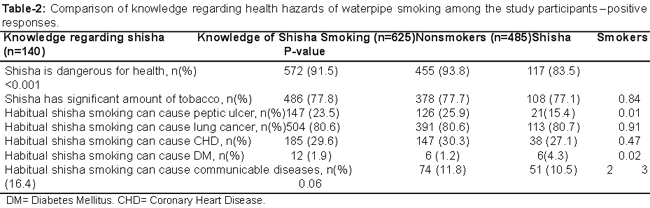
Among the gases, carbon monoxide was noted to be the major pollutant in shisha smoke by 411 (65.8%), followed by sulphur dioxide by 113 (18.1%). A comparison of beliefs regarding water-pipe smoking among the study participants was also done (Table-3).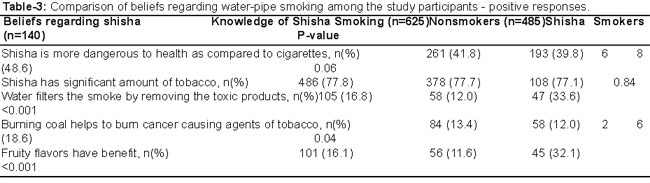
Discussion
The results showed that a majority of medical students had knowledge of shisha smoking. One out of five medical students reported to have smoked shisha and one in 10 reported recent shisha smoking. Although previous research has explored trends of shisha smoking in Pakistan, a majority of these studies focussed on individuals in the port city of Karachi.14,15 There has been limited research on shisha smoking from other parts of Pakistan.17 The present study is important because it describes the knowledge, attitudes, and practice of shisha smoking among a group of medical students from another geographically and socially distinct region, Rawalpindi.
Shisha has been gaining in popularity worldwide. Its emergence among the urban youth has caused a recent interest in it and led to studies being done in different countries. In a study amongst university students in Syria, 32% smoked water-pipe with higher rates among men.12 In a study amongst Israeli children, 22% used water-pipe at least once a week.18 In Arizona, USA, 10.3% high school students had ever smoked a water-pipe and 5.4% had done so in the preceding 30 days.13
In our study, 19.3% of the final sample had ever smoked shisha and 7.5% of the final sample reported current shisha smoking. We noted lower rates of ever smoking and current smoking than the university students surveyed in Karachi, where 53.6% of the university students had ever smoked shisha, and among medical and dental students in Karachi, where 22.7% respondents reported the same.14,15 It is notable that both studies carried out amongst healthcare-related students reported lower rates of ever smoking of shisha despite the geographical disparity. This discordance in smoking rates needs to be further explored in future research with an emphasis on health education for both healthcare-related and non-healthcare-related students.
Curiosity and peer pressure were cited as the main reasons for the initiation and popularity of shisha smoking along with its use having become fashionable. The shisha bars were the most common location for shisha smoking. The increase in the shisha bar outlets might be another reason for the high prevalence. Shisha smokers were likely to smoke for the first time with friends. This shows the influence of peer pressure on shisha smoking. These opinions need to be taken into account by the policy-makers to make an effective strategy.
Although majority of our respondents described initiation of shisha smoking between the ages of 18 and 24, recent work from Karachi found a mean starting age of 14 years among adolescent shisha smokers.19 Perception of risk among younger smokers may be different from older ones. Amongst studies carried out in populations younger than ours, a survey of 2443 Lebanese high school students showed that the majority considered water-pipe smoking to be less dangerous than cigarette smoking.20 Israeli high school students expressed similar opinions.19 Recent work on university students in Karachi has demonstrated similar perception of risks among both medical and non-medical students.15 In our study the majority of respondents considered it to be more dangerous or equally dangerous than cigarette smoking, while a significant minority considered it less dangerous. This is in contrast with the recent survey conducted in multiple cities of Pakistan where a majority of the respondents (69%) claimed that shisha smoking is less deleterious than cigarette smoking.17 In the present study, a majority of the respondents reported awareness of myths surrounding shisha smoking while only a minority thought that the water acts as a filtering agent and the burning coal helps to burn the carcinogens. Beliefs pertaining to a less injurious nature of shisha smoking were significantly more likely to be recorded among shisha smokers in our study. These beliefs may be a useful target for educational efforts aimed at reducing shisha smoking.
There are several limitations of the study that must be taken into account. Even though the sample size was large, the research was carried out at one institution where all the participants were medical students. As these students are from the same profession and may be well informed about the health effects of shisha, the study\'s findings may not be generalisable to non-healthcare students and the general population. However, findings of the present study conform to those noted by Khan et. al. among medical and dental students in Karachi.14 It is notable that population-based information is available on cigarette smoking and snuff in Pakistan,21 but corresponding information on shisha smoking is not available. There is a dire need for population-based research on shisha smoking and risk factors associated with it. While it is reassuring that fewer healthcare students — future health educators — indulge in shisha smoking, work needs to be carried in all the provinces of Pakistan, especially in the rural areas where hookah smoking is a part of a typical lifestyle, to get a more realistic idea of the knowledge, attitude and practice of shisha smoking in the general population of Pakistan.
Conclusions
Results showed that there was awareness among medical students about the hazards of shisha smoking. Water-pipe smoking was relatively common among the students, with a significant minority still believing it to be less harmful than cigarette smoking. Increased surveillance and additional research are necessary to address this growing threat to public health.
References
1. Aljarrah K, Ababneh ZQ, Al-Delaimy WK. Perceptions of hookah smoking harmfulness: predictors and characteristics among current hookah users. Tob Induc Dis 2009 18; 5: 16.
2. Knishkowy B, Amitai Y. Water-pipe (narghile) smoking: an emerging health risk behavior. Pediatrics 2005; 116: e113-9.
3. Primack BA, Sidani J, Agarwal AA, Shadel WG, Donny EC, Eissenberg TE. Prevalence of and associations with water-pipe tobacco smoking among U.S. university students. Ann Behav Med. 2008; 36: 81-6.
4. Jackson D, Aveyard P. Water-pipe smoking in students: prevalence, risk factors, symptoms of addiction, and smoke intake. Evidence from one British university. BMC Public Health 2008; 8: 174.
5. Shihadeh A, Saleh R. Polycyclic aromatic hydrocacrbons, carbon monoxide, "tar," and nicotine in the mainstream smoke aerosol of the narghile water pipe. Food Chem Toxicol 2005; 43: 655-1.
6. Kiter G, Ucan ES, Ceylan E, Kilinc O. Water-pipe smoking and pulmonary functions. Respir Med 2000; 94: 891-4.
7. Sajid KM, Akhter M, Malik GQ. Carbon monoxide fractions in cigarette and hookah (hubble bubble) smoke. J Pak Med Assoc 1993; 43: 179-82.
8. Ward KD, Eissenberg T, Rastam S, Asfar T, Mzayek F, Fouad MF, et al. The tobacco epidemic in Syria. Tob Control 2006; 15 suppl 1: 24-9.
9. Maziak W, Ward KD, Eissenberg T. Factors related to frequency of narghile (water-pipe) use: the first insights on tobacco dependence in narghile users. Drug Alcohol Depend 2004; 76: 101-6.
10. Maziak W, Rastam S, Ibrahim I, Ward KD, Eissenberg T. Water-pipe-associated particulate matter emissions. Nicotine Tob Res 2008; 10: 519-23.
11. Steentoft J, Wittendorf J, Andersen JR. Tuberculosis and water pipes as source of infection. Ugeskrift for Laeger 2006; 168: 904-7.
12. Maziak W, Fouad FM, Asfar T, Hammal F, Bachir EM, Rastam S, et al. Prevalence and characteristics of narghile smoking among university students in Syria. Int J Tuberc Lung Dis 2004; 8: 882- 9.
13. Primack BA, Walsh M, Bryce C, Eissenberg T. Water-pipe tobacco smoking among middle and high school students in Arizona. Pediatrics 2009; 123: e282-8.
14. Khan N, Siddiqui MU, Padhiar AA, Hashmi SAH, Fatima S, Muzaffar S. Prevalence, knowledge, attitude and practice of Shisha smoking among medical and dental students of Karachi, Pakistan. J Dow Uni Health Sci 2008; 2: 3-10.
15. Jawaid A, Zafar AM, Rehman TU, Nazir MR, Ghafoor ZA, Afzal O, Khan JA. Knowledge, attitudes and practice of university students regarding waterpipe smoking in Pakistan. Int J Tuberc Lung Dis 2008; 12: 1077-84.
16. Tamim H, Terro A, Kassem H, Ghazi A, Khamis TA, Hay MM, et al. Tobacco use by university students, Lebanon, 2001. Addiction 2003; 98: 933-9.
17. Rehman S, Sadiq MA, Parekh MA, Zubairi AB, Frossard PM, Khan JA. Cross-sectional study identifying forms of tobacco used by Shisha smokers in Pakistan. J Pak Med Assoc 2012; 62: 192-5.
18. Varsano S, Ganz I, Eldor N, Garenkin M. Water-pipe tobacco smoking among school children in Israel: frequencies, habits, and attitudes. Harefuah 2003; 142: 736-41, 807.
19. Anjum Q, Ahmed F, Ashfaq T. Knowledge, attitude and perception of water pipe smoking (Shisha) among adolescents aged 14-19 years. J Pak Med Assoc 2008; 58: 312-7.
20. Tamim H, Al-Sahab B, Akkary G, Ghanem M, Tamim N, El Roueiheb Z, et al. Cigarette and nargileh smoking practices among school students in Beirut, Lebanon. Am J Health Behav 2007; 31: 56-63.
21. Ahmad K, Jafary F, Jehan I, Hatcher J, Khan AQ, Chaturvedi N, et al. Prevalence and predictors of smoking in Pakistan: results of the National Health Survey of Pakistan. Eur J Cardiovasc Prev Rehabil. 2005; 12: 203-8.
Journal of the Pakistan Medical Association has agreed to receive and publish manuscripts in accordance with the principles of the following committees:


