

Nasreen Kirmani ( PMRC Research Centre and Department of Obstetrics and Gynaecology, Jinnah Postgraduate Medical Centre, Karachi. )
Shireen Rehman ( PMRC Research Centre and Department of Obstetrics and Gynaecology, Jinnah Postgraduate Medical Centre, Karachi. )
Sadiqua N. Jafarey ( PMRC Research Centre and Department of Obstetrics and Gynaecology, Jinnah Postgraduate Medical Centre, Karachi. )
May 1989, Volume 39, Issue 5
Short Reports

INTRODUCTION
Pelvic infection in females often occur as a result of colonization by a variety of bacteria1 On the vaginal and cervical epithelium. The type of organisms present in the vagina depends on pH and the enzymes in the vaginal secretions2. Therefore, knowledge of the bacterial inhabitants of the vagina and cervix during pregnancy is important and could be of value in assessing the pathogenesis of several clinical entities, like premature rupture of the membrane3,4. puerperal fever5,6 or intrapartum or neonatal infections via upper respiratory tracts or the umbilical cord7-10. Therefore, this study was undertaken to determine the pattern of bacterial flora of the vagina and cervix in pregnant women.
SUBJECT, METHOD AND RESULTS
Fifty three normal healthy pregnant women in the second trimester (20-28 weeks) were selected. Cervical and vaginal swabs were taken from each pregnant woman and brought to the laboratory in 5ml of nutrient broth for culture and microscopy (Wet mount slides). Microorganisms isolated were identified as described11,12. The pattern of the bacterial flora determined is shown in Table I & II.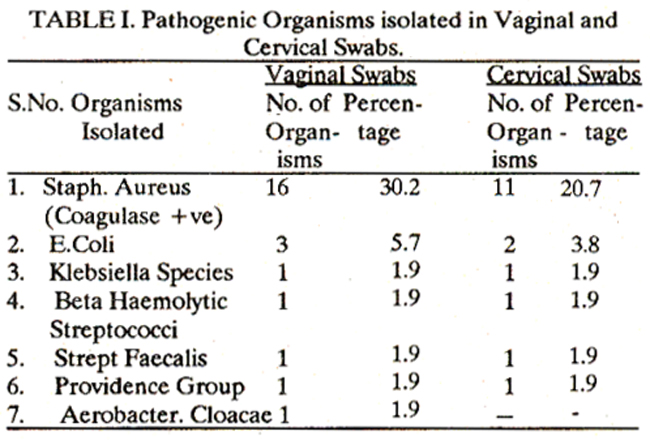
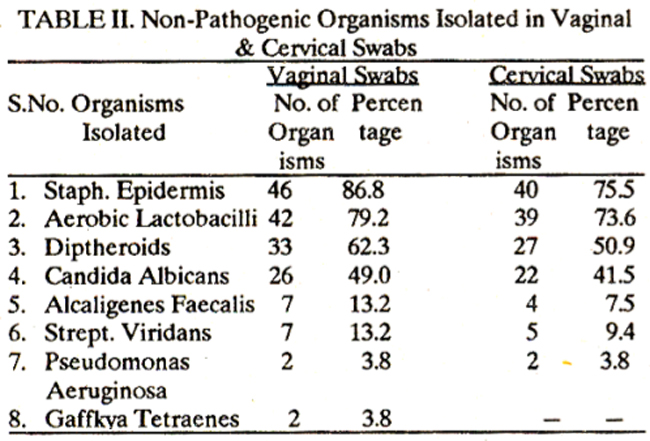
Fifteen microorganisms were isolated and identified, seven were pathogens and eight non-pathogens. Pure cultures of bacteria were rarely isolated. Vaginal cultures were positive more often than cervical cultures, and the overall pattern of the bacterial flora of the vagina and the cervix shows that pathogens were less frequently isolated than non-pathogens but pathogens were more frequent in vaginal (32.08%) than in cervical cultures (18.87%).
CONCLUSION
Since this is a small study, it is not justified to draw firm conclusions from the results reported. In order to determine the pattern of vaginal and cervical flora among pregnant women and their significance, a more comprehensive study in a larger number of samples and in all three trim-esters of pregnancy would be necessary.
REFERENCES
1. Slotnick, I.J., Hidlidebrandt, RJ., and Prystowsky, H. Microbiology of the female genital tract IV. Cervical and vaginal flora during pregnancy. Obstet. Gynecol., 1963; 21:312.
2. Joklik, W.K., Willett, H.P. and Amos, D.B. Zinsser’s microbiology: 18th edition. Narwalk Appleton-Century Crofts. 1984; p.439.
3. White, C.A., and Knootz, F.P. Bacterial flora of the cervix during pregnancy. Obstet. Gynecol., 1968; 32:402.
4. Hawkinson, .J.A. and Schulman, H. Prematurity associated with cervicitis and vaginitis during pregnancy. Am. J. Obstet. Gynecol., 1966; 94:898.
5. Gibberd, G.F. Pueiperal sepsis. J. Obstet. Gyneco!. Br. Commonw., 1966; 73:1.
6. Rao, KB., Ramamurthi, D.V. and Vimala, G. Intraparturn infections. A clinical and bacteriological study. Obstet. Gynecol., 1965; 26:833.
7. Blanc, W.A. Pathways of fetal and early neonatal infections. Viral piacentitis, bacterial and fungus chorioaniniomitis. J. Paed., 1961; 59:473.
8. Eickoff, T.C., Klein, J.O., Daly, A.K., Ingall, D., and Finland, PG. Neonatal sepsis and other infection due to group B Beta hemolytic streptococci. New. EngL .LMed., 1964; 271:1221.
9. Hazzard, G., Porter, P.J. and Ingall, D. Pneurnococcal laryngitis in the new born. New. Eng!. J. Med., 1964; 271:361.
10. Keital, H.G., Hananian, J., Ting, R., Prince, L.N. and Raiidali, E. Meningitis in the newborn infant. Pediatr:, 1962; 61:39.
11. Bailey, W.R., and Scott, E.G. Diagnostic microbiology, Saint Louis, Mosby, 1966, p.105.
12. Jawetz, F., Melnick, J.L., and Adelberg, E.A. Review of medical microbiology. 17th ed. Norwalk, Appleton and Lange, 1987, p.217.
Journal of the Pakistan Medical Association has agreed to receive and publish manuscripts in accordance with the principles of the following committees:


