

Farida Agha ( PMRC Research Centre and Atomic Energy Medical Centre, Jinnah Postgraduate Medical Centre, Karachi. )
May 1989, Volume 39, Issue 5
Original Article

Abstract
Iron stores were estimated in 333 professional blood donors by serum ferritin assay. Iron deficiency or depleted iron stores assessed by low serum ferritin levels ( <12ng/ml) were found in 15% donors. In 51% donors the serum ferritin was within the normal range, while 34% donors had high serum ferritin levels (above 200 and upto 3580 ng/ml). Anaemia (Hb < 13g/d1) was found in 284 (85%) donors, 51 (18%) of these had iron deficiency or low ferritin levels, 99 (35%) had high and 134(47%) bad normal serum ferritin levels. Iron deficiency in blood donors could be associated with repeated blood donations. High serum ferritin levels could be due to reasons like taking of medicinal iron much beyond the recommended dosage byself initiation. Therefore, estimation of serum ferritin has no value in professional blood donors (JPMA 39 :124, 1989).
INTRODUCTION
Bleeding results in mobilization of iron from body stores1. As stores decrease iron absorption increases2. With continued bleeding an individual either reaches equilibrium at a lower level of iron stores or becomes anaemic3. The quantitative information concerning iron stores in professional blood donors has been lacking, so this study was undertaken to get an idea about iron stores in subjects representing themselves as professional blood donors.
MATERIAL AND METHODS
Donors presenting themselves at Blood Bank, Jinnah Postgraduate Medical Centre, Karachi, who gave permission for the use of their blood for ferritin analysis were investigated. Their names, ages and blood groups were recorded. Blood was collected for hacmatological investigations in anticoagulant and for serum ferritin in plain tubes. Haemoglobin, PCV, MCH, MCHC, MCV, WBCs and RBCs were done on automatic particle counter, Model PC-604. The sera separated for ferritin analysis were frozen at -20°C till analysis. Serum ferritin concentration was measured by radioimmunoassay (RIA) techniques using ferritin RIA kit (Amersham International Limited, U.K.). The kit provides a sensitive and convenient assay for the measurement of ferritin in serum over the approximate range of 0 to 1000 ng/ml. A set of quality control sera (Amersham U.K.) were also analysed with each assay. Each assay was performed in duplicate serum samples and the radioactivity was counted in Multidetector comput terized Gamma Counter (Model 1612- NE) using 4 parameter non linear curve fitting model.
RESULTS
A total of 333 blood donors were investigated. All were males. The mean age was 31 (SE 0.25) years with a range of 20 to 45 years.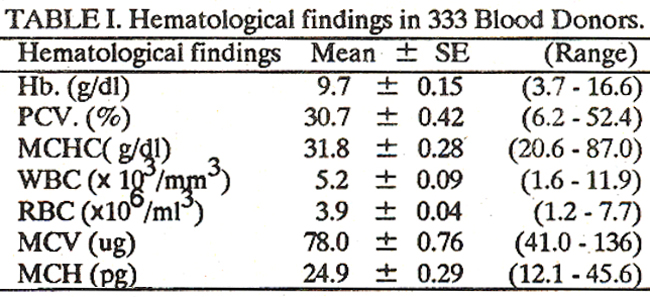
Table I shows hematological findings in blood donors. Of the 333 donors, 284 (85%) were anaemic according to WHO criteria (Hb < 13-g/dl). In 190 (57%) donors Haemoglobin levels were below 10 g/dl, (range 3.7 to 9.9 gIdl). The normal range for serum ferritin in adult males were up-to 200 ng/ml4, and serum ferritin less than 12 ng/ml (<12ng/ml) was taken as the. criteria for the presence of iron deficiency. Among 333 donors 169 (51%) had serum ferritin levels within the normal range. Only 52 (15%) had iron deficiency or depleted iron stores (i.e. serum fer ritin <12 ng/mI), while in 112(34%) ferritin levels were above 200 ng/ml. These higher values were distributed as follows; in 75 (22%) donors, levels were between 201 to 500 ng/mI, in 29 (8.7%) had levels between 501 to 1000 ng/ml, and 8(2.4%) had values above 1000 ug/mI up to 3580 ngfml.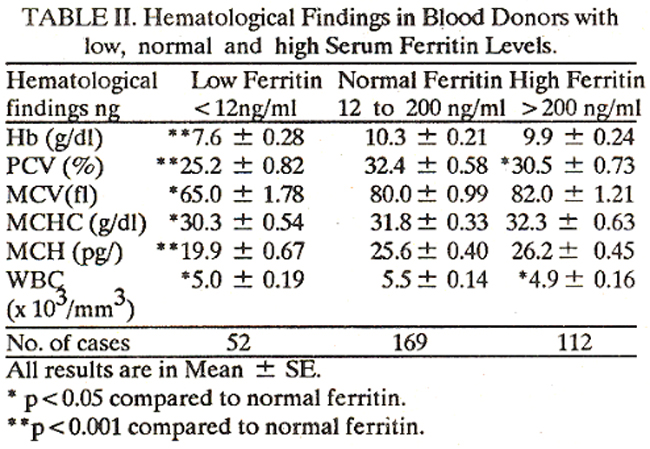
Table II shows the hematological fmdings in three groups with low, normal and high ferritin levels. Donors with low ferritin levels (iron deficient) had a significant decrease in all parameters (except RBCs) as compared with normal group, whereas those with higher than normal ferritin levels, only PCV, WBCs and RBCs were significantly low.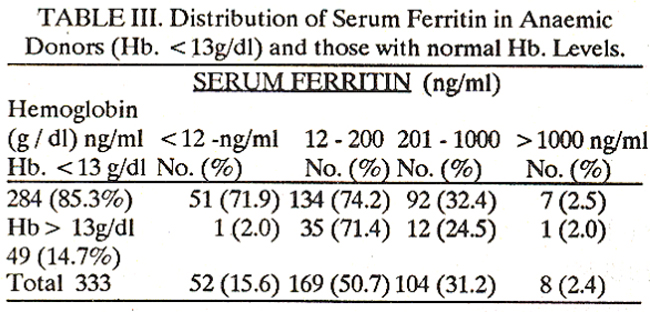
Table III shows serum ferritin levels in anaemic donors (Hb. <13 g/dl) and with normal Hb. levels. In total 284 (85%) anaemic donors, 134 (47%) had normal ferritin levels, 51 (18%) had low ferritin levels indicating presence of iron deficiency in them and 99 (35%) had high ferritin levels (>200 ng/ml), whereas in 49 (15%) donors with normal Rb. levels, only 1 (2%) had low and 13 (25%) had high ferritin levels. No significant correlation was seen between serum ferritin and any other hematological parameter.
DISCUSSION
The data on iron stores in professional blood donors has been lacking in Pakistan. This could be due to difficulty in obtaining true information aboUt previous history of their blood donations. There are many national and private organisations working in the country. In Karachi, it is a common practice that donors present themselves at more than one bleeding depots in short period of time or at the same depot with different names in order to get money. Majority of them were poor, drug addicts and some were Afghan refugees, who donate blood when they need money. They do not give any information about number of blood donations in certain time periods, nor even permission for the use of their blood for research purposes for fear of rejection. The presence of anaemia found in majority (85%) of donors in present study has also been reported previously5,6. However, iron deficiency assessed by low transferrin saturation (<15%) in previous studies5,6 was reported in 66% donors who were all anaemic (Fib < 13g/dl). In this study by serum ferritin, iron deficiency was found in only 15% donors. In clinical practice, low percent saturation of transferrin is a useful parameter associated with depleted iron stores, but it could also result from a block in the reticuloendothelial release of iron as in cases of chronic infections, whereas the serum ferritin assay proved to be the single most sensitive test to detect iron deficiency. A low serum ferritin always indicates iron deficiency or depleted iron stores3,7, but increase in serum ferritin was reported in many pathological conditions8,9. Patients with inflammation, liver disease, malignancy or increased red cell turnover shows high serum ferritin levels9. In this study iron deficiency in donors could be due to repeated blood donations1 as professional donors do not follow the rule that blood can be donated after every three months. They donate blood when they need money, even the next day. Anaemia by Hb. estimation was found in about 85% of donors, while not surprisingly ferntin levels were low in only 15%. It could be possible that these individuals have constant oral iron supplements by self initiation, much beyond the recommended dosage. This makes the ferritin estimation rather useless in this group of individuals. Though drug addiction, undernourishment and poverty all account for the presence of disease in them, but high ferritin levels in professional blood donors are more likely due to their constant use of oral supplements rather than inflammatory diseases. This study suggests that insufficient attention has been given to the iron status of blood donors. Further information is needed about the background of donors in respect of economic and nutritional status and history of previous diseases.
ACKNOWLEDGEMENT
We would like to acknowledge the cooperation of Blood Bank, JPMC, in supplying donors blood for this study and also express our thanks to staff of clinical Pathological laboratory, JPMC, for estimating hematological parameters. The statistical assistance of Mr. Ejaz Alam, is gratefully acknowledged.
REFERENCES
1. Finch, C.A., Cook, J.D., Ladde, R.F. and Culala, M. Effect of blood donation on iron stores as evaluated by serum ferritin. Blood, 1977; 50:441.
2. Jacob, R.A., Sandstead, H.H., Klevay, L.M. and Johnson, L.K. Utility of serum ferritin as a measure of iron deficiency in normal males undergoing repetitive phleb-oto my. Blood, 1980; 56:786.
3. Lipschitz, D.A., Cook, J.D. and Finch, C.A. A clinical evaluation of serum ferritiri as an index of iron stores. N. Engi. J. Med., 1974; 290:1213.
4. Agha, F., Akhter, P. and Khan, R.A. Serum ferritin levels in apparently healthy subjects. JPMA., 1987; 37:63,
5. Hashmi, J.A. and Sadaruddin, F. Serum iron and total iron binding capacity (TIBC) in anaemic and normal adult males. Pakistan J. Med. Res., 1976; 15:1.
6. Farzana, F., Zuberi, S.J. and Hashmi, J.A. Prevalence of abnormal hemoglobins and thalassemia trait in a group of professional blood donors and hospital staff in Karachi. JPMA., 1975; 25:237.
7. Jacobs, A., Miller, F., Worwood, M., Beamish, M.R. and Wardrop, C.A. Ferritin in the serum of normal subjects and patients with deficiency and iron overload. Br. Med. 3., 1972; 4:206.
8. Jacobs, A. and Worwood, M. Ferritin in serum. Clinical and biochemical implications. N. Engl. 3. Med., 1975;292:951.
9. Cook, J.D., Lipschitz, D.A., Miles, L.E.M. and Finch, C.A. Serum ferritin as a measure of iron stores in normal subjects. Am. J. Clin. Nutr., 1974; 27:681.
Journal of the Pakistan Medical Association has agreed to receive and publish manuscripts in accordance with the principles of the following committees:


