

Etem Emre Cogen ( Department of Neurology, Faculty of Medicine, Yuzuncu Yil University, Van, Turkey. )
Temel Tombul ( Department of Neurology, Faculty of Medicine, Yuzuncu Yil University, Van, Turkey. )
Gokhan Yildirim ( Department of Neurology, Faculty of Medicine, Yuzuncu Yil University, Van, Turkey. )
Faruk Omer Odabas ( Department of Neurology, Faculty of Medicine, Yuzuncu Yil University, Van, Turkey. )
Refah Sayin ( Department of Neurology, Faculty of Medicine, Yuzuncu Yil University, Van, Turkey. )
December 2013, Volume 63, Issue 12
Original Article

Abstract
Objective: To investigate the impact of atrial fibrillation on mortality and morbidity in ischaemic stroke patients.
Methods: The retrospective study was conducted at the Neurology Clinic, Faculty of Medicine, Yuzuncu Yil University, Van, Turkey, and comprised records of ischaemic stroke patients hospitalised between January 2006 and September 2009. SPSS 13 was used for statistical analysis.
Results: Of the 404 patients in the study, 69 (17.1%) had atrial fibrilation. The mean age of such patients was 66.78±12.23 years compared to 61.01±15.11 years for the rest. Besides 47 (68.1%) of these patients were females. According to the modified Rankin Scale scores, the degree of disability was significantly higher at the time of arrival and discharge, and mortality rates were significantly higher also (p<0.01).
Conclusion: Atrial fibrillation affected the prognosis of ischaemic stroke adversely in terms of mortality and morbidity.
Keywords: Ischaemic stroke, Atrial fibrillation, Mortality, Morbidity. (JPMA 63: 1516; 2013).
Introduction
Although hypertension (HT) is the strongest risk factor for stroke, age and the presence of other risk factors may modify the effect of increased blood pressure on stroke occurrence. In hypertensive people, coronary heart disease (CHD), cardiac failure, and, especially, atrial fibrillation (AF) are associated with increased stroke risk.1
Knowledge about the value of AF as a prognostic factor in ischaemic stroke is limited and sparse. Not all,2 but many studies have shown increased mortality rates in ischaemic stroke patients with AF.3,4 Although older age could explain the increased mortality rate in patients with AF, but the effects of larger lesions, more severe stroke or especially AF on the improvement process should be discussed. The effect of AF on neurological and functional results and the length of hospitalisation is not defined obviously.5
The current study was aimed at investigating the role of AF on mortality and morbidity in ischaemic stroke along with associated risk factors, the initial neurological stroke severity, etiological and location-based classification, mortality, early stage neurological and the functional recovery, and length of hospitalisation.
Patients and Methods
The retrospective study was conducted at the Neurology Clinic, Faculty of Medicine, University of Yuzuncu Yil, Turkey, between January 2006 and September 2009. It comprised the record of medical history, physical and neurological examination, laboratory tests and consultation of cardiology, electrocardiography (ECG), transthoracic echocardiography (TTE) and transesophageal echocardiography (TEE) of patients who had been hospitalized during the period. Hypertension, diabetes mellitus (DM), and previous history of stroke, peripheral arterial disease, ischaemic heart disease, other heart disease (dilated or hypertrophic cardiomyopathy, congenital heart disease, etc.), myocardial infarction (MI) and past or current angina pectoris, presence of valvular disease and valve operation history, past transient ischaemic attack (TIA), and past or current smoking, anti-platelet or anti-coagulant drug use, hydroxymethylglutaryl (HMG)-CoA reductase inhibitor use were recorded after approval was obtained from the institutional ethics committee.
Variables such as the age, gender, Trial of Org 10172 in Acute Stroke Treatment (TOAST) and stroke subtype according to Bamford classification, stroke side, the consciousness state at arrival, modified Rankin Scale (mRS) score during hospitalisation, and discharge, presence of AF in ECG and spontaneous echo contrast (SEC) or thrombus in TTE or TEE, as well as the presence of systolic and diastolic dysfunction, length of hospitalisation, mortality and anticoagulant treatment state during hospitalisation were studied. Patients with >200 mg/dl cholesterol and >130 mg/dl low-density lipoprotein (LDL) values were taken as hypercholesterolaemia; patients with >200 mg/dl triglyceride values were accepted as hypertriglyceridaemia.6,7 Stroke severity was assessed with the mRS and stroke etiology with TOAST classification, and stroke localisation with Bamford classification. Consciousness state of patients during hospitalization was recorded as conscious, semi-conscious (confusion, somnolence) and unconscious (stupor-coma). AF diagnosis was confirmed by a cardiologist through ECG.
For continuous variables, descriptive statistics were expressed as mean ± standard deviation (SD), minimum and maximum values for categorical variables were expressed as frequencies and percentages. One-Way analysis of variance (ANOVA) test was used for comparison of AF (2 groups), Bamford (4 groups) and TOAST (5 groups) groups. Following ANOVA, Duncan\'s multiple comparison test was performed. For determining differences between proportions of AF and non-AF groups for categorical variables, two-proportion Z test was performed. In all computations, statistical significance level was considered 5% and SPSS 13 was used for computations.
Results
The mean age of the 404 patients in the study was 61.99±14.81 years (range: 16-91). There were 223 (55.2%) males and 181 (44.8%) females. Besides, there were 69 (17.1%) patients in the AF group with a mean age of 66.78±12.23 (range: 31-83). In the non-AF group, the corresponding value was 61.01±15.11 years (range: 16-91). The mean age of patients with AF was significantly higher than patients without AF (p<0.05). Further, 22 (31.9%) patients with AF were male and 47 (68.1%) were female. In the AF group, there was a preponderance of women compared to the non-AF patients (male: 201, 60%; female: 134, 40%) (p=0.001). According to TOAST and Bamford classifications, there was no significant difference in terms of gender distribution (Table-1).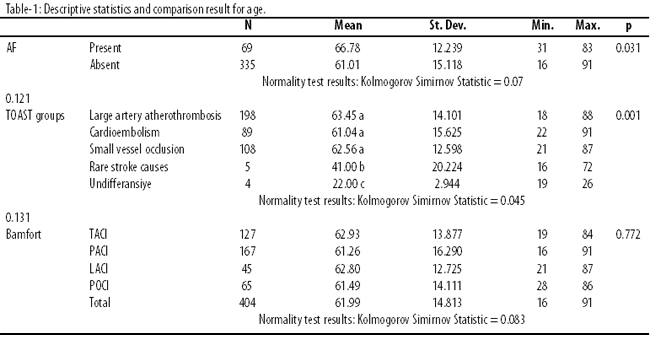
According to TOAST classification, 18 (26.1%) patients with AF had large artery thrombosis; 43 (62.3%) had cardioembolism, and 8 (11.6%) had small vessel occlusion. In the non-AF group, 180 (53.7%) patients had large artery atherothrombosis; 46 (13.7%) had cardioembolism, and 100 (29.9%) had small vessel occlusion. The difference was statistically significant (p<0.01). According to the Bamford classification for stroke subtypes, 37 (53.6%) patients with AF were total anterior circulation infarct (TACI); 26 (37.7%) were partial anterior circulation infarct (PACI); 2 (2.9%) were lacunar infarct (LACI); and 4 (5.8%) were posterior circulation infarct (POCI). For non-AF group, 90 (26.9%) patients had TACI; 141 (42.1%) had PACI; 43 (12.8%) had LACI; and 61 (18.2%) had POCI. The difference between the groups was statistically significant (p<0.01). In the AF group, TACI was higher than the other group, while LACI and POCI were quite low. Although PACI rates were similar for both groups, they were higher in the non-AF group.
In the AF group, 47 (68.1%) patients experienced first stroke; while 22 (31.9%) had two or more strokes. Among patients without AF 272 (81.2%) experienced first stroke, while 63 (18.8%) had two or more strokes. The risk of recurrent stroke for patients with AF was significantly higher (p<0.05). Besides, 45 (65.2%) patients with AF and 203 (60.6%) patients without AF had HT and there was no significant difference between the groups. DM rate was 11 (15.9%) for the AF group, and 71 (21.2%) for the non-AF group; the difference was not statistically significant. The rate of past or current peripheral arterial disease for the AF group was 2.9% and 2.1% for the non-AF group. The difference was not significant. Past or current ischaemic heart disease, other heart diseases, MI and angina pectoris for AF patients was 23/69 (33.3%) positive, while this ratio was 70/335 (20.9%) for those without AF. The rate was significantly higher in the AF group (p<0.05). The presence of valvular disease and a history of valve operation for patients with AF was significantly higher than the other group (17.4% vs. 4.8%) (p <0.01).
For the AF group, 55/69 (79.7%) of mRS scores at the time of admission was of 4 and 5, whereas it was 183/336 (54.6%) in the other group (p<0.01). The AF group was significantly worse in terms of 4-5 mRS scores in discharged patients (30/60 or 43.4% vs. 93/335 or 27.8%).
A total of 37 (9.2%) patients in the study died before discharge. This rate was 17.4% for the AF group, and 7.5% for the non-AF group (p<0.01) (Table-2).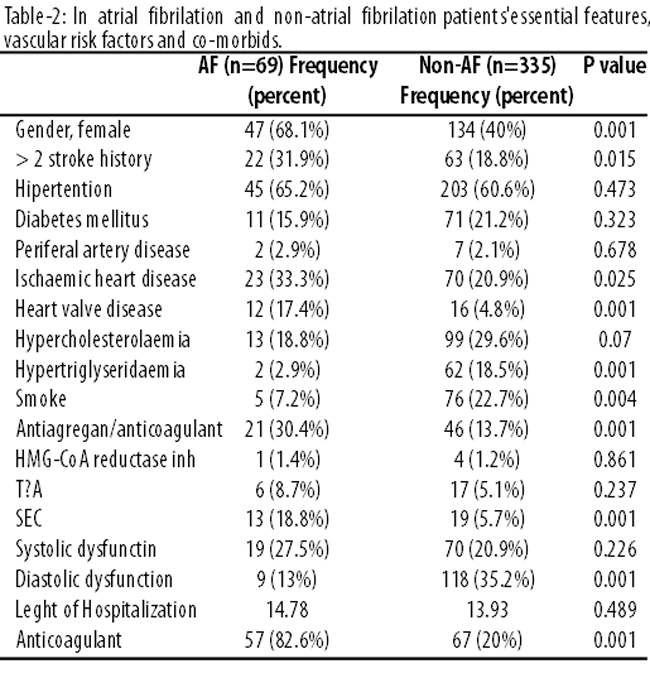
In our study, logistic regression was applied, but no statistical difference was observed between the two groups.
Discussion
In cardioembolic stroke, valvular and non-valvular AF are classified as high-risk groups in heart diseases.8 AF is a strong risk factor for arrhythmia and stroke. The prevalence of AF in heart diseases is about 1% in the general population and is 5.9% in the population over 65 years.9 Almost 15%-21% of stroke patients have AF.3,10 Although in AF, ischaemic stroke and systemic arterial embolism are generally explained with thrombus originating from left atrium, but the pathogenesis of thromboembolism is complex. Approximately 25% of the strokes occurr in AF patients may be due to cerebrovascular disease, other cardiac sources of embolism, or atheromatous pathology in the proximal aorta.11 In our study, AF was observed in 17.1% of ischaemic stroke patients and this data was consistent with literature.
Wolf et. al. obtained 311 AF in 5070 patients in 34 years of follow-up. Although they reported that the prevalence of each cardiovascular event increased with age, they stated 5-fold higher risk of stroke in the presence of AF.1 In 80-89 age group, the risk of stroke due to AF was reported as 23.5%. On the other hand, it was reported that co-existence of AF with coronary heart disease and heart failure is related to an increased risk for stroke such as 2-fold higher for men and 5-fold higher for women. The authors suggested that AF is an independent risk factor for stroke.1
In another study, mortality at the time of hospitalisation was shown to be significantly higher for 992 patients with AF than the non-AF group (25% vs 14%).12 In an other study conducted on 1061 patients with ischaemic stroke, the rate of 20.3% AF was detected. In patients with AF, 41.2% bed-ridden rate was detected, but it was found to be 23.7% in those without AF.13 Lamassa et. al. followed 4462 patients as a study group in terms of clinical features, treatment and stroke prognosis of AF; 803 of them (18%) had AF.14 When compared to the non-AF group, patients were older; more of them were female; and had a history of MI. Besides, there were less number of DM patients, and less alcohol and cigarette consumption in the AF group. The 28-day mortality rate was 19.1% for the AF group, and 12% for the non-AF group.14 According to a study which investigated the prevalence and prognosis of AF in patients who experienced first ischaemic stroke, AF was found to be 24.6%. When compared to the non-arrhythmia group, there were more female patients in the AF group.15
In our study, in line with literature, there was a preponderance of women and older age in patients with AF. While the mean age of AF group was 66.78 years, with a range of range 31-83, the mean age of non-AF group was 61.01 years, with a range of 16-91 years (p<0.05). Similarly, 47 of 69 AF patients in the study (68.1%) were female, while this number was 134 (40%) in the non-AF group (p<0.001).
According to Bamford\'s classification of ischaemic stroke, there were more TACI and PACI in patients with AF compared to the non-AF group, but in the non-AF group, there were important rates of LACI and POCI which were rare in AF as well as higher TACI and PACI. This was similar to previously reported data.13 Previous studies found no difference between AF and non-AF patients in terms of recurrent stroke.16 However, in another study, AF was found to be associated with recurrent stroke.5
The current study found high rates of two or more of ischaemic strokes in AF group patients. Therefore, we would like to emphasise that further studies with broadbased patient populations are needed to investigate recurrent stroke correlation for AF.
Steger et al.12 assessed the initial stroke severity by using mRS scale, National Institute of Health Stroke Scale (NIHSS) and Barthel index, and found the proportion of mRS score 5 for AF group patients as 52%, and for non-AF group as 31%. According to all scales, the AF group had significantly more severe stroke onset. Dull et. al. also evaluated the patients having mRS 5 at the time of admission as a separate group, and obtained 41.2% rate for the AF group and 23.7% for the non-AF group.12,13 Unlike these studies, we evaluated mRS scores at both arrival and discharge time and found significantly higher disability for patients with AF (p<0.05).
Information about the value of AF as a prognostic factor is sporadic and disorganised. Not all,2 but many reports have found an increase in mortality rates for stroke patients with AF.3,4,12-14,17 In our study, mortality rate was 17.4% for the AF group, and 7.5% for the non-AF group, and the difference was statistically significant (p<0.05). In previous studies, it was found that mortality rates after ischaemic stroke of patients with AF is approximately 1.5-2 times more than those without AF, and our findings were shown to be consistent with literature.10,14,17
Conclusions
Further multi-centered and comprehensive studies are needed to determine the role of AF on the length of hospitalisation and recurrent strokes.
References
1. Wolf PA, Abbott RD, Kannel WB. Atrial fibrillation as an independent risk factor for stroke: the Framingham study. Stroke 1991; 22: 983-98.
2. Censori B, Camerlingo M, Casto L, Ferraro B, Gazzaniga GC, Cesana B, et al. Prognostic factors in first-ever stroke in the carotid artery territory seen within 6 hours after onset. Stroke 1993; 24: 532-5.
3. Candelise L, Pinardi G, Morabito A. Mortality in acute stroke with atrial fibrillation. The Italian acute stroke study group. Stroke 1991; 22: 169-74.
4. Anderson CS, Jamrozik KD, Broadhurst RJ, Stewart-Wynne EG. Predicting survival for 1 year among different subtypes of stroke: results from the Perth Community Stroke Study. Stroke 1994; 25: 1935-44.
5. Jorgensen HS, Nakayama H, Reith J, Raaschou HO, Olsen TS. Acute stroke with atrial fibrillation: the Copenhagen Stroke Study. Stroke 1996; 27: 1765-9.
6. Nickenig G, Bäumer AT, Temur Y, Kebben D, Jockenhövel F, Böhm M. Statin-sensitive dysregulated AT1 receptor function and density in hypercholesterolemic men. Circulation 1999; 100: 2131-4.
7. Janssen I, Katzmarzyk PT, Ross R. Body mass index, waist circumference, and health risk: evidence in support of current National Institutes of Health guidelines. Arch Intern Med 2002; 162: 2074-9.
8. Bakac G. Cardioembolic stroke. In: Balkan S (ed.) Cerebrovascular Diseases. 2nd ed. 2005; pp 117-29.
9. Feinberg WM, Blackshear JL, Laupacis A, Kronmal R, Hart RG. Prevalance, age distribution, and gender of patients with atrial fibrillation. Analysis and implications. Arch Intern Med 1995; 155: 469-73.
10. Sandercock P, Bamford J, Dennis M, Burn J, Slattery J, Jones L, et al. Atrial fibrillation and stroke: prevalence in different types of stroke and influence on early and long term prognosis (Oxfordshire community stroke project). BMJ 1992; 305: 1460-5.
11. ACC/AHA/ESC. Treatment of patients with Atrial Fibrillation for the ACC/AHA/ESC 2006 guide. Turkish Cardiology Society Research 2007; 3: 76-127.
12. Steger C, Pratter A, Martinek-Bregel MM, Avanzini M, Valentin A, Slany J, et al. Stroke patients with atrial fibrillation have a worse prognosis than patients without: data from the Austrian Stroke registry. European Heart J 2004; 25: 1734-174.
13. Dulli DA, Stanko H, Levine RL. Atrial fibrillation is associated with severe acute ischemic stroke. Neuroepidemiology 2003; 22: 118-23.
14. Lamassa M, Di Carlo A, Pracucci G, Basile AM, Trefoloni G, Vanni P, et al. Characteristics, outcome, and are of stroke associated with atrial fibrillation in Europe: data from a multicenter multinational hospital-based registry (The European Community Stroke Project). Stroke 2001; 32: 392-8.
15. Marini C, De Santis F, Sacco S, Russo T, Olivieri L, Totaro R, et al. Contribution of atrial fibrillation to incidence and outcome of ischemic stroke: results from a population-based study. Stroke 2005; 36: 1115-9.
16. Saxena R, Lewis S, Berge E, Sandercock PA, Koudstaal PJ. Risk of early death and recurrent stroke and effect of heparin in 3169 patients with acute ischemic stroke and atrial fibrillation in the international stroke trial. Stroke 2001; 32: 2333-7.
17. Benjamin EJ, Wolf PA, D\'Agostino RB, Silbershatz H, Kannel WB, Levy D. Impact of atrial fibrillation on the risk of death: the Framingham heart study. Circulation 1998; 98: 946-52.
Related Articles
Journal of the Pakistan Medical Association has agreed to receive and publish manuscripts in accordance with the principles of the following committees:


