

Fatima Nizami ( PMRC Research Centre, Jinnah Postgraduate Medical Centre, Karachi-35. )
Sami Ashraf ( Surgical Unit III, Jinnah Postgraduate Medical Centre, Karachi-35. )
Sarwar J. Zuberi ( PMRC Research Centre, Jinnah Postgraduate Medical Centre, Karachi-35. )
Asghar Channa ( Surgical Unit III, Jinnah Postgraduate Medical Centre, Karachi-35. )
K.A. Jalil ( Clinical Laboratory, Jinnah Postgraduate Medical Centre, Karachi-35. )
S. Ejaz Alam ( PMRC Research Centre, Jinnah Postgraduate Medical Centre, Karachi-35. )
February 1990, Volume 40, Issue 2
Original Article

Abstract
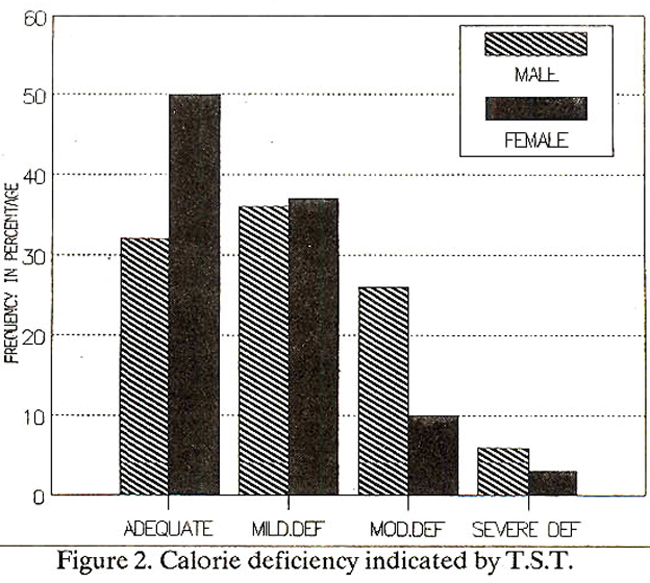
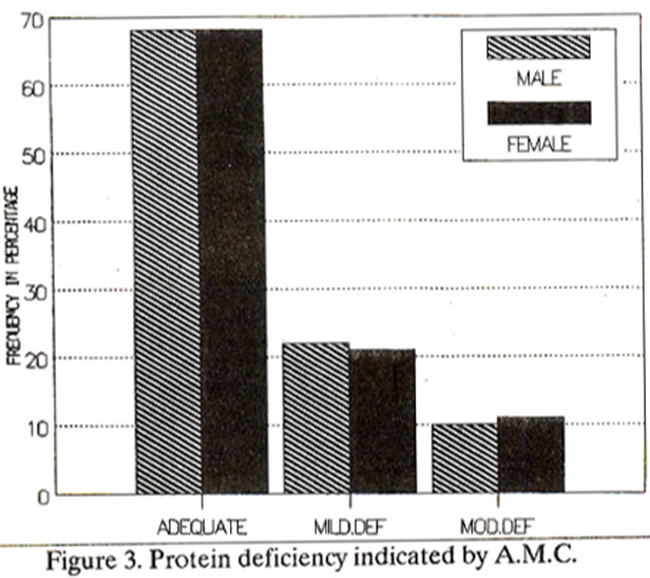
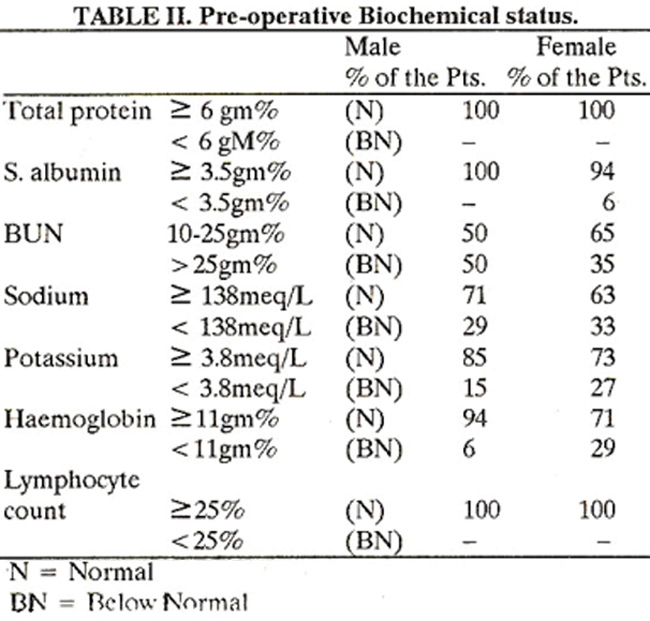
Sixty nine patients (31 males and 38 females) above the age of 12 years undergoing surgery under general anaesthesia were selected for this study. Thirty percent males and 29% females were depleted, 55% and 37% males and females, respectively, were normal and 13% and 34% males and females, respectively, were obese as indicated by Body-mass index (BMI). Measurement of mid-arm-muscle-circumference (MAMC) indicated mild to moderate protein deficiency in 32% of the patients while triceps skinfold thickness (T.S.T) indicates mild to severe calorie deficiency in 68% males and 50% females. Dietary intake both pre and post operatively was unsatisfactory. P re-operatively 26% of the females had Hb level below normal (<11G%). Only 3-5% of the patients had protein and albumin level below normal (<3.5 G%). Post-operatively all the anthropometric measurements as well as serum protein and albumin levels decreased and BUN increased significantly indicating body catabolism. Post operative hospital stay was significantly more in undernourished patients (JPMA 40 37, 1990).
INTRODUCTION
Malnutrition, obesity, late diagnosis ancillary disease or old age are associated with high morbidity and mortality1. Nutritional debt not only adds to the problems but also delays soft tissue repair2 resulting in slow recovery and prolonged hospital stay. Therefore, rfutritional care along with medicine is getting more priority in modern surgery. In Pakistan, little data is available to identify the nutritional problems in hospitalised patients at admission or their dietary intake during hospitalization. This study was undertaken to evaluate nutritional status of the patients in a general surgical ward, to assess pre and post operative dietary intake and the effects of nutritional status of patients on their hospital stay.
METHODOLOGY
One hundred and thirty one patients (71 males and 60 females) above the age of 12 years undergoing surgery under general anaesthesia were selected from surgical ward II of Jinnahh Postgraduate Medical Centre, Karachi. Sixty-two of them were included from this study due to incomplete data for assessment. Nutritional assessment was done on 69 patients (31 males and 38 females) . Most of them were between 3rd and 6th decade of life and in low income groups. Eighty five percent had a monthly income of less than Rs.2000/- (equivalent to US $90). The majority of patients of both sexes had abdominal surgery. The next most common operations were urogenital in males and thyroidectomy in females (Table 1).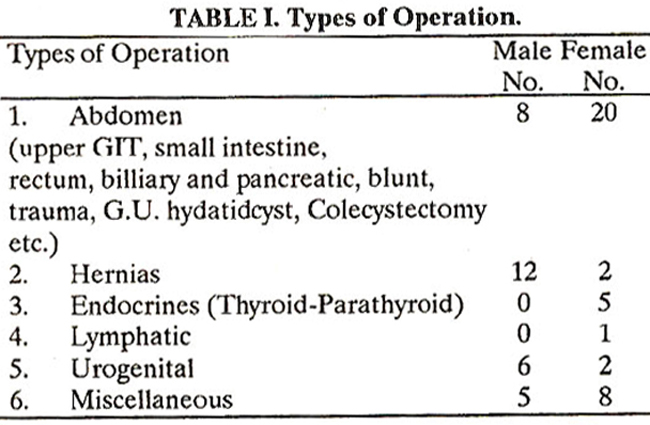
For preoperalive assessment age, sex, diagnosis, income, anthropometric measurements including height, weight, triceps skin fold thickness (TS.T), mid-arm circumference (M.A.C) as well as dietary intake in hospital were recorded on a proforma. Body mass index was calculated from Wt(Kg) formula of BMI = and grading was done {Ht(M)2} according to Garrow (1986); Midarm¬muscle circumference (MAMC) was calculated from the formula of (MAMC = MAC-xxTST). Normal averages for adult men and women are TST 12.5mm and 16.5mm respectiveiy anci MAMC 25.3cm and 23.2cm respectively4. These values are used to grade the degree of calorie and protein deficiency5. Blood was drawn for total protein, albumin, blood urea nitrogen (BUN), sodium, potassium, Hb and lymphocyte count. After operation dietary intake was recorded daily. Anthropometric measurements and bio¬chemical findings were recorded twice a week. Time taken to revert patients from parenteral to oral intake and duration of hospital stay were also recorded. Statistical evaluation was done using student t-test.
RESULTS
Pre-operative Nutritional Status
Nutritional status of the patients is shown in Figures 1,2 and 3, and biochemical status in Table II.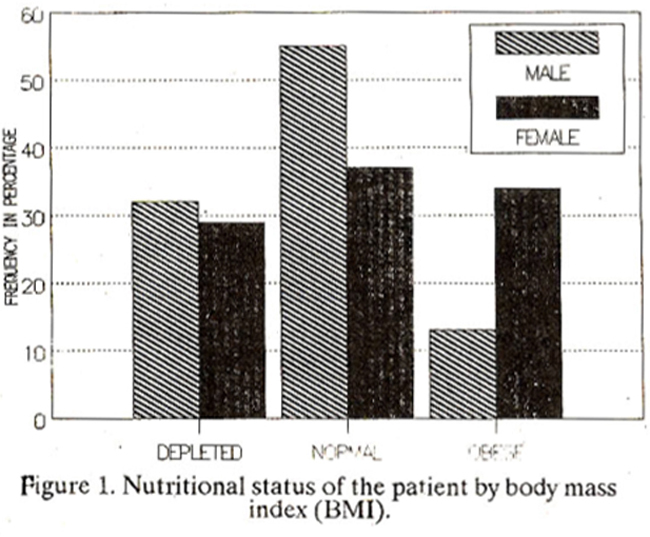
Pre-operative Dietary Intake
An average of 952 calories and 29 gms of protein were consumed by these cases respectively (Table III).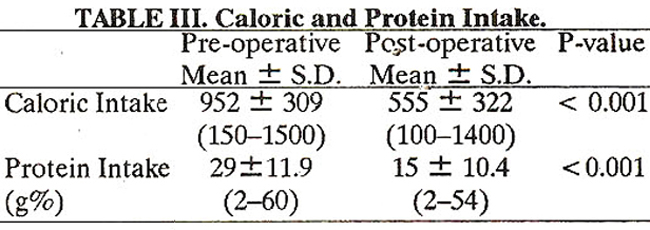
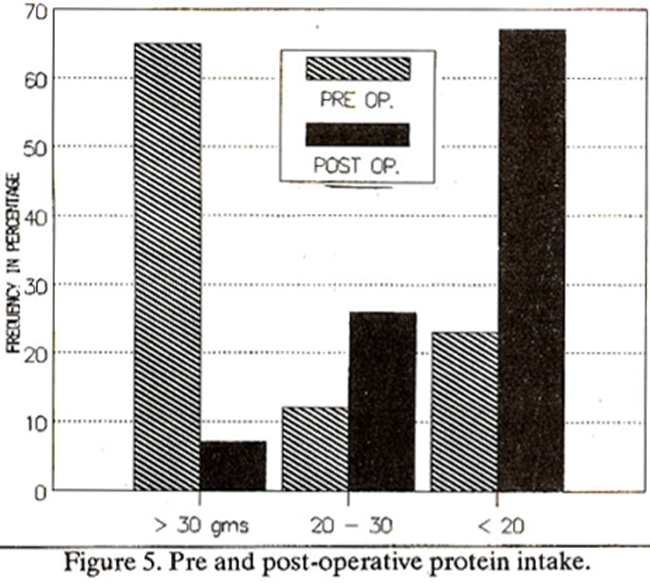
Sixty two percent consumed 1000-1500 calories and 38% less than 1000 calories. Twenty three percent of the cases had protein consumption of less than 20gms daily (Figures 4 and 5).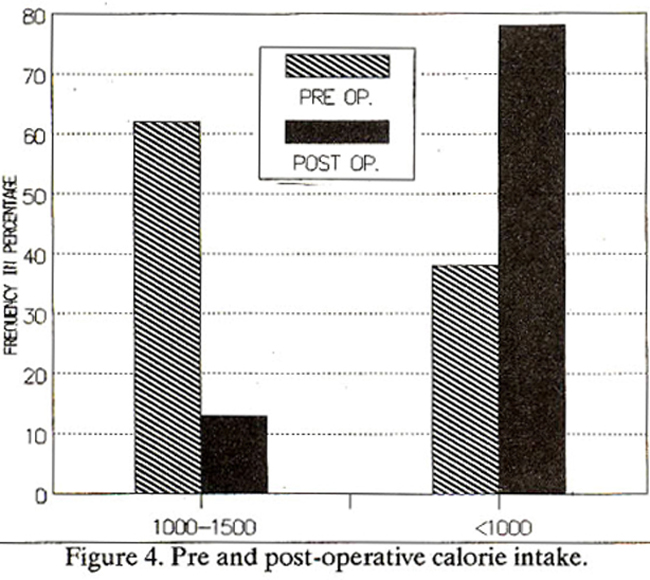
Post operative Nutritional Status
Post operatively all the anthropometric measurements were found to be decreased (Table IV).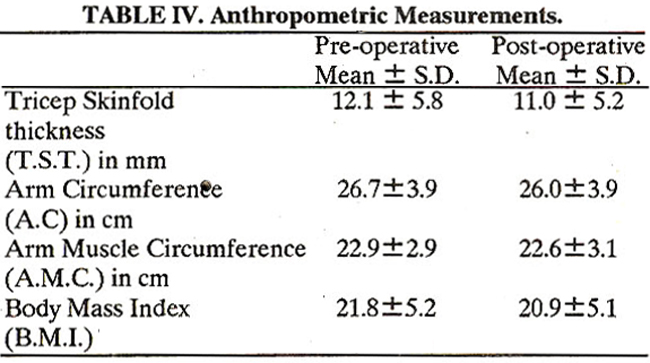
There was a significant reduction in total protein, albumin and sodium and an increase in BUN, slight fall in haemoglobin and no change in potassium and lymphocyte counts (Table V).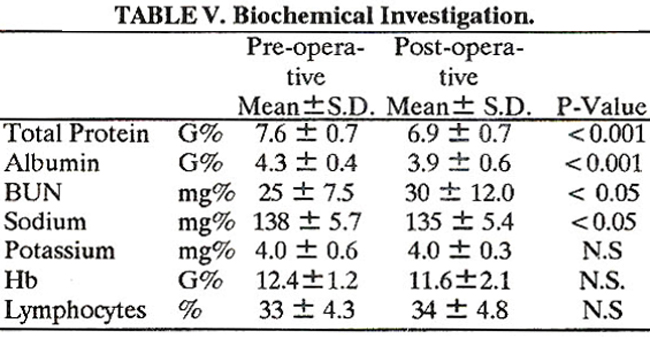
Post-operative Dietary Intake
Both the calorie and protein intakes were considerably reduced (Figures 4,5 and Table III). Post-operative hospital stay was significantly more in under- nourished patients (Table VI).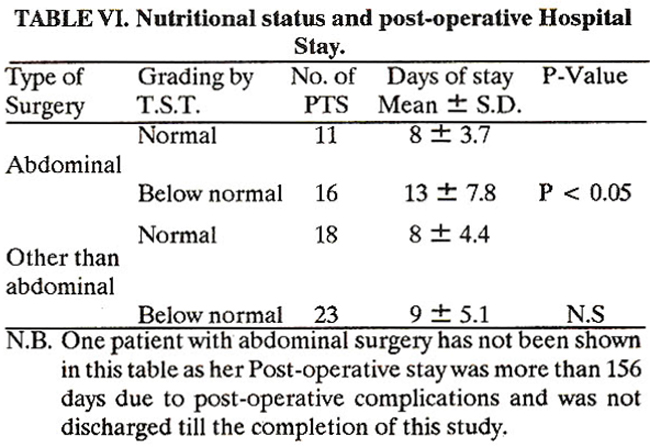
DISCUSSION
The prevalence of malnutrition in surgical patients is common the world over. On admission 33-65% of all hospital patients are to some degree malnourished which increases with increasing length of hospital stay6-13. Thirty to fifty percent of patients admitted in surgical wards of Scandinavian countries14 and United States15 were malnourished. Twenty-six percent of the patients had hypoalbuminia in the surgical wards of the Leeds General Infirmary16. Using BMI standard 41% males and 38% females were found undernourished and 18% males and 31% females were obese in surgical patients of Holy Family Hospital of Karachi. Twelve and half percent females also had low haemoglobin level17 (c1OG%). Similar pattern was observed in this study. Thirty two percent males and 27% females were depleted or under-nourished and 13% males and 34% females were obese as indicated by BMI. According to WHO criteria 26% of the female cases had haemoglobin level below normal (<11G%). Mild to severe deficiency of calories as indicated by T.S.T. measurements was found in 68% and 50% males and females respectively and protein deficiencywas found in 32% using MAMC grading (Figure 2 & 3). Both pre and post operative food intake was unsatisfactory. Pre- operatively 62% of patients could meet only their basal requirements. Similarly dietary intake of protein (which is one of the important nutrients required by surgical patients) was less than 20G in 23% of patients pre-operatively. Basal caloric requirement for an adult is 1400 K cal/day and that ingestion of <1000 calories and <30G of protein per day results in rapid protein caloric undernutrition5. Nutrient intake further decreased postoperatively, as 1000- 3000ml of 5% D/W without vitamin supplementation was given intravenously post-operatively for an average of 3 days. The change-over to normal oral feeding was very gradual or slow. After parenteral feeding these cases started oral intake of liquid or semi solid foods of either 1/2-1 cup of fruit juice or porridge without milk for an average of 2 days (1-11 days) which provided not more than 200 calories daily. Even when normal diets were resumed these cases preferred to eat fat free or low fat diets. Fear and apprehension in unfamiliar surroundings contribute detrimentally to the poor appetite engendered by the discomfort and symptoms of any underlying disease18. Moreover, it is fallaciously believed that fat free diets are essential for rapid wound healing during convalescent period. Fat free diets were drastically deficient not only in essential fatty acids (EFA) but also in total calories (Figure 4). As most of the protein foods also contain fat, protein intake was also restricted in these patients (Figure 5). Both adequate protein and fatty acids are essential for rapid wound healing, anabolism and resistance against infection. Therefore, catabolic states of these cases was enhanced post-operatively leading to loss of body weight and body mass as indicated from their anthropometric measurements (Table IV). Biochemical investigation also confirmed the catabolic state, with a significant drop in serum protein and albumin level and rise in BUN (Table V). Similarly the recovery was slow and the length of post-operative hospital stay was increased. (Table VI). Appropriate dietary supplementation especially to undernourished patients both pre and post-operatively will improve patients’ care, reduce the catabolic state and morbidity and mortality13,15,19. Malnutrition suppresses the immune response20,21 and thus predisposes to infection22. Therefore, attention should be given to these problems by wider recognition and practice of the principle of both pre and post operative nutritional assessment and care in order to decrease the morbidity and mortality18,19. At the same time assessment of obesity prior to operation is important as obesity also has harmful effects and brings in its own problems23,24.
REFERENCES
1. Majeski,J.A. and Alexander, W.J. Early diagnosis, nutritional support, and immediate extensive debridement improve survival in necrotising fascilitis. Am. J. Surg., 1983; 145 : 784.
2. Braun, R.M. and Schorr, R. Surgical nutrition in the patient with multiple injuries. J. Bone Joint Sur., 1983; 65A: 123.
3. Garrow, J.S. Treat obesity seriously. Edinburgh, Churchill Livingstone, 1986.
4. Butterworth, C. and Blackburn, G.L. Hospital malnutri. tion and how to assess the nutritional status of a patient. Annapolis, Maryland, Nutrition Today Incorporated, 1974.
5. 1-Ieymsfield, S.B., Bethel, R.A., Ansley, J.D. et al. Enternal Hyperalimentation: An Alternative to central venous hyperalimentation. Ann. Intern. Med., 1979; 90: 63.
6. Willcutts, HD. Nutritional Assessment of 1000 surgical patients in an affluent suburban community hospital. JPEN., 1977; 1 : 25.
7. Grills, N.J. and Bosscher, M.V. Manual of nutrition and Diet Therapy. ByGrills N.J. NewYork, Macmillan, 1981,p.3.
8. Seltzer, M.H., Bastides, J.A., Cooper, D.M., Engler, P., Slocum, B. and Fletcher, H.S. Instant nutritional assessment. JPEN., 1979; 3: 157.
9. Mutten, J.L., Burby, G.P. and Waldman, M.T. et al. Reduction of operative morbidity and mortality by preoperative nutritional assessment. Chicago, Surgical Forum -65th Annual Clinical Congress Chicago, p.80.
10. Weinsier, R.L., Hunker, EM., Krumdieck, C.L. and Butterworth, C.EJr. Hospital malnutrition. A prospective evaluation of general medical patients during the course of hospitalization. Am. J. Clin. Nutr., 1979; 32 : 418.
11. Faintuch, J., Faintuch, J.J., Machado, M.C. and Raia, A.A. Anthropometric assessment of nutritional depletion after surgical injury. JPEN., 1979; 3: 369.
12. Parsons, H.D., Francoeur, T.E., Howland, P., Spengler, R.F. and Pancharz, P.B., The nutritional Status of hospitalized children. Am. J. Clin. Nutr., 1980; 33: 1140.
13. Irving, M. Enteral an2 parenteral nutrition. Br. Med. J., 1985; 291 : 1404.
14. Symreng, T., Anderberg, B. Kagedal, B., Norr, A., Schildt, B. and Sjodahl, R. Nutritional assessment and clinical course in 112 elective surgical patients. Acta. Chir. Scand., 1983; 149: 657.
15. Bristrin, B.R., Blackburn, G.L., HalIwell, E. and Heddle, R. Protein Status of general surgery patients. JAMA., 230-858.
16. Hill, G.L., Pickford, D.1., Young, G.A. et at. Malnutrition in surgical patients; an unrecognized problem. Lancet, 1981; 1: 689.
17. Talati, J., Drago, P., Ali, Z. and Hasan, N. Low cost nutritional assessment of surgical patients in third world countries. JPMA., 1987; 37:86.
18. Johnston, I.D. Nutritional support before and after surgical operation. Proc. Nutr. Soc., 1980; 39: 107.
19. Mullen, J.L, Buzlay, G.P., Mathews, W.C., Smale, B.F and Rosato, E.F. Reduction of operative morbidity and mortality by continued preoperative and post operative nutritional support. Ann. Surg., 1980; 192: 604.
20. Hafegee, A.A., Angorn, 1.8., Brain, P.P., Duursma, J. and Bake; LW. Diminished cellular immunity dueJo impaired nutrition in oesophageal carcinoma. Br. J.Surg., 1978; 65 : 480.
21. Law, D.K., Dudrick, S. and Abdou, N.L The effects of protein- calorie malnutrition on immunecompetence of the surgical patient. Surg. Gynecol. Obstet., 1974; 139:257.
22. McLaren, D.S. Nutritional disorders in surgical patients, in nutrition and surgical patient. Edited by Graham Hill. Edinburgh, Churchill Livingstone, 1981, p. 1.
23. Jung, It. Obesity. Med. Int., 1985; 2 : 576.
24. Bray, G.A. Obesity. Med. Int., 1981; 1 : 355.
Journal of the Pakistan Medical Association has agreed to receive and publish manuscripts in accordance with the principles of the following committees:


