

Fariba Shahhraki Sanavi ( Student`s Scientific Research Center, Health Promotion Research Center, School of Health,Zahedan, Iran. )
Abdolvahab Baghbanian ( Department of Public Health, Health Promotion Research Center, School of Health,Zahedan, Iran. )
Mehdi Faraji Shovey ( Zahedan University of Medical Sciences, Zahedan, Iran. )
Alireza Ansari-Moghaddam ( Department of Epidemiology and Biostatistics, Health Promotion Research Center, School of Health, Zahedan, Iran. )
November 2013, Volume 63, Issue 11
Original Article

Abstract
Objective: To investigate the relationship between parenting styles and family communication patterns with adolescent\\\'s quality of life.
Methods: The cross-sectional study was carried out on 439 randomly selected adolescents in the city of Zahedan, Iran, from January to July 2011. The subjects were asked to complete the KIDSCREEN-52 health-related quality of life questionnaire, while their parents were asked to complete the Diana Brinder\\\'s Test to show their parenting styles. SPSS 15 was used to analyse data.
Results: Most parents had \\\'authoritative\\\' parenting style (n=380; 86.6%). Pluralistic (n=170; 38.7%) and consensual (n=152; 34.6%) patterns were the most frequent styles of communication in families. Data suggested a significant relationship between parenting style and some dimensions of quality of life, including physical well-being, psychological well-being, social support and peers, and autonomy (p<0.05). There was also a significant relationship between family communication patterns and parent relation and home life (p<0.001) as well as autonomy (p<0.006).
Conclusion: Families play a critical role in increasing adolescents\\\' health-related quality-of-life. Effort should be made to address problems facing parents while raising their children.
Keyword: Adolescent, Family communication pattern, Parenting styles, Quality of life. (JPMA 63: 1393; 2013).
Introduction
Family plays an important role in shaping a person\\\'s fate or destiny. Parental techniques for raising children and families\\\' training systems are amongst the most fundamental factors for a child’s personality formation. These can serve as deterrent or encouraging factors in their growth process.1
Parenting styles are significant factors in human development studies2 and have been known as important causes of sociability in adolescents.3 In fact, parents play an essential role in the transition phase of teenage years.3 In addition, parenting styles are the fundamental prerequisites of health improvement during adolescence which is a period of transition.4 Parenting styles include methods that parents apply for treating their children, and have profound impact on adolescents\\\' growth, their character, personality and behavioural traits. The training styles which parents select in turn is affected by a variety of factors, including both the parents\\\' and children\\\'s temperaments. Many of these factors arise from surrounding environmental conditions such as socio-economic circumstances and the dominant cultural values.5
Some parents believe in \\\'authoritative\\\' styles for independent and disciplined behaviours. They encourage verbal communications and have always a reason when they prohibit their children from doing something, or expect them to do something.5 Often, children of such families have friendly and respectful relations with their peers and assess their behaviours based on a rational criteria.1 Adolescents in such families enjoy social merits, sense of responsibility and independence4 and resist undesirable behaviours posed by peer pressure.1 \\\'Authoritarian\\\' parents are characterized by strict rules, harsh punishments and little warmth; believing in a set of conducting standards for controlling their children. Members of these families are less self-dependent, cannot easily develop self-control or manage their situations properly, and thus achieve little awards.5 Such people might become chronically disobedient in their families, or dependent on them.4
Parents with \\\'indulgent,\\\' \\\'non-directive\\\' or \\\'permissive\\\' behaviour are more responsive than demanding. These parents tend to be lenient or mild in their behaviour and avoid confronting their children. These parents allow children to control their own behaviour without any constraint on them, and believe that meeting their children\\\'s needs, demands or wishes is the way to show their affection and love to them.4 However, such parents cannot support the needs of their children, and assume false interpretations from their own responsibilities.5 Often, disciplinary rules, orders and regulations are dominant in such families.6 Family members are insufficiently valued by one another and the relationship between them is relatively unhealthy, showing degrees of disturbance or mechanical communications.5 Adolescents have a tendency to express selfishness and self-center behaviour in such families.4
A review of literature shows that individuals\\\' behavioural disorders and deviations mainly originate from their families, and that the majority of adolescents with wrong-doing interests come from families suffering from poor parenting styles. Parents with highly disciplined parenting styles and those with uncoordinated relationship with their children or low tendency to accept or involve them in psycho-social activities create an atmosphere vulnerable to perilous or high-risk behaviours amongst adolescents.3 Furthermore, findings show that parenting styles closely correlate with teenagers\\\' educational success, optimism, reliance, motivation, behavioural disorders, and levels of mal-adaptive behaviours such as addiction to drugs and so on.2,7 Similarly, parenting styles are largely related to adolescents\\\' health. Parents\\\' inner relationships and behaviour styles, their levels of support and intimacy affect children\\\'s health and their attitude toward human relationships in communities. Children who feel accepted by their parents would possess stronger health than those with indifferent, authoritarian and disturbed families or parents.8
Since 1960s, quality of life (QOL) has been extensively investigated in various political, social and economic realms.9,10 However, scientific, medical and technological advances are not merely sufficient to improve QOL. A combination of these progresses along with individuals\\\' values and perceptions about welfare and environmental circumstances would bring about life quality promotion.10 Among social factors, the role of families and the communication patterns between their members seem to be essential in shaping human equality of life. Taking into account the importance of family relations and parenting styles and their potential impact on teenagers\\\' health dimensions, the current study intended to assess the adolescents\\\' QOL. Despite the great body of literature on the subject, very little has been known about the relationship between perceived health-related quality of life (HRQOL) amongst adolescents and their parenting styles and communication patterns in south-east Iran. The study investigated the relationship between parenting styles and family communication patterns with adolescents\\\' QOL.
Methods
The cross-sectional descriptive-analytical study which was conducted in Zahedan, Iran, from January to July 2011, and comprised healthy adolescents and their parents. The adolescents were asked to fill the questionnaires at their respective schools. A total of 8 schools were part of the study: 4 each for boys and girls. The parents were asked to complete the questionnaire at home and return them to the study centres. The subjects were selected based on a multistage random sampling method. Firstly, the study setting was divided into 4 geographical regions. Then, schools were listed in each region for boys and girls, separately. Accordingly, two schools (1 for each gender) were selected in each area by using simple random sampling method. Finally, three classes were chosen randomly in each school. All the students in these classes along with their parents were included in the study. Written consent was obtained from all respondents after they were briefed about the methodology and the overall project. The adolescents were asked to complete the KIDSCRREN-52 QOL questionnaire, while the pre-designed Diana Brinder\\\'s Test was used to measure the parenting styles.
The Diana Brinder\\\'s Test comprises 24 questions.12 This questionnaire was translated into local language (Persian/Farsi). Its reliability was re-assessed through Cronbach test and was calculated to be 0.79. Content validity ratio and content validity index were 0.69 and 0.88, respectively. It was also utilised in Persian by Ghaljaee with a reliability rate of 0.79.12
The parenting style was evaluated based on the frequency distribution of responses to all the questions. Basically, each question comprised three choices A, B and C. Using these options, the respondents were classified into four categories: including permissive, authoritarian, authoritative and, permissive- authoritative. If the majority of answers were \\\'A\\\', the individual was grouped as permissive; if it was \\\'B\\\', the participant was classified as authoritarian; and if it was \\\'C\\\', the subject was categorised as authoritative. The permissive-authoritative group comprised parents who marked \\\'A\\\' and \\\'C\\\' frequently.
Questions of Health-Related Quality of Life (HRQOL) were based on the KIDSCREEN-52 project. The questionnaire consists of 10 dimensions with 52 questions. Although the reliability (0.77-0.89) and validity of the questionnaire have been determined previously.13-15 and the questionnaire has been evaluated as a suitable means of measuring QOL, for the purpose of the current study, the content validity ratio (CVR) and content validity index (CVI) were re-measured as 0.69 and 0.88 respectively and the reliability was a=0.87. The questionnaire is a self-assessment tool which consists of 52 questions including: in general how do you score your health status (1 question), physical well-being (5 questions), psychological well-being (6 questions), moods and emotions (7 questions), social support and peers (6 questions), parenting relation and family life (5 questions), self-perception (5 questions), autonomy (5 questions), school environment (6 questions), social environment (3 questions) and financial resources (3 questions). These questions were asked on a 5-point scale: the lowest and highest scores for each question were 5 and 1, respectively.13-15 Based on the summation of collected data and according to the quarter of scores achieved by respondents, the QOL was classified into four categories of poor, moderate, good and excellent (Total score=260). Data was also collected regarding demographic characteristics of the participants as well as self-reported psychological disorders (participants were asked if they had any history of psychological disorders diagnosed by a psychologist).
Following the completion of questionnaires, the data was imported into SPSS 15 software for statistical analysis. Descriptive statistics such as mean, standard deviation, frequency distribution and analytical statistics, including Peerson and Spearman correlation coefficients, X2 test, and analysis of variance (ANOVA) were used to analyse data. Multivariate analysis of variance (MANOVA) was also deployed for measuring the QOL and for determining its dimensions.
Results
At an overall response rate of 95%, the total study population comprised 439 families. Among the adolescents, there were 226 (51.5%) males; and 412 (93.9%) were aged 14-18 years. The average age of the students was 15.8±1.06 years. The number of children and teens in the participating families ranged between 1 and 16; and 252 (60.5%) families had at least four children. Besides, 381 (88.2%) students lived with their immediate parents; and the mean age of the mothers was 45.7±7.6 years, while that of the fathers was 40.7±6.2; 356 (84.6%) mothers were housewives, and 342 (89.1%) of fathers were full-time employees working with different governmental and non-governmental agencies. Mothers of 6 (1.4%) subjects and fathers of 22 (5%) had died.
In terms of financial status, 384 (90.6%) families considered it to be moderate to good (Table-1).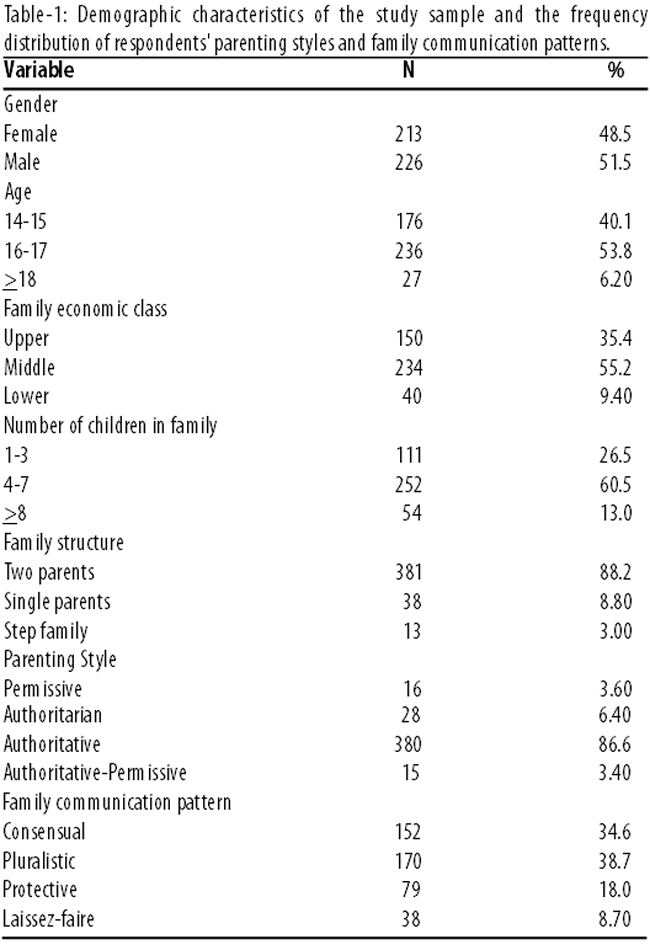
Most parents (n=380; 86.6%) had authoritative parenting style. Family communication patterns were pluralistic in 170 (38.7%) and consensual in 152 (34.6%) families. In addition, there was a significant relationship between parenting style and family household supervision (p<0.01). No significant correlation was found between parenting styles and parents\\\' job.
The mean scores and confidence interval of various QOL dimensions were calculated (Table-2).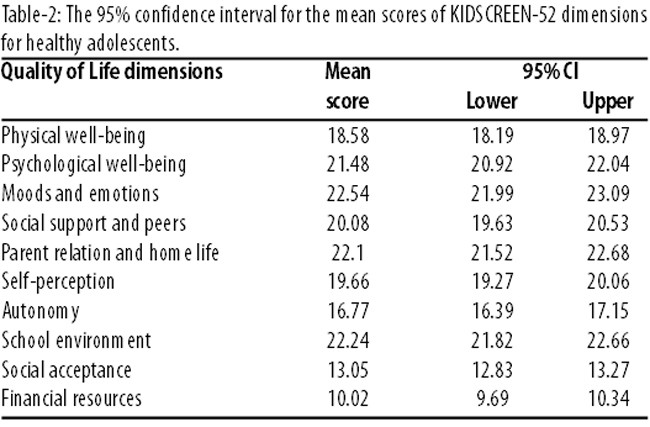
Accordingly, dimensions of moods and emotions (22.54±5.88), school environment (22.24±4.47), parent relation and home life (22.10±6.14) had the highest mean scores.
The mean score for all dimensions of HRQOL was 186.63±30.70. Based on the quartiles of the total score, the students\\\' QOL was classified into four distinct levels: poor (52-165); moderate (166-189); good (190-210); and excellent (211-260). Consequently, their HRQOL was almost equally rated as poor (n=109; 24.8%); moderate (n=114; 26%); good (n=109; 24.8%); and excellent (n=107; 24.4%).When ratings of excellent and good were combined to give an overall positive rating, 216 (49.2%) students rated their \\\'HRQOL\\\' score positively (190 and more).
ANOVA showed a significant association between the adolescents\\\' QOL mean score and various parenting styles) p<0.001 the mean QOL score being the lowest among adolescents living in families with authoritarian style (158.54±27.53). In comparison, adolescents with authoritative (189.43±30.04) and authoritarian-permissive (186.13±22.19) parenting types were similarly ranked in one group as the top QOL category in this study. Permissive parenting style (169.88±30.57) obtained a score between the low and top groups.
MANOVA revealed a significant relationship between parenting style and some QOL dimensions, including physical well-being (p<0.004), psychological well-being (p<0.001), social support and peers (p<0.051), and autonomy (p<0.006) (Table-3).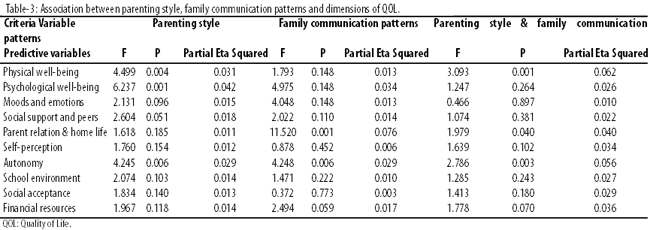
Also, there was a significant relationship between family communication patterns and some QOL dimensions including parent relation and home life (p<0.001) and autonomy (p<0.006).
Besides, a significant correlation was found between the combination of \\\'parenting style and family communication patterns\\\' and several QOL dimensions such as moods and emotions (p<0.010), parent relation and home life (p<0.040) and autonomy (p<0.056).
Discussion
Since scientific, medical and technological advances are not sufficient to improve the QOL, much effort is needed to identity fundamental factors affecting it. \\\'Families\\\' play a critical role in increasing adolescents\\\' HRQOL.11 The aim of this study was to investigate the relationship between parenting styles and family communication patterns and HRQOL in adolescents.
Results of a study on 13-15-year-old adolescents in Tehran indicated that 67.3% fathers and 76.2% mothers had authoritative parenting styles.11 Another study showed that the highest fraction (32.09%) belonged to authoritative and assuring parenting styles when the author conducted a research on adolescents 14 to 17 years of age in Isfahan.5 Results of another study on high-school adolescents in Malaysia showed that 81% fathers and 79.8% mothers had authoritative style.2 The findings of the current study are in line with those previously found in similar, cultural contexts.
One study found that fathers whose wives apply more authoritative style are more lenient and moderate; mothers generally applied more authoritative style compared to the fathers.16 It showed that most parents generally had similar parenting styles. Accordingly, filling parenting style questionnaire by one of the parents can be effective. In the current research also, only one questionnaire was sent for and filled by the parents.
Results of a research project showed that 53.35% mothers and 55.5% fathers of adolescents with conduct disorders followed authoritarian parenting style; and, there was a significant relationship between authoritarian parenting style and conduct disorders of adolescents (with 99% certainty).1 Also, investigation by Logarithmic-Linear pattern exhibited a significant difference between parenting styles and conduct disorder; signifying that mothers of adolescents with conduct disorders had authoritarian parenting style and those of normal adolescents followed authoritative style. In addition, the author\\\'s results proved that the degree of educational failure was greater in adolescents suffering from behaviour disorders.1 In the current research, since the majority of parents did not point to any particular psychological disorder, no significant relationship was discovered between their parenting styles and psychological disorders.
Results of a 2008 study were also indicative of the fact that authoritative parenting style — especially its warmth/supportiveness or autonomy dimensions, along with variable of socio-economic status — can help ease the sense of isolation or loneliness that female students felt.17 Findings of another research5 also revealed that there is a significant negative relationship between democratic parenting style and gluttonous and compensating behaviours; whereas a positive and significant correlation was found between authoritarian parenting style, compensating behaviour, as well as mental involvement and body weight.
Studies also showed a significant correlation between mental health disorders and authoritarian parenting style.5,11 In the current study, results from the multiple regression analysis also showed a significant relationship between parenting style and mental health of adolescents.
Results of a study in Brazil affirmed that adolescents with authoritative families obtained higher scores in all three dimensions of confidence including university, family and community, compared with those living in authoritarian or lenient families; and that their parenting style was the major factor in determining adolescents\\\' confidence and emotion.18 Similar studies have found a significant correlation between student\\\'s self-concept and intimacy/hostility of their parents; even though no significant relationship has been shown between lenient and authoritarian parenting styles and adolescents\\\' self-concept.19 Nonetheless, no significant relationship was observed between parenting style and dimension of adolescents\\\' self-conception in the current study.
In addition, findings of a 2010 study showed that students with authoritative parenting styles have had the lowest level of alcohol consumption during their high-school periods. However, students with authoritative parents and those with authoritarian parents had consumed alcohol at higher ages.20 One study argued that authoritarian parenting style had significant relationship with higher levels of moral judgments compared with other parenting styles. In addition, 50.26% of studied delinquent adolescents had no clear insight into their parents\\\' styles and 49.7% of them were not classified in any of the specified parenting style categories.21 On the other hand, findings from another research22 did not support expected results in other studies concerning the negative significant relationship between authoritarian and lenient parenting styles and children\\\'s self-motivation. Nevertheless, there was a positive and significant relationship between authoritarian parenting style and dominating motivations among first and third year-class students. In the current research, adolescents with authoritative parenting styles obtained the highest scores on dimensions of physical and mental health, emotion, excitement and temperament; confirming findings from the previous studies.
Furthermore, a 2007 study found a significant difference between physical health and self-perception dimensions of QOL in terms of gender (p<0.001). Comparison of these findings is indicative; they have had the same or lower scores than Iranian adolescents in terms of the above-mentioned dimensions.23
A 2009 study also showed that 44% of the studied European students suffered from poor to moderate health, low satisfaction with life and recurrent health problems; and that older adolescents (aging 16-19 years) and girls suffered more from health problems than their counterparts. The study found a significant relationship between low socio-economic status and health problems.24 In the current study, about 50% of adolescents described their health condition as \\\'a little good\\\' to \\\'fairly good\\\'; and based on the Fischer test a significant relationship was found between the physical health dimension (F=19/7; p<0.01) and the gender of adolescents. Yet, there was no significant relationship between family\\\'s financial condition and adolescents\\\' physical health and their overall QOL scores.
Studies from European and Asian countries have shown disparity in different dimensions of HRQOL. The data also demonstrated a moderate decrements in HRQOL among adolescents after 3-year follow-up.25-27 Moreover, findings of the current study demonstrated variation in different dimensions of HRQOL compared with previous studies. For example, score of autonomy and social acceptance in the present study is similar to some,28 but differs with other studies.29,30 These inconsistencies could be seen in other dimensions as well, and it points out the importance of the national/local data such as the present study for evidence-based planning on health and well- being of adolescents.
There are some limitations of the current study. Firstly, self- reported information was used for this analysis which may introduce some bias. Secondly, some parents were initially not willing to participate in the study, and had to be convinced.
Conclusion
The findings have shown a significant association between parenting style and family communication pattern with some QOL dimensions among adolescents. It can be used for evidence-based planning to address problems facing parents while raising their adolescents.
Reference
1. Kamijani M, Maher F. A comparison of child rearing practices of parent\\\'s adolescents with problem behaviors and normal adolescents. Danesh VA Pazhouhesh in Psychology 2007; 33: 63-94.
2. Elias H, Huey-Yee T. Relationship between perceived paternal and maternal parenting styles and student academic achievement in selected secondary schools. European Journal of Social Sciences 2009; 9: 181-92.
3. Okrodudu G. Influence of parenting styles on adolescent delinquency in Delta Central Senatorial District. EDO Journal of Counselling 2010; 3: 58-86.
4. Kopko K. Parenting Styles and Adolescents. (Online) (Cited 2010 May 27). Avaliable from URL: http://www.parenting.cit.cornell.edu/ parenting%20Styles%20and%20Adolescents.pdf.
5. Moumeni F, Amiri S. The relationship between parent\\\'s child rearing styles and incidence of anorexia nervosa among 14-17 years old female adolescents in Isfahan. Journal of Family Research 2008; 3: 775-89.
6. Khajepour M, Attar H. A comparison of child rearing practices with identity styles and their relationship among students of both sexs of preuniversity level in Shiraz. Educational Studies and Psychology 2007; 8: 178-97.
7. Raiisi F, Anisi J, Yazdi SM, Zamani M, Rashidi S. Mental health and child-rearing styles between candidate adult for addiction withdrawal in comparison with non-addict adults. Journal of Behavioral Sciences 2008; 2: 33-41.
8. Driscoll A, Russelly S, Crockettz L. Parenting styles and youth well-being across immigrant generations. J Fam Issues 2008; 29: 185-209.
9. King CR, Hinds PS. Quality of Life: From Nursing and Patient Perspectives: Theory, Research, and Practice. 1st ed. Canada: Jones & Bartlett Learning Co; 1998. pp Xi-30.
10. Rahimi M, Khayyer M. The relationship between family communication patterns and quality of life in Shiraz high schools. Journal of Educational and Psychological Studies 2007; 10: 5-25.
11. Karimy R, Taghavy-larijani, Mehran A, et al. Study relationships of girl\\\'s student\\\'s anxiety with parent\\\'s control style. Hayat Journal of faculty of Nursing and Midwifery 2005-6; 11: 83-8.
12. Ghaljaee F. Study relationships of girl\\\'s student\\\'s anxiety with parent\\\'s control style. [Masters Thesis] Tehran University of Medical Sciences; 2005.
13. Ravens-Sieberer U, Gosch A, Rajmil L, Erhart M, Bruil J, Duer W, et al. KIDSCREEN-52 quality-of-life measure for children and adolescents. Expert Rev Pharmacoecon Outcomes Res 2005; 5: 353-64.
14. Ravens-Sieberer U, Auquier P, Erhart M, Gosch A, Rajmil L, Bruil J, et al. The KIDSCREEN-27 quality of life measure for children and adolescents: psychometric results from a cross-cultural survey in 13 European countries. Qual Life Res 2007; 16: 1347-56.
15. Robitail S, Simeoni MC, Erhart M, Ravens-Sieberer U, Bruil J, Auquier P, et al. Validation of the European proxy KIDSCREEN-52 pilot test health-related quality of life questionnaire: first results.J Adolesc Health 2006; 39: 596.e1-10.
16. Winsler A, Madigan AL, Aquilino SA. Correspondence between maternal and paternal parenting styles in early childhood. Early Childhood Research Quarterly 2005; 20: 1-12.
17. Laali-Faz A, Askari AA. The power of predicting perceived parenting styles and demographic variables on girl student\\\'s loneliness feeling. The Quarterly Journal of Fundamentals of Mental Health 2008; 10: 71-8.
18. Marinez I, Garcia JF. Parenting styles and adolescents self-esteem in Brazil. Psychol Rep 2007; 100: 731-45.
19. Parish TS, McCluskey JJ. The relationship between parenting styles and young adults\\\' self-concepts and evaluations of parents. Adolescence 1992; 27: 915-8.
20. Kusmierski S, Nichols J, McDonnell R. Do parenting styles influence alcohol use and binge drinking during high school and college. (Online) (Cited 2010 May 27). Available from URL: http://murphylibrary.uwlax.edu/digital/jur/2001/kusmierski-nichols-mcdonnell.pdf.
21. Klengklao P. Parenting styles and moral judgment in Juvenile delinquency in Southern Thailand. [Masters Thesis] Mahidol University; 2007.
22. Cramer KE. The influences of parenting style on children\\\'s classroom motivation. [Masters Thesis] Louisiana State University; 2002.
23. Hong SD, Yang JW, Jang WS, Byun H, Lee MS, Kim HS, et al. The KIDSCREEN-52 quality of life measure for children and adolescents (KIDSCREEN-52-HRQOL): reliability and validity of the Korean version. J Korean Med Sci 2007; 22: 446-52.
24. Ravens-Sieberer U, Torsheim T, Hetland J, Vollebergh W, Cavallo F, Jericek H, et al. Subjective health, symptom load and quality of life of children and adolescents in Europe. Int J Public Health 2009; 54: 151-9.
25. Palacio-Vieira JA, Villalonga-Olives E, Valderas JM, Espallargues M, Herdman M, Berra S, et al. Changes in health- related quality of life (HRQOL) in a population-based sample of children and adolescents after 3 years of follow-up. Qual Life Res 2008; 17: 1207-15.
26. Michel G, Bisegger C, Fuhr DC, Abel T; KIDSCREEN group. Age and gender difference in health- related quality of life of children and adolescents in Europe: a multilevel analysis. Qual Life Res 2009; 18: 1147-57.
27. Stevanovic D, Tadic I, Novakovic T, Kisic-Tepavcevic D, Ravens-Sieberer U. Evaluating the Serbian version of the KIDSCREEN quality-of-life questionnaires: reliability, validity and agreement between children\\\'s and parents ratings. Qual Life Res 2013; 22: 1729-37.
28. Keenaghan C, Kilroe J, KIDSCREEN Group Europe. A Study on the Quality of Life Tool KIDSCREEN for children and adolescents in Ireland: Results of the KIDSCREEN National Survey 2005. The National Children\\\'s Strategy Research Series. Office of the Minister for Children, Department of Health and Children; 2008.
29. Tzavara C, Tzonou A, Zervas L, Ravens-Sieberer U, Dimitrakaki C, Tountas Y. Reliability and validity of the KIDSCREEN- 52 health- related quality of life questioner in a Greek adolescent population. Ann Gen Psychiatry 2012; 11: 3. doi: 10.1186/1744-859X-11-3.
30. Guedes DP, Pinto Guedes JER. Translation, cross-cultural adaptation and psychometric properties of the kidscreen-52 for the Brazilian population. Rev Paul Pediatr 2011; 29: 354-71.
Related Articles
Journal of the Pakistan Medical Association has agreed to receive and publish manuscripts in accordance with the principles of the following committees:


