

December 1992, Volume 42, Issue 12
Letter to the Editor

Editor, Pakistan is one of the signatories of Alma Ata Declaration and has adopted primary health care (PHC) strategy to achieve health for all by the year 2000. Besides other elements of PHC, use of essential drugs has the potentials to confer enormous health benefits. Pakistan has been labelled as a country having medium coverage of (20-60%) of people having access to essential drugs1. In our latest health policy, a strong emphasis and commitment has been given to essential drug programme in the country. Madam, let me take you briefly how far we have achieved success in this regard at governmental level (See table below):
DRUG SITUATION IN PAKISTAN*
Legislation drug regularitory mechanism exists but is not fully functioning.
Essential exists by generic name for the public sector only drug list
Procurement by tender from multiple sources, takes quality and price into account and medium prices are obtained.
Distribution moderately good.
Quality including a quality control laboratory exists, but does
assurance not function adequately.
Information There is no organized provision of information to health workers and patients.
Manpower continuing education is not systematic development
Monitoring no monitoring mechanism exists.
Production of pharmaceutical products take place in Pakistan.
*Source World Health Organization 1988. The world drug situation.
World Health Organization, Geneva
Focussing on private health sector which is one of the most important health resource in Pakistan2, we have got private markets having high prices of drugs and a high (more than 7000) proliferation of branded products1. According to Ahmed2, about 800 brand items of questionable value or high risk are available and account for more than 50% of total drugs sales in our country3. In Karachi4, it was found that of all the drugs prescribed, 55% of them fell in the categories of: a) anti-diarrhoeal, b) appetite stimulant, c) multi-vitamins and d) brain tonics. Of all the sales in pharmacies, 40% are without prescription. Thus there is a heavy reliance on drugs by people specially the poor for treating colds, malnutrition and parasitic infectipns benefitting the pharmaceuticals5. Interestingly, the areas which tended to be high in prescribed medicine use, also tended to be high in non- prescribed medicine use6. A study in Manila7 found that doctors always prescribe drugs for simple disorders as headache, fever and diarrhoea. Their prescription habit mediate the message “when ill, take a drug”. It has generally been found that volume of drugs prescribed is disproportionate among physicians, even within the same speciality8. Hemminki9,10 has introduced a model of prescribing decisions which suggests that the major factors affecting prescribing decisions are: a) demands from patients and society, b) drug firms and research and c) governmental control forces. The model further suggests that influence on practising physicians is primarily transmitted through education, scientific journals and advertising. Colleagues are depicted as another source of influence. Christensen11,12 has also described similar factors associated with prescribing practices. Raynes13 suggests that the therapy itself may be used as a diagnostic tool or test. A policy aiming at the rational use of drugs needs to emphasize appropriate drug use if sound prescribing practices and the informed use of drugs by patients and consumers are to be achieved. Such a policy needs to address the problems of overprescription; inappropriate prescription; excessive self- medication; medication for transient ailments where there is no need for drugs and use of new, expensive drugs when effective, safe high quality drugs are available at lower cost14. A policy for rational prescription of drugs falls into four major types (cited12). Those mainly affecting are: a) prescriber, b) manufacturers and distributors, c) pharmacists and d) patients (Table).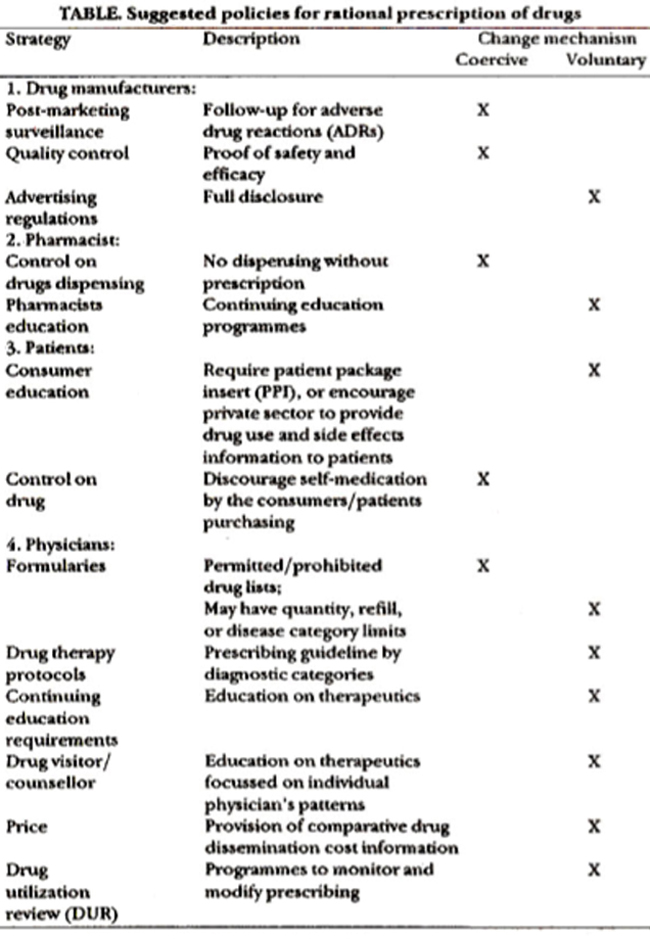
Broadly, it will be noted in the attached table that controls directed at manufacturers and pharmacists tend to be coercive and to involve structural changes while those directed at physicians and patients may involve structural changes in organization, but are more likely to rely on voluntarism to achieve the desired goals. The prescribing policy with major emphasis on physicians will involve small changes and would expect to get consensus from the parties involved, as is needed15 for incremental type of policy. A number of pressure groups16 can be involved in achieving the objective of rational prescription by the doctors. There are number of sectional groups which comprise mainly the professional bodies, e.g., Pakistan Medical Association, Pakistan Paediatric Association, College of General Practitioners and some non- professional bodies who are interested in essential drug programme. Besides, at the international level World Health Organization, HealthAction International, Voluntary Health Association of India17 can also be involved in assisting the programmes aimed at improving prescribing practices of doctors. The policy of rational prescribing can be implemented by organizing a workshop of the interest groups from private as well as public sector and observers from neighbouring countries and abroad, who are involved in same type of activities and can share their experiences. In that context UNICEF and other funding agencies can play an important role. Madam, I hope that through your journal the readers and specially the members of the Pakistan Medical Association will consider some of my suggestions and take a lead in implementing them so as to strengthen our essential drug programme.
Inayat H. Thaver
Health Policy Unit, Department of Public Health and Policy, London School of Hygiene and Tropical Medicine, Keppel Street (Gower Street), London WC1E 7HT, United Kingdom.
REFERENCES
1. World Health Organization. Theworid drugsituation. Geneva, WHO., 1988, p. 7..
2. Ouresbi, AF and Shepard, D.S. Health expenditure and services utilization in a squatter settlement. Takemi Research Paper. Harvard School of Public Health; May 1988.
3. Ahmed, SR.. and Shutta, Z.A. A survey of paediatnc prescribing and dispensing in Karachi. J.Pak.Med. Assoc., 1990:40:126-30.
4. Yudkin, J.S. Use and misuse of drugs in the third world. Dan. Med. BulL 1984; 31(Suppl.1): 11-17.
5. Rabin, D.L and Bush, P.3. The use of medicines; historical trends and international comparisons. Int.J. Health Services, 1974;4:61-68.
6. Hardon, A.P. Symptom-related drug use; doctor’s prescription, in A.?. Hardon Confronting Ill Health. Health Action Information Network, 1991.
7. Maronde, R.F. A studyof prescribing patterns. Med. Care, 1971;9:383-88.
8. Hemminki, E. Review of the literature on the factors affectingdrug prescribin& Soc. Sci. Med., 1975;9:111-18.
9. Hemminki, E.The role of prescription in therapy. Med. Care, 1975,13:150-56.
10. Christensen, D.B. and Wertheimer, AJ. Sources of information and influence on new drug prescribingamong physicians in an HMO. Soc.Sci. Med., 197913A:313-22.
11. Christensen, D.B. and Bush, P.J. Drug prescribing: patterns, problems and proposals. Soc.Sci. Med., 1981;15A:343-55.
12. Raynes, NV. What can I do for you? in R. Mapes (ed). Prescribing practice and drug usage. London, Croom Helm, 1980, pp.83-99.
13. World Health Organization. Guidelines for developing national drug policies, WHO., 1988, p. 3.
14. Willets, P. Pressure groupsas transnational actors, in P. Willets (ed). Pressure groups in the global system. London, Frances Printer, 1982.
15. World Health Organization. Selected annotated bibliography on essential drugs. World Health Organization. WHO/DAP/90.3; 1990.
Related Articles
Journal of the Pakistan Medical Association has agreed to receive and publish manuscripts in accordance with the principles of the following committees:


