

Mohammed Amir ( Department of Surgery, Federal Government Services Hospital, Islamabad. )
Mohammed Abdhoo Malik ( Department of Surgery, Federal Government Services Hospital, Islamabad. )
Inamul Haq Shami ( Department of Surgery, Federal Government Services Hospital, Islamabad. )
November 1993, Volume 43, Issue 11
Case Reports

Forequarter or inter scapulothoracic amputation is an uncommonly performed operation for malignant tumours involving the proximal end of humerus and the shoulder. A report of three cases who underwent this procedure at Federal Government Services Hospital, Islamabad is presented. In two cases the lesion was a primary bone tumour (osteogenic sarcoma) and the third one was an advanced metastatic lesion of the upper humerus with soft tissue involvement. The posterior approach of Little wood1 was used with a little modification. The incisions used are shown in Figure 1.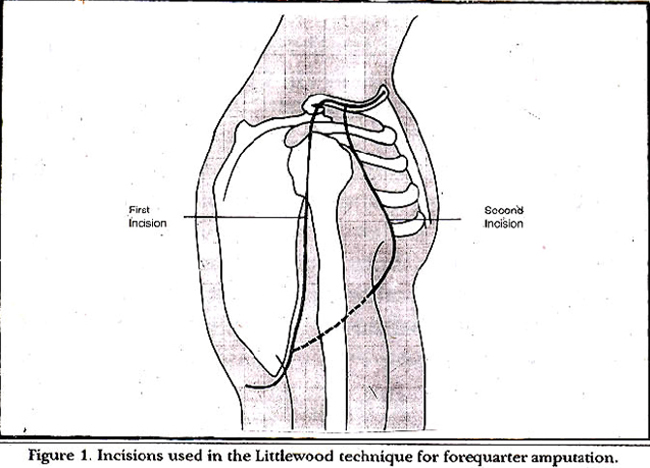
Using the posterior incision first Little wood secured the neurovascular bundle before making the second anterior incision. We found it convenient to ligate the bundle under direct vision as a last step after completing the anterior dissection as well.
Case 1
A female of 30 reported with a slowly increasing painful mass in the right upper arm for the last three months. Physical examination revealed a hard tender rounded mass of about 25 cm around the right upper arm with prominent veins over the skin. The radiographs and biopsy revealed osteogenic sarcoma of the upper end of humerus with soft tissue involvement. Her bone and visceral scan were normal. Initially she refused surgery. After about eight-months she came back as the weight of the arm was becoming unbearable due to further increase in size. A forequarter amputation was done. Postoperatively she developed; excessive upward lift of the breast which was corrected with plastic repair. She received chemotherapy. She remained symptom- free for about fifteen months when she started deteriorating and died due to multiple secondaries in the lungs.
Case 2
A 45 year old male, driver by profession, presented with history of a slowly progressing painful swelling of right upper arm for one month which was treated by local doctors with various regimes of analgesics and antibiotics. One day before admission he developed in-ability to move the arm with a deformity in the upper part. Radiograph revealed an osteolytic lesion at upper 1/3rd of humerus with a pathological fracture. It was suspected to be a secondary metastatic lesion. A search for the primary revealed a mass in the left renal area. Investigations confirmed a left renal neoplasm with secondary in the upper humerus. A left nephrectomy with intramedullary nailing of the right humerus along with biopsy of the lesion was done. Postoperatively he received radiotherapy arid chemotherapy. He was seen again after a year and a half with painful progressive swelling of the whole upper arm with loss of function of two months duration. X-ráys revealed almost complete resorption of right humerus with nail struck at both ends. Bone scan revealed increased uptake in the soft tissues of the upper limb including the shoulder joint area. A forequarter amputation was performed. He developed superficial wound infection managed successfully with appropriate antibiotics. Two years of follow-up since operation have been uneventful without any evidence of metastases.
Case 3
A young girl of 15 from Mad Kashmir presented with similar history of a slowly increasing sweffing of right upper arm for one year. The tumour was 30 cm in diameter. X-rays revealed an osteodestructive lesion of the upper end of right humerus with soft tissue extension. with typical Codman’s triangle (Figure 2).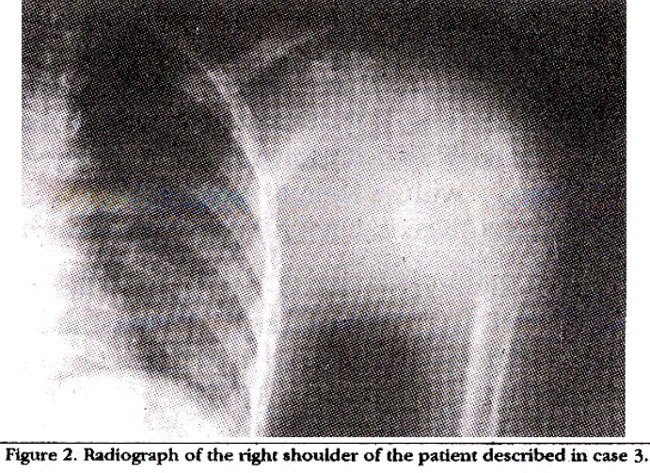
Biopsy revealed an osteogenic sarcoma of humerus. A forequarter amputation had to be done. She was referred to the radiotherapy institute where she received cytotoxic drug therapy. In the last eighteen months of follow-up she had been enjoying a satisfactory life free of metastases.
Discussion
Forequarter amputation is a mutilating procedure which imparts a grave psychogenic trauma to the patient. There is an initial refusal on the part of the patient and even hesitation on the part of the treating surgeon resulting in too few such procedures being carried out even when needed2. Techniques of limb salvage surgery and multimodality therapy like radiation, local and systemic chemotherapy are also being done for these patients3. For small tumours wide proximal humeral resection alone may suffice or followed by reconstruction with a metallic spacer or an allograft. In young people shoulder arthrodesis can be one of the options4. For large tumours Tickhoff-Linberg procedure1,5 or one of its modifications is being practiced provided the tumour does not extend to and involve the neurovascular bundle, the chest wall and the. axillary lymph nodes6. Following this technique the function of the forearm and hand are preserved. A custom humeral prosthesis6 or an inter positional metallic device7 may be implanted for reconstruction. But such salvage procedures can only be undertaken in well-confined and early lesions2,3,6. Our cases presented at an advanced stage. Cases 1 and 3 bad the tumour six months and one year before they were admitted and biopsies taken. The tumour by thattime had extended to the chest wall. In case 2 a limb salvage surgery was attempted for metastic lesion in the upper humerus. He did not turn up for follow-up and presented after 14 months with a big swollen and nonfunctioning arm with marked soft tissue and neurovascular involvement. So all three patients had to undergo such an extensive procedure. There is still a room for an extensive procedure like forequarter amputation for malignancies around the shoulder when limb salvage surgery is either inappropriate or impossible for local control of disease.
References
1. Crenshaw, AM. ed: Campbell\\\'s operative orthopaedics, 7th ed. Washington, D.C., MosbyCompany, 1987; pp. 645-46, 733-34.
2. Hardin, CA. Interscapulothoracic amputation for sarcomas of the upper extremity. Surgery, 1%1;49355-5&
3. Either, F.R., Mitts, J.J., Grant, T.T. et at. Is amputation necessary for sarcomas? A seven-year experiencewith limbsslvage. Ann. Surg., 1980;192:431-38.
4. Lewis, M.M. Bone tumours - evaluation and management. Orthop. Clin. North Am., 1989;20:340-41.
5. Hughes, S.P.F., Bensen, M.K.D.A., Cotton, CL et al The principles and practice of musculoskeletal surgery. New York, Churchill Livingstone, 1987, p.1014.
6. Malaiver, M.M., Sugarbaker, P.H., Lampert, M. et al. The Tikhoff- Linberg procedure: report often patients and presentation of a modified technique fortumour of proximal humerus. Surgery, 1985;97:518-28.
7. Whitehill, R.,Wanebo, Hi. and Mabie, K.N. Reconstruction aftertheTikhoff-Linberg procedure. Arch. Surg., 1982;117:1248-49.
Journal of the Pakistan Medical Association has agreed to receive and publish manuscripts in accordance with the principles of the following committees:


