

N. Islam ( Department of Medicine, Aga Khan University Hospital, Karachi. )
J. Akhter ( Department of Medicine, Aga Khan University Hospital, Karachi. )
N. Kayani ( Departments of Pathology, Aga Khan University Hospital, Karachi. )
M.A. Khan ( Department of Medicine, Aga Khan University Hospital, Karachi. )
November 1993, Volume 43, Issue 11
Original Article

Abstract
Fructosamine assay determines glycaemic control in diabetic patients by measuring glycosylated piasma protein. This study was done to assess the value of fructosamine as ah alternative test to HbA1 c as a measure of giycaemia. Sixty patients (both Insulin dependent diabetes mellitus and non insulin dependent diabetes meliitus) were selected from the diabetic clinic and fasting blood samples were collected for estimation of glucose, HbA1 c and fructosamine levels. The results were compared by correlation analysis and major discrepancies/discordance was detected by dividing the results into 3 clinical categories and detecting the cases in which the values fell in opposite clinical categories. Fructosamine correlated well with HbA1c (r= 0.41, p <0.01) and with fasting blood glucose (r= 0.45 p <0.01). Major discordance was detected in the results of only 7 patients which can partly be attributed to different periods over which HbA1 c and fructosamine reflect average glycaemia. Fructosamine measures glycaemia over the past 2-3 weeks and HbA1c over 8 weeks. As fructosamine assay is relatively inexpensive, reliable and simple to perform; it can be used as an alternative to HbA1c and is particularly suited for developing countries (JPMA 43:238,1993).
Introduction
The effective management of diabetic patients requires knowledge of the average glycaemia prevailing in the recent past. This objective measure of average glycaemia ideally should be reliable, simple to perform and inexpensive. The methods available so far, do not fulfill all these criteria. Random blood glucose is affected by many factors and is not an accurate measure of average glycaemia particularly in insulin dependent diabetes mellitus (IDDM)1. Laboratory fasting blood glucose is inconvenient for patients, though it gives some idea of diabetic control in non-insulin dependent diabetes mellitus (NIDDM) patients, it remains unreliable in IDDM patients. The glycosylated haemoglobin (HbA1c) assay has now become the standard by which average glycaemia is assessed over a certain period. Although established, HbA1c is expensive and time consuming to perform. Due to relatively long half life of erythrocytes, it reflects average glycaemia over the past two months2,3 and is not suited to monitor early changes in glycaemic control. In recent years a new method of determining glycaemic control by estimating glycosylated plasma proteins (SPPs) has been developed: These proteins have shorter half lives ranging from 17-20 days and are more sensitive than HbAlc in measuring intermediate diabetic control4-6. Initial assays of measuring glycosylated proteins were very time consuming and expensive7. In 1982 Johnson et al8 described fructosamine assay designed to measure serum glycosylated protein concentration. This test is based on the ability of glucose bound to protein with ketamine linkage (fructosamine) to reduce the dye nitro blue tetrazolium with measurement of the subsequent change in optical density9. This study was designed to assess the correlation of fructosamine with HbAlc and fasting blood glucose (FBG). The ultimate aim was to determine if fructosamine could replace HbA1c as an indicator of glycaemic control in diabetic patients.
Patients and Methods
Sixty patients (both IDDM and NIDDM) were selected from out-patient diabetic clinics of Aga Khan University Hospital. Fasting blood samples were collected and glucose, HbA1c and fructosamine were measured. Glucose was estimated by glucose oxidase method using Astra system by Beckman’°. HbA1c was determined by using akit from Sigma diagnostics which employs a cation exchange resin in a disposable column to separate haemoglobin variants based on their charge11. Fructosamine was assayed by calorimetric method employing a kit from Roche12 and a calibration standardized via glycated polylysine and human serum glycated with C-glucose13. A normal range of 205-285 mol/L is reported with the improved fructosamine assay and the standardization procedure as suggested above. For the same reference population a range of 2.2-2.8 mmol/L is reported by using the reagent and standardization procedure via 1-deoxy-1-morpholine fructose (DMF). Statistical analysis of the data was done by EPINFO software computer programme. Regression analysis and student’s "t" test were done to compare the variables. Major discrepancies and comparisons between glycaemic control of all three assays was obtained by dividing the results into good, moderate and bad control categories (Table).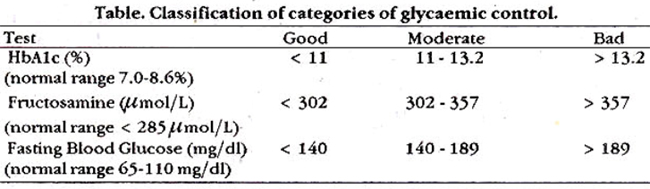
Results
Linear correlation analysis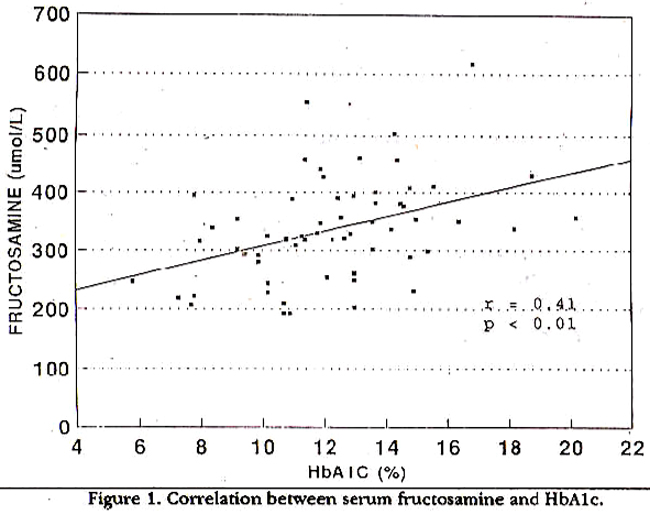
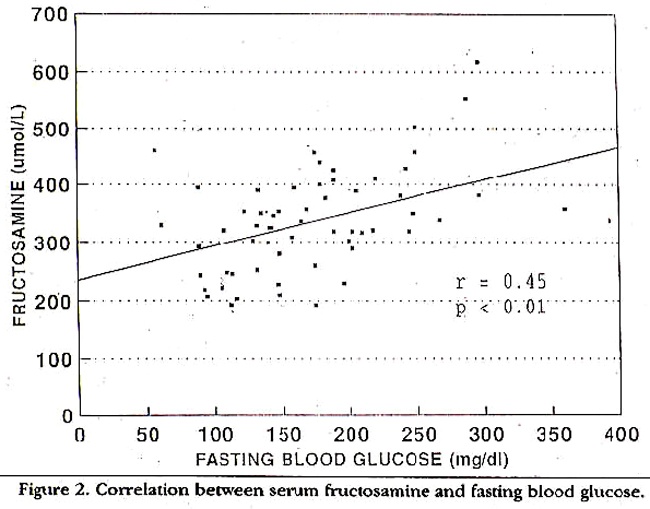
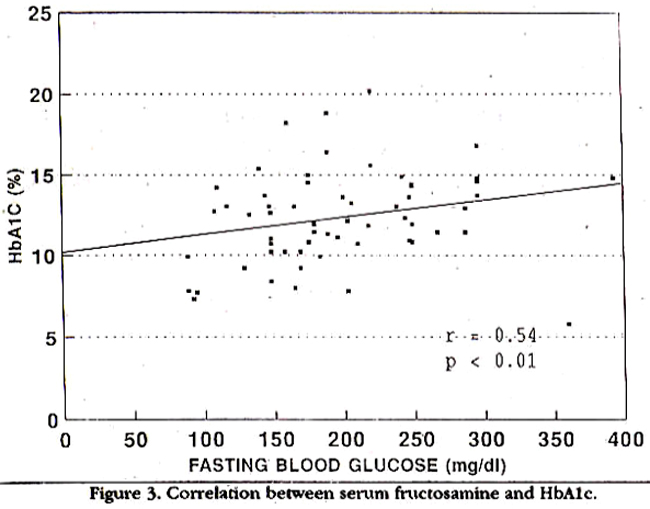
Figures 1,2 and 3 show the correlation between various measures of glycaemia (HbA1c fructosamine, FBG). The fructosamine level correlated well with HbAlc and was found to be highly significant (r= 0.41, p <0.01). Fructosamine also correlated closely with FBG (r= O.45,p <0.01). The correlation between HbA1c and FBGwas significant as well (r= 0.54, p c 0.01).
Comparison of control categories and discrepancies Severe discordance was defined as a patient with either good HbA1c, fructosamine or FBG, having one or both values of the other two glycaemic indices classified as bad, or vice versa. We had 7 such patients with major discrepancies. They fell into 3 groups. The first group had one patient with good HbA1c and FBG values but a very high fructosamine level of 395 umol/L. No obvious ‘reason was evident for this. The second group had 4 patients with good FBG but high fructosamine and HbA1c (relatively higher HbAlc as compared to fructosamine). This may be explained by a very recent effort to improve diabetic control, not long enough to affect fructosamine or HbA1c from previous bad control. The third group had 2 patients with good HbAlc but high fructosamine and FBG. This may be due to their recent deterioration of diabetic control.
Discussion
Measurement of HbA1c has become a standard test to assess glycaemic control in diabetic patients. Fructosamine assay is cheaper (one third of the cost of HbA1c at our hospital) and if reliable has the potential of replacing HbA1c. Our study has shown a correlation between fructosamine and HbA1c statistically significant. Similar good correlation has been described previously in other studies14-17. The major discrepancies detected in this study and the scatter pattern on the graph is due to the difference between HbAlc and fructosamine that they, in the periods of time, integrated glycaemia between HbAlc and fructosamine. Fructosamine reflects integrated glycaemia over 2 weeks and HbA1c over 6 weeks2,18. Cefalu et al19 have shown in their study that fructosamine level may be more effective than the HbAlc in detecting changes in glycaemic control over a shorter period of observation. In an uncontrolled diabetic patient where therapeutic alterations have been done to control the blood glucose, fructosamine level should be done to assess early improvement. Caution in interpretation of results should be exercised for both HbA1c and fructosamine in a population like ours where the incidence of haemoglobinopathies and severe hypoproteinaemia is relatively high. For fructosamine Baker et al9 have however shown that variability introduced by changes in albumin concentration may not be significant except for cases of severe hypo-albuminaemia with serum albumin below 30 gin/I. HbA1c may be erroneously elevated in patients suffering from conditions causing elevated haemoglobin F and carbamylated haemoglobin (in uraemia). Similarly a falsely low HbA1c may be reported in patient with hemolytic anaemia and hemoglobinopathies (haemoglobin S.C and D disease) 20. This study demonstrated that fructosamine levels correlated well with other indices of glycaemia. It is a relatively inexpensive and rapid to perform test and may be used as an alternative to HbA1c provided above mentioned cautions are considered. This study adds to the pool of few studies on fructosamine from the developing world especially from the Indian subcontinent where only two studies have so far been reported21,22.
References
1. Molnar, G.D., Marier, 0.3., Hunter, A.N. et al. Methods of assessing diabetic control Diabetologia, 1979;17:5-16.
2. Kennedy, AL. and Merimee, Ti. Olycosylated serum protein and hemoglobin A levels to meaaurecontrol of glycemia. Ann. intern. Med., 1981;95:56-58.
3. Jovanovic, L. and Petersen, C.M. The clinical utility of glycosylated haemoglnbin. Am.J.Med., 1981;70:331-38.
4. Dolhofer, R. and Wieland, OH. Glycosylation of serum albumin elevated glycosyl-albumin in diabetic patients. FEBS. L.ett, 1976;103:282-86.
5. Kennedy, L., Mebi, T.D., Riley, W.J. et al. Non-enzymatically glycosylated serum protein in diabetes mellitus: an indexofahort term glycaemia. Diabetologia, 1961;21:94-98
6. Jones, lit, Owens, D.R., Williams,S. et al. Glycosylated serum albumin: anintermediate indexofdiabeticcontrot Diabetes Care, 1983;6:501-3.
7. Mayer, T.K. and Freedman, Z.R. Protein glycosylation in diabetes mellitus: a review of laboratorymeaaurementa and of their clinical utility.Clin. chim. Acta., 1983;127:147-84.
8. Johnson, RN., Metcalf, PA. and Baker, JR. Fructosamine - a new approach to the estimation of serum glycoayl protein: an index of diabetic control. din. chim. Acts., 1982;127:87-95.
9. Baker, JR., O\\\'Connon, J.P., Metcalf, P.A et at clinical usefulnesa of estimation of aerum fructoaamine concentration as a screening test for diabetes mellitus. Br.Med.J., 1983;287:863-67.
10. Glucose reagent kit, Astra System, Instruction for uae, Galway, Ireland Beckman, 1966.
11. Glycated haemoglobin (HBA1c). Inatruction for use, St. Louis Missouri, USA, Sigma Diagnostic, 1991.
12. Armbruster, D.A. Fructosamine: structure, analyaia and clinical usefulness. Clin. Cbem., 1987;33:2153-63.
13. Schietcher, ED. and Vogt, B.W. Standardization of serum fructoaamine assays. Clin. Chem., 1990;36:136-39.
14. Lloyd, D.R., Mott, M. and Marples. J. Compsrison of serum fructosamine with glycosylated serum protein for the asaesament of diabetes control. Diabetic Med., 1985;2:474-78.
15. Hindle, E.J., Roshon, G.M. and GaIt, J.A The estimation of serum fructosamine. Concentration and alternative measurement to glycated haemoglobin. Ann. Clin. Biochem., 1985;22:84-89.
16. Lesley, MS., Alexander, F.H., Robert, J.Y. et at Comparison of fructoaamine with glycosylated hemoglobin and plasma protein as measures of glycaemia control Diabetes Care, 1988;11:433-36.
17. Gebhart, S.S., Wheaton, R.N., Mullins, R.E. et at A comparison of home glucoae monitoring with determination of HbA1C, total glycated haemoglobin, fructoasmine and random serum glucosein diabetic patients. Arch. intern. Med., 1991;151:1133-37.
18. Baker, JR., Johnson, RN. and Scott, Di. Serum fructosamine concentrations in patients with type II (non-insulin-dependent) diabetes mellitus during changes in management. Br.Med.J., 1964;288:1484-86.
19. Cefalu, W.T., Parker, T.B. and Johnson, CR. Validityof serum fructoaamine as indexof short term glycaemic control in diabetic out-patienta. Diabetes Care, 1988;11:662-64.
20. Francis, 5., Greenspan. Basicand clinical endocrinology 3rd ed. ALange Medical Book. Appleton and Lange. Prentice Hall International Inc., San Francisco, California, USA., 1991.
21. Goel, A, Bhatnagar, M.K. Milap, A. et al. Statua of fructoaamine in monitoring the control of diabetes mellitus.J. Aasoc. Physicians, India, 1991;39(9):708-10.
22. Das, B.S., Satpathy, S.K., Mohanty, S. et al. Influenceofaerum albumin and total protein on fructoaamine measurement. Indian J. Med. Res., 1992;96:60-64.
Journal of the Pakistan Medical Association has agreed to receive and publish manuscripts in accordance with the principles of the following committees:


