

Fariyal F. Fikree ( Department of Community Health Sciences, The Aga Khan University, Karachi. )
Mehtab S. Karim ( Department of Community Health Sciences, The Aga Khan University, Karachi. )
Farid Midhet ( Department of Community Health Sciences, The Aga Khan University, Karachi. )
Heinz W. Berendes ( Division of Epidemiology, Statistics and Prevention Research, National Institute of Child Health and Human Developments, National Institutes of Health, Bethesda, Maryland, U.S.A. )
October 1993, Volume 43, Issue 10
Original Article

Abstract
The Maternal and Infant Mortality Survey (MIMS) was conducted in eight squatter settlements of Karachi. The female mortality rate was 151.0 per 100,000 women aged 10-49 years and the maternal mortality ratio was 281 per 100,000 live births. The leading causes of deaths among women were complications of pregnancy (28.1%), infectious diseases (24.8%), cardiovascular diseases (20.7%), neoplasia (10.7%) and trauma (10.7%). Hemorrhage (47.1% of all maternal deaths), tuberculosis (40.0% of all infectious disease deaths), oropharyngeal cancer (23.1% of all neoplastic deaths), and burns (61.5% of all trauma deaths) were among the major causes identified. Maternal deaths were associated with young age and nulliparity (p-value <0.01), and a higher proportion occurred in the hospital or on the way to the hospital as compared to non-maternal deaths (JPMA 43:2081993).
Introduction
Cause and sex specific differences in adult mortality rates have been widely studied in the developed world where deaths due to cancer and cardiovascular diseases predominate and overall female mortality rates are lower than male mortality rates1. Inspite of excellent vital registration systems in developed countries, underestimation of deaths, particularly maternal deaths, has been reported2. In much of the developing world, vital registration systems are either inadequate or non-existent. Consequently, population-based information on the numbers and causes of death are not available and. require specially designed surveys of households, including verbal autopsy information on cause of death obtained through such surveys. There is also a paucity of research data from population-based studies on female reproductive age mortality and its causes in developing countries. Studies conducted in selected areas in Bangladesh, Egypt, Indonesia and Ethiopia provide estimates of the levels and causes of adult female mortality and of selected sociodemographic factors3-6. Adult female mortality (10-49 years) in certain developing countries, such as India and Bangladesh, is generally higher than adult male mortality, principally due to the high rate of maternal deaths3,7. It has been shown in rural Bangladesh that in the absence of maternal deaths, the adult female death rates closely parallel male mortality rates3. Complications of pregnancy, childbirth and the puerperium, infectious diseases such as tuberculosis, hepatitis, diarrhoea, and trauma are the main causes of reproductive age deaths reported in studies conducted in India, Bangladesh, Egypt and Indonesia4,5,7. This is comparable to reports about the prevalence of specific causes of deaths reported from developed countries some 50 years ago8,9. In Pakistan, community based studies on causes of female mortality have not been conducted and available reports are derived from hospital based studies10,11. Such data are highly selective and not representative. For example, in a study conducted in a large public hospital in Karachi, the maternal mortality ratio was 2,740 per 100,000 births, with haemorrhage and sepsis accounting for approximately 40 percent of all maternal deaths11. This paper presents population-based information about the levels and causes of adult female mortality in low socioeconomic squatter settlements of Karachi Pakistan using data gathered from the Maternal and Infant Mortality Survey (MIMS). This is part of a larger study which examines the prevalence of female mortality, its causes and risk factors in selected sites in Balochistan, North West Frontier Province, Sindh and Punjab.
Materials And Methods
During August-September, 1989 a survey was conducted in 10,135 households which were located in eight low socioeconomic squatter settlements of Karachi, Pakistan. A total of six field teams, consisting of five female interviewers and one male field supervisor per team, conducted the survey. Information was obtained on the composition of households and characteristics of its members, in and out migration, socioeconomic and demographic factors, and pregnancy histories for the period of five years prior to the interview for each ever-married woman. Additionally, each household was questioned about death of household members in the five years preceding the survey. For each death reported, the age and sex of the deceased was obtained. After completion of the survey, households reporting deaths of women aged 15-49 years at time of death were revisited to obtain a detailed verbal autopsy. The verbal autopsy questionnaire was designed to identify pregnancy related deaths and to establish a presumptive cause of death. The verbal autopsy interview, which was conducted by female doctors, was administered where possible to female relatives of the deceased woman. The questionnaire contained a detailed description of the symptoms and signs related to the major causes of deaths associated with pregnancy and questions on health care utilization prior to death. Demographic information such as age, education, occupation and pregnancy history for the deceased woman and her spouse were also obtained. Specific questions on pregnancy status at time of death, number of previous pregnancies, live births and currently living children were included. Three leading obstetricians of Karachi independently reviewed the information collected through verbal autopsy questionnaires to assign the most probable cause of death. Disagreements in causes of death classification were resolved at a meeting of the obstetricians. Verbal autopsy is an accepted method for assigning the probable cause of death in the absence of clinical and laboratory data, or access to hospitals or physicians’ records.
Results
A total of 121 women aged 15-49 died in these eight low socioeconomic squatter settlements. The overall adult female mortality rate in the sites surveyed was 151.0 per 100,000 women aged 10-49 years and the male mortality rate 146.9 per 100,000 men during the five years covered by the survey (1984-1989). The maternal mortality rate was 38.9 per 100,000 women and the non-maternal mortality rate was 112.1 per 100,000 women, which was considerably lower than the male mortality rate. The maternal mortality ratio was 281 per 100,000 livebirths. Probable causes of death and selected risk factors are presented for these women.
Cause of death
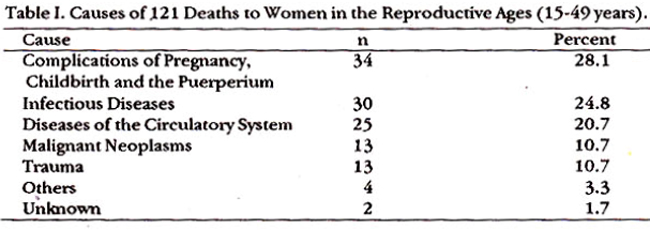
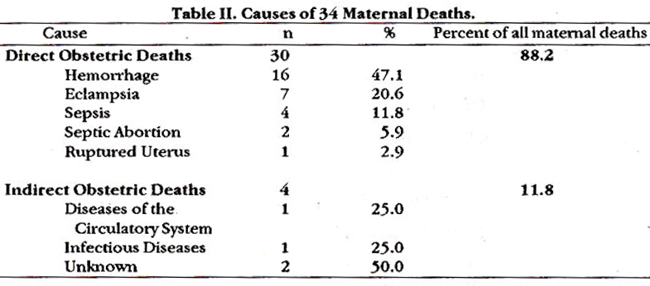
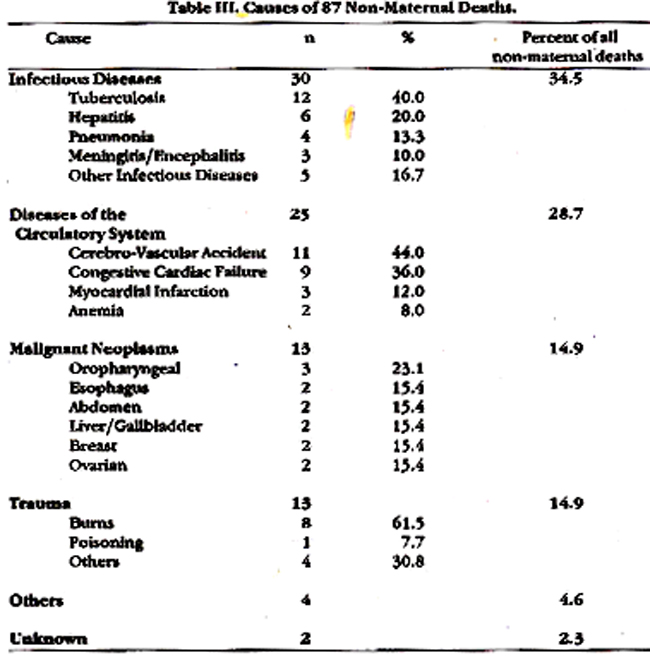
Tables I, II and III provide descriptive information on the cause-specific proportional mortality for 121 deaths, categorized as 34 maternal and 87 non-maternal deaths (including five “accidental” deaths). The leading causes of death were related to complications of pregnancy, childbirth and puerperium which accounted for 34 deaths or 28.1 percent of all deaths (Table I). Maternal deaths, as defined by the World Health Organization, include all deaths occurring during pregnancy or with in forty days after termination of pregnancy which are directly or indirectly attributable to complications of pregnancy or childbirth. Deaths of pregnant women occurring accidentally, such as injuries resulting from a fall or car accident, are classified as “accidental”, and are not included as maternal deaths. Direct obstetric deaths contributed nearly 88 percent of maternal deaths, with haemorrhage (47.1 percent) and eclampsia (20.6 percent) representing the main causes (Table II). Puerperal sepsis was reported in four and septic abortion in two cases (Table II). Four indirect obstetric deaths were identified: one due to the circulatory system (a consequence of valvular heart disease), one to infectious disease (tuberculosis), and no “probable” cause could be identified to the remaining two. Among all female deaths, the second largest categorywas infectious diseases (24.8 percent), followed by diseases of the circulatory system (20.7 peccent). There were 13 deaths (10.7 percent) due to malignant neoplasms and 13 deaths due to trauma (intentional and unintentional) (Table I). The distribution of cause-specific non-maternal deaths is shown in Table III. For infectious diseases, respiratory infections were the predominant cause of death with tuberculosis and pneumonia reported in 40 and 13 percent of cases respectively. There were no deaths due to acute or Chronic diarrhoea. Hepatitis represented 20 percent of infectious disease deaths. The major causes of death attributed to the circulatory system were cerebro-vascular accident (44.0 percent) and congestive cardiac failure (36.0 percent) followed by deaths due to myocardial infarction which accounted for 12 percent. Nearly 15 percent of all non-maternal deaths were due to malignant neoplasms, with the gastrointestinal tract, specifically the oropharyngeal region, being the most common site. Eight women died of burns, largely attributable to accidents associated with kerosene stoves. Infonnation obtained for the 13 trauma cases suggested that five of these (cause of death: head injury - 2 and burn - 3) occurredin currently pregnant women. Detailed inquiry from informed sources suggested that trauma was most probably “inflicted” in one burn and both the head injury cases. The question of including these three cases in the category of indirect obstetric deaths rather than accidental deaths is debatable. We propose that they be included as indirect obstetric deaths as it is probable that the provocation for the “trauma” was their gravid status. We suggest that the category of "accidental" deaths be limited to those cases where no evidence of inflicted “trauma” can be implied. We were interested in examining selected socioeconomic and demographic risk factors for maternal and non-maternal mortality (Table IV)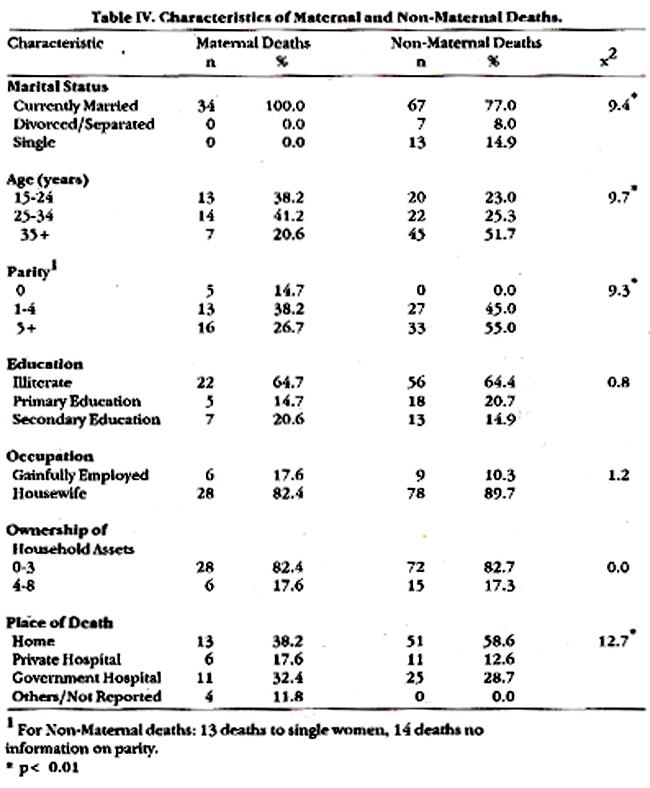
Socioeconomic factors such as maternal education, maternal employment status and ownership of household assets showed minimal variation between maternal and non-maternal deaths A significant difference in place of death was reported for maternal and non-maternal deaths (p-value <0.01): a higher proportion of maternal deaths occurred outside the home (in hospitals or on the way to hospitals) than non-maternal deaths. This may reflect the acute and emergency nature of the events leading to maternal deaths and attempts to get such women into hospitals rather than economic or accessibility issues. Maternal age and parity were significantly associated with adult female mortality (p-value <0.01). Nuffiparous, young women not surprisingly were at greatest risk of maternal death. The largest proportion of non-maternal deaths were to older, multiparous women (aged 35 and over; parity 5÷). No non-maternal deaths were reported to nulliparous women.
Discussion
Higher female than male mortality rates have been reported from studies conducted in rural Bangladesh, and it is estimated that female death rates would be substantially reduced after removal of deaths due to direct obstetric causes3,4,12. The current study found a 2.8 percent excess of female over male deaths. Since 28.1 percent of all female deaths were due to obstetric causes, removal of these causes resulted in a considerable reduction of adult female mortality. After removal of obstetric deaths, the adult female mortality was 23.7 percent lower than the male death rate, which is consistent with reports from developed countries where preventable obstetric causes of death have been largely eliminated. It is important to determine “probable” causes of death among women in the reproductive ages in Pakistan in order to determine public health priorities and to evaluate the possible impact of health intervention strategies on maternal, infectious and neoplastic disease mortality. Maternal and infectious diseases were the two leading causes of death identified. Patterns of cause specific mortality were consistent with population-based studies conducted in Indonesia and Bangladesh4,13. Fortney et al13 reported that deaths due to infectious diseases (22.0 percent) and complications of pregnancy, childbirth and puerperium (23.0 percent) were the two leading causes of deaths among women aged 15-49 years, with younger women dying largely from acute maternal conditions or accidents. Similar figures were reported from a poor rural area in Bangladesh4. The predominant cause among infectious disease deaths was diarrhoea in rural Bangladesh4 whereas in our study, tuberculosis was predominant, as was reported from Indonesia13. In Egypt, diseases of the circulatory system (28.1 percent) were the leading causes of death followed by maternal deaths (22.8 percent) 13. Fortney et al13 suggest that better access to medical care in Egypt affected the relative ranking of cause-specific death categories. In our urban study setting, despite geographic proximity to health care facilities, factors such as poverty, low social status of women, lack of antenatal care and mostly home deliveries attended by traditional birth attendants combine to produce high maternal death rates, 23.2 percent higher than that reported for Menoufia, Egypt13. There were three trauma deaths among pregnant women. If these are included as indirect maternal deaths, it raises the maternal mortality rate to 42.3 per 100,000 women aged 10-49 years and the maternal mortality ratio to 306 per 100,000 live births. The circumstances surrounding these three cases suggest that pregnancy may precipitate a precarious marital relationship and be the ultimate factor in a sequence of events leading to fatal physical abuse. Oropharyngeal cancer is the most common neoplasm in Pakistan and other parts of Asia14,15. It has been suggested that chewing of tobacco and “pan” are the predominant contributing causes14,15. In our study, among all cancer deaths, the proportion of oropharyngeal cancers was 23.1 percent, similar to that reported for all malignancies recorded in the Department of Radiotherapy in a large public hospital in urban Karachi16. The mortality rates reported in this study are probably minimum estimates. The retrospective study design with recall of deaths in the past five years would lead to under enumeration of deaths due to omissions, especially if female deaths result in the breakup of household units. The cause specific data given in this study should be regarded as tentative, based upon verbal autopsy information which was used in assigning “probable” cause of death rather than the more conventional clinical and laboratory data or autopsy findings. Verbal autopsy techniques to elicit probable cause of death are based on the assumption that the more common causes of maternal deaths have a unique pattern of symptoms and signs that can be reasonable, recalled and reported by third party respondents (female relatives of the deceased). In the absence of avital registration system to provide estimates of adult cause specific mortality for Pakistan, these data provide an estimate of the magnitude of the specific cause of death as a proportion of all deaths to women in the reproductive ages. This will enable health planners to decide on priorities and allocation of resources for health intervention strategies targeted to women.
Public Health Implications
Overall, about 53 percent of female deaths were due to maternal causes and infectious diseases for which preventable strategies are known and have been successfully implemented in developed countries. Specifically, for maternal deaths widespread use of antenatal care, training and supervision of traditional birth attendants, adequate and effective referral systems for high risk pregnancies, and greater availability and acceptance of family planning, especially among high risk women, would prevent many deaths. For infectious diseases, immunization and antibiotic therapy is available for tuberculosis. As reported in the verbal autopsy interviews, there was awareness of the type and availability of anti-tuberculosis drug therapy, as illustrated by reported visits to the anti-tuberculosis units set up by the Pakistan government. However, the high cost of prolonged treatment was detrimental and many discontinued treatment prematurely. Public health officials need to establish mechanisms for successful completion of drug regimens by making these drugs easily and cheaply available to those in need. The sustained high prevalence of deaths due to oropharyngeal cancers should be brought to the attention of public health officials. Additionally, we suggest a public education effort to make people aware of the seriousness of chewing tobacco and “pan”, and of early symptoms and signs of oropharyngeal cancer. Burns, a potentially preventible cause of death, is an important public health problem in Karachi as it ist other parts of the developing world, especially in those countries where use of kerosene stoves is prevalent17-19. In our study, about 61 percent of trauma deaths were due to burns, though for all non-maternal deaths this was only 9.2 percent. Reports from Egypt described a similar distribution: 58.2 percent of trauma deaths were burn victims, though this comprised only 8 percent of the overall distribution of deaths20. The eight cases of burns were reported to result from use of kerosene stoves. Public health programmes educating women on safer techniques in using kerosene stoves will have a significant public health impact. In summary, the necessity for dedicated effort by government and private organizations to reduce the excessive loss of life among women, especially young nulliparous women, dying from potentially preventible causes of death, needs to be urgently addressed. Development and implementation of low cost, effective health intervention strategies, including health education messages, should be a priority and challenge for the present democratic government.
Acknowledgements
We are deeply indebted to Dr Ronald Gray for his invaluable contribution to this manuscript. We appreciate and acknowledge members of the MIMS team: Drs John Bryant and Jose Villar, Wifflam Calvert, Saad bin Khalid, Iqbal Azam and field personnel for their valuable support and contribution to the study. We are deeply indebted to Drs Sadiqua Jafarey, Faridon Setna and Javed Rizvi for reviewing the verbal autopsy questionnaires. We thank Drs L. Hasan ali and F. Rabbani for assisting in conducting the verbal autopsy interviews. This investigation received financial support from the UNDP/World Bank/WHO Special Programme for Research and Training in Tropical Diseases. We also gratefully acknowledge help from Hewlett Foundation and NICHD/NIH. Support for this study was provided by research grant SFCP 08-024-N.
References
1. Hakulinen, T., Hansluwka, H., Lopez, AD. et al. Global and regienal mortality patterns by cause of death in 1980. Int.J. EpidemioL, 1986;15:226-33.
2. Rochat, LW., Koonin, LM., Atrash, ELK. etal. Maternal mortalityin the UnitedStates: report from the Maternal Mortality Collaborative. Obstet. Gynecol., 1988;72:91-97.
3. chen, LC., Geache, M.C,Ahmed, S. etal. Maternal mortalityin rural Bangladesh.Stud. Pam. Plann., 1974;5:334-41.
4. Fauveau,V.,Wojtyniak, B., Koenig. MA. etat Epidemiology and eauseofdeathsamong women in rural Bangladesh. Intl. Epidemiol., 1989;18:139-45.
5. Fortney, J.A., Susanti, I., Gadalla, S. et at Reproductive mortality in two developing countries. Am.J. Public Health, 1986;76:134-3&
6. Kwast, B.E., Rochat, LW. and Kidane-Mariam, W. Maternal mortality in AddisAbaba, Ethiopia. Stud. Fam. Plann., 1986;17:288-301.
7. Murray, C.J.L., Yang. G. and Qiao, X. Adult mortality: levela, patterns and causes. In: The health of adults in developing world. Eds. R.C.A. Feachem, T. Kjellstrom, C.J.L., Murray, M. Over and M.A. Phillips. Oxford University Press, New York, 1992, pp. 23-lit
8. Rosenfield, A and Maine, D. Maternal mortality- a neglected tragedy/where is the M in MCH? Lances, 1985;2:83-85.
9. Loudon, L Maternal mortality: 1880-1950. Some regional and international comparisons. Soc. Soc. Hiss. Med. Bull., 1988;1:183-228.
10. Jafarey, SN. Determinants of maternal mortality. In: Women in health and development Report of the International Seminar at the Aga Khan University, 14th and 15th November, 1990. Eds. ICY. Qureshi and AF. Qureshi. UNICEF, Karachi, 1990, pp. 28-32.
11. Ahmad, Z. Maternal mortality in an obstetric unit J.Pak.Med.Assoc., 1985;35:243-48.
12. D\\\'Souza, Sand Chen, L.C.Sex differentialsin mortalityin rural Bangladesh. Popul. Dev. Rev., 1980;6:257-70.
13. Fortney, J.A., Gadalla, S., Saleh, S. et al. Causes of death to women of reproductive age in twodevelopingcountries. Population Res. Policy It, 1987;6:137-4&
14. Thidi, S.H.M. and Jafarey, NA. Cancer problem in Pakistan with special reference to oropharyngeal carcinoma. J.Pak.Med. Assoc., 1966;16:44-52.
15. Pindborg, J.J., Kiaer, J., Gupta, P.C. and Chawla, T.N. Studies on oral leukoplakia. Bull. WHO., 1967;37:109-116.
16. Zaidi, S.H.M., Jafarey, NA. and All, S.A. Cancer trends in Karachi. J.Pak. Med. Asaoc., 1974;24:87-93.
17. Smith, OS. and Baraa, P. Unintentional injuries in developing countries: the epidemiology of a neglected problem. Epidemiol., Rev., 1991;13:228-66.
18. Saleh, S., Gadalla, S., Fortney, J.A. et at Accidental burn deaths to Egyptian women of reproductive age. Burns, 1986;12:241- 45.
19. Jha, S.S. Burns mortality in Bombay. Burns, 1982;8:118-122.
20. Gsdslla, S., Saleb, S., Fortney, J.A. and Rogers, S.M. Preventabilityof deaths to married women of reproductive age in Menoulia, Egypt. Population Sciences, 1987; 7:71-84.
Journal of the Pakistan Medical Association has agreed to receive and publish manuscripts in accordance with the principles of the following committees:


