

Bilal Jamal ( The Kidney Centre, Karachi. )
S.A.J. Naqvi ( Jinnah Postgraduate Medical Centre, Karachi. )
Rizwan Hussain ( The Kidney Centre, Karachi. )
July 1994, Volume 44, Issue 7
Case Reports

As the number of patients on maintenance hemodialysis in our country is increasing, long term complications of hemodialysis are emerging. Dialysis ascites, a serious sign of failure of dialysis regimen, having a poor pregnosis, has a mean survival time of seven months1,2. A case of dialysis ascites, managed by reinfusion of unmodified ascitic fluid is being reported.
Case Report
A 57 years old housewife with end stage renal disease (ESRD) secondary to diabetes mellitus and hypertension, was started on maintenance hemodialysis in March, 1992. On admission in August, 1992, she weighed 58.8 kg, had hypertension and signs of fluid overload. With hemodialysis she was stabilized at a dry weight of 48 kgs. As she was not disciplined regarding her diet and fluid intake, therefore, inter-dialysis weight gain was 3-3.5 kgs which at times was 4 kgs. In April, 1993 she developed ascites which gradually increased leading to painful and disabling abdominal distention. There was no sacral or pedal oedema and there were no signs of fluid overload. Her liver function tests were normal, serum albumin was 3.2 gm/dl. Abdominal ultrasonography was normal except large amount of free fluid in the abdomen. Chest x-ray showed cardiomegaly, echocardiography revcaled an ejection fraction of 54%, mild secondary mitral regurgitation, normal pericardium and no pericardial effusion. Ascitic fluid analysis revealed a protein concentration 2.8 gm/dl, total cell count 20/cumm, all were lymphocytes, Gram’s and ZN staining showed no micro-organism, the cultures were sterile and there were no malignant cells. She was labelled as a case of dialysis ascites. Intensive ultrafiltration was attempted but was futile. From September, 1993 she was not tolerating dialysis and frequently developed hypotension necessitating saline infusion. In December 1993 reinfusion of unmodified ascitic fluid was started. The patient was called a day prior to scheduled dialysis. Ascitic fluid was collected and stored under strict aseptic conditions. During dialysis ascitic fluid was reinfused and ultrafiltration adjusted considering the volume of fluid refused. Six sessions were performed and 13.2 litres of ascitic fluid was refused. The weight of the patient decreased from 51.8 to 38 kgs, with marked reduction in ascitic fluid. The patient remained normotensive throughout dialysis and ultrafiltration targets were achieved. Her serum albumin increased from 3.2 gm/dl to 4.4 gm/dl (Figure 1).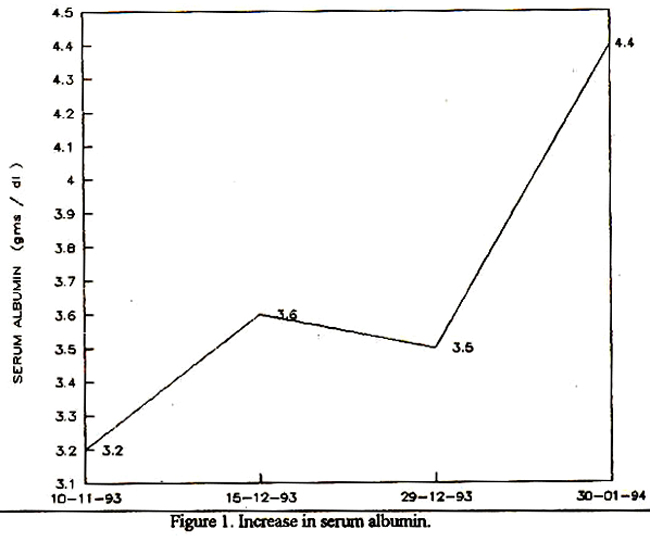
Her predialysis serum creatinine which was around 7.5 mg/dl decreased to 6.1 mg/dl (Figure 2).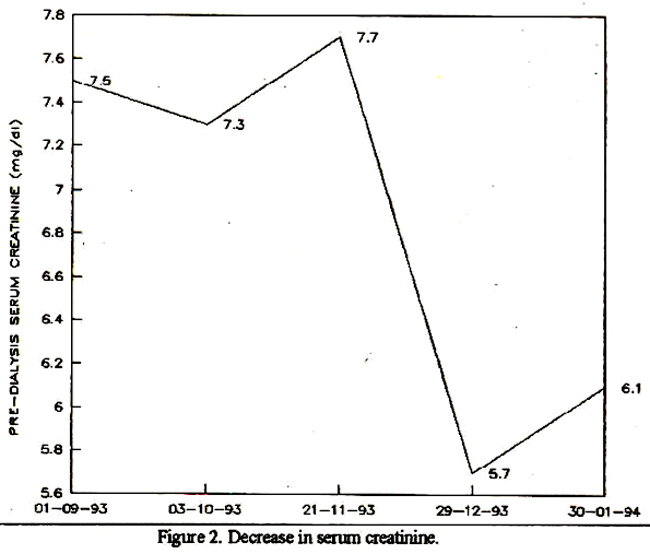
Discussion
Dialysis ascites was described in 19703, as a complication of long term maintenance hemodialysis. It is a diagnosis of exclusion4. The exact cause of ascites is not known, high fluid intake leading to long term and marked over-hydration and peritoneal irritation from uremic inflammation are thought to be the causes4. Past history of peritoneal dialysis is considered to have an etiological relationship with the development of ascites, however, this is not accepted by others5. The present case was never dialysed peritoneally. Time interval between initiation of hemodialysis and development of ascites is variable5. It was thirteen months in this case. Intensive ultrafiltration during bicarbonate dialysis4, intravenous administration of albumin2, strict salt and water restriction, renal transplantation2, binephrectomy, intravenous administration of ascitic fluid during hemodialysis5,6 intraperitoneal administration of non-absorbable steroids8, peritoneovenous shunting9 and resort to peritoneal dialysis have been described as therapeutic modalities. Reinfusion of unmodified ascitic fluid was chosen because of ease and economy. With six sessions of reinfusion there was a dramatic reduction in weight of the patient and the patient who was bedridden and in great discomfort was up and about after this therapeutic procedure. Ultrafiltration targets were achieved easily during and after the procedure. For the last two months there are no episodes of hypotension during dialysis, she is stable at a dry weight of 38 kgs. The decrease in her predialysis serum creatinine indicates better clearance during dialysis. No complication like febrile reaction, peritonitis, bacteremia or bleeding episodes were observed. If done meticulously, reinfusion of unmodified ascitic fluid during hemodialysis session in dialysis ascites is a safe, simple and effective procedure, whichbreaksthevicious cycle of ascites formation and produces long term relief.
Acknowledgements
We thank Dr. Saeed Hassan, Dr. A. S. soomro, Mr. Mohiuddin Masoom, Mr. Mohammad Javaid and the entire staff of dialysis clinic, The Kidney Centre, for their cooperation.
References
1. Runyon, BA. Care of patients with ascitea. N.Engl.J.Med., 1994;330:337-42.
2. Schrier, R.W. and Gottechalk, C.W. Diseaaea of the kidney. Boston, Little Brown and Company, 1988, p.3337.
3. Arismendi, G.S., Izard, M.W., Hampton, W.R. eta!. The clinical spectrum of aacitea associated with maintenance dialyaia. AmJ.Med., 1976 ;60:46-51.
4. Daugridaa, J.T. and Ing, T.S. Handbook of dialysis. Boston, Little Brown and Company, 1988, p.629.
5. Gotloid, L. and Servadio, C. Ascites in patients undergoing maintenance hemodialysit - report of six chses and phyaiopathologic approach. Am.J.Med., 1976;61 :465 70.
6. Nicholls, Al., Platts, M.M and Triger, D.R. Regular reinfusion of ascites during hemodialysis in a patient with amyloidosia. Br.Med.J., 1983;287:726.
7. Okads, K., Takahashi, S., Higuchi, T. et a!. Long term effect of intravenous reinfusion ofunmodifled sutogenous peritoneal fluid combinedwith hemodialysis in a patient with dialysis ascitea (letter). Nephron., 1993;65:474-75.
8. Pascual, J.F., Melendez, M.T. and Rivera-Viera, iF. Local steroid therapy of refractory aacites asaocisted with dialysis. J.pediatr., 1979;94:319-20.
9. Leveen, H.H., Wapnick, S., Grosberg, S. eta!. Further experience with peritoneo-venoua ahunt for aacites. Ann.Surg., 1976;184:574-81.
Journal of the Pakistan Medical Association has agreed to receive and publish manuscripts in accordance with the principles of the following committees:


