

Melvyn A. Lobo ( Department of Community Health Sciences, Aga Khan University, Karachi. )
Asma Fozia Qureshi ( Department of Community Health Sciences, Aga Khan University, Karachi. )
January 1994, Volume 44, Issue 1
Epidemiology and Biostatistics in Research

As described earlier in this series, research is based on Scientific Methodology which consists of a series of steps:
1. Statement of the problem
2. Formulation of hypothesis
3. Hypothesis testing: selecting the study design
4. Data interpretation and presentation
5. Utilization of results
What am I trying to find out?
Stating the problem or the purpose/objective of the study is the first step in research. The major research question determines the hypothesis which in turn helps choose the study design needed to verify the hypothesis. Problem statements are issues that you are interested in - questions arising from observations, ideas or problems that need answers, a gap in knowledge that needs to be filled.
What do I expect will happen?
A hypothesis is a theory, an expectation of what will happen, or an expected relationship between two or more variables that can be tested by further investigation. The hypothesis needs to: (i) meet the purpose of the study, (ii) be defined as precisely as possible as it both directs and guides research, determining the study design and (iii) be expressed in measurable terms.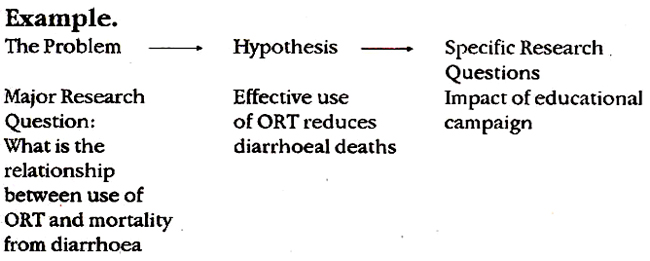
What type of study design should I choose?
The choice of study design depends not only on the purpose of the study, its objectives and hypothesis but also on manpbwer, money and time, the expertise available and the quality of existing records. In order to be able to choose a type of study to be conducted, you need to be familiar with the different study design.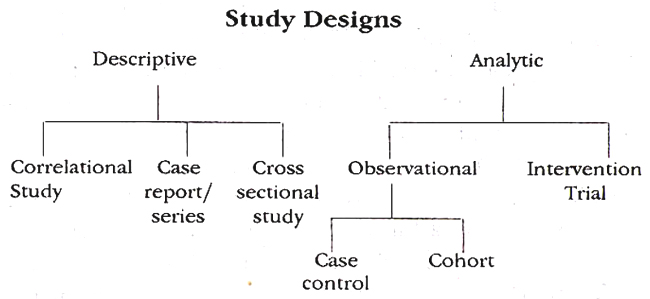
Study Designs
There are two types of study designs - descriptive studies and analytic studies.
Descriptive studies
Characterize disease patterns (in relation to person, place and time) and generate testable research hypotheses. They cannot test epidemiologic hypotheses. Descriptive data provide a first step in elucidating the causes of disease by identifying groups and factors likely to account for differences in disease rates. Descriptive studies are generally inexpensive and easy to conduct. Data can be collected from accessible sources - vital statistics records, hospital/clinic records, etc., or through surveys.
Types of descriptive studies:
There are 3 main types:
1. Correlational studies -- describe disease in relation to a factor of interest (age, time, health service utilization) and may be the first step in determining an exposure-disease relationship. For example, comparison of incidence trends of lung cancer over a period of time with those of cigarette sales, led researchers to speculate that cigarette smoking could be a risk factor for this disease. Since correlational studies examine characteristics of entire populations, they are unable to link exposure with disease in individuals and to control for the effects of potential confounders.
2. Case Reports and Case Series describe the experience of a single patient (case report) or group of patients with a similar diagnosis (case series). AIDS, for example; was first identified by studying cases of pneumOnia caused by the rare organism pneumocystis carinii. Limited inference can be made from these studies as they either deal with an individual case/group of cases and also suffer from a lack of an appropriate comparison group.
3. Cross-sectional surveys assess exposure and disease status simultaneously, providing a ‘snapshot of the health experience of a population or cohort at a specified period or point in time.
Due to simultaneous assessment of exposure and disease status, it is not possible to determine causality. Furthermore, as these surveys consider total burden of disease (prevalence) rather than new cases (incidence), data obtained reflect determinants of survival and etiology. For example, prevalence data from the Framingharn study (T.R. Dawber et al) showed that frequency of coronary heart disease (CHD) was equal in males and females in early adulthood. Examination of incidence data, however, showed that males in this sge group were at far greater risk of CHD compared to women; males experienced a higher mortality and therefore, were not alive to be represented in prevalence data.
Analytic Studies
Hypotheses are accepted or rejected through analytic studies. In turn, results of analytic studies generate ideas for additional descriptive studies as well as new hypotheses. The 2 main categories of analytic studies are (i) observational studies and (ii) intervention trials.
i. Observational Studies: In this more usual approach, the investigator observes disease occurrence in people already segregated into groups on the basis of some experience or exposure. For example, you Ean compare patients with lung cancer to non-cases (controls) with respect to a history of smoking Another example could be the higher incidence of low birth weight babies born to malnourished mothers compared to normally nourished mothers.
There are 2 main types of observational studies: (i) Case-control studies, (ii) Cohort studies.
ii. Intervention (clinical) trials determine the impact of some &ctor that is under the control of the rtsearcher. These studies can establish a causal association between a factor and a disease more conclusively than observationalstudies. Forexample,youcouldstudythe efficacy of a particular drug for treating a disease compared to a placebo or another drug. Having stated the problem, formulated the hypothesis and specific research questions you can choose an appropriate study design. The next step is to describe in detail the research design.
References
1. Hennekens, C.H. and Buring, J.E, Edited byS.L Myrent. Epidemiology in medicine. 1st Ed. Little Brown and Company, Boston, 1987.
2. Mausner, J.S. and Kramer, 5. Epidemiology - an introductory tea. 2nd Ed. W.B. Saunders Company, Philadelphia, 1985.
3. Dawber, T.R., Kanne, W.B. and Lyell, LP. An approach to longitudinal studies in a community: the Framingham study.Ann. N.Y.Acad. 5ci., 1963;107:593.
4. Dawber, T.R., Meadors, G.F. and Moore, RE Epidemiological approaches to heart disease: tbeFramingham study.Am.3. Public Health, 1951;41:279-86.
Related Articles
Journal of the Pakistan Medical Association has agreed to receive and publish manuscripts in accordance with the principles of the following committees:


