

Jafar Pasand Masoumi ( Department of Bacteriology, College of Community Medicine, Microbiology Section, Zoology Department, Punjab University, Lahore. )
Mohammad Saeed Anwar ( Department of Pathology, Postgraduate Medical Institute, Lahore. )
Shamim Raza Bokhari ( Institute of Health Management, Lahore. )
October 1995, Volume 45, Issue 10
Original Article

Results
There were 1964 diarrheal episodes of which 1206 (61.4%) yielded single (Table I), 47 (2.4%) multipleenteric pathogens (Table II, III) while 711 (36.2%) samples gave a negative result.
Clinical features of diarrhea caused by single pathogens
Fever was commonly associated with the infantile diarrhea caused by Yersinia enterocolitica (61.5%) and rotavirus (26.1%). Vomiting was more frequent with V. Cholerae (81.8%) and Shigellosis (64.6%). Dehydration was mostly observed in Vibrio cholerae (90.9%) and salmonella (84.9%) infections while watery stools were more often seen in Vibro cholerae (90.9%) and rotavirus infection (43%) as compared to other enteric pathogens (Table I).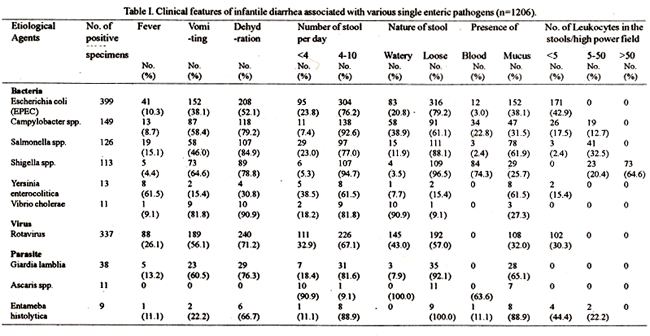
Bloody diarrhea (dysentery) was mostly associated with shigella (74.3%) and Campylobacter (22.8%) infection. As regards presence of leukocytes per high powerfield, more than 50 leukocytes/HPF were found in Shigellosis (64.6%), however, less number of leukocytes (5-50/HPF) were seen in diarrhe associated with Salmonella (32.5%), Entamoeba histolytica (22.2%). Shigella (20.4%) and campylobacter (12.7%) infections(Table I). Statistical analysis between organisms causing invasive and non-invasive infection revealed that infections with invasive organisms lead to vomiting (P<0.05), 4-10 stools per day (P<0.01) and dehydration-invasive organism. Similarly significantly higher number of stool samples in infections with invasive organisms showed presence of blood (p<0.001) and more than 5 leukocytes/HPF in the stools (P<0.001) as compared to non-invasive organisms.
Clinical features of diarrhea associated with multiple pathogens
Many cases of diarrhea harboured multiple pathogens. For example, out of 12 cases positive for Campylobacter, 9 also had EPEC and 3 Salmonella (Table II).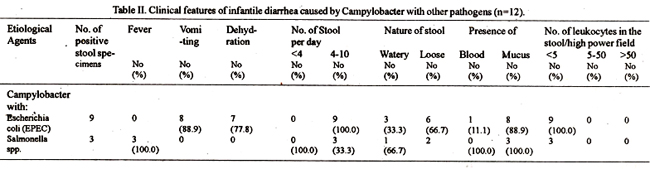
Similarly, 35 cases positive for rotavirus were also infected with Giardia (12’ cases), Shigella (2 cases), EPEC (13 cases), Salmonella (4 cases) and Shigella+EPEC (4 cases) (Table III). The results showed that predominant clinical features in cases of CampyIobacter+EPEC were vomiting (88.9%), dehydration (77.8%) and 4-10 stools per day (100%). Fever was more common in diarrhea due to rotavirus+Shigella+EPEC (50%) and rotavirus+Giardia (4 1.7%) infection. Diarrhea! cases due to rotavirus+Giadia, rotavirus+Shigella and rotavirus + Shigella + EPEC mostly had vomiting and dehydration. The results also showed that in general, diarrhea due to rotávirus with any one of Giardia, EPEC, Salmonella or due to Shigella + EPEC was associated’ with 4-10 stools per day and presence of mucus (Table III).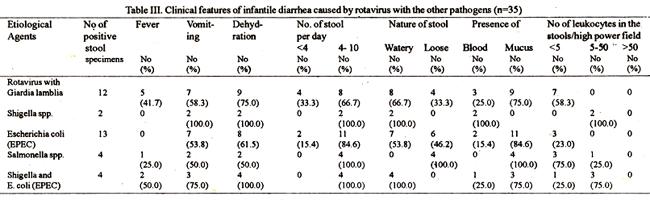
Abstract
Clinical features of infantile diarrhea were studied among 603 infants from birth to 12 months of age to determine the predominant clinical feature(s) seen in infantile diarrhea associated with a specific enteric pathogen. Among the major clinical features, fever was most often seen in diarrhea due to Yersinia spp. (61.5%) followed by that in rotavirus (26.1%). Vomiting was mostly associated with Vibno cholerae infection (90.9%) and sItigellosis (64.6%). Dehydration was predominant in Vibrio cholerae (90.9%) and Salmonella (84.9%) infections. Bloody diarrhea was mostly due to Shigella infection (74.3%): As regards diarrhea with multiple pathogens, vomiting and dehydration were most frequent with Campylobacter+Enteropathogenic Escherichia coli (EPEC) (88.9% and 77.8%, respectively), while fever was more common with rotavirus+Shigella+Escherichia coil and rotavirus+Giardia. Infection with invasive organisms lead to vomiting, 4-10 stools per day and dehydration significantly more often as compared to infections with non-invasive organisms. Similarly more stools of patients infected with invasive organisms showed presence of blood and more than 5 leukocytes/HPF as compared to those infected with non-invasive organisms (JPMA 45:266,1995).
Introduction
Diarrheal disease is a major public health problem in most developing countries, especially in children1,2. As regards diagnosis of different etiological agents of diarrhea, it can be established by using various standard laboratory techniques such as staining cultural characteristics, biochemical and serological tests3,4,4 But these tests remain out of reach forpediatricians inpractice. At the same time most of the clinical laboratories are not well equipped in this respect. Thus, pediatricians often treat the children on the basis of symptoms alone. The purpose of present study was to correlate the clinical features of infantile diarrhea withvanous kinds of entempathogens (single or multiple).
Subjects and Methods
The study population comprised of 618 infants born between October, 1987 - February, 1993 in low socio-economic areas of Lahore, Pakistan. The infants were registered soon after birth through Maternal and Child Health Center of College of Community Medicine and Public Health Nursing School, Lahore. Out of the 618 infants, 15(2.4%) dropped out from the study due to change of residence before 12 months age. Thus 603 infants could be studied for one year. All the diarrhea episodes (1964) occuring in these infants were recorded. At the same time clinical features like fever, vomiting, dehydration, number of stools per day and nature of stools, were also noted. All these episodes were investigated by examination of stool specimens in the laboratory to identify the entenc pathogen (s). The specimens were collected at the infant’s home. When the stool was available as such, it was put in a wide mouth clean dry container and a portion was transferred into a container of Anue’s transport medium5. If it was not available as such, it was aspirated with the help of a disposable feeding tube No.8 (Gammatron Company) and 5cc disposable syringe. A portion of this was put in the Arnie’s transport medium while the rest was kept in the syringe and transported to the laboratory. Gross examination of the stool inclusive of consistency and presence of mucus/blood was performed. Microscopic examination showed leukocytes, RBC and presence of parasites by standard techniques3,4. Specimens present in the Arnie’s transport medium were cultured on appropriate media for isolation of the enteric pathogens like E. coli, Salmonella spp., Shigella spp., Vibrio cholerae, Yersinia enterocolitica and Campylobacter spp. The pathogens were then identified by standard biochemical and serological tests as required3,4,6,7. All the diarrheal stool samples were also tested for rotavirus by ELISA technique with the .rotavims ELISA Kit manufactured by DAKOPATFS Company Denmark, strictly following the manufacturer’s instructions.
Discussion
The common clinical features seen in a child with diarrhea are fever, vomiting and dehydration. At the same time infections with various enteric pathogens are accompanied by these signs and symptoms to a variable extent8-10. In the present study, an attempt has been made to find the predominant clinical feature(s) which may be seen in infantile diarrhea associated with a specific enteric pathogen. In this study, fever was more commonly seen in the diarrhea caused by Yersima enterocolitica and rotavirus. However, fever was not a common feature in Shigella, Salmonella and EPEC associated diarrhea. These results are different from those of Levine11 and others8,9 who have considered fever as one of the important clinical feature in diarrhea associated with these pathogens. Vomiting has been reported to be a common feature in severe cases of diarrhea due to V. cholerae10. The present study also has similar findings. It was also observed that dehydration was more common in diarrhea associated with V. choleme and Salmonella species. Similar results have been reported by other workers12. Watery stools are significantly more common with rotavims infections13. In the present study, apart from V. cholerae, rotavirus and to some extent Campylobacter, this was not a common feature. In general, vomiting, watery diarrhea and dehydration were the predominant clinical features in V. cholerae infection. These findings are similar to other workers10,14. The results of the present study revealed that bloody diarrhea was mostly associated with Shigella and Campylobacter infections. Reports from other parts of the world also support this finding13,15-18. Similarly, children infected with Shigella spp., are more likely to have leukocytes in their diarrheal stools than patients infected with other pathogens13,18,19. The findings in the present study are in accordance with the observations of these authors as more than 50 leukocytes were found in cases of Shigellosis. Since management of diarrhea due to invasive and non-invasive organisms differs, therefore, it is also helpful to identify the clinical features of diarrhea due to invasive organisms and non- invasive organisms. As observed in the study, infections with invasive organisms lead to vomiting, diarrhoea (4-10 stools per day) and dehydrations significantly more often as compared to infections with non- invasive organisms. Similarly higher number of stool samples in the former showed presence of blood and more than 5 leukocytes/HPF in the stools as compared to the latter. In the present study, EPEC V. cholerae and rotavirus are considered as non-invasive10,20,21 while Campylobacter, Salmonella, Shigella, Yersinia and E. histolytica have been considered as invasive organisms8,9,20. Clinical features of diarrhea in mixed pathogen infections (Campylobacter with either EPEC or Salmonella) varied. Campylobacter+EPEC had more vomiting and dehydration, whereas, diarrhoea, mucus and <5 leukocytesf HPF were more marked in Campylobacter+ Salmonella infections. Similarly variable results were seen in clinical features of diarrhea caused by rotavims with other pathogens. Although diarrhea associated with multiple pathogens was seen only in a small number of children in the present study, yet its investigations and treatment has an important role in treating and investigating infantile diarrhea.
Acknowledgements
The authors would like to express thanks to Dr. Syed Abdul Rashid, Associate Professor of Bacteriology Department, College of Community Medicine, Lahore and Dr. Kausar Khalil, Head of Pediatric Pathology Lab., King Edward Medical College, Lahore for providing the laboratory facilities.
References
1. Snyder, J. D. and Merson, M.H. The magnitude of the global problem of acute diarrhoeal disease: A review of active surveillance data. Bull. WHO., 1982;60:605-13.
2. Rhode, J. E. Selective primary health care: Strategies forcontrol ofdisease in the developing world. XV. Acute diarrhea. J. Infect. Dis., 1984;50:840-54.
3. Cheeabrough, M. Medical Laboratory Manual for Tropical Countries. Volume II: Microbiology. ELBS, Low-Priced edition. Funded by the British Govemmast, 1984. pp. 422-479.
4. World Health Organization. Program for control of diarrheal diseases (CDD/83.3 REv. 1). In: Manual for laboratory investigations of acute enteric infections. Geneva: WHO, 1987. pp. 5.27.
5. Amies, C. R. and Douglas, J.I. A modified formula for the preparation of stuart\\\'s transportmedium. Can. J. Public Health, 1967;58:296-300.
6. Finegold, S. M. and Martin, W. J. Bailey and Scott’s Diagnostic microbiology. 6th ed. St. Louis. The CV Mosby Company, 1982, pp. 199-248.
7. Difco, Manual. “Dehydrated culture media and reagentsfor microbiology". 10th ed. Detroit Michigan, Difco Laboratories, 1984, pp.309.321,851-861,784-801.
8. Cleary, T G. Diarrheagenic Escherichia coli. In: Behrman R. E., Kliegman, R. M.. Nelson, W. E., Vaughan Ill V.C., eds. Nelsontextbook ofPediatrics. 14th ed. Philadelphia, W. B. Saunders, 1992, pp. 727-29.
9. Feigin, R.D. Infections due to Salmonellae. In: Behrman, R. E., Kliegman, R.M., Nelson, W. E., Vaughan. III V.C. ads. Nelson textbook of pediatrics. 14th ed., Philadelphia, W. B. Saunders, 1992. pp. 729-34.
10. Merson, M. H.. Cholera. In: Behrman, R. E., Kliegman, R. M., Nelson, W. E., Vaughan, III V. C, ads. Nelson textbook of Pediatrics. 14th ed. Philadelphia, W. B. Saunders, 1992, pp. 736- 38.
11. Levine, M. M. Escherichia coli that cause diarrhea: enterotoxigenic, enteropathogenic, enteroinvasive, enterohemorrhagic and enteroadherent. J. Infect. Dis., 1987;155:377-89.
12. Mikhail, I. A., Hyamns, K. C., Podgore, J. K. et al. Microbiologic and clinical study of acute diarrhea in children in Aswan, Egypt. Scand. J. Infect. Dis., 1989;21:59-65.
13. Taylor, D. N., Echeveria, P., Sethabutr, 0. et al. Clinical and microbiologic features of Shigella and enteroinvasive Eschertchia coli infections detected by DNA hybridization. J. Clin. Microbiol., 1988;26: 1362-66.
14. Jawetz, E., Melnick, 3. L., Adelberg, E. A. Medical microbiology. 18th ad. London, Prentice-Hall International, 1989, pp. 221.
15. Casalino, M., Yusuf, M. W., Nicoletti, M. et al. A two year study of enteric infections associated with diarrheal diseases in children in urban Somalia. Trans. R. Soc. Trop. Med. Hyg., 1988;82:637-41.
16. Stoll, B. J., Glass, R. I., Huq, M. I. et al. Epidemiologic and clinical features of patients infected with Shigella who attended a diarrheal disease hospital in Bangladesh. J. Infect. Dis., 1982;146:177-83.
17. Ronsmans, C., Bennish, M. L. and Wierzba, T. Diagnosis and management of dysentery by community health workers. Lancet, 1988; 11:552-55.
18. Stoll, B. J. Glass, R. I., Banu, H. et al Valueofstool examination in patients with diarrhoea. Br. Med. J., 1983;286:2037-40.
19. Spoelman, P., McGlaughlin, R., Kabir, I. et al. Differential clinical features and stool findings in Shigellosis and Amoebic dysentery. Trans. R. Soc. Trop. Med. Hyg., 1987;81:549-51.
20. Cleary, T. G. and Pickering, L. K. Acute gastroenteritis. In: Krugman, S., Katz, S. L. Gershon, A. A., Wilfert, C. M. ads. Infectious diseases of children. 9th ed., St. Louis Mosby year book, 1992, pp. 105-126.
21. Blacklow, N. R. Viral gastroenteritis. In: Gorbach, S. L., Bartlett, J. G., Blacklow, N. R eds., Infectious diseases. Philadelphia. W. B. Saunders Company, 1992, pp. 617-22.
Journal of the Pakistan Medical Association has agreed to receive and publish manuscripts in accordance with the principles of the following committees:


