

Muhammad Saaiq ( Department of General Surgery, Pakistan Institute of Medical Sciences (PIMS), Islamabad. )
Syed Aslam Shah ( Department of General Surgery, Pakistan Institute of Medical Sciences (PIMS), Islamabad. )
Muhammad Zubair ( Department of General Surgery, Pakistan Institute of Medical Sciences (PIMS), Islamabad. )
September 2013, Volume 63, Issue 9
Audit

Abstract
Objective: To assess the clinical presentation and outcome of surgical management of benign thyroid disorders in a tertiary care set up in Pakistan.
Methods: The clinical audit was carried out at the Department of Surgery, Pakistan Institute of Medical Sciences (PIMS), Islamabad, from September 2002 to December 2010. The data were recorded on a pre-designed proforma, which comprehensively encompassed the relevant variables and outcome measures. SPSS 10 was used for statistical analysis.
Results: Out of 527 patients, there were 474(89.94%) females and 53(10.05%) males. The overall age ranged 21-56 years, with a mean of 41.99±9.07 years.
Symptoms due to local pressure effects of the goiter were the commonest presenting features found in 473(89.75%) patients. The mean duration of thyroid disorder was 11.85±3.41 years. Hypothroidism was the commonest biochemical abnormality found in 117(22.20%) patients, while hyperthyroidism was found in 63(11.95%) patients.
Multinodular goitre was the most frequent disorder found in 439(83.30%) patients. Subtotal thyroidectomy constituted the commonest surgical procedure performed in 398(75.52%) patients. Temporary hypocalcaemia was the most common post-operative complication observed in 93(17.64%) patients. The mean hospital stay was 4.76±2.14days. There was no in-hospital mortality.
Conclusion: Benign thyroid disorders are prevalent in our population and commonly affect the younger females. Majority of the patients have a family history of thyroid disorders. Most of the patients present with several years history of the disease. Subtotal thyroidectomy is the most frequently offered surgical procedure, which is safe.
Keywords: Benign thyroid disorders, Thyroidectomy, Subtotal thyroidectomy, Total thyroidectomy. Near-total thyroidectomy, Hypothyroidism, Iodine deficiency. (JPMA 63: 1172; 2013).
Introduction
Benign thyroid disorders are common in the general population and palpable nodules are reported to be present in 4%-7% of the adult population.1-3 Benign nodular goiter constitutes the most common endocrine disorder requiring surgical treatment, especially in places with a high prevalence of dietary iodine deficiency.4-7
According to World Health Organisation (WHO), iodine deficiency is a public health issue in 54 countries of the world and goiters are endemic in iodine-deficient areas.8
Our country has mountainous ranges of the Hamalayas and the Karakurum which are known iodine-deficient geographic belts.
The present study was undertaken to assess the clinical presentation of these disorders in our local population, analyse the demographic features of the sufferers and assess the outcome of surgical management presently being offered to these patients, and hence, to evolve an actionable evidence base that would help to further improve the management outcome of these patients.
Patients and Methods
The clinical audit was undertaken at the Department of Surgery, Pakistan Institute of Medical Sciences (PIMS), Islamabad, from September 2002 to December 2010. All adult patients of either gender who presented with benign thyroid disorders and were managed surgically during the study period were included. Patients with malignant thyroid disorders (on pre-operative evaluation or those who turned so on histology of the resected surgical specimens) or those who received only medical management were excluded.
The data was recorded on a pre-designed proforma maintained at the department. The variables assessed included patients\\\' demographic features, presenting symptoms of the disease due to pressure effects like dyspnoea, dysphagia, hoarseness of voice, duration of the disease, family history of benign thyroid disorders, status of thyroid gland on investigations, type of surgical procedure undertaken. The outcome measures included post-operative morbidity due to complications, duration of hospital stay and in-hospital mortality.
Initial diagnosis was made on the basis of history, physical examination and ancillary investigations (Thyroid function tests [TFTs] and pre-operative indirect laryngoscopy [IDL] in all patients, and other tests in selected cases such as 99m Technetium thyroid scan for toxic goitres, fine needle aspiration cytology [FNAC] for solitary, dominant and cold nodules, X-ray thoracic inlet for retrosternal extension in huge goitres, serum thyroglobulin and anti-thyroid antibodies, etc where indicated.) The operative specimens were subjected to histopathological examination.
All patients who had toxic goitres were rendered euthyroid with neomercazole with or without b-blockers before subjecting them to surgery. All patients were hospitalised for surgery. The operative procedures undertaken were tailored according to the type of thyroid disorders and included lobectomy with isthmusectomy (for clinically solitary nodules in the ipsilateral lobe with benign FNAC), subtotal thyroidectomy/total thyroidectomy (for bilateral nodularity, diffuse goitres, Hashimoto\\\'s thyroiditis, and Graves\\\' disease), and near-total thyroidectomy (for solitary nodules in the ipsilateral lobe with inconclusive FNAC or cold nodules on thyroid scan). The subtotal thyroidectomy entailed resection of all thyroid tissues except for a remnant of 5-8gm in each lobe. The near-total thyroidectomy entailed lobectomy with isthmusectomy on the affected side plus subtotal resection on the uninvolved side.
All the procedures were undertaken under general anaesthesia and standard operating theatre conditions. Post-operatively the patients had clinical and biochemical evaluation for hypocalcaemia. The status of the recurrent laryngeal nerve (RLN) was assessed from the voice of the patient and IDL. The target follow-up period was one year, with scheduled visits at 3 month intervals. If hypocalcaemia persisted beyond 6 months, it was regarded as permanent.9 Similarly, if RLN palsy persited for over six months, it was considered permanent.10
The data were analysed through SPSS version 10 and various descriptive statistics were used to calculate frequencies, percentages, means and standard deviation. The numerical data, such as age, duration of disease, and duration of hospital stay were expressed as mean ± standard deviation. The categorical data such as gender distribution and surgical procedures instituted were expressed as frequencies and percentages.
Results
Out of 527 patients, there were 474(89.94%) females and 53(10.05%) males. Overall mean age was 41.99±9.07 years (range: 21-56 years).
The majority (n=511; 96.96%) belonged to Murree, Kashmir, Chitral, Gilgit-Baltistan, districts in the immediate periphery of Islamabad, and adjoining districts of Punjab. Family history of thyroid disorders was positive in 323(61.29%) patients.
Among the presenting features, 473(89.75%) patients had various symptoms due to local pressure effects of the goiter in the form of dyspnoea, dysphagia and hoarseness of voice, 63(11.95%) had features of toxicity, 27(5.12%) had anxiety about neck lump, while 9(1.70%) had cosmetic concerns. The duration of disease ranged from 3-23 years with a mean of 11.85±3.41 years.
Functional status of the thyroid, as determined by initial baseline TFTs, showed hypothroidism as the commonest biochemical abnormality found in 117(22.20%) patients, followed by hyperthyroidism in 63(11.95%). The remaining 347(65.84%) patients were euthyroid. Among the 63 patients with hyperthyroidism, there were 47(74.60%) toxic multinodular goitres, (MNGs), 14(22.22%) toxic adenomas and 2(3.17%) cases of Graves\\\' disease. The pre-operative IDL was unremarkable in all patients.
Thyroid scan was performed in 63 (11.95%) patients, showing increased uptake of I131. Additionally it showed cold nodules in 23 (36.50%) of these patients.
Overall, FNAC was performed on 113 (21.44%) patients with solitary nodules, dominant nodules and cold nodules/areas detected on thyroid scan.
The mean hospital stay ranged from 2-13 days with a mean of 4.76±2.14 days. There was no in-hospital mortality.
The spectrum of benign thyroid disorders found among the study population was noted down (Table 1)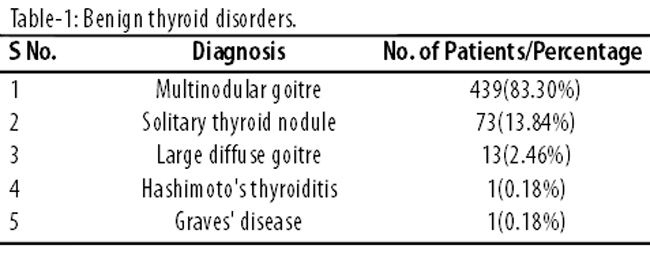
and so was the various surgical procedures undertaken (Table-2).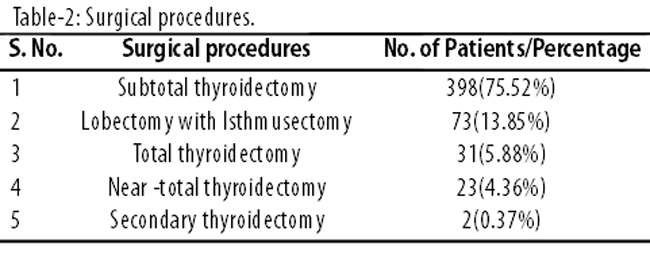
All patients were available for the scheduled followup visits for the initial 6 months but, 9 months and one year, the number reduced to 437(82.92%) and 312(59.20%) respectively.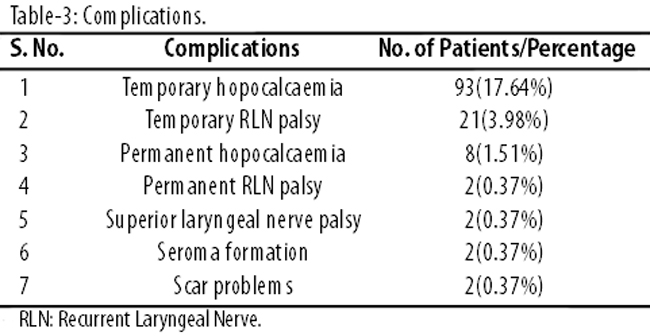
Temporary hypocalcaemia was the most common early complication found in 93(17.64%) patients.
Discussion
Benign thyroid disorders constitute one of the most common surgical problems which present to the general surgical units in our country.5-7 In the West, endocrine surgery has emerged as a distinct specialty, in our country general surgeons continue to be responsible for performing thyroid surgeries.
In our study, females were 9 times more commonly affected than males. Other published studies have also reported marked female preponderance.5,7,9,10
Our study showed more frequent involvement of relatively younger population. This finding conforms to what is reported by several other earlier studies.10-12 from Iran, however, reported increasing frequency of thyroid disorders in post-menopausal women with advancing age.13
In our study, multinodular goitre was the most common presentation. This conforms to results of several other published studies.5,10 We had one case each of Hashimoto\\\'s thyroiditis and Graves\\\' disease undergoing surgery, but studies from the West have reported greater number of such patients.4
In the present study, hypothyroidism was the commonest biochemical disorder, which is in line with literature.12-15
In our study majority of the patients underwent subtotal thyroidectomy. We had relatively more frequent total thyroidectomy towards the later years of the study. The appropriate management of benign thyroid disorders continues to be debated with a recent growing trend towards total thyroidectomy especially in the younger patients.16,17 Historically, Dunhill popularised near-total thyroidectomy for patients with benign disease to minimise complications and subsequent hypothyroidism.
Our study, had 17.64% rate of temporary hypocalacemia while 1.51% had permanent hypocalcaemia. There is a wide variation in the reported incidence of hypocalcaemia, but is less than 3% in most studies. One has reported the rate of temporary and permanent hypocalcemia as 21% and 3% respectively.4 Another study has reported the rates of to be 2.8% and 0.7% respectively.7 Hypocalcaemia following thyroidectomy is mostly temporary and a study regarded the temporary hypoparathyroidism as an accepted outcome of bilateral thyroid surgery rather than a complication.1 Hypoparathyroidism may be caused by injury, devascularisation or removal of a gland, although other non-mechanical factors may be associated with the development of hypocalcaemia.
In our study the rates of temporary and permanent RLN palsy were 3.98% and 0.37% respectively. Other published studies have variably reported these rates, ranging from 1.4%-3.2% and 0.3%-1.4% respectively.4,7,10
In our study, the two patients who had unilateral permanent RLN palsy had undergone secondary thyroidectomies for recurrent MNG. In general, secondary thyroidectomy carries a 10 folds increased risk of causing permanent complications.19
RLN palsy may be the result of a number of iatrogenic injury mechanisms. For instance, it may be caused by direct section, thermal injury by cautery or by suture entrapment of the nerve. It may also be secondary to neuropraxia or the formation of perineural fibrous tissue. The best way to safeguard the nerve is to either stay away from its course as in subtotal thyroidectomy or to identify it to its fullest extent as in total thyroidectomy. In special situations where its dissection appears very difficult, a section of the isthmus of the thyroid and its release in the mediolateral direction can be helpful.
In our study, two patients had features of injury to the external branch of superior laryngeal nerve. They had a lowered voice tone, vocal fatigue and difficulty in singing note intonation. Most of the literature is, however, silent about reporting superior laryngeal nerve injuries.4,5,7,10 The prudent way to preserve the nerve is to perform the individual ligation of the terminal branches of superior thyroid artery while clamping, ligating and cutting the upper poles and staying close to the surface of the gland.
We encountered post-operative bleeding in one patient who had undiagnosed factor VIII deficiency. He was successfully managed with conservative measures.
Given the evidence base, we suggest measures to promote health of the at-risk-population of the mountainous iodine-deficient range. There is need for focused educational programmes to increase the awareness of public about early recognition and reporting of the disease in order to reduce the associated morbidity.
The study had some limitations. We covered only the most important aspects of the presentation and outcome of management of thyroid disease. Relationship between the disease and individuals at risk is complex and influenced by many factors such as gender, age, non-use of iodized salt etc.
Conclusion
Benign thyroid disorders are prevalent in our population and commonly affect the younger females. Majority of the patients have a family history of thyroid disorders. Most of the patients present with several years history of the disease. Subtotal thyroidectomy is the most frequently offered surgical procedure. Thyroid surgery is safe in General Surgery unit with low morbidity, short hospital stay and no in-hospital mortality.
References
1. Mehanna HM, Jain A, Moreton RP, Watkinson JC, Shaha A. Investigating the thyroid nodule. BMJ 2009; 338: 705-9.
2. Mazeh H, Beglaibter N, Prus D, Ariel I, Freund HR. Cytohistologic correlation of thyroid nodules. Am J Surg 2007; 194: 161-3.
3. Sclabas GM, Staerkel GA, Shapiro SE, Fornage BD, Sherman SI, Vassillopoulou-Sellin R, et al. Fine-needle aspiration of the thyroid and correlation with histopathology in a contemporary series of 240 patients. Am J Surg 2003; 186: 702-10.
4. Watkinson JC. Fifteen years\\\' experience in thyroid surgery. Ann R Coll Surg Engl 2010; 92: 541-7.
5. Rathi PK, Shaikh AR, Shaikh GA. Identification of recurrent laryngeal nerve during thyroidectomy decreases the risk of nerve injury. Pak J Med Sci 2010; 26: 148-51.
6. Qureshi Z, Qureshi I, Ahmed R, Sabir O, Ali M, Iqbal T. Complications of thyroidectomy for benign disease. J Ayub Med Coll Abbotttabad 2001; 13: 17-8.
7. Khanzada TW, Samad A, Memon W, Kumar B. Post thyroidectomy complications: the Hyderabad experience. J Ayub Med Coll Abbottabad 2010; 22: 65-8.
8. de Benoist B, Andersson M, Egli I, Takkouche B, Allen H, (eds.). Iodine Status Worldwide: WHO Global Database on Iodine Deficiency. Geneva: WHO; 2004.
9. Mehanna HM, Jain A, Randeva H, Watkinson JC, Shaha A. Postoperative hypocalcaemia: the difference a definition makes. Head Neck 2010; 32: 279-83.
10. Zakaria HM, Al Awad NA, Al-Kreedes AS, Al-Mulhim AM, Al-Sharway MA, Hadi MA, et al. Recurrent laryngeal nerve injury in thyroid surgery. Oman Med J 2011; 26: 34-8.
11. Lamfon HA. Thyroid Disorders in Makkah, Saudi Arabia. Ozean J Appl Sci 2008; 1: 55-8.
12. Hunter I, Greene S. MacDonald, Morris A. Prevalence and aetiology of hypothyroidism in the young. Arch Dis Child 2000; 83: 207-10.
13. Niafar M, Najafipour F, Bahrami A. Subclinical thyroid disorders in postmenopausal women of Iran. J Clin Diag Research 2009; 3: 1853-8.
14. Cooper DS. Subclinical Hypothyroidism. N Eng J Med 2001; 345:260-5.
15. Khurram IM, Choudhry KS, Muhammad K, Islam N. Clinical presentation of hypothyroidism: a case control analysis. J Ayub Med Coll Abbottabad 2003; 15: 45-9.
16. American Thyroid Association (ATA) Guidelines Taskforce on Thyroid Nodules and Differentiated Thyroid Cancer, Cooper DS, Doherty GM, Haugen BR, Kloos RT, Lee SL, et al. Revised American Thyroid Association management guidelines for patients with thyroid nodules and differentiated thyroid cancer. Thyroid 2009; 19: 1167-214.
17. British Thyroid Association, Royal College of Physicians. Guidelines for the Management of Thyroid Cancer in Adults (Perros P, ed) 2nd ed. Report of the Thyroid Cancer Guidelines Update Group. London: Royal College of Physicians; 2007.
18. Delbridge L, Guinea AI, Reeve TS. Total thyroidectomy for bilateral benign multinodular goiter: effect of changing practice. Arch Surg 1999; 134: 1389-93.
19. Menegaux F, Turpin G, Dahman M, Leenhardt L, Chadarevian R, Aurengo A, et al. Secondary thyroidectomy in patients with prior thyroid surgery for benign disease: a study of 203 cases. Surgery 1999; 126: 479-83.
Journal of the Pakistan Medical Association has agreed to receive and publish manuscripts in accordance with the principles of the following committees:


