

Khalid S. Khan ( Department of Clinical Epidemiology and Biostatistics, Mc Master University, Hamilton, Ontario L8N 3Z5, Canada. )
August 1995, Volume 45, Issue 8
Special Communication

Abstract
Objective: To describe a health priority setting exercise in Pakistan and its relevance to traditional medical care and care providers.
Methods: Literature search of local and regional data was performed to identify priority health problems, those with high disease burden and with cost-effective interventions.
Results: Major causes of ill-health were communicable (diarrhoea, respiratory infections, childhood immunizable diseases, malaria, tuberculosis) and pregnancy related diseases. Factors that contributed to these disorders included malnutrition, anemia, poor sanitation and water supply, low level of education, high fertility rates and poverty. For these conditions, cost-effective interventions for prevention included environmental control (provision of clean water and sanitation), education programmes, expanded programme of immunization and family planning and those for treatment included case management of diarrhoea, respiratory infections, tuberculosis and complications of pregnancy and childbirth.
Conclusion: Priority health problems include factors outside the domain of traditional medical care. Their definition is important for directing policy reform, medical curricula and health research.
Introduction
In 1988, the number of deaths in Pakistan totalled 1,194.4101. Of these 357,689 were infants and 26,826 were mothers during pregnancy and child birth - with every passing hour of the day that year, 40 infants and 3 pregnant women died, in a majority of the cases prematurely, due to potentially preventable causes. Ten years after Pakistan became signatory to the “Health for All” declaration of the World Health Assembly in Alma Ata, things had not changed very much. If we have a look at sonic indicators of performance in health overthe 1978-91 time period1,2 (Figure I),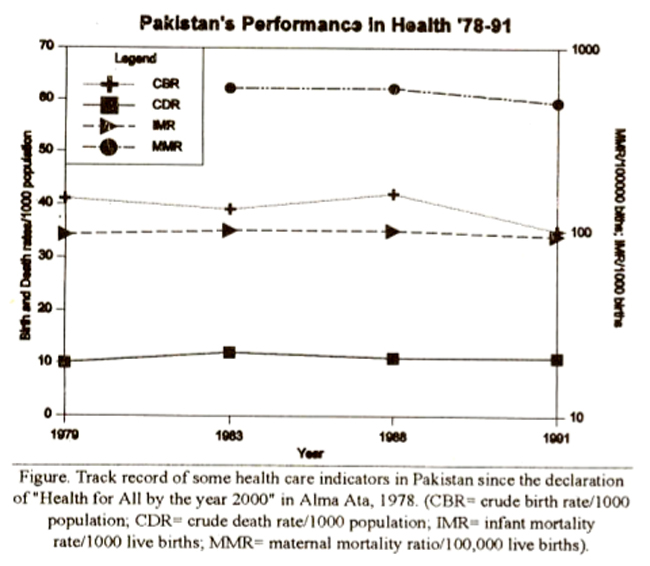
it can be easily seen that we did not make alot of progress. even though the number of medical doctors graduated in the country increased from 15,539 to over 50,0001. It is obvious that the numerical increase in doctors was not related to any impact on the health of the nation. While the reasons fora lack of relationship in this matter are multifactorial, the question to be raised is: What can the physicians of today do to change this pattern. In the face of limited resources, one has to realize that the choices are going to be limited. Accordingly, the medical community needs to set priorities for maximizingbenefit from scarce resources. To begin this process, the fundamental objective of health care needs to be defined clearly. Medical doctors are skilled in provision of clinical care for diseases they see in the setting of their clinical practice. Their perspective on health is, therefore, biased by seeing recovery from disease as improvement in health. While this is an important component of medical care, this is certainly not the only way in which health care should be viewed. The societal perspective on health should be avoidance of disease to begin with and the goal of health care should be maximization of the health of the population served3. Health priority setting is, therefore, different in a population setting compared to a clinical one. Since the health of the population is a sum of the health of all the individuals in the population, medical doctors are likely to play a central role in any health strategy as they care for the individuals in need. The task of national health policy and planning is to choose effective interventions from competing alternatives; to design health delivery systems and to select government, private and community instruments to encourage these interventions. An important first step is to understand the contribution of different diseases and factors in ill-health and the potential for benefit from remedy of these conditions. Health priority setting is the next task, which involves choosing most appropriate interventions. In health policy and health care delivery, this forms the basis for effective resource allocation and in academic medicine, this forms the basis for reorientation of teaching curricula and determination of areas for future health research. When priorities arc not established, different agencies and interest groups with competing objectives give different weights to the elements on which decisions and policies are made. In this debate, priorities are often inconsistent and incompatible. In a country with poor general health and with severe constraints on increasing health expenditures. there is more urgent need to prioritise health problems in order to select and implement actions in the field of health and health care. The purpose of this paper is to report a population health priority setting exercise suitable for Pakistan, in order to increase the awareness and importance of prioritizing health problems in the medical community.
Materials and Methods
Health Priority Setting Process
The process of priority setting in health begins with the definition of “health”. As a starting point one could use a negative definition, one that measures health by absence of disease rather than presence of health. While this is quite a deviation from the positive view of a state of complete mental, physical and social well-being, proposed by the World Health Organization, it is often a reasonable start because of operational usefulness and practically4. However, it is limited in that it deals with medical diagnoses and leaves out the richness of causal factors related to health problems. The approach used in this priority setting exercise was to describe the burden of ill-health and preventability and treatability of the conditions contributing to the burden. A priority health problem was defined as one that has a combination of higher disease burden and cost-effective interventions. To describe the burden of ill-health, one needs to describe the causes of premature death and disability (and their contributors). Indicators such as prevalence and incidence are useful alongwith description of severity of individual disorders, with indicators such as case fatality rates and level of remaining life quality. Preference should be given to community based data but the only available information is often hospital based. As data on these indicators are difficult to find in developing countries, leading causes of deaths and disability is one way of looking at the burden of ill-health. An attempt should be made to look at contributory causes in addition to medical diagnoses in order to capture the whole picture. In this analysis, where appropriate, a unified indicator of ill-health, disability associated life years lost (DALYs) 5, was used to make comparisons between disorders on data from the geographic region to which Pakistan belongs. The DALY indicator as a single measure of total burden of disease was developed by the World Bank and the World Health Organization, in a joint exercise, to fully quantify the loss of healthy life due to premature mortality as well as disability. The diseases were classified according to the International Classification of Diseases (9th revision, 1977) which covers all possible causes of death and about 95% of causes of disability. For each death the numberof years of life lost was defined as the difference between the actual age at death and the expectation of life at that age. For disability a severity weight (in comparison to loss of life) was obtained for each and number of years of healthy life lost was obtained by multiplying the expected duration of the condition by its severity weight. The sum of healthy life lost due to death and disability was then weighted according to the age, weight and discounted at 3% per year The number of DALYs lost across all ages and conditions were then summed up to represent the burden of disease. In making judgements about preventability and treatability, cost-effectiveness for different interventions, was sought for. In this case, reports from low income developing countries were considered generalizable to Pakistan’s health situation. In suggestions about changes in the system, search was made for evidence that assessed the impact of suggested changes on reduction of the burden of health problems. The literature sources for determination of disease burden included Pakistan Demographic and Health survey of 1990/912, World Bank Development Report of 19935, a review of Pakistan’s health and social situation by Mubaraket al1 and those for preventability and treatability included World Bank Development Report of 19935 and a review of health priorities in developing countries by Jamison6.
Results
Pakistan and its health infrastructure and services
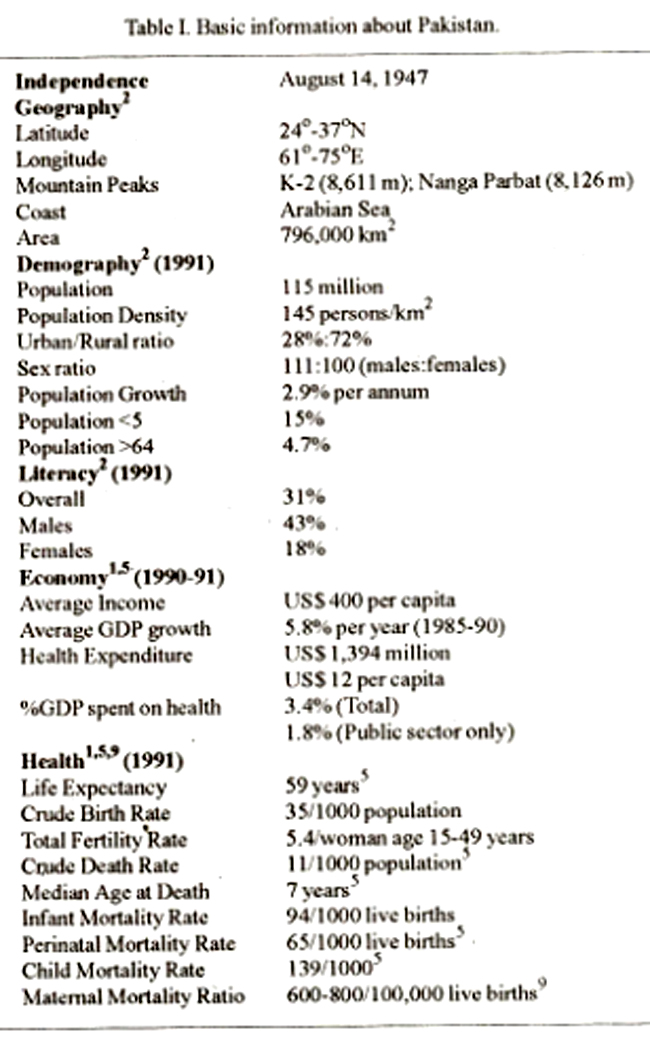
Table I shows the basic demographic, economic, social and health characteristics of Pakistan. Pakistan is the 9th most populous country in the world growing at a rate of 2.9% per annum, one of the highest. It is classified as a low income moderately indebted economy, with severe limitations on spending on health5. At present it spends US$12 per capita on health which makes 3.4% of total GDP. The spending in the public health sector is only 1.8% of GDP. The median age at death is 7 years and life expectancy is 59 years at birth. Piped water and adequate sanitation facilities are available to <70% of population and the situation in rural areas is worse than that in the cities. According to statistics from Pakistan’s Planning Commission7 in 1988 there were 6050 dispensaries and maternal and child health centres, 3496 basic health units, 492 rural health centres and 670 hospitals. The number of hospital beds was 63,619. There are 1800 According to statistics from Pakistan’s Planning Commission7 in 1988 there were 6050 dispensaries and maternal and child health centres, 3496 basic health units, 492 rural health centres and 670 hospitals. The number of hospital beds was 63,619. There are 1800 people for each hospital bed and 28400 for each dispensary1. There is one doctorforevery 3000-people and nurse to doctor ratio is 0.85. The shortage in nurses is reported to be of the order of 95%1. Pakistan’s clinical health system is characterised by high private spending for modern and traditional medical care and drugs and public services under-financed from general revenues5.
Burden of lll-health
In assessing the burden of disease, the search for most prevalent disease resulted in lack of local data in this area. Only the annual incidence rate of tuberculosis was reported to be 150 per 100,000 population5. One report1 revealed a list of 10 most common causes of death, shown in table II.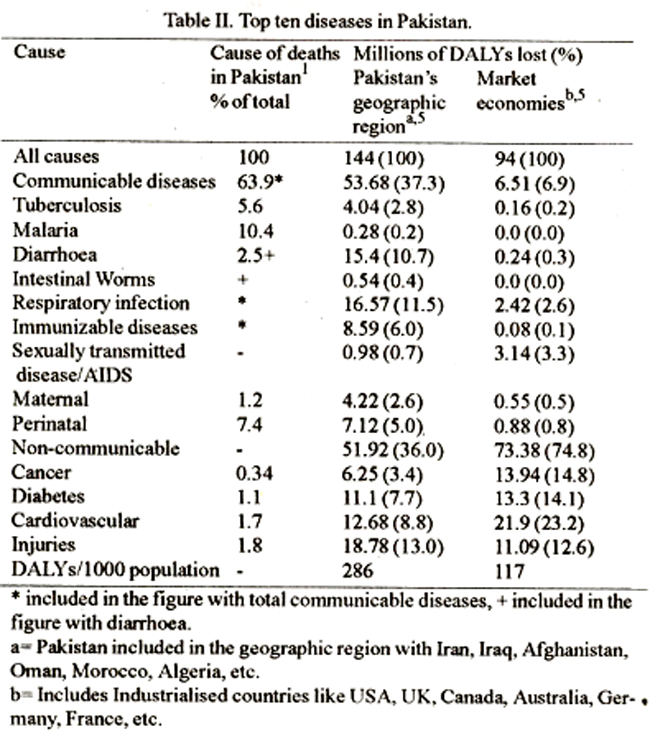
In addition to this report, regional information on DALYs lost due to premature death and disability was evaluated, using data from established marked economics for comparison5. The overall burden of disease as measured by DALYs per thousand population was twice as high as that of developed economies. Conununicable and maternal and perinatal diseases turned out to be the most common causes of fatality. Non-communicable diseases like cancer, diabetes and cardiovascular, formed a small component of the overall disease burden. A qualitative report on the perception of two Pakistani communities about their health problems’ revealed that age groups considered to be at highest risk were >60 years and 0-5 years; people fell sick on average about 4-6 times a year; younger age groups suffered more from respiratoiy and diarrhoeal disease; elderly suffered more from gastrointestinal and nutritional diseases; and fevers, skin disorders and ear, nose, throat and eye diseases were considered moderately prevalent. Search of specific groups at higher risk led to identification of infants and children aged 1-4 years as being at significant risks, because of high infant and child mortality rates2,5. The major causes of death in infancy in Pakistan were infective and parasitic diseases (74%) including immunizable diseases, diarrhoea, tuberculosis and malaria and congenital and perinatal causes (20%)1. The burden of childhood disease preventable by immunization in Pakistan’s geographical region, amounted to 86 DALYs per thousand children <5 years, compared to only one in developed countries5. Contnbutoiy factors included malnutrition5,8 (as measured by 50% stunting and 9% wasting in children5) in addition to low birth weight, childhood anemia, lack of maternal education, short interbirth interval and lack of economic progress. The other high risk group was pregnant women, Maternal mortality (at 600-800/100,000 live births) was one of the highest in the world5,8,9. The major medical causes of maternal deaths in Pakistan were haemorrhage. infection, obstructed labour and medical disorders of pregnancy9. Contributoiy causes include scarcity of emergency obstetric care and transport services, maternal malnutrition and anemia, lack of family planning and high fertility rate5,9. Anemia was reported to be prevalent in 57% of the pregnant population5. Among the many factors contributing to ill health, poverty of household environment was identified as contributing to infectious diseases in general5. Specifically, overcrowding, poor sanitation and water supply, and indoor air pollution contributed to disease like tuberculosis, diarrhoea, intestinal worms, etc. leading to a loss of 338 million DALYs every year in developing countries5. Similarly, malnutrition resulted in 8:9 million DALYs loss perthousand population in the geographical region to which Pakistan belongs, which compares unfavourably with the 1.1 figure for developed countries5.
Preventability and Treatability
The interventions studied were those relevant to the burden of disease in Pakistan. 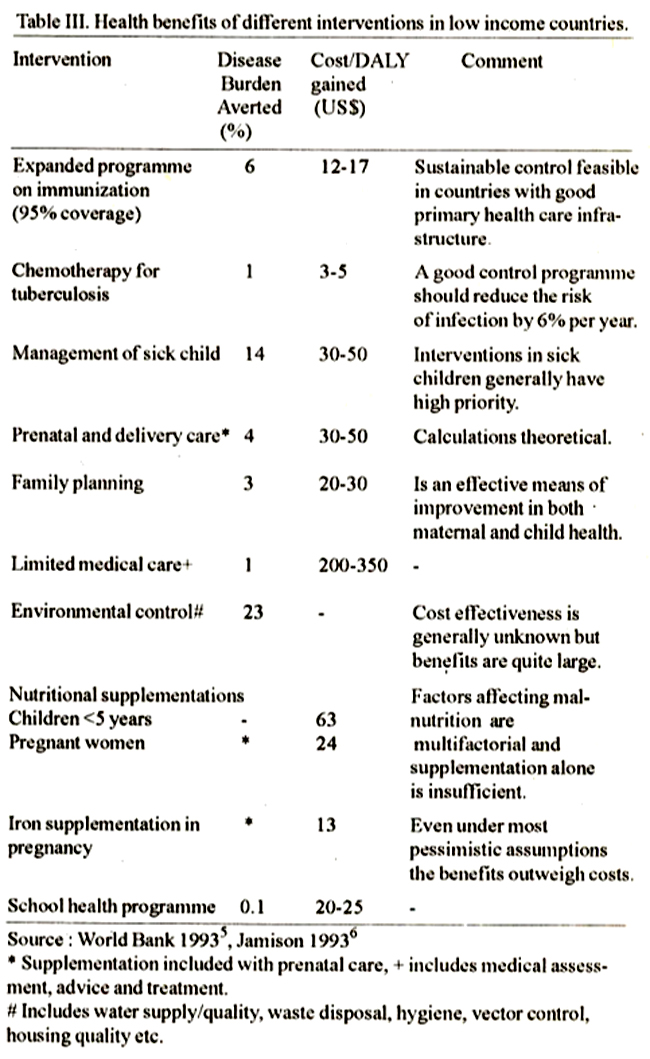
Table III summarizes the findings of the cost effectiveness analysis of different interventions in low income countries5,6. Reduction of burden of disease was higher with environmental control including sanitation, water supply and hygiene: case management of childhood diseases: and expanded programme of immunization. Cost-effectiveness was high with case management of tuberculosis, expanded programme for immunization, iron and nutritional supplementation in pregnancy, family planning, case management of sick children and prenatal and delivery care. The avoidance of disease burden with limited medical care for treatment of medical disorders with pain. infections and injuries, was low and at a high cost6. The treatment of non-communicable diseases such as cancer, diabetes, mvocardial infarction arid hypertension was not cost-effective, over US$1000 per DALYs gained6.
Discussion
Priority setting is not a straight forward process. it requires knowledge. judgement and ability to synthesize information across different dimensions. The findings of our literature search, summarized in table IV.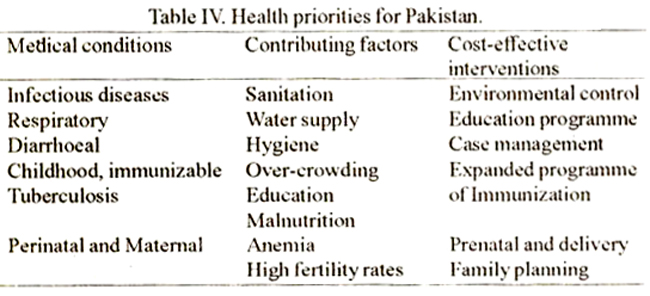
show that communicable (diarrhoea, respiratory infections, childhood immunizable diseases, malaria, tuberculosis) and pregnancy related diseases contributed the major portion to the overall burden of ill—health in Pakistan. Factors that contributed to these disorders incbide malnutrition, anemia, poor sanitation and water supply. low level of education, high fertility rates and poverty. For these conditions, the set of cost-effective interventions for prevention included environmental control with provision of clean water and sanitation, education programmes. expanded programme of immunization and family planning. The cost-effective clinical interventions included ease management for diarrhoea. respiratory infections, tuberculosis and complications of pregnancy and child birth. Non-communicable disease contributed less to the burden of disease arid their interventions were not cost-effective. Priority setting in health has been criticised on several grounds. In the approach utilizing a negative definition of health if priority disorders are selected from deficient data, they would tend to focus on the more readily identifiable, acute causes of death or morbidity4. in this case, chronic sickness, contributing causes (such as malnutrition, poor sanitation, lack of education) and conditions without clearly recognizable symptoms, would tend to be overlooked. Therefore, in this priority setting exercise, a deliberate attempt was made to look at contributing factors other than medical diagnoses in the hope that the broader picture will be captured. Good quality data bases do not exist in most countries6. There was difficulty in measuring the burden of ill-health in Pakistan due to lack of local data as highlighted by Mubamk1. In addition, there is controversy about the trustworthiness of the sources of data, which may range from doubtful1 to reasonable2 depending upon the assessors’ affiliations. In the face of limited information, one has to rely upon whatever is available irrespective of its quality, in order to avoid bias, in this analysis, an attempt was made to look at multiple data sources and make comparisons, using the presence of consistent trends as an index of reliability. Conduct of methodologically sound surveys in data poor countries do not necessarily change the preliminary ranking of the main diseases6. Hence, for the purpose of priority setting the combination of transferable data from other countries and country specific information usually makes it possible to be roughly right in the health strategy without time consuming studies on site. Although the absence of comprehensive epidemiological studies should not be seen as a hurdle in initiating the priority setting process. but their conduct should be encouraged as they add precision to existing information which is helpful in priority evaluations in the future. Generalisation from regional data to local situation requires caution. The geographical region to which Pakistan belongs, has a number of middle income countries (Saudi Arabia) but there are others with very low income (Afghanistan). Pakistan being somewhere in the middle. Therefore, it may be reasonable to assiune that the overall picture may be more representative of Pakistan than that of countries at the extremes in this region. The relatively close match between the local data on leading causes of death and the regional distribution of DALYs lost lends support to this assumption. Similarly, the generalization of cost—effectiveness data from that of low income countries to Pakistan is relatively safe. In using regional data generated by the World Health Organization and the World Bank. one must understand their approach to measuring loss of health. This is relatively new and must be studied before making inferences from it. Since a lot of assumptions. including sonic about ethical and social values, have gone into the development of The DALY indicator, it is recommended that it should be used with caution. Percent DALYs lost is considered a useful measure of the contribution of individual disorders in the overall burden of disease with a region. and DALYs lost/1000 population is considered useful in comparisons between regions and in tracking improvements in a nations health. It appears to be a more reliable approach in establishing priorities for allocation of resources6 - clearly it will need further testing and validation. The approach to priority setting in this analysis took account of existence of both existence of substantial disease burden and an intervention that is effective against it at a reasonable cost. A priority condition for action was one with both high disease burden and cost-effective intervention, and a condition with high disease burden and no cost-effective intervention should be seen as a priority condition for research. The insistence on cost- effectiveness as a criterion for action is also a means to achieving equity in health10. According to the World Bank5, in low income countries like Pakistan, an essential health care package is expected to cost US$12 per capita and avert 32% of disease burden. This cost forms 4% of per capita income in Pakistan. From the government’s perspective the challenge is to increase the current expenditure on public health sector in Pakistan from 1.8% to 3.4% of GDP. Scarcity of money is a critical limiting factorinthe progress towards thegoal of”Health forAll”. The priority setting approach in health spending could translate into healthier lives for the people. Health priority setting has been criticised for making the assumption that improvement in health of the population can be achieved by mass delivery of a few technologies, with or without social and economic change4. In this analysis, no assumption about isolated health improvement is made. Social and environmental factors are given due consideration as is evident in the choice of interventions. Based on the relationship of economic progress and health improvement, it has been argued that without alleviation of poverty health improvement is difficult. However, health depends on factors other than income growth alone5,11, ~, but good health is essential for individual productivity5. Health should be valued for its own sake and not only as a means to development. It was earlier suggested that increased numbers of doctors had no impact on the national health indicators, but should this be automatically expected? It can be argued that this should not, because the doctor to population ratio only improved marginally from 1:3448 to 1:2940. In addition, the doctors are trained in clinical care anda large burden of disease is outside this domain! Such arguments cannot relieve them of their responsibility for the nation’s health care. After all, a majority of them were educated with the support of public funds, and many of them have set up their clinical practices with equipment acquired with govermnent loans and rebate on taxes’, that could potentially have contributed to public services in health and social sectors. Medical doctors thus have an obligation to act on behalf of the public. If an attempt was to be made towards achieving the goal of maximizing the health of the population, the medical community would be faced witha conflict as giving priority to the society will sometimes be at the cost of their individual patients. This is most likely to happen as Pakistan spends nearly half of its health budget on tertiary care5 and action on the basis ofpnorities would imply more investment inprirnarv care. This will cause discomfort to the physicians whose favourite interventions might have received low priority. Here physicians need to understand that interventions did not receive low priority only because they were expensive: the only received low priority if their benefits were too small to justify the costs. It should also be appreciated that an attempts to maximize the care given to our personal patients at the cost of public funds will go against the principle of “greatest good to the greatest number”, as it makes the problem of limited resources worse by diversion to tertia care. Hence. the setting of priorities on the basis of factors other than those related to societal disease burden and cost-effectiveness would have to be given up, though this process may be very difficult3. In as much as the efforts of international agencies like the World Health Organization, the United Nations Development Programme and the World Bank. are directed towards reonenting govenunents attitudes and policies towards improving their peoples’ health, the least the medical community can do is to take the responsibility to participate, in this process, as advocates for the people who they are trained to serve. They serve as technocrats and bureaucrats in the health policy arena, and their input influences the choices that are made in the health reform process12. Serving the people involves having full appreciation of their health problems and setting of priorities by unbiased means. Support for a logical set of priorities by the medical community can influence the government to invest in the population’s health.
References
1. Mubarak, M. M Health Coverage in Pakistan, An evaluation for the future strategy, “Health for All”. Rawalpindi, The Army Press, 1990.
2. National Institutes of Population Studies. Pakistan Demographic and Health Survey 1990/91. Islamabad, Government of Pakistan, 1992.
3. Eddy, D. M. Principles for making difficult decisions in difficult times. JAMA.. 1994;271:1792-98.
4. Feachem, R. 0., Graham, W. J. and Timaeus, I. M. Identifying health problems and health research priorities in developing countries. J. Trop. Med. Hyg., 1989;92: 133-91.
5. World Bank. Investing in Health. World Bank Development Report 1993. New York, Oxford Univ. Press, 1993.
6. Jamison, D. T. Disease Control Priorities in Developing Countries: An Overview. In: Jamison, D. T., Mosley, W. H., Measham, A. R. and Bobdilla, J. L. (eds), Disease Control Priorities in Developing Countries. Toronto, Oxford Medical Publishing, 1993, pp. 3-33.
7. Pakistan Planning Commission. Seventh 5 Year Plan 1988-93. Islamabad, Government of Pakistan, 1988.
8. Government of Pakistan and United Nations Children\\\'s Fund. Country program of Co-operation 1992-96. Master Plan of Operations. Islamabad, Government of Pakistan, 1992.
9. Qureshi, R. N., Hussain, S. T. and Jadoon, S. S. Situation ofreproductive health on women of Pakistan. Karachi, College of Physicians and Surgeons, 1995.
10. Musgrove, P. Investing in Health: The 1993 World Development Report of the World Bank. Bull. Pan. Am. Health Organ., 1993;27:284-86.
11. Evans, J. A.. Hall. K. L. and Warford, 1. Shattuck Lecture- Health care in the developing world: problems ofscarcity and choice. (Special Article) N. EngI. J. Med., 198l;305:117-27.
12. Grindle, M. S. and Thomas, T. W. Policy makers, policy choices and policy outcomes: The political economy of reform in developing countries. Policy Sciences, 1989;22:213-48.
Journal of the Pakistan Medical Association has agreed to receive and publish manuscripts in accordance with the principles of the following committees:


