

M. Gungor ( Department of Obstetrics and Gynaecology, University Schoo’ of Medicine, Bilan, Ankara, Turkey. )
B. Cengiz ( Department of Obstetrics and Gynaecology, University Schoo’ of Medicine, Bilan, Ankara, Turkey. )
Y.H. Turan ( Department of Obstetrics and Gynaecology, University Schoo’ of Medicine, Bilan, Ankara, Turkey. )
F. Ortac ( Department of Obstetrics and Gynaecology, University Schoo’ of Medicine, Bilan, Ankara, Turkey. )
May 1996, Volume 46, Issue 5
Case Reports

Laparoscopy is used as a diagnostic and therapeutic tool in gynecologic oncology, including the follow up of patients with known ovarian carcinoma. It offers an excellent magnified view of pelvis and anterior abdominal contents. In addition, the operator can easily obtain specimens from suspected sites of involvement and can make laparoscopy guided washings. We present a case of tumor implant occurring in the abdominal trocar site of ovarian papillary cystadenocarcinOma of a patient with known ovarian carcinoma. The purpose of this report is to call attention to the fact that this diagnostic procedure may result in tumor implantation in the abdominal wall even in the absence of visible intraperitonealtumoral involvement in ovarian carcinoma. To our knowledge, there has not been any reported case of abdominal trocar site implant following third-look laparoscopy.
Case Report
A 54 year old white woman, underwent a total abdominal hysterectomy, bilateral salpingoophorectomy. omentectomy and pelvic-paraaortic lymphadenectomy because of ascites and adnexial neoplasm, two years ago. The procedure was well tolerated and all visible tumor was removed. The pathological diagnosis was bilateral serous papillaiy cystadenocarcinoma with metastasis to omentum, fallopian tubes and serosal surface of uterus and cul de sac. There was no lymph node metastasis. Cytological examination of ascitic fluid was positive for malignant cells. The stage was 111b, according to FIGO. She was given 6 courses of chemotherapy with CAP protocol and a second-look operation was carried on. At second-look laparatomy, the cytological examination of pentoneal washing was positive but the pathological examination of biopsy specimens was negative for malignant cells. Six courses of second-line chemotherapy of CAP protocol were administered. Serum CA 125 levels increased over 135 lU/mi, 6 months after chemotherapy. The computerized tomography of abdomen and scintigraphy of bone and liver were normal and a third-look laparoscopic examination was planned. It showed no evidence of tumoral involvement of pentoneal and serosal surfaces but the peritoneal washings were positive for malignant cells. Third-line chemotherapy was planned and 120 mg Cisplatin was administered intrapentoneally.
A hard palpable subcutaneous mass upto 4 cm in diameter was observed at the trocar site 8 months after the laparoscopy. All visible tumor was removed and histopathological examination confirmed the occurrance of tumor at the trocar site (Figure).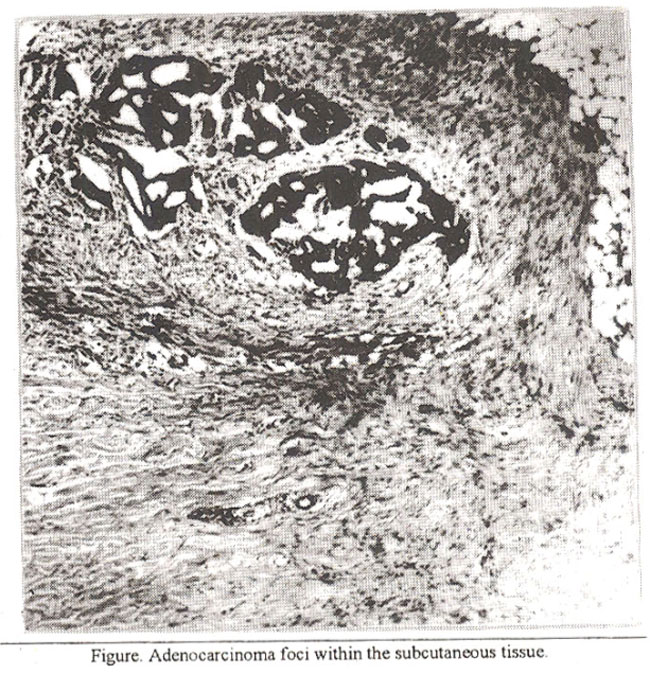
Serum CA 125 level was 640 lU/ml. Atlaparatomy, multiple tumoral implantations of 1 cm in diameter were observed on peritoneal surface. The patient died 3 months after the last operation.
Discussion
Laparoscopy is widely used as a diagnostic and therapeutic tool in gynecology. Indications for laparoscopy in gynecologic oncology includes the determination of ongin of a pelvic mass, identification of the cause of malignant ascites. following up or second-look for invasive and other ovarian tumors1. Tumor implantation along the trocar sites after diagnostic laparoscopic biopsies or after resection of tumors have been reported2-4. Abdominal wall tumor implants at paracentesis sites for relief of malignant ascites in ovarian carcinoma are common4. Occurrence of tumor implantation along the needle tracts of percutaneous needle aspiration of malignant neoplasms have also been reported in 1/1000 to 1/40000 procedures5. . Cutaneous tumor nodules can also occur in laparotorny scars6. In one series of needle laparoscopy, 454 second-look laparoscopies were performe4on 236 patients with stage III ovarian carcinoma and no abdominal wall metastasis was reported1.
To our knowledge, this is the first case report of abdominal wall seeding after third-look laparoscopy although there were no macroscopic tumors but peritoneal washings were positive. This may be a direct invasion of invisible tumor through trocar tract or implantation of tumoral cells in positive peritoneal washing. Use of laparoscopy in the diagnostic biopsy and surgery of primary ovarian carcinoma is controversial2,3, although its use as a second-look procedure is widely accepted’. But the presence of positive peritoneal washing without macroscopic tumor may cause involvement of trocar site during laparoscopy. The main puipose of this report is to direct attention to the fact that even without laparoscopic biopsies or msections, tumor implants can occur along the tmcar sites. Trocar sites and operation scars must be evaluated carefully. Any mass located on these sites must alert the physicianfor the recurrence and poorprognosis of the disease.
References
1.Finkler, N.J. and Griffiths, CT. Laparoscopy. In: Coppleson,M. (Ed) Gynecologic Oncology. 2nd ed., Edinburgh, Churchill Livingstone, 1992.
2.Hsiu, J.G., Given, F.T. and Kemp, G.M. Tumor implantation after diagnostic laparoscopic biopsy ofserous ovarian tumors of low malignant potential. Obstet. Gynecol., 1986;68:90S-93S.
3,Gleeson, NC. and Nicosia, V. S. Abdominal wall metastasis from ovarian cancer after laparoscopy. Am. J. Obstet. Gynecol., 1993;169:522-3.
4.Maiman, M., Seltzer, V. and Boyce, J. Laparoscopic excision of ovarian neoplasms subsequently found to be malignant. Obstet, Gynecol., 1991 ;77:5635,
5.Lundstedt, C., Stridbeck, H., Andersson, R. et al. Tumor seeding occurring after fine needle biopsy of abdominal malignancies. Acta. Radiologica., 1991;32:518-20.
6. Forther, J.G. Inadvertent spread of cancer at surgery. J. Surg. Oncol. 1993;53:191-06.
Related Articles
Journal of the Pakistan Medical Association has agreed to receive and publish manuscripts in accordance with the principles of the following committees:


